
Secondary Mathematics worked examples are powerful when students use them to understand a method, and dangerous when students use them as a substitute for thinking. Parents searching for E-Math worked examples, Secondary Math model answers, how to study Mathematics solutions or Mathematics tuition in Sengkang often see the same pattern: the child can follow a solution line by line but cannot reproduce the method once the example is closed.
The educational problem is support dependence. A worked example removes decisions that the student eventually needs to make alone: how to start, which method to choose, what to write next and how to check the route. The correct use of examples therefore includes a fade. Students study the structure, complete partially worked problems, then solve fresh questions independently.
At eduKate Sengkang, this Advanced Mathematics Tutorials article owns the worked-example intent. It supports the Mixed-Topic Method Selection, Multi-Step Questions and revision owners without duplicating them.
Quick answer: how should students use worked examples?
Study the decision structure, hide part of the solution, complete the missing step, then close the example and solve a fresh problem with the same underlying method.
- Identify what type of problem the example is solving.
- State why the first method was chosen.
- Label the purpose of each important line.
- Hide the next step and predict it before revealing.
- Use completion problems with fewer and fewer provided steps.
- Close the example before attempting a parallel question.
- Change numbers, signs, orientation or context to test transfer.
- Return later without the example to check retention.
Why copying feels like learning
When a solution is visible, every next step looks obvious. Recognition creates fluency because the student is not generating the route. Once the example disappears, that fluency can vanish.
The test of learning is therefore not whether the student can understand a displayed solution. It is whether the student can make the same decisions independently on a changed question.
The five-stage worked-example fade
Stage 1: full example
The tutor models the complete method and explains why each major step exists.
Stage 2: prediction
Before revealing each next line, the student predicts what should happen and why.
Stage 3: completion problem
Some lines are provided and the student fills the missing mathematical decisions.
Stage 4: parallel problem
The structure is preserved but the numbers, signs, diagram or wording change.
Stage 5: mixed transfer
The method appears among unrelated topics, so the student must recognise when it applies.
What to annotate in a worked example
- Problem family
- Final unknown
- Why the method fits
- High-risk sign or bracket step
- Intermediate quantity and unit
- Checking method
- What would change if the surface question changed
These annotations turn a model answer into a map of decisions instead of a sequence to copy.
Worked examples in Secondary 1
Secondary 1 examples are especially useful for new symbolic conventions: negative numbers, algebraic expressions, equations and graph relationships. The tutor should make invisible decisions explicit because students are still learning what each symbol means.
Worked examples in Secondary 2
Secondary 2 students benefit from contrasting examples: expand versus factorise, equation versus inequality, graph versus algebra. The comparison teaches method selection, not only execution.
Worked examples in Secondary 3
By Secondary 3, examples should increasingly demonstrate how several ideas connect. A trigonometry example may include diagram reading, algebra and calculator control. Students should identify which part of the solution belongs to which dependency.
Worked examples in Secondary 4
Final-year students need examples that show efficient exam routes rather than every possible explanatory step. The tutor can compare a safe method with a shorter method and discuss when compression is justified.
The worked-example error map
- Can explain example but cannot solve parallel question: transfer gap.
- Copies exact layout even when question changes: surface imitation.
- Waits for model answer before attempting: support dependence.
- Skips explanation and memorises line order: structural understanding is weak.
- Can solve parallel question but not mixed question: method-selection gap.
- Can solve immediately but forgets next week: retention gap.
A three-student worked-example lesson
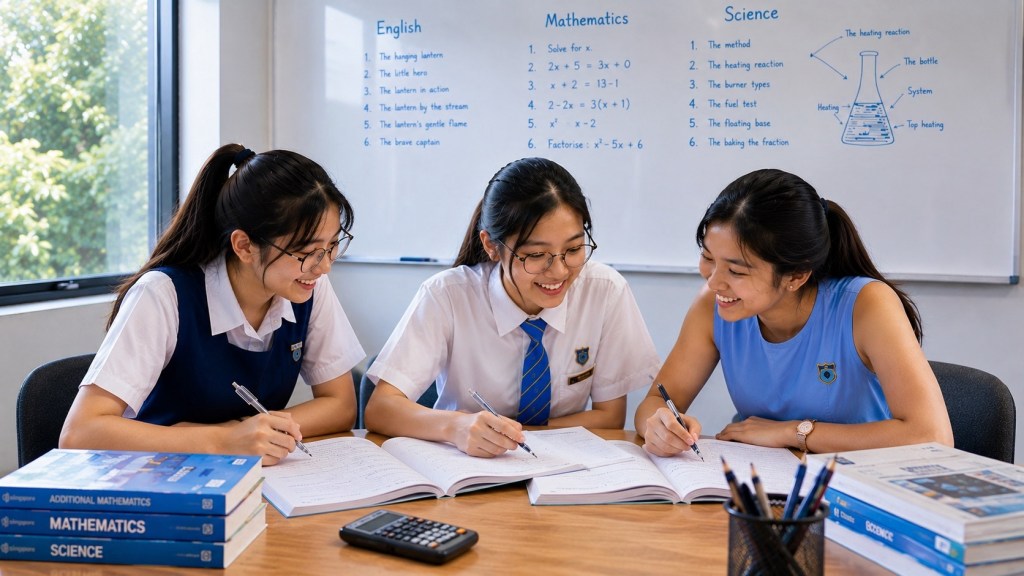
The tutor can model one shared example, then give three different completion problems. One student may receive more scaffolding, another fewer hints, and the strongest learner a changed-condition version.
All three then complete independent parallel questions. This keeps the group together while making support level individual.
How parents can help with model answers at home
- Do not hand over the solution immediately.
- Ask the child where the route first breaks.
- Reveal one step, not the whole answer.
- Ask what the revealed step is doing.
- Close the answer and try a fresh question.
- Return to the skill after several days.
Frequently asked questions
Should students copy worked solutions into notes?
Copying can be useful only if the student annotates why the method works and later reproduces it independently. Pure copying is weak evidence of learning.
How many worked examples are enough?
Enough to expose the structure and important variations. Once the student can predict and transfer the method, independent problem solving should replace additional examples.
What if the student gets stuck immediately without the example?
Use a partial prompt or completion problem rather than restoring the entire model answer. The goal is to give the smallest support that restarts thinking.
Where this worked-example guide sits in the Mathematics estate
Use the Self-Study vs Mathematics Tuition guide for broader support decisions and the Mixed-Topic Questions guide once worked-example support has been faded.
Worked-example use should change by Secondary level
Secondary 1: understand the new symbolic language
Secondary 1 examples should make the invisible rules explicit: why a negative sign changes a result, why the same operation preserves equality on both sides, and how an algebraic expression differs from an equation. The learner should be able to explain what each line means before examples are faded.
Secondary 2: compare neighbouring methods
Secondary 2 is ideal for paired examples: expansion versus factorisation, equation versus inequality, table versus graph. Contrasting examples help students discriminate between methods instead of memorising one chapter routine at a time.
Secondary 3: show how topics connect
Secondary 3 examples should increasingly combine skills. A trigonometry solution may depend on diagram reading, algebraic rearrangement, calculator mode and units. The student should identify which dependency each line is using.
Secondary 4: study efficient exam routes
Final-year examples should highlight method efficiency and error risk. Two correct solutions can be compared for length, clarity and recovery value so students learn which route is safer under time.
The worked-example independence test
- Can the student hide the final two lines and predict them?
- Can the student explain why the first method fits?
- Can the student solve a changed-number version?
- Can the student solve a changed-wording version?
- Can the student recognise the method inside a mixed set?
- Can the student retrieve it several days later without the model?
The example has done its job only when support is no longer necessary. If the student still needs the same model beside every question, the lesson has produced familiarity rather than independent control.
A worked-example correction loop
When a student copies a model answer incorrectly, do not simply restore the correct line. Ask which decision was being imitated without understanding. Then rebuild that one decision with a simpler micro-example before returning to the original problem family.
Cross-link: from examples to independent problem solving
Once the model has been faded, continue to Hints and Scaffolding when support still needs to shrink gradually, and to Self-Explanation when the student needs to articulate why the method works.
Continue through the Mathematics Learning Hub for routes by concept and level, the Complete Mathematics Index for the wider estate, or Mathematics Tutor Sengkang when the question is specifically about tutoring support.
