
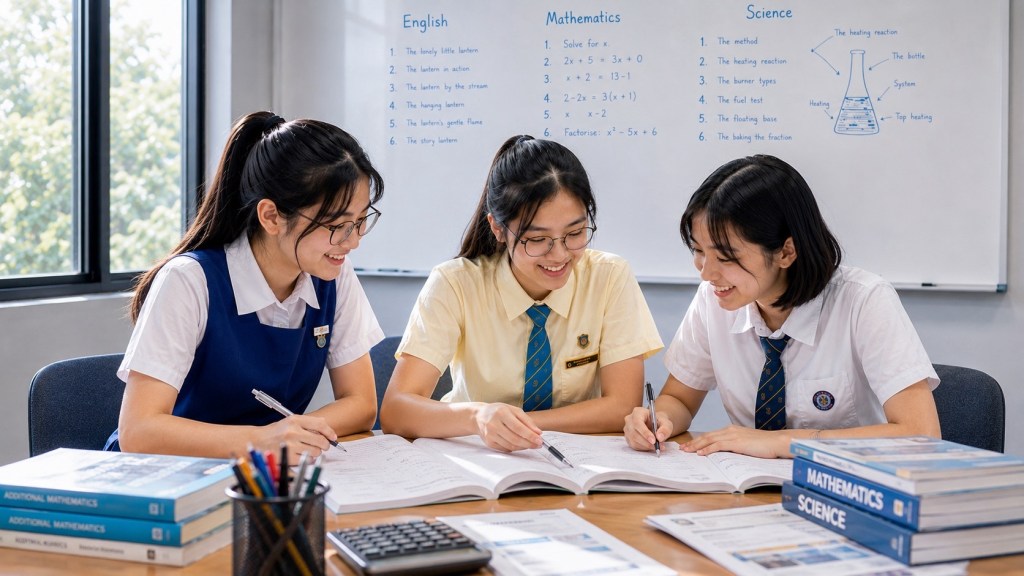
A three-student Secondary Mathematics tutorial should not be a normal tuition class with fewer chairs. Parents searching for small-group Math tuition, 3-pax Secondary Mathematics tuition, personalised E-Math support or Mathematics tuition in Sengkang are usually paying for one specific advantage: the tutor should be able to see how each learner thinks, not only deliver the same explanation to a smaller audience.
That changes the mechanics of the lesson. The tutor can inspect every student’s working, ask each learner to explain a method, notice hesitation before it becomes a blank answer, give different follow-up questions, and return to the same learner several times within one session. The group still has peer energy, but no student should be able to disappear inside it.
At eduKate Sengkang, the Mathematics estate already has year-level commercial owners for Secondary 1–4 and a broader Secondary Mathematics S1–S4 Capability Map. This Advanced Mathematics Tutorials article owns a different intent: what a genuinely useful three-student Mathematics tutorial should actually do, minute by minute and decision by decision.
Quick answer: what should be different in a 3-student Mathematics tutorial?
The class should produce more observation, more student explanation, faster correction, differentiated practice and clearer independent evidence—not simply a quieter mini-lecture.
- Every student’s working should be visible to the tutor.
- Every student should answer and explain during the lesson.
- The tutor should identify the first wrong move, not only the final wrong answer.
- Students can work on different difficulty levels when needed.
- Peer solutions should be compared without replacing individual accountability.
- Guided practice should lead into unsupported attempts.
- The tutor should revisit each learner repeatedly during the session.
- Continuation work should reflect the learner’s error profile.
- Class pace should be coordinated, not forced to the fastest or slowest student.
- The lesson should end with evidence of what each student can do independently.
Small group does not automatically mean personalised
A class of three can still be poorly personalised if the tutor talks for eighty minutes while students copy examples. The headcount is small, but the teaching model remains a lecture.
Personalisation begins when observation changes the next instructional move. If one learner loses a negative sign, the tutor changes the next prompt. If another understands the concept but works too slowly, the tutor changes the practice. If the third is secure, the tutor can extend the question.
The group size matters because it creates enough time to make those adjustments without stopping the class completely.
The tutor should watch the start of the problem
The first ten seconds of a student’s attempt are often more informative than the final answer. Does the learner identify the unknown? Choose a formula immediately? Draw a diagram? Start manipulating algebra without reading? Freeze?
A large class often reveals only completed work. A three-student tutorial can reveal the decision that produced the work.
That is where diagnosis becomes precise. Two students with the same wrong answer may need completely different correction.
Each learner should explain mathematics aloud
Explanation exposes whether the student understands a method or is only imitating it. A tutor can ask: Why did you choose this equation? What does this gradient represent? Which side is opposite the angle? Why can these terms combine?
The point is not to turn Mathematics into constant conversation. Short explanations at high-value moments make reasoning visible.
Students also learn by hearing another valid route, but each learner should still be able to reproduce the idea independently.
Three students create useful method comparison
One learner may solve an algebra problem by direct manipulation, another may substitute first, and another may use a graphical interpretation. The tutor can compare the routes and ask which is safer, shorter or easier to verify.
Method comparison builds flexibility. It also prevents students from believing that Mathematics always has one teacher-approved sequence.
The important boundary is that comparison should clarify thinking, not reward imitation.
The class should allow different levels of practice
Students do not need identical worksheets simply because they share a lesson. One learner may require simpler sign-control questions, another may need mixed assessment questions, and another may be ready for extension.
The common lesson can still have a shared mathematical theme. The differentiation happens in numbers, scaffolds, question complexity and required explanation.
This is one of the practical advantages of a three-student group over a much larger class.
Prompting should be calibrated, then faded
A tutor should not rescue every pause. Too much help can create assisted performance that looks like learning.
Useful prompting often moves through levels: ask the student to reread, identify the unknown, name the relationship, choose a representation, then only if needed provide a stronger cue.
As the learner improves, prompts should disappear. The goal is independent Mathematics, not permanent tutor dependence.
Error correction should target the first failure
When an answer is wrong, the tutor should trace backwards to the first unreliable step. Was the concept wrong? Was a sign lost? Was the wrong formula selected? Was the diagram misread?
Correcting the first failure is more efficient than reteaching every later step that became wrong because of it.
The next question should test whether the correction transfers.
Independent evidence must appear inside the lesson
A student can look successful while following a tutor or copying a peer. The class therefore needs unsupported moments.
After guided practice, each learner should solve at least one fresh question alone. The tutor observes but does not immediately intervene.
This independent sample tells the tutor whether the method is owned, partially owned or still scaffold-dependent.
A 90-minute three-student lesson can have a clear operating rhythm
0–10 minutes: retrieval
Short old-topic questions reveal what remains available and what has decayed.
10–30 minutes: concept or repair
Teach one shared mathematical idea, while adjusting prompts to each learner’s starting point.
30–50 minutes: guided practice
Students work in parallel. The tutor rotates, inspects working and asks for explanations.
50–70 minutes: differentiated independent work
Each learner receives questions matched to their error profile or readiness.
70–82 minutes: mixed or timed transfer
The class tackles unfamiliar or assessment-style questions without topic labels.
82–90 minutes: error review and continuation plan
Each student identifies one learning point, one error-control action and one follow-up task.
The tutor should revisit every student repeatedly
One long ten-minute conversation with each learner is not enough. Mathematics unfolds step by step, so the tutor should cycle through the group several times.
A student may understand the explanation but fail during independent execution. Another may make a new error once time pressure appears. Repeated observation captures those transitions.
Three students make this practical within a ninety-minute lesson.
The fastest student should not set the class standard
A small group can still become unhealthy if the quickest learner dictates pace. Speed is not the same as readiness, and temporary performance is not a permanent ability label.
The tutor should set shared lesson goals while varying challenge. A fast student can receive extension without forcing the other two to skip needed repair.
Likewise, one struggling learner should receive targeted support without converting the whole class into a remedial lesson.
Peer learning should not hide weak understanding
Listening to another student’s explanation can be useful, but the tutor must distinguish borrowed understanding from independent understanding.
After peer discussion, ask each learner for their own explanation or fresh question. If the method disappears without the peer, the learning has not transferred.
Individual accountability protects the educational value of collaboration.
Homework should not be identical by default
Continuation work should reinforce what each learner needs next. One student may need ten short algebra questions; another may need three mixed questions and an error retest; another may need an extension problem.
This does not require three completely separate curricula. It requires the tutor to understand where each student is in the shared route.
Targeted homework also prevents unnecessary volume.
What parents should ask about a “small-group” Mathematics class
- What is the actual maximum class size?
- How often does the tutor inspect each student’s written work?
- Do students explain methods aloud?
- Can learners receive different questions within the same lesson?
- How are weak students prevented from hiding behind stronger peers?
- How are strong students extended without rushing the whole group?
- What happens when one learner needs to revisit an earlier dependency?
- How is independent understanding checked?
- How is homework differentiated?
- How does the tutor use recent school tests and teacher feedback?
When a three-student tutorial is especially useful
- The student has repeated error patterns that require close inspection.
- School marks fluctuate despite apparent understanding.
- The learner needs repair without leaving the current syllabus entirely.
- The student is quiet and easily disappears in large classes.
- The learner needs frequent questioning to make reasoning visible.
- The student is strong but needs extension and method comparison.
- E-Math and A-Math workload need coordinated planning.
- Exam technique requires observation of pace, working and recovery.
When a three-student class may not be enough
A learner with very large foundational gaps, major attendance issues or needs outside normal tuition scope may require a different form of support. Small group size is not a universal solution.
The tutor should be honest about fit. The class should be appropriate for the student’s level, pace and current learning condition.
The first consultation should therefore use actual schoolwork and goals rather than treating enrolment as automatic.
How this format supports the Clementi-style SEO and teaching pattern
The strongest local tuition pages explain what the teaching model actually does. “3-pax” becomes meaningful only when the page shows the mechanism: observation, diagnosis, differentiated practice, independent evidence and fast feedback.
That is stronger than repeating “small group” as a marketing phrase because the reader can understand why the number changes the learning environment.
For Sengkang, the same principle applies: truthful local routing plus a concrete educational mechanism.
Frequently asked questions
Is three students better than one-to-one tuition?
Not automatically. One-to-one offers maximum individualisation. Three students add peer explanation and method comparison while still allowing close observation. The better format depends on the learner.
Is three students better than six students?
The smaller group gives the tutor more observation bandwidth, but teaching quality still depends on how that time is used.
Can three students be at different levels?
Yes within a reasonable range, if the tutor differentiates practice and the shared mathematical theme remains useful. Very large differences may make grouping unsuitable.
How long should a Secondary Mathematics tutorial be?
eduKate commonly uses 1.5-hour lessons for this format. The important issue is whether the time includes explanation, independent practice, checking and error review rather than continuous lecture.
What should parents bring to a consultation?
Recent tests, homework, teacher comments and examples of questions the student finds difficult. Visible working is especially useful.
Where this three-student tutorial guide sits in the Mathematics estate
Use the relevant Secondary 1–4 Mathematics Tuition Sengkang owner for level-specific enrolment and the Secondary Mathematics S1–S4 Capability Map for the broader route.
This page owns the format-mechanics intent: what a real three-student Mathematics tutorial should actually do and how parents can tell whether small-group teaching is genuinely being used.
