
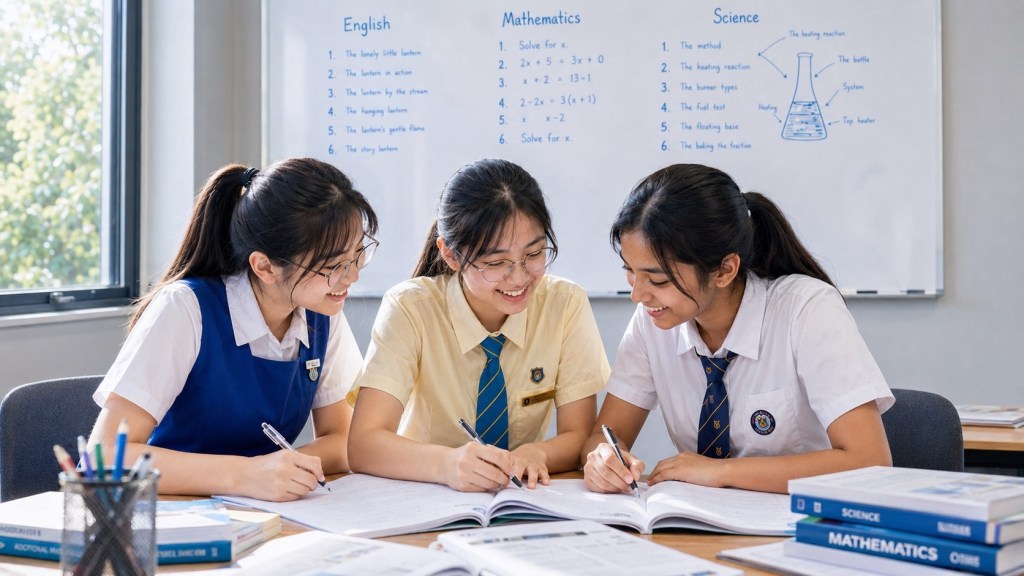
Buangkok parents searching for an Additional Mathematics tutor in Sengkang are often dealing with a subject that feels much larger than the actual problem. A Secondary 3 student may say A-Math is impossible when the first weak link is algebraic manipulation, function notation or graph interpretation. A Secondary 4 student may know many techniques but still lose marks through method selection, signs, exactness and time control.
Useful A-Math tuition in Sengkang should therefore begin with dependency mapping. At eduKateSengkang, our nearby Punggol teaching location runs three-student, 90-minute Mathematics tutorials. The small group lets the tutor inspect long working closely enough to find the first wrong line, repair the missing relationship and reduce support until the student can generate the method independently.
The high-intent Additional Mathematics search language is consistent: A-Math tutor, Additional Mathematics tuition, algebra, quadratics, functions and graphs, logarithms, trigonometry, differentiation, integration, past papers and exam techniques. These are not isolated chapters. They form a network, and the tutor’s job is to make that network usable.
Buangkok is a local route, not a separate branch claim
This page is written for Buangkok and nearby Sengkang families comparing A-Math support. eduKateSengkang teaches at a nearby Punggol location; we do not claim a separate Buangkok branch. The canonical A-Math owner remains Additional Mathematics Tuition Sengkang.
Current 2027 SEC Additional Mathematics levels
For the 2027 SEC, SEAB lists Additional Mathematics at G2 as K232 and at G3 as K341. Older resources may still use the earlier 4051 and 4049 references. Parents should use official SEAB information to confirm the current examination level and syllabus.
Algebra is the operating system
Algebra appears inside quadratics, functions, logarithms, trigonometric equations and calculus applications. If signs, brackets, factorisation, fractions or equation solving are slow, several chapters can feel weak at once. The tutor should audit algebra separately from the current topic.
Quadratics build method judgement
Quadratic work can involve factorisation, completing the square, the quadratic formula, graphs or discriminant conditions. The learner needs to know not only how each method works but when one method is cleaner or safer than another.
Functions organise the subject
Functions connect equations and graphs and later support exponential, logarithmic, trigonometric and calculus thinking. The tutor should move among formulas, tables and graphs so the student sees one relationship in several representations.
Trigonometry requires target awareness
Formula recall is not enough. Students need to recognise which identity or transformation will reduce complexity. A useful routine begins with the target form before any manipulation.
The dedicated route Additional Mathematics Trigonometry Tutor Sengkang covers the topic in depth.
Logarithms expose structural understanding
Logarithm laws can be misused when students recognise visual patterns without understanding structure. Every transformation should be explainable. If the student cannot say why the expression changed, memorisation may be carrying too much of the work.
Calculus still depends on algebra
A student may differentiate correctly and then lose the solution while solving the resulting equation. Another may integrate correctly but misunderstand what the area or rate means. The tutor should separate calculus concepts from algebra execution.
The local topic route Additional Mathematics Calculus Tutor Sengkang covers differentiation, integration, tangents and rates of change.
Worked examples should fade
A complete worked solution can make every step look obvious after the strategic decision has already been made. Support should therefore fade from complete example to partial solution, blank-page reconstruction, near transfer, mixed transfer and delayed re-test.
Corrections should locate the first wrong line
Copying a model answer is not enough. The student should identify the first invalid line, name the mechanism and create a prevention cue. “Lost the negative sign after expansion” is more useful than “careless”.
Secondary 3 and Secondary 4 need different jobs
Secondary 3 is mainly about building the A-Math engine: algebraic fluency, functions, notation and retrieval. Secondary 4 increasingly becomes a conversion problem: consolidate, analyse prelims, use mixed papers and reduce repeated errors under time.
Catch Up, Keep Up and Move Ahead
- Catch Up: repair algebra, functions or another prerequisite blocking current work.
- Keep Up: stay aligned with school while retrieving older topics.
- Move Ahead: deepen transfer, precision and method selection after the core methods are secure.
What three students changes
A-Math errors often hide inside long working. A three-student class gives the tutor enough visibility to inspect signs, factorisation, identity choice and method economy while still allowing students to compare different valid solutions.
The Buangkok A-Math decision
A-Math tuition should make the subject feel organised rather than mysterious. The student should understand the architecture, know where errors begin and increasingly make the first correct decision without the tutor.
Continue: Additional Mathematics Parent Guide · A-Math Tuition Sengkang · Buangkok PSLE Mathematics.
A-Math dependency mapping: one weak node can destabilise several chapters
Additional Mathematics feels broad because its topics are densely connected. Weak factorisation affects quadratics. Weak indices affect logarithms. Weak function sense affects graphs. Weak algebra affects trigonometric equations and calculus applications. A tutor should therefore map dependencies before assigning more chapter practice.
This is the A-Math version of finding the first weak link. If the central node improves, several visible symptoms can improve together.
The algebra precision audit
A short audit can reveal whether the current A-Math difficulty is genuinely new or whether older manipulation habits are creating friction. The tutor can test expansion, factorisation, signs, brackets, fractions, indices, substitution and equation solving.
- Does a negative sign survive expansion correctly?
- Can the student factorise without random trial-and-error drift?
- Are denominators handled legally?
- Can equations be rearranged while preserving equality?
- Can powers and indices be simplified accurately?
- Are negative values substituted with brackets?
If these steps are fragile, pushing deeper into calculus or trigonometry can make every lesson feel harder than necessary.
Why quadratics are a method-selection laboratory
Quadratic problems can be approached through factorisation, completing the square, the quadratic formula, graphs or discriminant conditions. The student needs judgement about which representation or method best fits the task.
A tutor should compare methods explicitly. Which route is shortest? Which is easiest to check? Which reveals the graph? Which remains robust when factorisation is not obvious? Method comparison develops examination judgement.
Functions are the organising language of A-Math
Functions connect many topics that otherwise look unrelated. Quadratic, exponential, logarithmic and trigonometric relationships can all be understood as functions. Calculus then studies the change and accumulation of functions.
A student who understands functions conceptually can move more easily between equation, table and graph. The tutor should ask what the input means, what the output means, how parameters change behaviour and what the graph reveals.
Graph interpretation should be tested independently
Some students can draw a graph from instructions and still struggle to interpret it. They may miss intercepts, turning points, asymptotic behaviour or the relationship between algebraic roots and graphical intersections.
Graph interpretation should therefore be tested as its own capability. Ask the student to explain the graph without calculation, then ask how the algebra predicts what is visible.
Trigonometric identities need target awareness
Students can waste time transforming both sides of an identity without a plan. A stronger routine begins by inspecting the target form. Which side is more complicated? Which identity would reduce complexity? What expression do we want to create?
This turns identity work from random manipulation into directed reasoning. The same habit helps with trigonometric equations because the student learns to choose transformations for a purpose rather than search a formula list blindly.
Logarithms require valid transformations, not visual similarity
Logarithm laws are easy to misuse because expressions can look similar even when the structure is different. A student may split a logarithm of a sum as if it were a product or combine terms that do not share a valid law.
The tutor should require every transformation to be explainable. If the student cannot name the law or relationship, the manipulation is not yet trustworthy.
Surds and exact algebra train precision
Surds force students to preserve exact values and manipulate expressions without converting everything to decimals. Rationalising denominators, simplifying radicals and combining terms demand careful structure.
This precision later supports exact trigonometric values and more controlled calculus work. A tutor can use surds as a precision laboratory rather than an isolated chapter.
Polynomial work reveals whether factor and remainder ideas are connected
Students can memorise the Factor Theorem and Remainder Theorem as separate rules. Stronger understanding connects them to polynomial evaluation and roots. The tutor should ask what information a substitution gives and why a zero remainder matters.
This conceptual connection makes later polynomial questions easier to organise and reduces rule hunting.
Coordinate geometry is where algebra and geometry meet
Coordinate geometry asks students to move between geometric relationships and algebraic representations. Gradient, distance, midpoint and equations of lines are not just formulas. They describe spatial relationships in symbolic form.
A tutor should connect the formula to the geometry so the student can check whether the algebraic result makes sense on a diagram.
Exact values and rounding are part of A-Math precision
Surds, fractions and trigonometric values sometimes need to remain exact until the final stage. Converting to decimals too early can introduce unnecessary rounding error. Students should know when approximation is required and when exact form carries more information.
This is another reason A-Math is not simply harder calculation. The student needs judgement about representation and precision.
Calculus should be split into concept and execution
A differentiation error and an algebra error after differentiation are not the same problem. A student may understand rate of change but mishandle the equation that follows. Another may execute the derivative rule correctly while misunderstanding what a stationary point means.
The tutor should separate concept from execution so the repair is targeted. This reduces the temptation to reteach an entire calculus chapter when only one layer is failing.
Long working needs line discipline
Clear working is an external memory system. Multi-step A-Math solutions are difficult to hold mentally. One meaningful transformation per line helps the student preserve signs, terms and conditions while making errors easier to locate.
Line discipline is not about presentation alone. It reduces cognitive load and makes recovery possible.
The worked-example fading ladder
Worked examples are useful when they reveal reasoning. They become harmful when the student cannot perform without them. A useful fading ladder moves through six stages.
- Stage 1: study a complete solution and explain the strategic decisions.
- Stage 2: complete a partially worked example.
- Stage 3: reproduce the method from a blank page.
- Stage 4: solve a near-transfer question.
- Stage 5: solve a mixed or far-transfer question.
- Stage 6: return after a delay with no cues.
The direction is always toward independent method selection. If the learner still needs the first step supplied every week, the support has not faded far enough.
The first eight weeks of Secondary 3 A-Math
The opening weeks matter because early habits compound. A useful first-eight-week plan can include a baseline algebra audit, repair of the highest-leverage prerequisite, retrieval of early topics and a test of independent transfer without notes.
The goal is not to rush ahead. It is to build a stable engine before the subject becomes crowded with more chapters.
A-Math homework has three modes
- Learning mode: examples and notes may remain open; the goal is understanding.
- Retrieval mode: notes are closed; the method must be generated from memory.
- Performance mode: mixed questions are attempted under more realistic time and support constraints.
Confusing these modes creates false confidence. A student can look excellent in learning mode and still be unprepared for examination conditions.
How an A-Math error log should work
An error log should not become a scrapbook of wrong questions. Record the first wrong line, the mechanism and the prevention cue. “Used the wrong identity because the target form was not identified” is more useful than “careless”.
Then re-test the error after a delay. If it returns, the prevention cue needs improvement.
When past papers become useful
Past papers become most useful when the individual topic methods are stable enough for mixed recognition and time control to become the main challenge. Too early, and a full paper merely samples many weaknesses at once.
Use topical work to repair, mixed sets to test method selection and full papers to rehearse whole-paper execution. Each resource has a different job.
Secondary 4 prelims should become a recovery map
A prelim result can feel like a verdict. The tutor should turn it into categories: missing knowledge, algebra, method selection, notation, calculator, time and transfer. The final revision period should attack the largest repeated category first.
This makes the remaining work finite and visible rather than emotionally overwhelming.
Mixed-topic switching is a separate A-Math skill
Chapter worksheets announce the method. Examination papers do not. The student must decide whether a question requires a quadratic approach, logarithmic transformation, trigonometric identity, differentiation or another tool.
The tutor should ask what feature of the question triggered the method choice. This makes recognition conscious and trainable.
Timed work should be introduced in layers
Timing an unstable topic rewards rushing. A better sequence is untimed understanding, reasonable fluency, timed mixed sections and finally full papers. When a student runs out of time, measure where the minutes went.
Slow algebra, repeated re-reading, calculator mistakes and refusal to leave a hard question need different interventions.
How to recognise A-Math overload before it becomes avoidance
Overload can appear as procrastination, very long homework sessions, repeated checking or refusal to begin unfamiliar questions. The tutor should measure the time cost before labelling the learner unmotivated.
Once the source is known, the response can be precise: build fluency, reduce simultaneous demands, repair a prerequisite or change the practice sequence.
How strong A-Math students can plateau
Strong students may know the content yet continue losing the last few marks through method economy, exactness, compressed working or overconfidence on routine questions. More difficult chapters do not necessarily fix this.
The tutor can work on precision, alternative methods, final-answer discipline and the ability to predict where errors are most likely to occur. A cleaner ordinary solution can be more valuable than another exotic question.
How struggling A-Math students can catch up without restarting everything
Catch-up should be surgical. Identify the prerequisite needed for the current chapter, repair it, test it, then reconnect the student to school work. Sending the learner back through months of secure content wastes time and can damage motivation.
A good tutor preserves what already works and repairs only what is missing.
How AI solution tools should be used
A-Math is especially vulnerable to solution dependence because worked solutions are long and convincing. A generated solution can make the mathematics look obvious after the key strategic choice has already been made.
Use AI after an attempt, not before. Ask for one hint at the sticking point, close the help, complete the problem independently and revisit a related question later.
What independence should look like before prelims
A Secondary 4 A-Math student should increasingly be able to plan a revision block, identify weak topics from recent scripts, attempt mixed questions without examples beside them and classify the first wrong line after correction.
Perfect performance is not required. Participation in diagnosis is. The learner should no longer wait passively for the tutor to decide everything.
Why the last A-Math marks depend on judgement
At higher performance levels, students often know the formulas and procedures. The remaining difference comes from judgement: choosing an efficient method, preserving exact values, recognising when a graph can verify algebra, deciding when to leave a question and checking the highest-risk steps.
This is why strong students may benefit more from mixed method-selection work than from rushing into new content. Examination readiness increasingly means using known mathematics with precision.
How to decide when to leave an A-Math question
Students can lose large amounts of time because a difficult question feels unfinished. The tutor should teach a leaving rule based on evidence: if no meaningful progress has been made after a reasonable interval, mark the question, secure other available marks and return later.
This is not giving up. It is paper management. The decision can be rehearsed until it feels normal.
How to check A-Math working selectively
Full reworking is too expensive. Students need targeted checks. Expand a factorisation to verify it. Substitute a root into the original equation. Inspect domain restrictions. Compare an algebraic result with the graph. Check whether a derivative sign matches the expected behaviour.
Selective checking uses mathematical structure to catch likely errors quickly.
How to use contrast cases
Two similar-looking questions can require different methods. Putting them side by side teaches the student to notice the decisive feature. Compare a factorisable quadratic with one better handled by the formula. Compare two trigonometric identities where only one benefits from rewriting everything in a common form.
Contrast cases build discrimination, which is exactly what mixed papers require.
Why self-explanation should be timed carefully
Asking “Why?” can deepen learning when the student knows enough to answer. When prerequisite knowledge is missing, repeated explanation requests can create frustration. The tutor should first model or narrow the task, then ask the learner to explain once the relevant knowledge is available.
How to simplify final revision resources
The final revision phase should reduce the number of active resources. Keep one main source of mixed papers, one error log and a small set of targeted repair questions. Duplicate books and online banks can create the illusion that unfinished resources represent unfinished learning.
The student needs reliable methods and known error controls, not a completed library.
What a useful parent update sounds like
“A-Math improving” is too vague. A useful update might say: algebraic sign errors have reduced, function-graph interpretation is stable, and the next check is mixed trigonometry under time. Specific communication helps parents understand the learning without turning every lesson into a report card.
Eight Buangkok parent questions
- Which SEC level and examination year is my child preparing for?
- How do you test algebra readiness?
- How do you teach functions as relationships rather than notation?
- How do you fade worked examples?
- When are mixed and timed sets introduced?
- How do you separate calculus errors from algebra errors?
- How do you use AI and online solutions without creating dependence?
- What would make you recommend less rather than more tuition?
The local reason and the educational reason
For Buangkok families, nearby tuition can reduce travel friction. That is the local reason. The educational reason is stronger: the three-student class should reveal the learner’s actual A-Math bottleneck and turn tutoring support into independent student capability.
Buangkok summary
Additional Mathematics becomes more manageable when the internal architecture is visible. Algebra supports functions. Functions support graphs. Trigonometry and logarithms require controlled transformation. Calculus depends on the same symbolic discipline. Paper performance adds method selection, timing and recovery.
The strongest outcome is a student who can generate those decisions when the tutor is silent.
How A-Math should change from Secondary 3 to Secondary 4
Secondary 3 A-Math is mainly a construction problem. The student needs a stable algebra engine, clear notation, function sense and a routine for retrieving early topics while new chapters arrive. Secondary 4 becomes increasingly a conversion problem: the content must survive mixed papers, prelims, time pressure and unfamiliar combinations.
A tuition programme that treats both years identically misses this shift. The amount of explicit teaching should usually fall as mixed recognition, error analysis and independent paper work increase.
How to tell whether the current chapter is really the problem
When marks fall in trigonometry, the first weak link may be algebra. When calculus feels impossible, function or graph understanding may be missing. When logarithms collapse, indices may be unstable. The current chapter is often where the weakness becomes visible, not where it began.
A tutor should test prerequisite skills with short diagnostic questions before re-teaching the entire chapter.
How to practise trigonometry without memorising every question shape
Trigonometry improves when students learn a few stable decision routines. Identify the target expression. Inspect whether the identity should reduce powers, convert between functions or create a common denominator. Decide which side is more complex. Keep the target form in view.
Variation should then change the surface while preserving the structure. This teaches recognition rather than template memorisation.
How to practise calculus for transfer
After differentiation or integration rules are stable, practice should move beyond near-identical exercises. Mix in tangent problems, stationary points, rates of change, areas and equations where calculus is only one step inside a larger solution.
The student should explain which part of the question signals calculus and what must happen after the calculus step.
Why formula memorisation should be strategic
Not every formula deserves equal memory effort. Students should know what the official formula sheet provides, what relationships must be recalled, and which results can be derived quickly if forgotten. Memory allocation is part of examination preparation.
A tutor should avoid both extremes: memorising what is already provided and assuming the formula sheet will choose the method for the student.
How to prepare for mixed-paper switching
Mixed papers require rapid switching between algebra, functions, trigonometry and calculus. This switching can be practised before full papers. Use short mixed sets and ask the student to name the topic family and likely method before solving.
The purpose is to train recognition without adding full-paper fatigue too early.
How to decide when to leave an A-Math question
Students can lose large amounts of time because a difficult question feels unfinished. The tutor should teach a leaving rule based on evidence: if no meaningful progress has been made after a reasonable interval, mark the question, secure other available marks and return later.
This is not giving up. It is paper management.
How to check A-Math working selectively
Full reworking is too expensive. Students need targeted checks. Expand a factorisation to verify it. Substitute a root into the original equation. Inspect domain restrictions. Compare an algebraic result with the graph. Check whether a derivative sign matches the expected behaviour.
Selective checking uses mathematical structure to catch likely errors quickly.
How to simplify final revision resources
The final revision phase should reduce the number of active resources. Keep one main source of mixed papers, one error log and a small set of targeted repair questions. Duplicate books and online banks can create the illusion that unfinished resources represent unfinished learning.
The student needs reliable methods and known error controls, not a completed library.
What a useful parent update sounds like
“A-Math improving” is too vague. A useful update might say: algebraic sign errors have reduced, function-graph interpretation is stable, and the next check is mixed trigonometry under time. Specific communication helps parents understand the learning without turning every lesson into a report card.
How to know the student is ready for less intervention
The student begins homework without waiting for rescue, retrieves older topics, uses worked examples less often, analyses errors with reasonable accuracy and selects methods in mixed sets. These behaviours show that the learning system is becoming self-sustaining.
That is a better long-term success measure than permanent dependence on weekly explanation.
One final Buangkok principle
Do not judge A-Math tuition by how impressive the tutor’s solution looks. Judge it by what the student can generate when the tutor is silent. Independent method selection, accurate execution and recovery after a failed first route are the end product.
How to build a final A-Math priority list
The final revision list should be shorter than the syllabus. Rank weaknesses by marks lost, frequency and downstream impact. A repeated algebra-sign problem may deserve attention before a rare difficult calculus question because it affects more chapters and more marks.
For each priority, record one repair and one re-test condition. This turns revision from “do more A-Math” into a technical plan.
Why one mixed set can reveal more than another topical worksheet
Topical worksheets tell the student which method to use. A mixed set reveals whether the learner can choose. Once the individual methods are stable, method selection becomes one of the highest-value skills to practise.
The tutor can ask the student to name the trigger before solving. This exposes whether recognition is based on structure or superficial familiarity.
What should become automatic before the final examination period
Common algebraic transformations, checking of signs and brackets, recognition of major function families and basic calculator handling should consume less attention. The student then has more working memory available for unfamiliar combinations and strategic decisions.
Buangkok families should expect the tutor to become quieter
The clearest sign of progress is that the tutor can wait longer before intervening. The student begins, chooses a method, notices some errors and attempts recovery independently. Explanation is still available, but it is no longer the engine of every question.
That shift from tutor-driven to student-driven Mathematics is the strongest long-term return on A-Math tuition.
Why the final A-Math weeks should narrow the decision space
Late revision should not ask the student to hold every possible method in equal attention. The tutor can reduce the decision space by identifying the recurring question families, the highest-cost error mechanisms and the checking routines that matter most. Secure chapters move to maintenance while fragile areas receive targeted mixed practice.
This makes the final weeks more technical and less emotional. Instead of “A-Math is huge”, the student sees a short list: protect algebraic signs, recognise function structure, keep exact values, choose identities deliberately and leave expensive questions when necessary.
For Buangkok families, that narrowing is a sign of maturity in the programme. Revision becomes less about consuming resources and more about controlling the known risks that still separate current performance from reliable examination execution.
Final Buangkok A-Math calibration
The final measure of Additional Mathematics readiness is not whether every chapter feels easy. It is whether the student has a dependable response to difficulty: identify the topic family, preserve exact structure, choose a method, work cleanly, check strategically and change route when necessary.
The closer examination season comes, the quieter the tutor should be able to become. The student should increasingly decide which formula, identity, representation or checking move is appropriate without a prompt.
For Buangkok families, that transition from tutor-led explanation to student-led judgement is the strongest long-term return on A-Math tuition.
A final Buangkok parent check is to ask the student what happens after the first A-Math method fails. If the answer is only “ask the tutor”, independence is still incomplete. A stronger learner can inspect the target, change representation, return to a known identity or relationship, try a second method, or leave the question temporarily and return later.
That recovery behaviour is one of the clearest signs of mature A-Math performance. The student does not need every question to look familiar because the subject has become organised enough to navigate. Tuition has done its job when that navigation increasingly belongs to the learner.
For Buangkok families, that independence is the clearest sign that A-Math support has moved from explanation to real capability.
The end-state is a learner who can navigate the subject without needing every route pre-selected in advance.
Return to Mathematics Tutor Sengkang for the complete small-group Mathematics tutoring route: see the working, locate the first weak link, repair precisely and transfer control back to the learner.
