
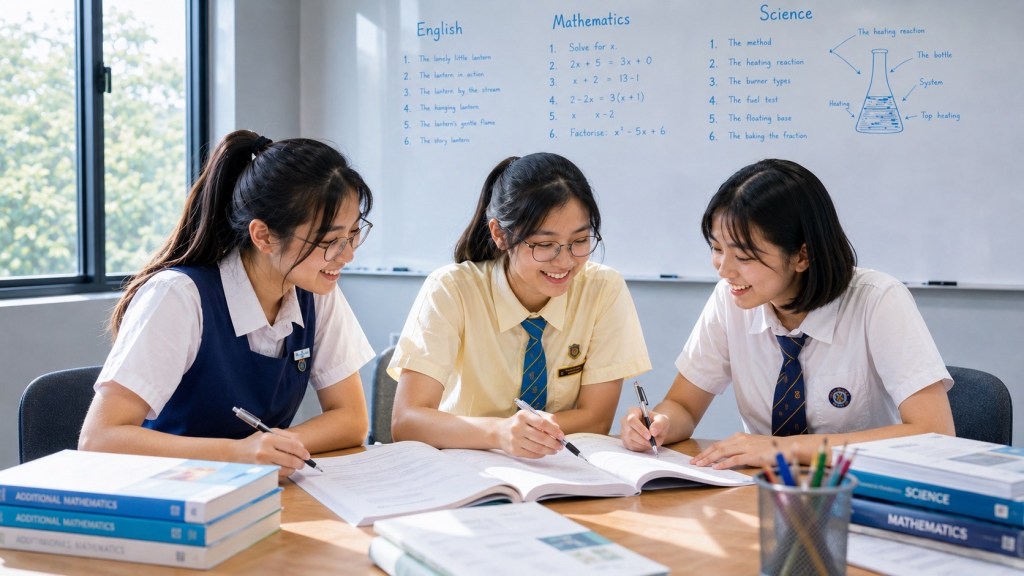
Parents searching for an Additional Mathematics tutor in Sengkang often compare A-Math tuition, differentiation, integration, calculus, tangents and normals, stationary points, maxima and minima, area under a curve, rate of change and examination preparation. Calculus can feel difficult because it compresses several ideas—algebra, functions, graphs, geometry and rates—into one symbolic language.
A strong Additional Mathematics tuition programme in Sengkang should therefore teach calculus as a connected system rather than a catalogue of differentiation and integration formulas. The 2026 Singapore-Cambridge O-Level Additional Mathematics syllabus includes derivative as gradient and rate of change, product, quotient and chain rules, stationary points, maxima and minima, connected rates, integration as reverse differentiation, definite integration and areas, together with motion applications.
At eduKate Sengkang, calculus is taught in small groups of up to three students so the tutor can see whether a wrong answer began with algebra, function notation, differentiation rules, sign control, graph interpretation or failure to connect the derivative back to the original context. The aim is a student who can interpret calculus, not merely execute it.
The One-Sentence Goal
A strong calculus learner can interpret change locally, accumulate change globally, choose the correct derivative or integral method and connect the symbolic result back to a graph or real situation.
Calculus Is About Change and Accumulation
Differentiation asks how a quantity changes at a point. Integration asks how small contributions accumulate over an interval. These are not unrelated chapters. They are inverse ways of studying variation.
Students often understand calculus more deeply once they see this relationship rather than learning “differentiate down, integrate up” as a pair of procedures.
What “Weak in Calculus” Can Actually Mean
| Visible problem | Possible first weak link | What we investigate |
|---|---|---|
| Power rule errors | Index algebra | Can the learner manipulate powers and coefficients reliably? |
| Chain rule is missed | Composite-function recognition | Can the student see one function nested inside another? |
| Product and quotient rules are confused | Structure recognition | Can the learner classify the expression before differentiating? |
| Stationary points are found but not interpreted | Graph connection | Can the student connect derivative sign to increasing/decreasing behaviour? |
| Integration constants are omitted | Family-of-functions model | Does the learner understand why indefinite integration needs +C? |
| Area answers are negative | Definite-integral interpretation | Can the student distinguish signed integral from geometric area? |
| Rates problems collapse | Variable linkage | Can the learner connect changing quantities through an equation? |
Derivative as Gradient
At a point on a smooth curve, the derivative gives the gradient of the tangent. This is a local measure: it describes how steeply the function is changing at that point.
If y = x², then dy/dx = 2x. At x = 3, the gradient is 6. The number 6 is not simply “the answer after differentiation”; it is the slope of the tangent at that point.
Derivative as Rate of Change
If one variable depends on another, the derivative describes how rapidly it changes. In motion, displacement differentiated with respect to time gives velocity; velocity differentiated gives acceleration.
This interpretation helps students connect calculus to physics and real modelling rather than treating dy/dx as notation to manipulate mechanically.
The Power Rule
If y = xⁿ, then dy/dx = nxⁿ⁻¹.
The rule applies to rational powers in the syllabus, but algebraic simplification often needs to happen first. Roots and reciprocals may need to be rewritten as powers so the derivative structure becomes visible.
Product Rule: Two Functions Multiplying
When y = uv, both factors may be changing. The product rule accounts for both:
d(uv)/dx = u(dv/dx) + v(du/dx)
Students improve when they label u and v clearly before differentiating rather than trying to remember the pattern mid-line.
Quotient Rule: Structure First
For a quotient, students need to preserve numerator and denominator structure. Many errors come from sign reversal or an incomplete denominator square.
We encourage one clean setup line before substitution into the rule.
Chain Rule: Differentiate the Outside and the Inside
Composite functions are functions inside functions. If y = (3x + 1)⁵, the outside function is “raise to power 5” and the inside function is 3x + 1.
dy/dx = 5(3x + 1)⁴ × 3 = 15(3x + 1)⁴
The extra factor comes from the rate at which the inside function changes.
Tangents and Normals
Once the derivative gives a tangent gradient, coordinate geometry completes the line equation. The normal is perpendicular to the tangent, so its gradient is the negative reciprocal when defined.
This is a good example of calculus relying on earlier algebra and geometry. Weak prerequisites can look like calculus weakness.
Stationary Points
A stationary point occurs where dy/dx = 0. But solving dy/dx = 0 only locates the candidate point. The student still needs to determine its nature where required.
Gradient sign or the second derivative can distinguish local maxima and minima in appropriate cases. The student should connect the symbolic test to graph behaviour.
Worked Stationary-Point Example
Let y = x² − 4x + 7.
dy/dx = 2x − 4
2x − 4 = 0 → x = 2
y = 4 − 8 + 7 = 3
The stationary point is (2,3). Since d²y/dx² = 2 > 0, it is a local minimum.
Maxima and Minima Problems
Optimisation problems test more than differentiation. The hardest part is often building the function to optimise.
A rectangle may have a fixed perimeter, giving one dimension in terms of another. Only then can area be expressed as a single-variable function, differentiated and optimised.
Connected Rates of Change
When several quantities change with time, students need an equation linking them before differentiating with respect to time.
For a circle, A = πr². If radius changes with time, then differentiating gives dA/dt = 2πr(dr/dt). The equation connects the changing area and changing radius.
The chain rule is operating conceptually even when students first meet the topic as a “rates question”.
Integration as Reverse Differentiation
If differentiation of x³ gives 3x², integration of 3x² returns x³ plus a constant.
∫3x² dx = x³ + C
The constant appears because many functions differing only by a vertical shift have the same derivative.
Definite Integration
A definite integral accumulates signed change over an interval. It can represent area relative to the x-axis, displacement from velocity or another accumulated quantity depending on context.
Students should not interpret every integral automatically as “area” without reading the problem.
Area Under a Curve
When a region lies above the x-axis, the definite integral gives its area directly. Regions below the axis produce negative signed integrals, so geometric area requires appropriate treatment.
This distinction between signed accumulation and positive geometric area is one of the most important conceptual checks.
Motion Applications
If s(t) is displacement, v = ds/dt and a = dv/dt. Conversely, integrating acceleration can produce velocity, and integrating velocity can produce displacement when constants or initial conditions are handled correctly.
Students must distinguish displacement from total distance travelled. Direction changes matter.
Calculus Is Algebra-Heavy
Many calculus errors are really algebra errors. Factorisation, indices, fractions, trigonometric identities, logarithms and exponentials appear inside calculus expressions.
We repair only the prerequisite needed, then reconnect it immediately to the calculus task.
Why Three Students Can Work Well
Calculus benefits from comparing solution routes. One learner may simplify before differentiating; another may use product rule directly. The tutor can compare efficiency and validity while still requiring every student to complete independent working.
A Practical Lesson Sequence
- Interpret: identify what derivative or integral represents.
- Classify: power, product, quotient, composite or trigonometric/exponential form.
- Execute: apply the correct rule.
- Simplify: keep algebra controlled.
- Interpret: connect the result to gradient, rate, turning point or area.
- Check: differentiate an integral or inspect dimensions and signs.
- Transfer: solve a new problem with the same calculus idea in a different surface form.
What Progress Looks Like
- Students classify expressions before differentiating.
- Chain-rule factors are missed less often.
- Tangent and normal questions connect calculus to coordinate geometry.
- Stationary points are interpreted rather than merely found.
- Optimisation starts with a correct single-variable model.
- Integration constants are handled reliably.
- Definite integrals are interpreted with sign awareness.
- Motion questions distinguish displacement, velocity and acceleration.
- Unfamiliar calculus contexts require fewer tutor prompts.
Frequently Asked Questions
Why is calculus difficult even when my child knows the rules?
The student may be struggling with algebra, function structure or interpretation. Calculus requires all three.
Should differentiation formulas be memorised?
Core derivatives and rules should become fluent, but students should understand the structure that tells them which rule applies.
What should parents bring to a consultation?
A recent Additional Mathematics paper with full working is ideal. The exact line where the method fails often reveals whether the issue is algebra, rule selection or interpretation.
The End Goal Is Calculus With Meaning
Calculus becomes more manageable when differentiation and integration stop feeling like symbol tricks and start functioning as tools for understanding change and accumulation.
Continue through the Additional Mathematics Learning Hub, the Additional Mathematics Study Guide, or the Secondary Algebra route.
