
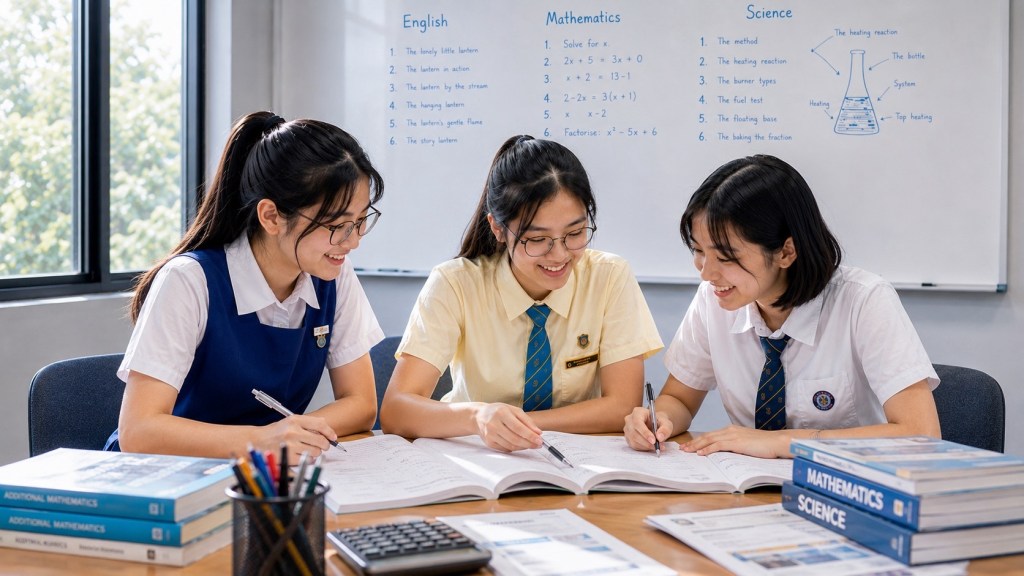
Families around Buangkok searching for a Mathematics tutor in Sengkang are often trying to solve a Primary 6 problem that is easy to describe and difficult to diagnose: the child knows many topics, yet PSLE Mathematics performance remains unstable. Fractions look fine in a topical worksheet. Ratio is manageable when the chapter is announced. Percentage is familiar. But mixed word problems, speed, geometry and multi-step questions expose weak recognition, inefficient methods, careless execution or time control.
That is why useful PSLE Mathematics tuition in Sengkang should begin with the first weak link rather than the next revision package. At eduKateSengkang, our nearby Punggol teaching location serves Sengkang families in groups of three students. The purpose of the small group is not simply to reduce class size. It is to make the learner’s working visible enough for the tutor to see where the mathematics first breaks.
The high-intent PSLE search language is familiar: PSLE Math tutor, PSLE Math tuition, word problems, ratio, percentage, speed, fractions, bar models, past papers and exam techniques. Those phrases describe one system. PSLE Mathematics asks students to recognise familiar relationships after the topic label disappears, choose a representation, calculate accurately and keep control of the paper.
Buangkok is a local search route, not a separate branch claim
This article is written for Buangkok and nearby Sengkang families comparing Mathematics support. eduKateSengkang does not claim a separate Buangkok branch. Our teaching location is nearby in Punggol. The local proposition is practical: three students, 1.5-hour lessons and a diagnosis-led Mathematics programme for families in the Sengkang–Punggol corridor.
The canonical service page remains Mathematics Tutor Sengkang. This Buangkok page narrows the intent to PSLE Mathematics recovery, mixed problem solving and paper control.
Why Primary 6 students can look prepared and still lose marks
Topic-by-topic success can hide transfer weakness. A student may know how to calculate percentage when the worksheet says “Percentage” but fail to recognise the same relationship when it appears inside a purchase, comparison or before-and-after word problem. Another may understand ratio but not know how to represent three interacting quantities. A third may solve everything correctly at home but finish a timed paper late.
The same final score can therefore come from very different causes. Tuition should identify the mechanism before prescribing more work.
The six PSLE Mathematics failure families
- Reading: conditions, units or comparison language are missed.
- Concept: the underlying relationship is not understood.
- Representation: the student cannot turn the situation into a model, table, diagram or equation.
- Method selection: the student knows several methods but chooses an inefficient one.
- Execution: arithmetic, units, copying or notation breaks down.
- Paper control: time, checking or recovery from a difficult question collapses.
Fractions, ratio and percentage should be connected
Upper-primary Mathematics becomes easier to transfer when students see fractions, ratio and percentage as connected ways of expressing part-whole and comparison relationships. One half, 0.5 and 50% are not three unrelated facts. The representation changes, but the magnitude relationship remains connected.
This matters because PSLE questions mix topics. A percentage question can depend on fraction equivalence. A ratio question can require percentage change. A speed problem can combine rates and unit conversions. A tutor who teaches only chapter procedures can leave the child fragile when those chapters collide.
Word problems test translation before calculation
“Weak in word problems” is not a diagnosis. The tutor needs to see whether the problem is vocabulary, relationship detection, representation, method choice or arithmetic. A repeatable entry routine helps: identify the target, mark the known information, state the relationship in words, choose a representation, calculate, then check against the original situation.
When students become faster at this process, it is usually because they waste less time beginning in the wrong direction—not because they rush.
Speed problems reveal unit control
Speed, rate and time problems are often treated as formula exercises. The deeper challenge is unit discipline and relationship sense. A child can memorise a triangle or formula and still fail because hours and minutes are mixed, distance units are inconsistent or the quantity being compared is misunderstood.
A tutor should ask students to predict the unit of the answer before calculating. That simple habit makes the mathematics more meaningful and catches many errors early.
Past papers should answer a diagnostic question
Past-paper practice is valuable when the tutor knows what is being tested. A paper can reveal pacing, mixed-topic recognition, stamina and checking behaviour. It is inefficient when the student has one narrow concept gap that would be better repaired through targeted practice.
Families should use the current official examination information from SEAB for the paper format, rather than relying on old tuition assumptions.
Careless mistakes need names
“Careless” can hide several repeatable behaviours: copied number, wrong base quantity, missing unit, premature rounding, skipped condition, arithmetic slip or correct answer changed during anxious checking. If the error repeats, it is not random.
A useful error log records the first wrong step and a prevention cue. The student then meets a related question later to prove the correction survived.
Catch Up, Keep Up and Move Ahead
- Catch Up: repair the prerequisite that is blocking current PSLE work.
- Keep Up: stay aligned with school while retrieving old topics.
- Move Ahead: deepen mixed problem solving, precision and paper control once foundations are secure.
What a three-student PSLE Mathematics lesson can do
A small group should allow the tutor to inspect individual working, not simply deliver a shorter lecture. One student may need a percentage repair. Another may need timed mixed practice. A third may need harder word-problem transfer. The class can still share explanations and method comparisons while follow-up work is differentiated.
Buangkok parents should look for leading indicators
Useful progress appears before the final PSLE mark. The student starts unfamiliar questions with less prompting, repeated error types reduce, old topics remain retrievable, working becomes easier to inspect, paper pacing becomes more stable and checking becomes selective rather than frantic.
Those behaviours show that the system is becoming more reliable.
The Buangkok decision
PSLE Mathematics tuition should reduce confusion, not simply increase workload. The family should know what is being repaired. The student should know what to do when a question is unfamiliar. The tutor should know when support can be reduced.
That is the value of a nearby Mathematics tutor in Sengkang for a Buangkok family: not guaranteed marks, but a small-group environment where the thinking can be seen, repaired and gradually returned to the learner.
Continue: Primary 6 Mathematics Tuition Sengkang · Surviving PSLE Mathematics · Mathematics Tutor Sengkang.
A diagnostic example: the percentage question that is really a fraction problem
Suppose a Buangkok Primary 6 student repeatedly loses percentage questions. It is tempting to assign another percentage worksheet. A closer inspection may show that the student does not understand equivalent fractions well enough to see 25% as one quarter or 40% as two fifths. The percentage chapter is the visible failure, but fraction structure is the first weak link.
Repairing that earlier relationship can improve several areas at once. The student becomes faster at benchmark percentages, ratio comparisons and estimation. This is why diagnosis often saves time: one accurate repair can replace many hours of repeated surface practice.
A diagnostic example: the ratio question that is really a representation problem
Another student may simplify ratios perfectly but go blank when three quantities interact in a word problem. The ratio knowledge is present. The missing skill is external representation. The child does not know what to draw, what to keep constant or how to align the quantities.
A tutor can test this by temporarily removing the arithmetic. Ask the student to show the relationship using bars, a table or labelled units. If the problem becomes manageable once the structure is visible, the intervention should focus on representation choice rather than more ratio drills.
A diagnostic example: the correct student who still runs out of time
Some students are accurate in untimed practice and still underperform in papers. They may use long methods for routine questions, re-check everything twice or refuse to leave one difficult question. Their mathematics is not necessarily weak. Their paper-control system is expensive.
The tutor should measure where the minutes go. Time one section, not just the whole paper. Record questions that consumed disproportionate time. Compare the chosen method with a safer or shorter method. Teach selective checking instead of complete reworking. Paper control can be trained as deliberately as fractions or ratio.
The four layers of PSLE Mathematics performance
A useful PSLE model separates four layers. Knowledge is knowing facts, concepts and standard methods. Recognition is seeing which mathematics applies when the topic is not announced. Execution is carrying out the method accurately. Performance is doing all of this under time, fatigue and examination pressure.
The lowest unstable layer usually deserves attention first. Timed full papers cannot repair a missing concept. Another explanation cannot repair a pacing problem if the student already understands the method. This hierarchy keeps tutoring efficient.
Why mixed practice should come after enough stability
Mixed sets are valuable because they remove the chapter label. Students must choose the method. But mixing too early can create random guessing. The individual methods need to be stable enough for the learner to discriminate among them.
The tutor can stage the transition. Start with one topic. Add a near neighbour. Mix two or three topics. Change the wording. Change the representation. Add time only after the student can choose the right family reliably. This builds recognition without turning practice into chaos.
How PSLE Mathematics corrections should work
A correction should answer three questions: where did the solution first become invalid, why did that happen, and what cue will prevent it next time? Copying a full model answer often hides the most important information because the student sees the perfect route but not the decision that was missed.
After correction, close the solution. Re-attempt the question. Then revisit the same structure after a delay. If the error returns, the repair is not stable yet. Delayed re-attempts are one of the simplest ways to separate familiarity from learning.
A one-page PSLE Mathematics dashboard for parents
Parents do not need a complex spreadsheet. One page can track four categories: secure, rusty, weak and exam-control. Secure topics receive light retrieval. Rusty topics need a short refresh. Weak topics need explicit repair. Exam-control issues such as pacing and checking need timed practice.
For each weak item, record the evidence, repair and re-test date. “Percentage change — wrong base in three scripts — identify base before calculation — re-test Friday.” This creates a stable plan instead of changing direction after every worksheet.
How to use prelim papers without treating them as a verdict
Prelim papers are valuable because they show mixed performance under realistic conditions. They should not become a permanent label. A low mark can be disassembled into repairable causes. A high mark can still hide inefficient methods, late-paper fatigue or dependence on familiar question forms.
After prelims, classify every significant loss. Concept? Representation? Arithmetic? Time? Checking? Once the distribution is visible, the remaining weeks can become selective rather than frantic.
Why the final six weeks should become more selective
Early preparation can be broad. The final phase should narrow. Secure topics move to maintenance. Rusty topics receive retrieval. Weak topics receive focused repair. Timed sections test whether the repair survives pressure. Full papers are used when whole-paper control is the skill being tested.
This protects the student from the common mistake of trying to finish every available paper, book and online quiz simply because PSLE is close.
The difference between a hard question and an expensive question
A hard question demands advanced reasoning. An expensive question consumes too much time relative to its value. Sometimes the same question is both. PSLE control requires students to recognise when persistence has stopped being productive.
A tutor can rehearse leaving and returning. This makes question triage a deliberate strategy rather than a panic response. The student learns that temporarily moving on is compatible with strong Mathematics.
How to teach checking without doubling the paper
“Check your work” is too broad. Students need selective checks matched to their error profile. Estimate before calculation. Verify units in measurement. Substitute into equations. Re-read the final question when an answer can be expressed in several forms. Check the base quantity in percentage change. Inspect copied values before starting a long calculation.
A personal checking protocol is faster and more reliable than attempting to repeat every solution.
Why sleep and workload belong inside a Mathematics plan
Attention and working memory are part of performance. A tired student can look careless, slow or forgetful even when the mathematics is stronger than the paper suggests. The final PSLE runway should protect sleep and realistic study blocks.
More revision hours are not automatically more learning hours. One focused set that targets the current weak link can be more useful than several duplicate worksheets completed late at night.
How parents can help without becoming the second tutor
Parents can manage conditions: study rhythm, materials, sleep and realistic workload. The tutor manages instruction. The student increasingly manages learning. A useful home question is not “How many pages did you finish?” but “What did you discover needs repair?”
Keep old test papers because they show patterns across time. Resist buying another assessment book before understanding why the current resources are not transferring. Encourage the child to bring precise questions to tuition rather than a general statement that Mathematics is hard.
What PSLE Mathematics independence looks like
An independent Primary 6 learner does not solve every question instantly. Independence means having a response to uncertainty: read again, identify the target, represent the relationship, try a method, check plausibility, leave and return if necessary.
The tutor’s prompts should gradually become the student’s internal prompts. That handover is a stronger sign of readiness than the number of practice papers completed.
Eight questions Buangkok parents can ask before enrolling
- How do you diagnose the first weak link?
- How do you distinguish a concept gap from an exam-control problem?
- How are three Primary 6 students differentiated?
- When do you use topical repair versus mixed papers?
- How are corrections re-tested after a delay?
- How do you teach checking and time allocation?
- How do you prevent dependence on model solutions?
- What evidence would tell you the student needs less support?
Buangkok summary
For Buangkok families, PSLE Mathematics tuition should make the problem smaller and clearer. The family should know what is failing, the student should know the next move, and the tutor should know how to test whether the repair has transferred.
The local value of a nearby three-student Sengkang-facing class is not simply convenience. It is the opportunity to see the learner’s mathematics closely enough to repair the right thing before adding more work.
How to prioritise the final PSLE Mathematics repair list
A revision list is most useful when it is shorter than the syllabus. Parents can begin with the three weaknesses currently costing the most marks or time. For each one, write the evidence, the repair task and the re-test condition. A useful entry might read: “Percentage change — wrong base quantity in three recent scripts — state the base before calculating — re-test in a mixed set on Friday.”
This stops revision from changing direction after every difficult question. Once one weakness becomes stable, replace it with the next priority. The system stays finite and visible.
Why Primary 6 Mathematics often needs less material and better sequencing
By Primary 6, many families own enough resources. The problem is often sequence rather than supply. A child can move from school worksheet to tuition booklet to online quiz without ever returning to yesterday’s error after a delay. Activity is high, but memory remains shallow.
A better sequence is learn, retrieve, vary, mix and re-test. The material can come from school, tuition or past papers. What matters is how the questions are used.
The difference between blocked practice and mixed practice
Blocked practice groups similar questions together. It is useful when a method is new because the student can focus on execution. Mixed practice removes the method label and forces the learner to decide what kind of problem is present.
PSLE requires both. A student who has never stabilised the method cannot benefit fully from mixing. A student who only practises blocked sets can become dependent on headings and worksheet structure. The tutor should move between the two deliberately.
How to build speed without teaching haste
Speed can come from several sources: fluent number facts, faster recognition, shorter methods, cleaner notation and better question triage. Only one of those is “work faster”. The tutor should identify which source is limiting performance.
If arithmetic is slow, build fluency. If recognition is slow, use mixed sets and ask the student to name the structure before solving. If the method is long, compare alternatives. If one hard question consumes ten minutes, train leaving and returning. Speed is the result of organised decisions.
PSLE Mathematics and the Primary 6 to Secondary 1 bridge
The final Primary year should not be reduced to examination technique. Students are about to enter a more symbolic Secondary Mathematics environment. Organised working, ratio sense, graph reading, estimation, flexible representation and self-correction all carry forward.
A tutoring method that teaches one-off tricks can improve a narrow question type while weakening transfer. A better method helps the student understand why a representation or operation works, then practise using it in changing contexts.
What to do when the child says “I forgot everything”
Forgetting after a delay does not always mean the topic was never understood. It may mean the knowledge was not retrieved often enough. The tutor should test how quickly the idea can be restored. If a short cue brings the method back, the problem may be retrieval strength. If the child remains confused even with support, the concept may need re-teaching.
This distinction matters because the interventions are different. Rust needs retrieval. Structural weakness needs repair.
Why redoing the exact same question is not enough
A student can remember the surface of a corrected question. To test whether the structure was learned, change the numbers, wording or representation. A ratio problem can become a table. A percentage problem can use a different base. A geometry question can hide the same relationship in a different diagram.
Variation makes transfer visible. The learner proves that the method belongs to them rather than to one remembered page.
How strong students can still improve before PSLE
Strong Primary 6 students often need precision more than additional syllabus content. Their lost marks may come from rushing easy questions, changing correct answers, incomplete units, method overcomplication or failing to recognise an efficient representation.
For these students, extension can mean comparing methods, explaining why a shortcut is valid, solving unfamiliar combinations and making ordinary questions almost error-proof.
How a struggling student should experience recovery
A struggling student should not be presented with the whole PSLE syllabus as one problem. The tutor should reduce the task. One ratio relationship. One percentage-base issue. One checking routine. One timed section. Small repairs build evidence that the subject can become controllable.
This evidence matters emotionally. Confidence grows when the student can point to something that now works, not only when an adult says everything will be fine.
How to use online practice responsibly
Online platforms can provide fast feedback and large question banks. Their value depends on what happens after an error. If the student simply clicks through until the answer turns green, practice can become completion without learning.
The student should record important errors, explain the correction and revisit the idea away from the platform. Digital practice is most useful when it feeds a larger learning system.
Why a tutor should sometimes say “show me your school paper first”
School scripts show what the student actually met under real conditions. Before assigning generic tuition material, the tutor can inspect recent tests, corrections and teacher feedback. This avoids building a programme from assumptions.
School evidence also helps prevent parallel curricula. Tuition can repair and strengthen the child while remaining connected to the methods and demands already in use.
The final handover: tutor prompts become student routines
At the start, the tutor may ask: What is the whole? Which quantity changed? What representation fits? Are the units consistent? As the student improves, these prompts should disappear from the tutor’s voice and appear in the student’s own thinking.
This is the clearest form of independence. The learner has internalised a way to begin, check and recover.
Buangkok parent checklist for the final runway
- Are the top three weak links written down?
- Does each weak link have a specific re-test date?
- Are secure topics maintained lightly rather than over-practised?
- Is mixed practice being introduced after enough stability?
- Is timing used to diagnose rather than punish?
- Does the child have a personal checking routine?
- Are tutor prompts decreasing?
- Is sleep protected as PSLE approaches?
One final principle for Buangkok families
Do not measure a revision day only by pages completed. Measure whether one important thing became more reliable. The student who can now identify the correct base quantity, leave an expensive question strategically or start a mixed ratio problem without help has made real progress.
That is the standard a Mathematics tutor in Sengkang should work toward: a child whose system becomes more dependable each week and less dependent on the tutor.
How to plan the final seven days without cramming the whole syllabus
The final week should protect retrieval, sleep and confidence built from evidence. Do not reopen every old weakness. Keep secure topics alive with short mixed work, revisit only the highest-leverage recurring errors and use one or two realistic timed sections to maintain pacing. The student should know the personal error list and checking routine before the final days begin.
New tricks introduced at the last minute can create interference. The student is better served by reliable methods that have already survived practice. If a new shortcut is taught, it should be simple, clearly understood and demonstrably safer than the existing route.
How to separate anxiety from missing Mathematics
A student can know the mathematics and still go blank under pressure. The tutor should compare untimed, lightly timed and full-pressure performance. If the concept remains available until the clock or paper environment changes, the intervention should include exam routines and recovery rather than only more teaching.
Useful recovery routines include writing the known information, marking the question target, drawing a quick representation, moving temporarily to another question and returning with fresh attention. The goal is not to eliminate nerves; it is to preserve mathematical action when nerves appear.
Why the tutor should sometimes assign fewer questions
Five carefully selected questions can be better than fifty repetitive ones when they test distinct error mechanisms. A tutor may choose one ratio transfer question, one percentage-base question, one speed-unit question, one geometry representation question and one mixed problem that requires method selection.
The student then corrects, explains and re-attempts. Depth of feedback can produce more learning than raw volume.
What to do after a surprisingly good practice paper
Do not immediately raise the difficulty everywhere. First inspect why the paper went well. Were old error types absent? Was pacing stable? Did the student make good decisions on hard questions? A strong result is useful because it shows which parts of the system are now reliable.
Keep those strengths in maintenance and spend the saved time on remaining weaknesses. Improvement should simplify the plan.
What to do after a surprisingly bad practice paper
One bad paper should trigger analysis, not a complete programme reset. Check sleep, timing, unfamiliar topic mix, careless-error distribution and whether one difficult section affected the rest of the paper. Compare with several previous scripts before deciding that a secure topic has collapsed.
Good diagnosis protects families from overreacting to noise while still responding quickly to genuine decline.
The local reason and the educational reason
For Buangkok families, nearby tuition can reduce travel friction. That is the local reason. The educational reason must be stronger: the class should identify the student’s real PSLE bottleneck and create a visible path toward independent performance.
When both conditions are met, tuition fits the family rather than simply occupying another evening.
Final Buangkok PSLE Mathematics calibration
The final calibration is simple: secure knowledge should be maintained lightly, weak knowledge should be repaired explicitly, transfer should be tested in mixed questions and paper control should be rehearsed under realistic time. Every task should have a reason. If the family cannot explain why a worksheet is being done, the programme is probably carrying too much noise.
The strongest signal that preparation is working is not that the child has seen every possible question. It is that unfamiliar questions no longer cause immediate paralysis. The student can identify the target, choose a representation, try a method, check the result and recover when the first approach fails.
For a Buangkok family, that is the practical outcome worth paying for: not permanent rescue, but a more reliable mathematical operating system as PSLE approaches.
Why the last marks usually come from control, not another chapter
Late in Primary 6, many students already know most of the syllabus. Their remaining losses come from unstable recognition, inefficient methods, weak checking and decisions made under pressure. Adding another chapter-style worksheet can feel productive while leaving those losses untouched. The tutor should increasingly ask whether the student can identify the structure quickly, preserve easy marks and recover after a difficult question.
This is also where strong students benefit from deliberate method comparison. One correct route may require six lines, another three. One route may be faster but vulnerable to arithmetic slips. The student should learn which method fits their own control under examination conditions.
For Buangkok parents, this gives a practical final question: is tuition still teaching new Mathematics, or is it now making known Mathematics more dependable? Close to PSLE, dependable performance is often the higher-value job.
A final practical note for Buangkok parents: the last stage of PSLE Mathematics preparation should feel more organised than the first. The child should know the priority list, recognise the personal error patterns, understand when to use topical repair and when to use mixed papers, and have a tested routine for checking and recovery. When these systems are visible, the family no longer needs to react to every worksheet as if it were a new crisis. Revision becomes a controlled process with clear reasons for each task, which is exactly what a strong tutoring programme should create.
