
The Feynman Technique can be useful for Science when it is treated as a diagnostic explanation loop rather than a slogan about “teaching simply”. The practical routine is to choose a concept, explain it in plain language from memory, notice exactly where the explanation becomes vague or breaks, return to a reliable source to repair that gap, and then explain the idea again before testing it in a changed context. For parents searching for the Feynman Technique, how to study Science, active recall, Science revision, Primary Science tuition, PSLE Science help or Secondary Science tuition in Sengkang, the value of the method is that it makes weak understanding visible.
The popular “Feynman Technique” is commonly presented as a four-step learning routine associated with physicist Richard Feynman. Universities and study-skills programmes describe versions built around selecting a topic, explaining it to a beginner, finding gaps, reviewing the source and simplifying again. It is best used as a practical framework rather than treated as a formally standardised scientific protocol. Its most useful parts overlap with retrieval, self-explanation, feedback and learning by teaching.
For Science, one extra step is essential: transfer. A student can give a polished explanation of the exact example they studied and still fail a new question. The tutorial should therefore end with a changed diagram, data set, experiment, context or calculation. If the idea survives the change, the learner has stronger evidence of understanding.
Quick answer: the Science Feynman loop
- Choose: select one concept or relationship.
- Retrieve: close the notes and explain it from memory.
- Locate the gap: identify where the explanation becomes vague, circular or dependent on a keyword.
- Repair: return to the textbook, teacher notes or reliable source and rebuild only the weak section.
- Re-explain: produce a clearer explanation without copying the source.
- Transfer: use the same Science in a changed question.
- Return: revisit the idea after a delay to check whether it remains available.
Why explaining exposes weak Science understanding
Reading creates recognition. The student sees the idea and thinks, “Yes, I know this.” Explanation removes that support. The learner has to retrieve the parts, order them, connect cause and effect and choose precise language. Gaps that were hidden during rereading become obvious.
A student may say, “Evaporation happens because water wants to become gas.” The sentence reveals a weak mechanism. Another may say, “The bulb lights because electricity goes through it,” without explaining the need for a complete circuit. A Secondary student may recite a formula but be unable to explain what the quantities mean. Explanation gives the tutor something diagnostic to work with.
Step 1: choose a concept small enough to explain
“Science” is too large. “Heat” is often still too large. Choose a concept with a clear boundary: why a metal spoon becomes warm in soup; how evaporation differs from boiling; why a bulb lights in a complete circuit; how density compares mass with volume; how a plant structure supports one function; why a graph trend changes under a stated condition.
A good topic can usually be explained in a few minutes. If the explanation requires twenty unrelated subtopics, split it. Smaller concepts make the location of the gap easier to see.
Step 2: explain from memory before looking
Close the book. Do not copy the chapter heading, model answer or teacher slide. Explain aloud or write a short explanation as if the listener knows less Science than you do. Use ordinary language where possible, then add technical terms when they are needed for precision.
The important rule is that simple language must not become inaccurate language. “Explain simply” does not mean remove the mechanism. It means remove unnecessary jargon while preserving the scientific relationship.
Step 3: mark exactly where the explanation breaks
Do not label the whole topic “weak”. Mark the sentence, step, diagram or relationship that failed. Did the student forget a prerequisite? Confuse two terms? Skip the middle of the mechanism? Use a correct keyword without knowing what it does? Misread a representation?
A useful gap statement is operational: “I can name photosynthesis but cannot explain how changing light affects the process,” or “I know the density formula but still think heavier always means denser.” These statements tell the next tutorial what to repair.
Step 4: repair only the missing link
Return to the source with a question. Do not reread the entire chapter by default. Find the part that answers the identified gap. Compare the student’s explanation with the reliable model, diagram or definition. Then close the source again.
This makes the method efficient. The learner spends study time on the unstable link rather than on pages already understood.
Step 5: explain again with the repaired mechanism
The second explanation should be independently generated. If the learner can only repeat the source sentence, the concept may still be fragile. Ask for another phrasing, a diagram, an analogy with limits, or a step-by-step causal chain.
One strong structure for Science is condition → relevant concept → mechanism → outcome. Another is evidence → model → reasoning → conclusion. The exact structure depends on the question.
Step 6: transfer to a different surface context
This is the step that makes the method more useful for examinations. After explaining evaporation using laundry, switch to a puddle or open container. After explaining conduction using a spoon, switch to cookware. After explaining density using two blocks, switch to a table of mass and volume. After explaining a circuit, redraw the same connections in a different layout.
If the student can recognise and use the same underlying Science, the explanation is becoming transferable. If performance collapses when the example changes, return to the gap.
Step 7: revisit after a delay
An explanation that works immediately after repair may still depend on short-term memory. Return the next day or later in the week. Ask for the mechanism without the original notes and use another fresh example. Delayed retrieval helps distinguish durable learning from immediate familiarity.
Worked Primary Science example: evaporation
A Primary 5 learner explains: “Clothes dry because the Sun heats them and the water disappears.” The explanation contains a familiar observation but does not yet specify the process clearly.
Gap: the learner cannot explain evaporation independently of “the Sun”. Repair: revisit the idea that evaporation can occur from the surface of a liquid and can be affected by conditions such as temperature, airflow and exposed surface. Re-explain: the learner describes water leaving the wet material as water vapour. Transfer: ask why clothes may still dry in shade with moving air. The changed context tests whether the process is understood.
Worked PSLE example: open-ended explanations
A Primary 6 student knows the keyword “conductor” but writes, “The spoon gets hot because metal is a conductor.” The answer may be incomplete because it names the property without making the transfer mechanism visible.
Ask the learner to explain the event without using the word conductor. This forces the underlying relationship into ordinary language. Then reintroduce the scientific term after the mechanism is clear. Finally change the object or setup. The Feynman loop reveals whether the keyword represents real understanding or memorised answer language.
Worked Secondary Science example: density
A Secondary learner can write density = mass ÷ volume but says the heavier object is always denser. Ask for an explanation of “mass per unit volume” without using the formula. The student may stall because the symbolic relationship was memorised without a conceptual model.
Repair using equal-volume and equal-mass comparisons. Re-explain density as a comparison between mass and occupied volume. Then transfer to a graph or table where the student must decide whether calculation is necessary. The method moves from formula recognition to conceptual discrimination.
Worked Secondary Science example: a biological structure
A student can label a structure but cannot explain why it is suited to its function. Use the loop: explain the function, identify the structural feature, connect the feature to the process, and state the functional outcome. If any link becomes vague, that is the repair target.
Then change the condition: what would happen if the feature were reduced or altered? The prediction reveals whether the structure-function relationship has been understood.
Where the Feynman Technique can fail
- Oversimplification: the learner removes essential scientific detail to make the explanation sound easy.
- Confident error: the student explains an incorrect model fluently.
- No verification: gaps are noticed but never checked against reliable material.
- No transfer: the learner masters one rehearsed example only.
- No delayed return: the explanation works today and is forgotten next week.
- Using it for everything: some basic facts, procedures or calculations may be better learned with direct practice, worked examples and retrieval.
Explain simply does not mean remove technical vocabulary
Technical vocabulary exists because Science needs precision. The aim is to understand the term well enough to explain it, not to permanently replace it with everyday language. A student may first say “water particles leave the surface” and then learn how the syllabus expects evaporation to be described. Ordinary language is a bridge to precision.
Analogies need boundaries
Analogies can help explanation, but they are models. Ask where the analogy works and where it breaks. A circuit may be compared with a flow system for one relationship, but the comparison has limits. Particles may be compared with moving objects, but real particle behaviour is not identical to the everyday analogy.
Adding the question “Where does this analogy stop being accurate?” prevents simplification from creating a new misconception.
The blank-page version
Give the student a blank sheet and one concept title. Without notes, the learner writes the big idea, key terms, a diagram, one mechanism, one example and one likely confusion. Then compare with the source. The blank page makes missing structure visible very quickly.
The teach-a-parent version
Ask the student to teach the concept to a parent who deliberately asks basic questions: “Why?” “How do you know?” “What does that word mean here?” “Would the same thing happen if this changed?” The parent does not need to know the answer in advance. The questions expose unexplained jumps.
The three-student tutorial version
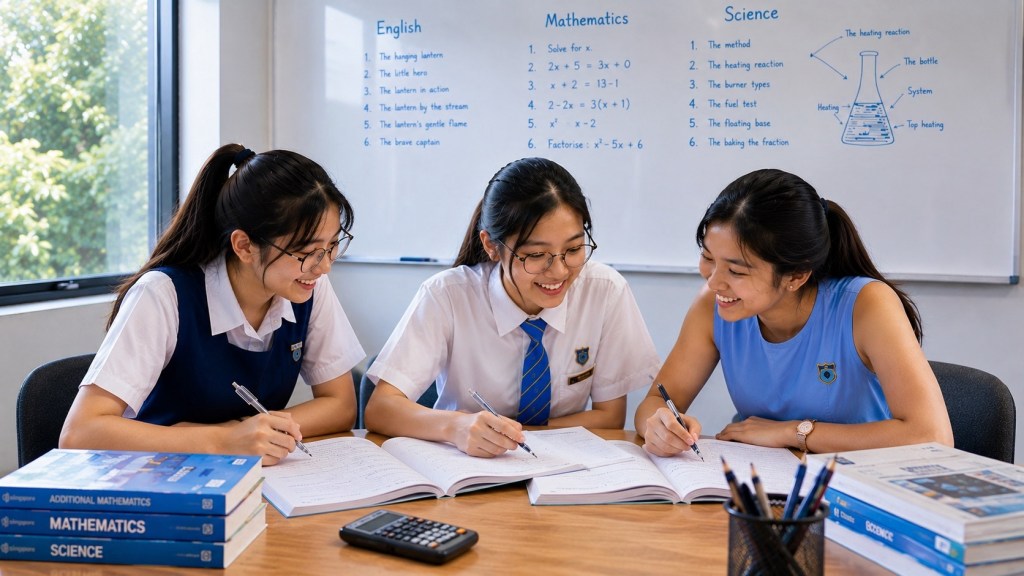
In a three-student class, Student A explains the concept, Student B asks for clarification and Student C tests transfer with a changed example. Then rotate. The tutor listens for gaps, misconceptions and overconfident shortcuts.
This makes teach-back more rigorous than simply asking one student to present. The peer questions and transfer test create evidence that the explanation is usable.
Feynman Technique for Primary 3–4
Keep explanations short and concrete. Use a picture, one mechanism and one everyday example. Do not demand adult-style simplification. The learner should be able to say what happens and why at the level expected by the Primary Science curriculum.
Feynman Technique for Primary 5–6 and PSLE
Use it for recurring misconceptions, open-ended explanation chains, experimental variables and cross-topic connections. After every explanation, add one unfamiliar application. That keeps the routine aligned with PSLE transfer rather than becoming a note-making exercise.
Feynman Technique for SEC G1, G2 and G3 Science
Secondary students can explain models, equations, graphs, practical methods and mechanisms. A useful sequence is verbal explanation, representation, calculation if needed, and transfer. The exact depth should match the current SEAB syllabus for the student’s subject level.
Combine the technique with retrieval and spacing
The explanation itself is a retrieval attempt when done from memory. Make it stronger by spacing the attempts across days. Explain today, test transfer tomorrow, revisit after several days and then mix the concept with another topic. This creates a learning sequence rather than a one-time performance.
Combine it with an error log
Every explanation gap can become an error-log entry: missing prerequisite, vague mechanism, confused terms, weak representation or incomplete transfer. Add one future cue beside the gap. “Explain what happens between condition and outcome.” “State what the graph actually shows before explaining.” “Use both mass and volume.”
A 20-minute Science Feynman session
- 3 minutes: choose the concept and retrieve key ideas.
- 5 minutes: explain it from memory.
- 3 minutes: mark the exact gaps.
- 4 minutes: repair from a reliable source.
- 3 minutes: re-explain.
- 2 minutes: answer one changed transfer question.
A one-week Feynman cycle
Monday: explain one concept. Tuesday: repair and re-explain. Wednesday: transfer to a new context. Thursday: explain a neighbouring concept and compare them. Friday: mixed retrieval. Weekend: teach the original concept again without notes. The final explanation should require less support and include more accurate relationships.
Questions parents can ask during teach-back
- What does that word mean here?
- What happens in the middle?
- How do you know?
- What evidence supports that explanation?
- Would it still work if I changed this condition?
- Can you draw it?
- Can you explain the diagram in words?
- Which part are you least sure about?
- What would prove your explanation wrong?
- Can you give a different example?
How to know the technique worked
The best evidence is not that the second explanation sounds smoother. Look for independent retrieval, fewer vague gaps, accurate use of scientific vocabulary, successful transfer to a changed context and delayed success several days later. The student should also need less prompting.
When to use another study method instead
Use direct retrieval for basic facts and definitions. Use worked examples for unfamiliar calculations. Use flashcards for small vocabulary units. Use concept maps when organisation across a whole chapter is the main problem. Use past-paper practice when mixed examination control is the target. The Feynman loop is strongest when understanding and explanation are the main weak link.
Useful eduKate Sengkang routes
- Master Science Tutorials Quickly | Science Revision Notes
- Master Science Tutorials Quickly | Primary Science Process Skills
- Advanced Science Tutorials | How to Study Science Effectively
- Complete Science Index
- Oakland University | Feynman Technique study session
Frequently asked questions
Did Richard Feynman publish a formal method called the Feynman Technique?
The popular four-step routine is associated with Feynman’s approach to understanding and explanation, but it is best treated as a later study framework rather than a formally standardised protocol he published under that name.
Does explaining simply prove understanding?
No. A student can explain an incorrect model fluently. Verification, transfer and delayed retrieval are needed.
Can Primary students use the technique?
Yes, in a simpler form. Ask for a short explanation, identify one gap, repair it, then use another example. Keep the language and concept depth appropriate to the child’s level.
Can it help PSLE Science open-ended questions?
It can help students expose missing mechanisms and vague keyword knowledge. Pair it with actual PSLE-style questions and transfer practice.
The Science Feynman receipt
A useful Feynman-style Science session ends with four pieces of evidence: the student can explain the concept from memory, can identify what was previously missing, can use scientifically accurate language, and can apply the idea to a changed question.
That is why the method belongs in a “Master Science Tutorials Quickly” lane. It does not make difficult Science magically easy. It makes the location of difficulty easier to see, so the tutor and student can repair the right thing instead of rereading everything.
The explanation-quality ladder
Not every explanation from memory has the same quality. A tutor can use a five-level ladder to decide what the student needs next. Level 1 is recognition: “I know this when I see it.” Level 2 is naming: the learner can state the correct term. Level 3 is description: the student can say what happens. Level 4 is mechanism: the learner can explain why or how it happens. Level 5 is transfer: the same mechanism can be selected and used in a changed context.
The Feynman-style loop is most valuable when it moves a learner from Level 2 or 3 toward Level 4 and 5. A student who already has strong mechanism and transfer may need different work, such as timed examination practice or more advanced quantitative problems.
How to recognise a circular Science explanation
Circular explanations sound scientific but repeat the outcome. “It evaporates because evaporation happens.” “The bulb lights because electricity flows.” “The plant grows more because it grows faster.” These sentences name the event without explaining the causal middle.
A useful prompt is: “If I did not already know the answer, what part of that sentence would tell me why it happens?” If the answer is none, the student needs a mechanism. The repair may involve particles, energy transfer, structures and functions, forces, chemical changes or another model appropriate to the topic.
How to use the method with equations
For quantitative Science, ask the learner to explain the equation in words before calculating. What does each symbol represent? What unit belongs to each quantity? Which relationship does the equation express? Under what conditions is it relevant? What would happen qualitatively if one quantity increased?
Then solve a numerical example. After calculation, ask what the answer means scientifically and whether its magnitude is plausible. This prevents the method from becoming a purely verbal exercise and helps connect conceptual and procedural understanding.
How to use the method with graphs
Ask the student to explain the graph to a beginner: what each axis means, what the scale shows, what the pattern is, what changes and what does not. Then ask for the scientific explanation of the pattern. If the learner immediately gives theory without describing the graph, separate evidence from explanation.
Transfer by changing the graph shape, units or context while keeping the same reading skill. The learner should still orient, describe and explain accurately.
How to use the method with practical Science
Ask the learner to teach an investigation as if the listener has never seen it. What is the question? What changes? What is measured? What must stay controlled? How is the measurement made? What result would support the conclusion? What limitation matters?
If the student can repeat the method but cannot explain why a control is needed, the explanation gap has located a practical-reasoning weakness. Repair the logic and then redesign the experiment in a different context.
How to use the method with vocabulary
For a technical term, explain the concept without using the word first. Then insert the word where it adds precision. Give an example and a non-example. Compare it with a nearby term. Finally use it in a full Science explanation.
This is useful for words students can spell but do not truly understand. The method forces vocabulary to reconnect with mechanism.
The two-column Feynman page
Divide a sheet into two columns: My Explanation and Gap or Check. Write the explanation on the left without notes. Every time the learner hesitates, uses a vague phrase or feels uncertain, mark the exact point on the right. Only after the first attempt should the source be reopened.
After repair, rewrite only the weak segment and then re-explain the full concept. This keeps the study session focused and prevents the learner from copying entire pages.
The Feynman transfer test
After a concept is explained, choose one of five transfer moves: change the object, change the representation, change the numbers, change the experimental condition or ask for the inverse comparison. The underlying Science should remain recognisable even though the surface has moved.
For example, a heat-transfer explanation can move from spoon to saucepan; a density concept can move from objects to a graph; a plant-process explanation can move from one environmental condition to another. Transfer prevents rehearsed fluency from being mistaken for mastery.
How parents can avoid accidentally doing the explaining
Parents often know enough to rescue the child quickly. Resist that impulse at first. Ask where the explanation became uncertain. Ask what the child would look up. Ask what evidence is missing. Give the smallest cue that restarts reasoning.
If the parent supplies the complete mechanism too early, the session turns back into listening. The diagnostic power comes from letting the learner reveal the gap.
How tutors can use peer explanation without spreading errors
Peer explanation is useful only when inaccurate explanations are checked. In a three-student tutorial, one student explains, another asks for evidence, and the third compares with a model or reliable source after the first attempt. The tutor supervises scientific accuracy and prevents confident misconceptions from being reinforced.
After correction, the original explainer must teach the repaired version again. This makes feedback active.
When the student cannot simplify because prerequisite knowledge is missing
Sometimes the explanation breaks immediately because the student never learned the prerequisite. Do not force more simplification. Identify the dependency and teach it. A learner cannot explain density conceptually if mass and volume are not understood; cannot explain a circuit if complete pathways are unclear; cannot explain a biological function if the structure is unknown.
The Feynman loop is therefore also a dependency detector. The gap may point backward to earlier learning rather than deeper into the current chapter.
What a four-week Science Feynman programme looks like
Week 1: use the method on familiar concepts to learn the routine. Week 2: target recurring misconceptions. Week 3: add graphs, experiments and calculations. Week 4: mix topics and require transfer without telling the student which model to activate.
Track the prompt level. The strongest evidence is that explanations become more accurate while external support decreases.
Final rule: simple, accurate, transferable
A strong Science explanation is simple enough to follow, accurate enough to survive scrutiny and connected enough to transfer. If simplification removes the mechanism, it is too simple. If technical vocabulary hides misunderstanding, it is too opaque. If the explanation works only for one memorised example, it is too narrow.
The useful target is a learner who can explain the idea clearly, show where the evidence comes from, recognise the model behind it and adapt the reasoning when the question changes.
