
Science in everyday life is one of the fastest ways to make school Science meaningful because familiar places are full of forces, energy transfers, materials, living systems, measurements and evidence. A child can meet heat transfer in a bowl of soup, evaporation in laundry, friction at a shoe sole, electricity in home appliances, pressure in pumps and tyres, light in mirrors and windows, sound on an MRT platform, biology in food and exercise, and weather Science on the walk to school. For parents searching for everyday Science examples, Science activities for kids, Primary Science tuition in Sengkang or ways to connect PSLE and Secondary Science to real life, the neighbourhood itself can become a source of questions.
The aim is not to turn every moment into a lesson. Everyday Science is useful because it gives students a concrete phenomenon first and a school concept second. The learner sees something happen, describes it, asks what might explain it, connects it to a model and then tests whether the same idea works in another context. This strengthens transfer: the child learns that Science is not trapped inside a chapter heading.
This guide uses Singapore-friendly contexts such as HDB homes, lifts, MRT journeys, sheltered walkways, tropical weather, food, appliances and ordinary machines. It does not encourage unsafe experiments with mains electricity, heat, sharp tools, traffic, chemicals or machinery. Observe safely, use school-approved investigations and let adults handle hazardous equipment.
Quick answer: 12 Science ideas hiding in ordinary life
- Heat transfer in cooking, drinks and air-conditioning.
- Evaporation and condensation in laundry, bathrooms and cold drinks.
- Forces and friction in doors, shoes, bicycles and transport.
- Energy transfers in appliances, batteries and moving systems.
- Electric circuits in lamps, switches and devices.
- Light and reflection in mirrors, windows and shiny surfaces.
- Sound and vibration in speakers, trains and household objects.
- Materials and properties in cookware, furniture and packaging.
- Pressure in pumps, tyres, syringes and sealed containers.
- Biology in food, exercise, plants and human body systems.
- Weather and water cycle processes in Singapore’s tropical environment.
- Measurement, data and probability in daily decisions.
Science at home: heat in the kitchen
A kitchen provides many heat-transfer examples, but it should be observed safely rather than used for unsupervised experiments. A metal spoon in hot soup becomes warm because thermal energy is transferred from the hotter food to the cooler spoon. A pot handle may use a material selected partly because of its thermal properties. A lid can change how heat and water vapour move through the cooking system.
Ask a child: What is hotter? What is cooler? In which direction is thermal energy transferred? Which material properties matter? What evidence can you observe without touching a hot object? These questions move the learner from “the spoon gets hot” toward mechanism.
For older students, connect the everyday example to models of conduction, convection or energy transfer at the level required by the syllabus. The real-life scene gives the context; the curriculum supplies the scientific precision.
Laundry: evaporation without a worksheet
Drying clothes is an accessible way to discuss evaporation. The child can observe that water disappears from the fabric over time and infer that liquid water enters the surrounding air as water vapour. Conditions such as airflow, exposed surface and temperature can affect how quickly drying occurs.
Ask: Why might clothes dry faster when spread apart? What changes when air moves? Which factors should be kept the same if we wanted a fair comparison? What would we measure: mass, time, dampness or another operational measure? A simple household observation can therefore lead into variables, measurement and evidence.
Cold drinks and bathroom mirrors: condensation
Water droplets on the outside of a cold drink do not usually come through the container wall. Water vapour in the surrounding air can cool and condense on a sufficiently cool surface. A bathroom mirror can fog for related reasons when warm, humid air meets a cooler surface.
Ask students to separate observation from explanation. Observation: droplets appear on the outer surface. Explanation: water vapour in the surrounding air changes state under suitable conditions. Then ask what evidence could distinguish this explanation from the idea that water leaked through the container.
Air-conditioning: heat, humidity and comfort
Air-conditioning invites several Science questions. A room feels cooler because energy is transferred as part of the cooling system, while moisture can also be removed from the air. Condensate water from an air-conditioning system is evidence that water vapour can change state under cooler conditions.
For Secondary Science, the air-conditioner can become a system model: energy input, heat transfer, fluid movement and phase change. Students do not need to dismantle equipment to reason scientifically about observable inputs and outputs.
HDB lifts: forces, motion and energy
A lift is an everyday motion system. When it starts, stops or changes speed, passengers can feel changes in motion even though they remain standing on the floor. The lift motor transfers energy to the system, while forces act on the cabin and passengers.
Primary learners can focus on motion: moving, stopping, direction and speed. Secondary students can analyse forces more formally using the model expected by their syllabus. The key tutorial habit is to define the object being analysed before naming forces.
Doors, ramps and trolleys: simple machines and force
A door rotates about hinges, so pushing at different distances from the hinge changes how easily it turns. A ramp allows a load to be moved through a longer distance rather than lifted vertically in one step. Trolley wheels reduce the difficulty of moving heavy loads across a surface by changing the interaction with the ground.
Ask: Where do you push the door if you want it to open easily? Why? How does a ramp change the distance and force required? Which parts of a trolley reduce resistance to motion? These examples connect ordinary design to physical principles.
Shoes and sheltered walkways: friction
Friction matters every time a shoe pushes against the ground. Wet surfaces can change grip, which is one reason surface texture and footwear design matter during rain. The everyday observation can lead to questions about material, surface roughness, normal force and motion, depending on the learner’s level.
A safe comparison can use toy objects on different surfaces rather than asking children to run on slippery ground. Measure distance or required pulling force using school-approved methods and discuss which variables should be controlled.
MRT travel: motion, sound and systems
An MRT journey contains several Science ideas. The train accelerates and decelerates. Braking changes motion and transfers energy. Sound announcements travel through air as waves generated by vibrating speakers. Doors use sensors and control systems. Platform ventilation moves air. The rail network itself is a large engineered system involving electricity, signalling and mechanical design.
Parents can ask children to choose one observable phenomenon rather than trying to explain the whole train. “Why do you feel a change when the train begins moving?” “What evidence tells you the train is slowing?” “How is sound produced by the speaker?” “Which parts of this system need sensors?” The questions scale from Primary curiosity to Secondary modelling.
Escalators and moving walkways: motion and reference points
Motion depends on reference. A person standing still on an escalator is stationary relative to the step but moving relative to the building. This is a useful way for older students to think about frames of reference without needing complex mathematics.
Younger learners can simply compare what moves and what stays fixed. The same observation later supports more formal motion descriptions.
Windows and mirrors: light, reflection and transmission
A mirror reflects light strongly enough to form an image. A clear window transmits much of the visible light while also reflecting some, which becomes obvious at night when indoor lighting is brighter than the outside scene. Frosted glass scatters light and reduces clear image formation.
Ask: Why can you sometimes see your reflection in a window? Which material property lets you see through the glass? What changes when the surface is rough or frosted? These questions connect material properties to light behaviour.
Fans: moving air, energy and evaporation
A fan does not necessarily reduce the room’s air temperature in the same way an air-conditioner does, but moving air can change how people feel and how quickly moisture evaporates. The motor converts electrical energy into mechanical motion, and the blades transfer energy to the air.
This is a useful misconception check. Ask the child whether the fan “creates cold” or moves air, then connect the sensation to evaporation and heat transfer where appropriate.
Refrigerators: moving heat rather than making cold
A refrigerator is another useful system model. Electrical energy powers a system that transfers heat from the interior to the surroundings. The back or sides of a refrigerator can become warm because energy is released to the room. Food stays cooler because heat is continually removed from the insulated compartment.
For Primary learners, keep the explanation simple and safe. For Secondary students, the refrigerator can lead into energy transfer, phase change and thermodynamic ideas at the appropriate syllabus level.
Electric kettles and chargers: electrical energy transfer
An electric kettle transfers electrical energy into thermal energy in the heating element and water. A phone charger changes electrical conditions so the battery can store energy chemically. Both examples remind students that devices are energy systems with inputs, transfers and outputs.
Observe appliances only in normal safe use. Never open mains-powered equipment. Ask about the energy pathway rather than the internal wiring.
Food: biology, chemistry and materials
Food connects multiple sciences. Digestion breaks large food molecules into smaller substances the body can absorb. Cooking causes physical and chemical changes. Emulsions, foams, gels and solutions are examples of material structures. Fermentation involves microorganisms. Nutrition connects food to body systems and energy use.
Parents can ask: Which change is reversible? What evidence suggests a new substance formed? Which body system processes this food? Why does texture change during cooking? The exact explanation should fit the child’s syllabus.
Exercise: respiration, circulation and heat
During exercise, breathing rate and heart rate often increase because body systems need to support greater energy demand. Muscles generate heat, sweating and blood flow help regulate temperature, and the respiratory and circulatory systems work together to move gases and nutrients.
A safe observation activity can record pulse before and after mild school-appropriate exercise, following health and school guidance. The important Science question is not simply “did pulse rise?” but “what body-system demand changed, and how does increased circulation help?”
Plants along the neighbourhood: structure, growth and environment
Roadside trees, balcony plants and park vegetation provide living examples of structure and function. Leaves capture light, roots anchor and absorb, stems support transport, and growth responds to environmental conditions. Students can observe leaf arrangement, shade, soil moisture and growth without damaging plants.
Ask: Which observation can you make without touching the plant? Which structural feature might support a function? What evidence would you need before claiming that one condition caused different growth?
Singapore weather: clouds, rain, humidity and heat
Tropical weather provides constant examples of the water cycle and energy transfer. Warm air can contain substantial water vapour; cooling can lead to condensation and cloud formation; rain returns water to the surface. Strong solar heating affects surfaces differently depending on material, shade and moisture.
Students can compare shaded and sunlit surfaces without touching dangerously hot materials. They can observe cloud changes, rainfall patterns and puddle evaporation. Older learners can use official weather data to practise graphs, averages and evidence-based claims.
After rain: puddles, drainage and the urban water system
A puddle shrinks through evaporation and drainage. Water on different surfaces behaves differently because of slope, permeability and surface structure. Drains are engineered to move water away from roads and walkways. The observation connects Primary water-cycle concepts to urban design.
Ask what is directly observed and what is inferred. “The puddle is smaller after two hours” is an observation. “Some water evaporated” is an inference that can be supported by environmental conditions and prior knowledge. “All the water evaporated” may be unjustified if drainage also occurred.
HDB rubbish chutes and recycling: materials and systems
Waste systems raise questions about materials, decomposition, recycling, contamination and energy use. Why are some materials recyclable in a particular system while others are not? What properties make glass, metals, plastics and paper behave differently? How does contamination affect processing?
Use official local recycling guidance for practical decisions, while using the Science lesson to discuss material properties, mixtures and environmental systems.
Batteries: stored energy and chemical change
Batteries provide portable energy through chemical processes that create electrical potential. Primary students can treat a battery as an energy source in a circuit. Secondary students can learn more detailed electrochemical models if required by the syllabus.
Never open or damage batteries. The learning question is how stored chemical energy becomes available to an electrical system and what happens to the circuit when the battery is depleted.
Simple machines in ordinary objects
Scissors, bottle openers, tongs, ramps, screws and wheel systems illustrate mechanical advantage and force. Ask students to identify the pivot, input force, load or motion path where appropriate. The object makes the concept visible.
For older learners, ask what trade-off is involved. A machine can reduce the force required while increasing distance or changing direction. The exact analysis depends on syllabus depth.
Phones and screens: light, electricity and information
A phone combines electrical circuits, light-emitting displays, radio communication, sensors, batteries, processors and software. It is too complex to explain as one school topic, but individual functions make excellent Science prompts. How does the screen produce light? What sensor detects orientation? Why does the battery warm during heavy use? How does wireless communication carry information?
The important skill is system decomposition: choose one subsystem and explain only what the student can support scientifically.
Everyday Science should produce transfer
The point of a real-life example is not to entertain the student and then return to worksheets unchanged. Use the example to build a transferable rule. After discussing evaporation from laundry, change to a puddle or open container. After discussing friction at a shoe, change to bicycle brakes or a toy car. After discussing reflection in a mirror, change to a window.
If the learner can recognise the same mechanism under a different surface context, everyday Science has done useful educational work.
The everyday Science question ladder
- What do you observe?
- What changed?
- What could you measure?
- Which Science idea may be relevant?
- What mechanism connects the condition to the outcome?
- What evidence supports the explanation?
- What would you predict if one condition changed?
- How could you test the idea safely?
- What should stay controlled?
- Where else would the same Science appear?
Primary 1–2: everyday Science as disciplined curiosity
For younger children, keep questions concrete. Observe rain, shadows, plants, toys, materials and household objects. Compare, classify and predict. Use everyday words first. The goal is to build habits, not accelerate the formal syllabus.
Primary 3–4: connect everyday examples to formal concepts
When formal Science begins, use home and neighbourhood contexts to reinforce school learning. Ask the child to name the scientific term, draw the relevant diagram or explain the relationship. The real-life example should strengthen the concept rather than create an alternative informal theory.
Primary 5–6 and PSLE: use everyday life for unfamiliar application
Upper-primary students can use everyday contexts as transfer practice. Present a familiar principle in an unfamiliar object and ask which Science remains the same. Require evidence and mechanism. This is closer to the challenge of PSLE application than memorising one standard example.
SEC G1, G2 and G3: model the system
Secondary students can go further by modelling everyday systems. A refrigerator becomes an energy-transfer system. A phone becomes several electrical and information subsystems. Transport becomes forces, motion, energy and control. Weather becomes thermodynamics, water, measurement and data.
The current SEAB syllabus should determine how much technical depth is appropriate. Everyday examples are routes into models, not permission to add irrelevant advanced content.
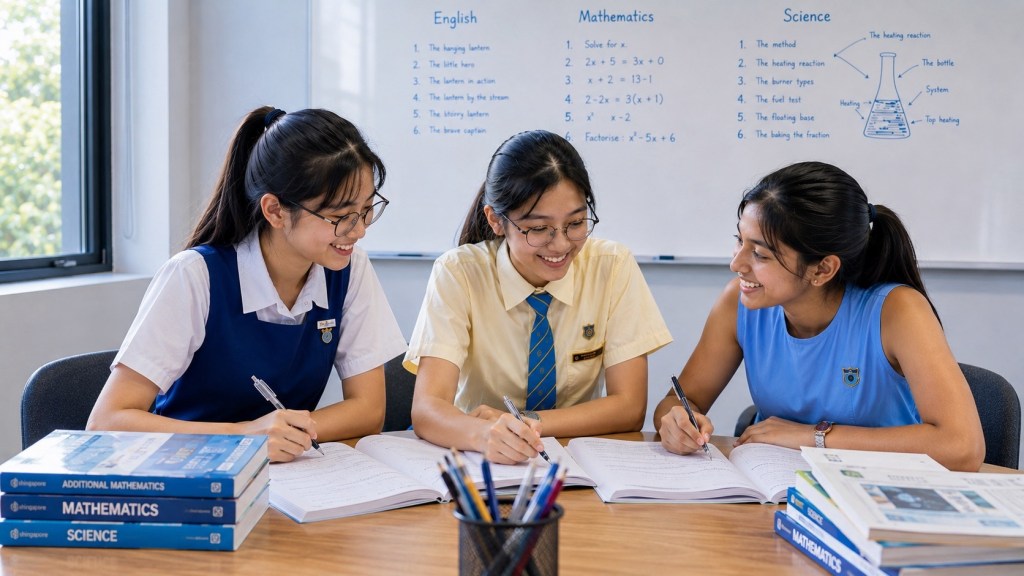
How a three-student Science tutorial can use everyday life
Give three students the same everyday phenomenon and different jobs. One observes, one builds a mechanism, one proposes a safe way to test the explanation. Then rotate. The tutor can see whether each learner can move among evidence, model and experiment.
For Sengkang and Punggol families, local contexts also make questions more immediate. The lesson can start from a train ride, HDB lift, tropical rain or household appliance and then connect back to syllabus language.
Useful eduKate Sengkang routes
- Master Science Tutorials Quickly | Primary Science Process Skills
- Master Science Tutorials Quickly | 100 Science Questions for Kids
- Primary Science Tuition Sengkang
- PSLE Science Learning Guide
- Complete Science Index
Frequently asked questions
Does everyday Science replace school revision?
No. It provides concrete contexts for retrieval and transfer. Students still need the official curriculum, school materials and appropriate assessment practice.
What is the best everyday Science example?
The best example is one that connects clearly to the child’s current concept and can be observed safely. Familiarity matters less than the quality of the scientific question.
Should parents explain the Science immediately?
Usually ask for the child’s observation and reasoning first. The first attempt reveals the weak link. Then add only the support needed.
Can everyday contexts help Secondary Science?
Yes. Secondary learners can use ordinary systems to practise modelling, quantitative relationships, practical reasoning and explanation. Keep the technical depth aligned to the student’s actual syllabus.
The everyday Science receipt
Everyday Science works when the learner can move from a familiar event to a scientific model and back again. The student should be able to observe what happens, identify relevant evidence, explain the mechanism, predict what changes under a new condition and recognise the same idea somewhere else.
That is the educational value of home, HDB, MRT, weather, food and machines. They are not substitutes for the syllabus. They are places where the syllabus becomes visible.
Twenty more everyday Science prompts for Singapore families
- Why does a shaded floor feel different from a sunlit floor?
- Why can a metal railing feel hotter than nearby wood under the same Sun?
- Why do wet footprints disappear faster in some places than others?
- Why can a cold bottle become wet on the outside?
- Why does a fan change how warm a person feels?
- Why are some cooking handles made from different materials than the pot?
- Why does a lift feel different when it starts or stops?
- Why does a trolley roll more easily on wheels than if it slid?
- Why do shoe soles have texture?
- Why is an MRT announcement still audible when the train is moving?
- Why can you see a reflection in a dark window at night?
- Why does an umbrella material need both strength and water resistance?
- Why does a puddle shrink after rain?
- Why do drains have slopes and openings in particular places?
- Why can leafy areas feel different from large paved areas during the day?
- Why does a battery-powered device eventually stop working?
- Why does a phone sometimes become warm during heavy use?
- Why can cooked food smell different from raw food?
- Why does breathing rate change during exercise?
- Why do some plants grow better in one location than another?
Each prompt can be adjusted to the child’s level. A Primary 2 learner may only observe and compare. A Primary 5 student can identify variables and mechanisms. A Secondary learner can model the system quantitatively or discuss limitations of the explanation.
Everyday Science and measurement
Real-life examples become stronger learning tasks when students measure something. Record drying time, shadow length, temperature, pulse rate, distance, mass or rainfall data where safe and appropriate. Measurement turns “I think” into evidence that can be compared.
Ask which instrument is suitable, which unit belongs to the quantity and what procedure should remain consistent. Even simple measurements build habits that matter later in experiments and graphs.
Everyday Science and data
Use public weather data, transport timings or household measurements to practise tables and graphs. The content can be familiar while the representation skill becomes more formal. Students should identify headings, units, trends and unusual values before explaining causes.
This is especially useful for PSLE and Secondary learners because data skills transfer across topics. A student who learns to compare change accurately in a weather graph can use the same process in a plant-growth or cooling graph.
Everyday Science and modelling
Ask students to simplify a complex real system. An air-conditioner becomes an input-transfer-output model. A lift becomes forces and motion. A refrigerator becomes energy transfer. A plant becomes linked structures and functions. A phone becomes several subsystems.
Then ask what the model leaves out. This prevents students from confusing the school model with the complete real-world system.
Everyday Science and experimental design
When a child proposes testing an everyday idea, make safety the first filter. Then ask whether the question can be tested fairly with available school-style materials. What condition will change? What will be measured? What should remain similar? What result would support the prediction?
If the proposed activity requires mains electricity, open flames, chemicals, roads, machinery or unsafe heights, replace it with discussion, a simulation or a teacher-approved investigation. Good scientific reasoning does not require unnecessary risk.
A one-week everyday Science challenge
- Monday: observe one heat or temperature phenomenon.
- Tuesday: find one force or motion example.
- Wednesday: identify one material chosen for a useful property.
- Thursday: notice one water-cycle process.
- Friday: identify one electrical or energy-transfer system.
- Weekend: choose one example and explain it using evidence, mechanism and a changed-context prediction.
The challenge should remain brief. The purpose is to train the learner to see Science outside worksheets and then return to school learning with better transfer.
