
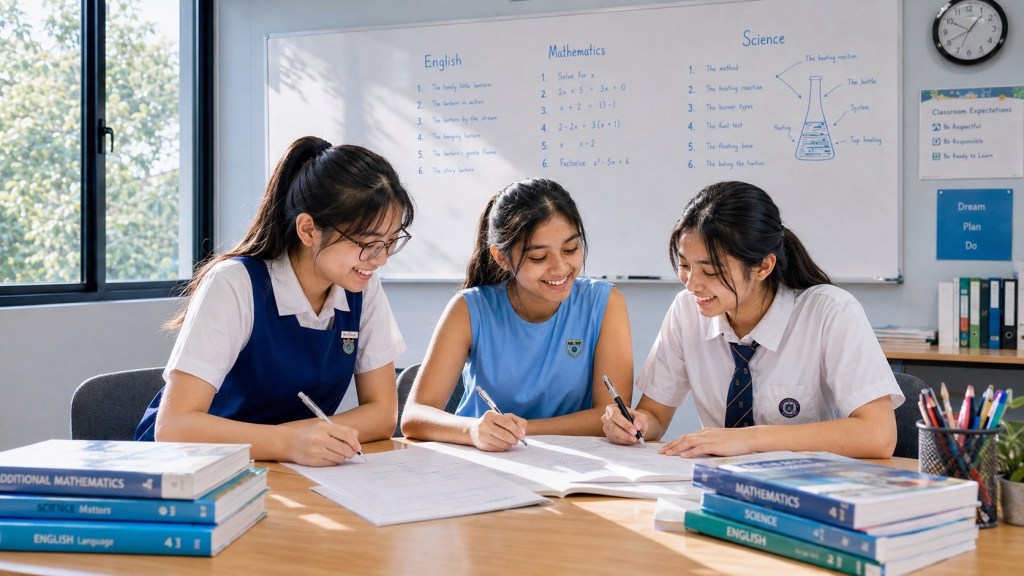
Should a child attend Science tuition during the school holidays? Parents searching for school holiday Science tuition, PSLE Science intensive, Science holiday programme, P5 Science masterclass, catch-up Science lessons or revision classes are usually deciding how to use a short block of time when the normal school timetable loosens. The danger is treating every holiday as a chance to add more hours. The opportunity is using the break for a job that is difficult to do during a busy term: repair, consolidate, retrieve, transfer or prepare calmly for the next phase.
Current Singapore Science tuition providers commonly advertise holiday masterclasses, short intensive courses, open-ended workshops, concept clinics and PSLE preparation blocks. Those formats can be useful because a holiday offers longer uninterrupted windows and fewer competing school deadlines. They can also create fatigue if the family fills every free day with tuition. A good holiday programme should have a narrow objective and a clear end point.
At eduKate Sengkang, formal Science tuition covers Primary 3 to Primary 6, including PSLE Science, in focused groups of up to three students for 1.5-hour lessons. Primary 1–2 Science content is educational discovery material rather than a formal lower-primary tuition offer, while Secondary G1/G2/G3 Science is used for transition guidance. This article owns the parent decision about school holidays: when Science tuition should be used for catch-up, consolidation, enrichment or exam preparation—and when rest is the better investment.
A holiday is not automatically a revision emergency
Families often feel pressure because the holiday looks like unused academic capacity. But rest is part of learning. A child who finishes a demanding term tired may gain more from several days of sleep, play and normal family life before structured revision begins.
The better first question is: What job needs the holiday? If the answer is unclear, more tuition may simply fill time. If the answer is specific—repair experiment variables, recover forgotten Primary 4 topics, prepare P5 open-ended work or stabilise PSLE timing—the holiday can be used strategically.
Four useful holiday jobs
- Catch-up: repair missing prerequisites after absence, disruption or a difficult term.
- Consolidation: strengthen material already taught so it survives into the next term.
- Transfer: practise using concepts in unfamiliar questions without school deadlines pressing.
- Preparation: build a controlled runway into P5, P6, prelims or PSLE.
These jobs should not be mixed indiscriminately. A child who needs catch-up should not spend the holiday racing ahead. A child who is already secure may not need a remedial programme at all.
Catch-up: use the holiday to repair the first missing dependency
Catch-up is not the same as redoing the entire term. The tutor should identify which earlier idea is blocking current work. A learner struggling with plant systems may need one prerequisite concept, not every Primary Science chapter since Primary 3.
A short diagnostic at the beginning of the holiday can prevent over-teaching. Once the dependency is repaired, the learner should return to current-level questions and confirm that the repair actually reconnects the learning route.
Consolidation: make the term survive the break
A holiday can expose a common weakness: knowledge that was available during continuous school teaching begins to fade after several days without cues. This is useful information. The learner can retrieve older topics, identify fragile areas and strengthen them before the next term starts.
Consolidation should involve closed-book recall, changed examples and correction return. Simply rereading term notes during the holiday can create familiarity without durable access.
Transfer: use the holiday for the questions school weeks often rush
During term, students are often focused on finishing current homework. Holidays create space for unfamiliar application, open-ended comparison and experiment questions that require slower thinking. A tutor can deliberately vary contexts and ask the child to explain why the same scientific relationship still applies.
This kind of transfer work is valuable because it tests whether concepts are flexible rather than memorised.
Preparation: get ready without pre-teaching everything
Parents sometimes want tuition to teach the entire next term in advance. Pre-teaching can reduce anxiety, but too much can make school passive. The child recognises everything without having to think deeply and may become dependent on always seeing content first in tuition.
A stronger preparation programme targets the skills that will make the next term easier: retrieval routines, diagram reading, open-ended explanation, experiment logic and the most important prerequisite concepts.
Primary 3 holidays: discovery before acceleration
Primary 3 students do not need every holiday converted into formal revision. If the learner is secure, the break can include everyday Science: observe plants, compare materials, visit a museum, notice weather or run simple safe investigations.
Formal holiday tuition is more useful when the child has a specific gap in classification, vocabulary, observation or explanation that is likely to make the next term harder.
Primary 4 holidays: repair before the upper-primary load rises
Primary 4 holidays can be strategically useful because the learner is approaching Primary 5. If relationships, experiment reasoning or open-ended explanations are unstable, a short repair block can prevent those weaknesses from compounding.
The Primary 4 Science | Building the P5 and PSLE Science Corridor Early route explains why this transition deserves attention.
Primary 5 holidays: build the PSLE runway
Primary 5 holidays are a natural time for cumulative retrieval. Students can revisit older Primary 3–4 concepts, strengthen P5 systems and identify which open-ended patterns are still unstable before Primary 6.
A useful programme should not simply throw Primary 6 papers at the learner. The goal is to reduce inherited weaknesses so the PSLE year begins with a cleaner foundation.
Primary 6 holidays: distinguish catch-up from final-stretch preparation
Primary 6 holiday decisions depend heavily on timing. Early-year breaks can support foundation repair and cumulative retrieval. Later breaks closer to prelims or PSLE may justify timed-paper work, open-ended review and targeted intensive sessions.
The canonical PSLE Science Tuition Sengkang | Use the Paper to Find the Failure route should guide paper-based decisions. More papers are useful only when the errors they reveal change what is taught next.
What a good holiday intensive should look like
- A specific objective stated before the programme begins.
- A short baseline task or recent school evidence.
- Daily or session-to-session retrieval from previous work.
- Independent attempts rather than continuous explanation.
- Changed-context transfer questions.
- Enough spacing and rest between intensive sessions.
- A final check that resembles ordinary school work.
- A plan for what continues once school restarts.
What a poor holiday intensive looks like
- Every day is filled because the family fears “wasting the holiday.”
- The tutor races through future chapters without checking understanding.
- The student completes many papers but repeated errors are not classified.
- There is no delayed retrieval because every lesson introduces new material.
- The child returns to school tired and dependent on tuition prompts.
- Parents cannot explain what capability the programme was meant to build.
How many holiday sessions are enough?
The right number depends on the job. A narrow catch-up problem may need two or three focused sessions. A broader PSLE intensive may need a short series spread across one or two weeks. The number should follow the amount of repair and the child’s capacity, not a generic package size.
The companion How Often Should My Child Have Science Tuition? guide explains frequency and spacing in more depth.
Why consecutive-day intensives can be misleading
When lessons happen on consecutive days, the previous teaching is still fresh. Students can appear to improve quickly because memory has not been tested after meaningful delay. A good intensive therefore includes cumulative retrieval and a later follow-up check.
If the child succeeds only while the programme is running, the holiday created short-term performance rather than durable learning.
Use the final holiday week differently from the first
The start of a long holiday can hold more intensive repair because the learner has recovery time afterward. The final days before school restarts should increasingly resemble the school rhythm: earlier sleep, shorter study blocks, organised materials and retrieval rather than marathon tuition.
This helps the child re-enter term without feeling that the holiday programme and normal school life are two disconnected systems.
Holiday homework should remain learner-owned
A holiday class may assign revision work, but the volume should preserve independence and family time. A small number of retrieval and transfer tasks can be enough to keep the learning alive.
Parents should avoid becoming the home tutor during the holiday. If a task exposes a gap, mark it and bring it back. The purpose is to create evidence for the next lesson, not to produce a perfect worksheet.
Should high-scoring students attend holiday Science tuition?
Only if there is a clear marginal goal. A strong student may benefit from enrichment, deeper transfer or a short PSLE refinement block. But a student who is already independent should not be enrolled simply because a holiday programme exists.
Enrichment should extend thinking rather than create pressure to race further ahead in the school syllabus.
Should weak students attend intensive holiday tuition?
Potentially, but the programme should begin with diagnosis. A struggling learner may need slower reconstruction, not an accelerated masterclass. Intensives can be effective when they reduce distractions and focus on one dependency at a time.
The companion My Child Is Weak in Science guide helps parents identify which kind of weakness is actually present.
Holiday Science versus more rest
A child who is sleeping poorly, emotionally exhausted or overloaded may not be ready to benefit from an intensive. Rest can be the correct educational decision. The learner returns with better attention and memory, making later tuition more effective.
The family should not interpret rest as lack of ambition. Learning capacity is finite.
Holiday Science versus another subject
If several subjects are weak, the holiday can become a competition for hours. Prioritise the subject with the highest-dependency problem or the most urgent upcoming demand. Spreading the child across four intensives may create shallow improvement everywhere.
The site’s Which Subject Should Get Tuition First? guide can help families make this allocation decision.
How to evaluate a holiday programme afterward
- Can the child retrieve the repaired concept a week later?
- Can the learner use it in a changed context?
- Has school homework become easier after the break?
- Are repeated error categories smaller?
- Does the child need fewer prompts?
- Did the programme leave the learner rested enough to use the gains?
- Is there a clear next-step routine once school resumes?
Current holiday programme language parents will see
Singapore providers currently advertise terms such as holiday masterclass, critical concepts, open-ended questions, PSLE intensive, school-holiday workshop, recorded replay and targeted revision. Parents should ask what the active ingredient is. Is the programme repairing a specific gap, giving structured transfer practice or simply compressing more teaching into the break?
The label “intensive” should describe a deliberate concentration of learning, not uncontrolled volume.
After PSLE: the post-exam holiday should change purpose
Once PSLE is over, the learner does not need to continue Primary Science examination drilling. The long holiday is a transition period. Curiosity, reading, practical observation and gentle exposure to more formal Secondary Science thinking can be useful, but pre-teaching the entire G1/G2/G3 curriculum is not necessary.
The PSLE to Secondary Science G1, G2 and G3 Parent Guide explains the transition. Formal Secondary Science tuition is routed through eduKate Singapore, not the stated eduKate Sengkang Science programme.
Frequently asked questions
Is holiday Science tuition necessary?
No. It is useful when the holiday has a clear learning job such as catch-up, consolidation, transfer or targeted exam preparation.
Should my child attend a PSLE Science intensive during the holidays?
It can help when recent papers show repeated gaps that need concentrated repair. The programme should still include retrieval, transfer and rest.
How many holiday Science lessons should we book?
Enough to complete the defined job and test the repair. A narrow gap may need only a few sessions; a broader exam block may require more. Avoid choosing frequency only from package size.
Does eduKate Sengkang offer holiday programmes?
This article explains how parents should evaluate holiday Science support. Current holiday classes, timing, fees and availability should be confirmed directly through the enquiry route.
Final idea: a holiday should create a cleaner next term
The best holiday Science tuition does not win by occupying the most hours. It leaves the learner with fewer unresolved dependencies, stronger retrieval, clearer explanations and a better routine for the next term.
For Sengkang and Punggol families, decide the job before choosing the programme. If the child needs catch-up, repair. If the child needs consolidation, retrieve. If the child is secure, protect rest and curiosity. The holiday is valuable because it creates space; use that space deliberately.
Use the first holiday day to diagnose, not to accelerate
A holiday programme often begins with enthusiasm and a full stack of material. A stronger first day samples recent school evidence and checks which parts of the previous term are actually fragile. This prevents the programme from spending hours on chapters the child already owns.
The tutor can then build the remaining holiday around the few weaknesses that matter most. Diagnostic restraint makes an intensive more efficient.
Design holiday learning around morning-after retrieval
Consecutive sessions become more useful when each new day begins with a short recall of the previous day. Ask the learner to reconstruct the concept, explain one mechanism or solve one changed question before any new teaching begins.
This morning-after check shows whether the intensive is creating memory or only fresh familiarity. If yesterday’s learning is already inaccessible, the pace may be too fast.
Use one theme per holiday block
A two- or three-day block should have a coherent theme: experiments, open-ended explanations, cumulative retrieval, Primary 5 systems or PSLE paper control. Jumping between unrelated goals makes it difficult to know what improved.
A clear theme also helps the child understand the purpose of the programme and makes the final transfer check more meaningful.
Catch-up should end by rejoining current-level work
A catch-up programme can fail if the child spends the entire holiday on old worksheets. The purpose of prerequisite repair is to re-enter the current curriculum. After the missing foundation is rebuilt, the learner should immediately use it in present-level questions.
This confirms that the earlier weakness was genuinely causal and prevents the student from feeling permanently behind.
Consolidation should include old topics, not just the most recent term
Upper-primary Science is cumulative. A holiday review that focuses only on the final two chapters can leave earlier knowledge fragile. Select a small sample from older topics and test whether the learner can still retrieve the relationships without notes.
This is especially important in Primary 5 and Primary 6 because PSLE does not respect term boundaries.
Enrichment should deepen structure, not merely move ahead
For a strong learner, enrichment can involve designing investigations, evaluating evidence, reading more advanced diagrams or connecting Science to everyday systems. Racing into future syllabus content is only one form of extension and often not the most valuable.
Deepening the same concept can build transfer and scientific curiosity without creating a dependency on constant pre-teaching.
Holiday PSLE preparation should protect paper quality
Students can complete more papers during a holiday because the timetable is open. The danger is paper fatigue. Once concentration drops, the child begins practising rushed reading and weak checking.
Use fewer full papers and more targeted review when the error pattern is clear. A paper is most valuable when it changes the next teaching decision.
Build rest days into the programme intentionally
Rest days should not be treated as accidental gaps caused by scheduling. They are part of the design. Spacing gives the learner a chance to retrieve after delay and prevents every answer from being supported by very recent teaching.
A child who performs well only when lessons occur every day may not yet have durable learning.
Use the holiday to repair study routines
One high-value holiday job is rebuilding how the learner studies. The tutor can help the child organise notes, create an error return routine, plan short retrieval blocks and learn how to prepare for a school test without last-minute rereading.
These routines continue producing value after the holiday programme ends, which makes the intensive more than a temporary score intervention.
A sample three-session holiday structure
- Session 1: diagnostic sampling, concept repair and one transfer question.
- Between sessions: short independent retrieval, not a large worksheet.
- Session 2: delayed return, targeted application and open-ended feedback.
- Between sessions: one changed-context task and correction return.
- Session 3: mixed transfer, timed sample if relevant and a plan for school re-entry.
This structure is only an example. The important feature is that every session tests what survived from the previous one.
A sample Primary 5 December holiday goal
A Primary 5 student preparing for Primary 6 might use the holiday to identify three cross-topic weaknesses: retrieval of older concepts, experiment variables and incomplete open-ended mechanisms. The programme can repair those without attempting to pre-teach the whole Primary 6 syllabus.
The child enters January with a cleaner learning system and enough untouched new content for school to remain meaningful.
A sample Primary 6 mid-year holiday goal
A Primary 6 student may use the mid-year break to review recent school papers, classify lost marks, rebuild one or two repeated weaknesses and practise timed transfer. The goal is not maximum paper volume. It is to convert the first half of the year into a sharper second-half plan.
If the student is already stable, the holiday may need only light maintenance and more rest.
Holiday tuition should not become punishment for a bad report card
A low result can make families want to fill the entire break with remediation. The child may interpret this as losing the holiday because of failure, which can damage engagement. A better approach is bounded and explanatory: identify the specific problem, schedule the repair and preserve meaningful free time.
The learner should understand that the holiday programme is a tool, not a penalty.
Use the final session to test independence
The last lesson should not end with the tutor giving a summary while the student listens. Ask the learner to solve a mixed task, explain what was repaired and state how the new routine will continue when school restarts.
The programme has succeeded when the child can carry the next step without needing the intensive to continue indefinitely.
Do not confuse holiday availability with educational capacity
A child may have more hours free during the holidays but not more mental capacity for formal lessons. Travel, camps, family events and accumulated term fatigue still matter. The programme should fit the whole holiday, not just the empty boxes in a calendar.
This is why two well-spaced sessions can sometimes be more useful than five consecutive mornings.
How parents can compare holiday programmes
- What exact capability is the programme designed to build?
- Does it begin with diagnosis or assume every student has the same gap?
- How much independent work happens between sessions?
- Are sessions spaced enough to test retrieval?
- How large is the class and how is individual feedback delivered?
- Does the programme use current school evidence?
- What happens after the programme ends?
- Is there enough rest left in the holiday?
Holiday tuition should create a measurable before-and-after question
Before the programme begins, choose one question the family wants answered: Can the child now explain experiment conclusions accurately? Can old Primary 4 concepts be retrieved? Can the student complete a PSLE timed section without the old pacing collapse?
At the end, test that same capability under changed conditions. This makes the value of the holiday visible without relying on vague impressions.
Use school marking days and short breaks differently from long holidays
Not every school break creates the same opportunity. A one- or two-day marking break is best suited to a narrow workshop or targeted paper review. A longer June or year-end holiday can support deeper catch-up, cumulative retrieval and study-system repair.
The programme should fit the length of the break. Trying to rebuild a large foundation in one marking day creates false urgency; spreading a tiny issue across a month wastes the holiday.
The December holiday should include forgetting on purpose
Long holidays create a valuable test: what survives when school cues disappear? Instead of preventing all forgetting through constant tuition, allow some time away and then retrieve. The difficulty of that return provides information about which knowledge is durable.
A learner who can reconstruct old concepts after several weeks is building a stronger foundation than one who remains continuously supported.
Use holiday workshops for one high-value process skill
Workshops are particularly suited to cross-topic skills such as experiment design, graph interpretation, open-ended causal explanation or scientific vocabulary in context. Because the same skill can be practised across multiple topics, the child sees the common structure.
This is often more valuable than a workshop that tries to cover an entire syllabus superficially.
Holiday tuition can repair school absence without creating panic
Students who missed school through illness, travel or family circumstances may enter the holiday with real content gaps. A focused catch-up plan can reconstruct the missing dependencies and reconnect the child to current-level work.
The tutor should obtain the school topic sequence if possible and avoid unnecessary reteaching of material the student already understands.
Holiday revision should preserve handwriting and paper skills
Online holiday courses can be convenient, but Primary and PSLE students still need to write, annotate and manage paper-based Science. Include handwritten open-ended answers and timed paper sections even when teaching happens digitally.
The objective is transfer back to the assessment environment, not fluency only inside the online platform.
Holiday enrichment can connect Science to real life
A break creates room for Science beyond worksheets: museums, parks, weather observations, simple home investigations, machines, cooking, materials and environmental systems. These experiences can deepen concepts when the tutor helps the learner connect observation to scientific explanation.
Enrichment does not have to become another formal class. The family can preserve curiosity while still strengthening the language of evidence.
Do not use holiday tuition to erase every future difficulty
Parents sometimes want the child to return to school having already learned everything. This can make the learner less tolerant of normal classroom difficulty. Encountering new content, struggling productively and asking the school teacher questions are healthy parts of learning.
Holiday preparation should create readiness, not immunity from challenge.
A holiday programme should include an exit task
The final task should resemble what the child will face after the holiday: a school-style mixed set, a timed PSLE section or an independent explanation. If the learner succeeds only on the programme’s own rehearsed worksheets, transfer is unproven.
Use the exit task to decide what, if anything, needs to continue once term begins.
Families should budget holiday tuition as time, not only money
A holiday intensive can be financially affordable and still consume too much family capacity. Consider travel, meals, sleep, camps and time with relatives. The best programme fits around the whole holiday rather than turning the break into another term.
This is especially important for younger Primary students whose recovery needs are easy to underestimate.
A strong holiday programme should make normal weekly tuition easier
If the child returns to term with clearer prerequisites, better retrieval and a more organised correction routine, ordinary weekly lessons can become more efficient. The holiday programme has reduced future teaching load.
If the child returns exhausted and immediately forgets the intensive, the programme may have created activity without durable value.
Parents should ask what will not be taught
A well-designed holiday programme has boundaries. The tutor should be able to say which topics or skills are outside the current objective. This restraint is a sign that the programme is prioritised rather than simply packed.
Knowing what will not be covered protects the learner from overload and makes the final outcome easier to evaluate.
The best holiday plan includes a ‘nothing academic’ block
Families can protect several days where the child does no formal tuition, no papers and no correction work. This is not lost time. It creates recovery and gives the later retrieval check more meaning because the learner has experienced a real gap.
For a heavily scheduled student, deliberate empty space may be one of the most educationally useful parts of the holiday.
Do not start the new term with the holiday programme still running at full intensity
A dense intensive that continues into the first school week can create immediate overload. Taper the schedule before term begins. Let the learner re-establish school bedtime, pack materials, review the next week’s commitments and use a lighter retrieval routine.
The goal is a smooth transition, not squeezing one final lesson into every available slot.
Holiday tuition can be a good time to test a new tutor or format
Because school deadlines are reduced, families can trial a new Science tutor, small-group format or online arrangement with less pressure. The trial should still use real school evidence and a clear diagnostic goal.
If the fit is poor, the family has time to adjust before the new term. If the fit is strong, the learner can enter school with an established routine.
Short holiday programmes should not promise permanent mastery
A three-session workshop can teach a useful method and reveal a weakness, but durable mastery still requires later retrieval and school transfer. Parents should be cautious about language that implies a complex Science capability is permanently solved after one short course.
The correct question is what the programme starts, what it proves by the final session and what must continue afterward.
Use the first school week as the final transfer test
The strongest evidence of holiday value arrives after school restarts. Does the child recognise the repaired concept in normal classwork? Are open-ended answers more precise? Is homework easier to start?
If the gains appear only on holiday materials, the transfer is incomplete. The tutor can use the first school evidence to decide whether any follow-up is necessary.
A parent checklist before booking a holiday Science programme
- What exact problem are we trying to solve?
- Why is the holiday a better time to solve it than the normal term?
- How many sessions are necessary for that problem?
- Where are the rest days?
- How will learning be retrieved after a delay?
- What transfer task will be used at the end?
- What should the child do once school restarts?
- Would the child benefit more from recovery than additional instruction?
Holiday programmes should respect the difference between practice and performance
A child can perform well in a holiday class because the tutor has just explained the exact method. The final test should happen after a gap, preferably on a task the learner has not seen before. This tells the family whether the programme built independent capability rather than temporary supported performance.
That delayed check can be small. One open-ended question, one experiment item or one mixed retrieval set may be enough to show whether the core repair survived.
The holiday should end with a lighter week
If possible, avoid scheduling the most intense Science work in the final days before school resumes. Taper the programme. Use shorter retrieval, organise materials and return sleep to the school schedule. The child should enter the new term ready to learn, not recovering from the intensive.
A good holiday programme creates less urgency afterward
Catch-up should leave the learner closer to current work. Consolidation should reduce forgotten topics. PSLE preparation should make the next revision block clearer. If the family finishes the holiday feeling that even more emergency tuition is immediately required, the programme may have uncovered a genuine large gap—or it may have been poorly bounded.
Parents should ask which is true before booking the next intensive.
The final holiday question is what the child can carry back into term
A good break leaves something portable: a retrieval routine, a cleaner error log, a repaired prerequisite, a better open-ended structure or a more stable timed-paper plan. These are capabilities the learner can use when the holiday timetable disappears.
If the benefit depends on the intensive continuing indefinitely, the programme has not yet completed its job. The holiday should create a stronger ordinary week, not a need for permanent holiday-level support.
Parents can preserve a short note at the end of the holiday: what was repaired, what still needs monitoring and what the learner will do independently once school resumes. This one-page handover prevents the programme from disappearing into memory and gives the next school week a practical starting point. It also helps families resist booking another intensive automatically, because the next decision can be based on whether the planned transfer actually occurs.
A final holiday principle is to leave something unfinished on purpose. The learner does not need to complete every chapter, worksheet or paper before school begins. Finishing the highest-value repair well and carrying a clear next-step routine into term is usually more useful than touching everything superficially. A bounded programme protects both learning quality and the sense that holidays still belong partly to the child.
Parents can make the same decision after the holiday by asking one final question: did the programme reduce the amount of urgent support the child now needs? If the answer is yes, the intensive has created leverage. If the answer is no, inspect whether the target was too broad, the pace was too fast or the diagnosis was wrong before adding another block.
A holiday programme is therefore successful when the new term needs less emergency repair, not when the break contains the largest number of lessons. The child should return with clearer knowledge, better routines and enough energy to use them.
The same principle protects family resources. Book the smallest holiday block that can answer the current learning question, evaluate transfer after school resumes, and only then decide whether more support is needed. This keeps holiday tuition targeted, proportionate and connected to real school performance rather than to the simple availability of free days.
Use the break to create a stronger learner, not simply a busier calendar.
Then let it breathe.
Science and Sengkang routes: return to the Science Hub or Complete Science Index for the wider Science estate; use What about Sengkang? for the town-wide route.
Return to Science Tutor Sengkang for the complete small-group Primary Science tutoring route: diagnose the first weak link in observation, concepts, relationships, evidence, explanation and examination execution.
