
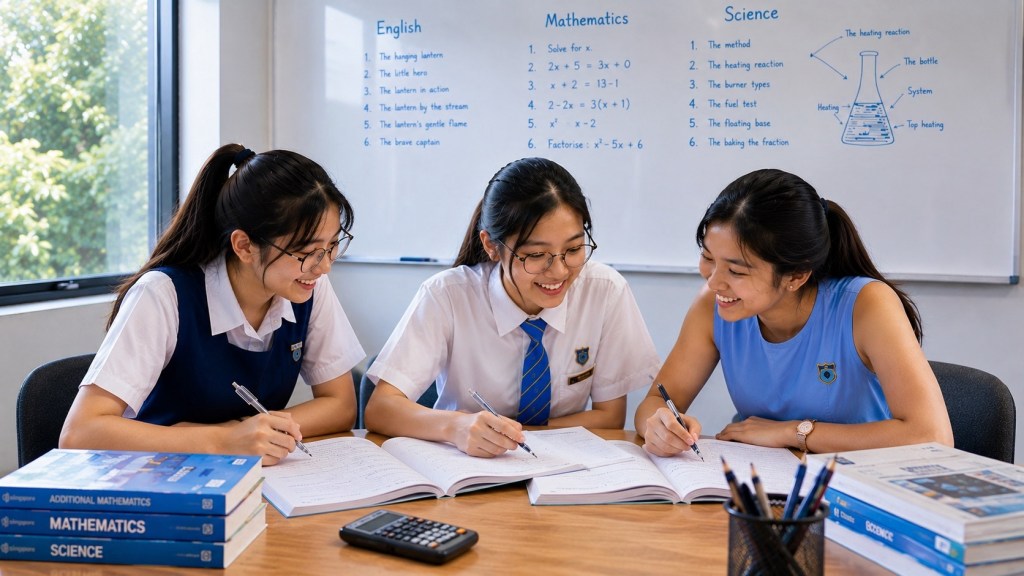
Master English Tutorials Quickly by building background knowledge before asking a child to use more reading comprehension strategies. Search language such as reading comprehension, improve comprehension, vocabulary, prior knowledge, background knowledge and reading strategies often focuses on technique. Technique matters, but readers also need enough knowledge about the topic to understand what words and sentences refer to, connect ideas, make inferences and decide what information is important.
For Primary, PSLE and SEC students in Sengkang and Punggol, this explains a common puzzle: a child can read every word aloud correctly and still understand very little. The difficulty may not be decoding. The passage may contain unfamiliar concepts, weakly known vocabulary, references to events the student has never encountered, or relationships that make sense only if the reader already knows something about the topic. More generic “find the main idea” practice may therefore produce limited gains until the knowledge gap is addressed.
This tutorial gives parents a practical system for building the kind of knowledge that supports English reading, vocabulary, comprehension, oral discussion and writing. The method is simple: choose a topic, read several connected texts, learn the key vocabulary, discuss relationships, retrieve the knowledge later and then read a harder text on the same topic. The aim is not trivia accumulation. It is to make future texts easier to understand because the learner brings a richer mental model to the page.
The fast answer: why background knowledge changes reading
- Known concepts reduce the amount of new information the reader must process at once.
- Topic knowledge helps readers infer unstated relationships.
- Vocabulary is easier to understand when words connect to an existing knowledge network.
- Readers can identify what is important when they understand the subject being discussed.
- Writing improves because the student has more accurate ideas, examples and language to draw on.
- Oral responses improve because the learner has something substantive to say.
Research reviews and literacy guidance consistently treat background knowledge as an important part of comprehension. Reading Rockets summarises a research review on the role of background knowledge in reading comprehension, while the Education Endowment Foundation notes that prior knowledge is a key consideration when planning reading comprehension instruction. See the EEF reading comprehension strategies guidance.
A reading strategy cannot supply missing world knowledge
Imagine two students reading a passage about coral bleaching. Both can decode the words. One already knows that corals are living organisms in marine ecosystems, that algae live in coral tissue, that water temperature matters and that reefs support many species. The other knows almost nothing about coral. The first reader can connect new sentences to an existing model. The second must build the model while simultaneously interpreting every new term.
The second student may appear to have a “comprehension problem” even if general reading skills are adequate. A useful intervention might begin with short accessible texts, diagrams, key vocabulary and discussion before returning to the harder passage.
Background knowledge is not the same as vocabulary—but they reinforce each other
Vocabulary is knowledge about words; background knowledge is knowledge about the world, ideas, systems, people, events and relationships those words describe. The two are tightly connected. A learner who knows how volcanoes work is more likely to understand magma, eruption, crater and tectonic inside a passage. Learning those words in turn makes future explanations about volcanoes easier to process.
That is why topic clusters are powerful. Instead of reading five unrelated passages in one week, read several texts around one domain: migration, rainforests, transport systems, inventions, food security, space exploration, local history or animal adaptation. Repeated concepts and vocabulary create a growing network.
The Topic Cluster Method
Step 1: choose one fertile topic
A good topic has enough depth for several texts and connects to school learning or genuine curiosity. For Primary students, try weather, ecosystems, transport, inventions, health, space or Singapore places. For Secondary students, use technology, climate, economics, media, public health, energy, ethics or urban planning.
Step 2: start with an accessible overview
The first text should establish the map. What is the topic? What are the main parts? Which words are likely to recur? A short video transcript, infographic, children’s nonfiction book or introductory article can work.
Step 3: collect a small vocabulary set
Choose five to ten words that unlock the topic. Learn them in sentences, not as isolated definitions. Include common collocations and word families where appropriate.
Step 4: read a second text with a different purpose
If the first text explained a system, the second might present a case study. If the first described a problem, the second might compare solutions. Different text purposes force the learner to reorganise knowledge rather than memorise one article.
Step 5: retrieve the topic without looking
Ask the student to explain the topic in five sentences, draw a simple concept map, define key words or answer “how” and “why” questions. Retrieval reveals what is actually available in memory.
Step 6: read a harder text
Now return to a denser school-style passage. The text should feel more manageable because fewer concepts are completely new.
A worked example: build knowledge around urban heat
Start with a short explanation of why cities can be warmer than surrounding areas. Teach surface temperature, vegetation, shade, absorb, reflect and urban heat island. Read a second text comparing trees, reflective roofs and green roofs. Discuss why each solution might work and where limitations appear.
Then ask the student to read a new passage about heat mitigation in a tropical city. Comprehension questions that once felt like pure inference now have more anchors. The reader can connect statements about concrete, shade and evaporation to known mechanisms.
How background knowledge supports inference
Inference depends on combining textual evidence with knowledge. If a story says, “Amir placed the cake on the table, lit sixteen candles and waited for his sister,” the text does not need to state that a birthday celebration is likely. Cultural and world knowledge fill the gap.
School texts increasingly expect this kind of connection. The challenge is to distinguish legitimate knowledge-supported inference from unsupported imagination. The evidence must still constrain the answer.
How background knowledge supports main idea
Readers identify central ideas by distinguishing important information from detail. That is easier when the topic structure is familiar. In a passage about photosynthesis, a learner who knows the basic process can recognise that an example about leaves near a window illustrates a larger principle rather than becoming the main point.
How background knowledge supports vocabulary in context
Suppose a passage states that a species “declined rapidly after its habitat was fragmented by roads and development.” A reader who understands habitat and ecosystems can infer that fragmented means broken into disconnected parts, even if the word is unfamiliar. Knowledge narrows the possible meaning.
How background knowledge supports writing
Students often have a writing problem that is partly a knowledge problem. “I have no ideas” can mean “I do not know enough about this issue to make distinctions, explain mechanisms or give examples.” More sophisticated sentence starters cannot solve an empty knowledge base.
Before argumentative or expository writing, build topic knowledge through reading and discussion. Then teach students to separate what they know, what they think and what evidence would be needed to support a claim.
Primary 1–2: knowledge through talk, pictures and read-alouds
Young children can build knowledge before they can read complex texts independently. Use read-alouds, diagrams, conversations, museum visits, neighbourhood walks, documentaries and simple nonfiction. Ask the child to name, compare, classify and explain. Oral knowledge later supports reading.
Primary 3–4: move from learning to read toward reading to learn
Upper Primary introduces more informational reading across Science, Mathematics and other subjects. Students need to navigate headings, diagrams, cause-and-effect relationships, comparison and technical vocabulary. Reading Rockets describes practical ways to help students work with nonfiction text and its structures in this guide to nonfiction comprehension.
Primary 5–6 and PSLE: build knowledge without turning revision into trivia
For PSLE, the goal is not to predict passage topics. The goal is to create a broad enough knowledge base that unfamiliar topics are less cognitively expensive. Read across science, people, places, social issues, history, technology and nature. Keep the reading age-appropriate and discuss the ideas, not just vocabulary lists.
SEC G1, G2 and G3: knowledge becomes fuel for analysis
Secondary English asks students to handle denser texts, viewpoints and issues. A student who reads about climate policy, transport, technology, social behaviour and public health can bring richer conceptual resources to comprehension, oral discussion and argumentative writing. Knowledge does not replace close reading; it makes close reading more productive.
The weekly knowledge-building routine
- Day 1: accessible overview and five key words.
- Day 2: second text on the same topic; compare what is new.
- Day 3: oral explanation or concept map from memory.
- Day 4: third text with a different structure or viewpoint.
- Day 5: write one paragraph explaining the topic or answering a question.
- Weekend: read an unfamiliar passage and notice how much prior knowledge helps.
Do not pre-teach everything
Background knowledge should support reading, not remove all productive challenge. If parents explain every idea and word before the child reads, there is little left to infer. Preview only the concepts and vocabulary that would otherwise block comprehension. Let the learner discover manageable details from the text.
Beware of misconceptions
Prior knowledge can help, but incorrect prior knowledge can mislead. A child who believes all deserts are hot may misread a text about polar deserts. Teach students to update their mental model when the text provides better evidence. “I thought X, but this text shows Y” is a powerful comprehension sentence.
The parent diagnostic: knowledge gap or reading-skill gap?
- If comprehension improves dramatically after a short topic explanation, knowledge may be a major factor.
- If the child struggles equally on familiar and unfamiliar topics, inspect decoding, fluency, question interpretation and language structure.
- If the child understands orally but not in print, inspect reading processes.
- If the child reads accurately but cannot explain key concepts, inspect vocabulary and knowledge.
- If the child knows the topic but answers vaguely, inspect evidence selection and answer construction.
How to choose reading that compounds knowledge
Use sequences rather than randomness. Three short texts about one topic often build more transferable knowledge than three unrelated passages. Mix formats: article, diagram, biography, explanation, news feature or documentary transcript. Repeated vocabulary and concepts strengthen the network while the changing format prevents simple memorisation.
Connect knowledge building to eduKate Sengkang’s English skill owners
This article owns the knowledge-building route, not general comprehension technique. For close-reading strategies, use Reading Comprehension Strategies Parents Can Use at Home. For inference and answer precision, use How to Improve Inference, Evidence and Answer Precision. For vocabulary, use How to Build English Vocabulary for School and Exams.
Parents can route by year through the Primary English Tuition Sengkang capability map or the Secondary English Sengkang capability map.
When tuition can help
Tuition is useful when a student’s reading weakness is difficult to classify. A tutor can test the same comprehension process on familiar and unfamiliar topics, change the vocabulary load, ask the student to explain thinking aloud and see whether the breakdown comes from knowledge, language or question handling.
eduKate Sengkang uses small groups of up to three learners so the tutor can hear explanations, compare strategies and choose texts that expose the right weakness. The goal is not to pre-teach every possible topic. It is to build enough knowledge and reading control for the learner to handle unfamiliar material independently.
Frequently asked questions
What is background knowledge in reading comprehension?
It is what the reader already knows about the topic, concepts and relationships in a text. That knowledge helps interpret new information and make inferences.
Can background knowledge improve vocabulary?
Yes. Words are easier to learn when they attach to known concepts and recurring topic networks.
Should I teach the topic before my child reads?
Preview only what would otherwise block comprehension. Too much pre-teaching removes the need to infer and learn from the text itself.
Is wide reading better than comprehension worksheets?
They serve different purposes. Wide and topic-focused reading builds vocabulary and knowledge; targeted comprehension work teaches how to process questions and evidence. Strong programmes use both.
What topics should Primary students read?
Use a broad mix of nature, science, people, places, inventions, history, health and everyday systems. Interest matters because sustained reading is more likely when the child cares about the topic.
What topics should Secondary students read?
Add current affairs, technology, environment, public policy, economics, culture and social issues, while keeping sources age-appropriate and reliable.
A twelve-topic knowledge curriculum for one school year
Families do not need a complicated encyclopaedic programme. Choose one substantial topic each month and let reading compound. A possible sequence is: weather and climate; ecosystems; food and agriculture; health and the human body; transport; energy; inventions; cities; migration; oceans; space; and communication technology. The exact sequence matters less than sustained exposure to connected concepts and vocabulary.
Within each topic, mix one easy overview, one visual source, one narrative or biography connected to the topic, and one harder explanatory text. By the fourth source, the student should recognise recurring concepts and words. That familiarity frees attention for deeper comprehension.
Background knowledge also matters in fiction
Knowledge building is not only for textbooks. Stories rely on assumptions about relationships, places, traditions, occupations, historical settings and social situations. A child reading a story set on a farm may misunderstand why characters behave in certain ways if the learner has no idea how crops, seasons or farm work operate. A historical story may become confusing when the reader lacks the period context.
Before fiction, preview only the context that unlocks the story. A map, photograph, short explanation or key term may be enough. Then let the narrative do the rest of the teaching.
Knowledge building through conversation
Parents can build useful English knowledge without turning dinner into tuition. Ask children to explain why something happens, compare two things, predict consequences or connect a news item to school learning. “Why do you think some roads flood more easily?” “How is a train system different from a bus network?” “What might happen if a predator disappears from an ecosystem?” These questions build causal and comparative language alongside world knowledge.
The knowledge notebook: fewer notes, stronger connections
Use one page per topic with four boxes: key concepts, important vocabulary, relationships and unanswered questions. Avoid copying full paragraphs. The student should write compressed statements such as “evaporation increases when water gains heat” or “urban trees provide shade and cooling through transpiration.” Short relational notes are easier to retrieve than copied prose.
At the end of the week, cover the page and reconstruct it. Missing connections tell the learner what to revisit.
How to tell whether a comprehension problem is really a knowledge problem
Use matched texts. Give one passage on a familiar topic and another of similar reading difficulty on an unfamiliar topic. If the learner performs much better on the familiar topic, background knowledge may be contributing significantly. Then give a short primer on the unfamiliar topic and retest with a new passage. A large improvement is useful diagnostic evidence.
This is not a formal assessment, but it prevents a common mistake: treating every low comprehension score as proof that the child needs more generic reading strategies.
What not to do when building knowledge
- Do not turn every topic into a list of facts to memorise.
- Do not choose texts so difficult that every sentence needs adult translation.
- Do not stay with only one favourite topic for months; breadth also matters.
- Do not confuse watching passively with learning; ask for retrieval and explanation.
- Do not treat prior beliefs as automatically correct; compare them with new evidence.
An eight-week comprehension-and-knowledge cycle
- Weeks 1–2: one science or nature topic, with repeated vocabulary and causal explanation.
- Weeks 3–4: one people, history or place topic, with chronology and perspective.
- Weeks 5–6: one technology or social-system topic, with problem–solution and comparison.
- Weeks 7–8: mixed unfamiliar passages to test whether broader knowledge now supports inference and vocabulary in context.
Keep the final two weeks mixed so the student does not become dependent on knowing the topic in advance. Knowledge should support flexible reading, not replace it.
Build knowledge from the child’s real environment
Sengkang and Punggol provide many real-world starting points for knowledge building. A walk near waterways can lead to reading about drainage, biodiversity and urban planning. An MRT trip can lead to transport networks, signalling and city design. A hawker centre can lead to food supply chains, nutrition, migration and culture. HDB estates can lead to housing, population density, lifts, energy use and public space.
The point is not to turn every outing into homework. It is to attach language to experience. When a child has seen a canal after heavy rain, words such as runoff, drainage, overflow and retention have something concrete to connect to. Later informational texts become less abstract.
Use one topic across reading, speaking and writing
Knowledge becomes more durable when it moves across modes. After reading about mangroves, ask the student to explain how roots help the ecosystem, discuss why coastal habitats matter, and write a short paragraph comparing mangroves with another habitat. The same concepts and vocabulary are retrieved several times for different purposes.
This also prevents English from becoming detached from content. Students learn that vocabulary, grammar and paragraph structure are tools for representing knowledge accurately.
The concept-chain exercise
Write five important concepts from a topic on separate cards. Ask the student to connect them with arrows and relationship words such as causes, depends on, is part of, contrasts with or results in. A knowledge network built from relationships is more useful for comprehension than a list of disconnected definitions.
Teach students to notice when prior knowledge is being used
After reading, ask: “What did you already know that helped?” and “What new information changed your understanding?” These questions make the hidden process visible. Students begin to recognise that comprehension is an interaction between the text and what the reader brings to it.
Knowledge gaps in examination passages
Students cannot prepare for every possible PSLE or SEC passage topic, and they should not try. A broad knowledge base reduces the number of completely unfamiliar concepts, but close reading still has to work when the topic is new. Teach a fallback routine: identify known words, locate definitions and examples, map the paragraph structure, and build the topic model as the passage unfolds.
This combination—broad knowledge plus a reliable unfamiliar-text strategy—is more durable than trying to predict examination content.
Knowledge and curiosity reinforce each other
Students often enjoy reading more once a topic stops feeling opaque. Initial knowledge makes the next article easier; easier comprehension makes further reading more rewarding; further reading adds more knowledge. Parents can use this positive cycle by following genuine interests while gradually widening the range of topics.
Final principle: comprehension grows from skill plus knowledge
When a student reads every word but understands little, do not automatically prescribe more generic comprehension technique. Ask what the learner knows about the topic, which concepts are missing and which vocabulary carries the passage. Build enough knowledge to create a mental model, then return to close reading and evidence.
For Sengkang and Punggol families who want help identifying whether a child’s difficulty comes from knowledge, reading process or answer construction, review the eduKate Sengkang tuition enquiry process.
English route: return to the English Hub or Complete English Index for the wider English estate.
