
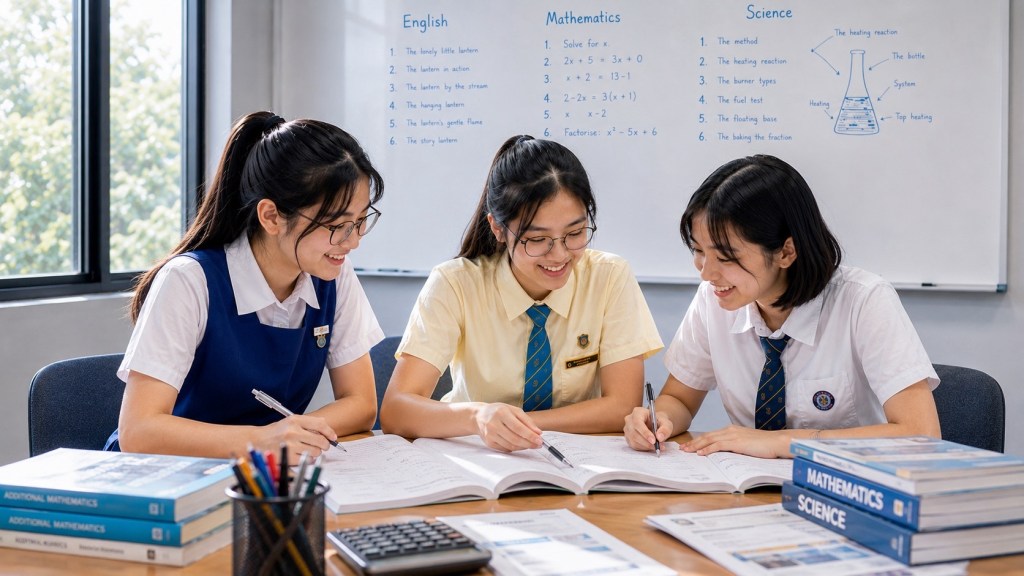
Primary 6 Mathematics is where six years of Primary Mathematics must become usable under examination conditions. Parents searching for Primary 6 maths tuition, PSLE Mathematics tuition, Primary 6 math tuition in Sengkang, help with ratio, percentage, speed, algebra, circles, volume, pie charts or difficult problem sums are usually facing two tasks at once: the child still has new and demanding content to master, while older knowledge must be retrieved quickly enough to survive mixed PSLE-style questions.
A strong Primary 6 Mathematics programme therefore cannot be only a revision factory. It has to identify missing dependencies, connect fractions, percentage and ratio, strengthen speed and algebra, repair geometry and measurement gaps, train non-routine problem solving, build checking routines and gradually improve performance under time pressure. The best preparation is a controlled progression from understanding to mixed transfer to examination execution, not immediate exposure to endless full papers.
At eduKate Sengkang, this Advanced Mathematics Tutorials article is the parent-facing gateway into that final Primary Mathematics year. The detailed Primary 6 Mathematics Learning Hub already contains the deeper teaching estate. This guide explains what a Primary 6 tutor should diagnose, how three-student tutorials can be used for repair and exam control, what a sensible PSLE Mathematics runway looks like and how parents can distinguish genuine readiness from temporary worksheet familiarity.
The current MOE Primary Mathematics syllabus includes Primary 6 work in fractions, percentage, ratio, speed, algebra, geometry, measurement and data, with problem solving at the centre. That architecture matters because PSLE Mathematics does not only ask whether a child remembers isolated procedures. It asks whether the learner can recognise relationships, select methods, execute accurately and keep control when several ideas appear together.
Quick answer: what should Primary 6 Mathematics tuition actually improve?
Primary 6 tuition should make the student more independent under uncertainty. The goal is not to make every question familiar. It is to build enough structure, fluency and checking control that unfamiliar questions can still be attacked sensibly.
- Repair high-leverage gaps from Primary 4 and Primary 5 before they damage new content.
- Connect fractions, decimals, percentages and ratios so proportional questions become easier to interpret.
- Build speed as a relationship among distance, time and rate rather than a formula to swap around blindly.
- Introduce algebra as a language for unknown quantities and simple equations.
- Strengthen geometry, circles, volume, nets and visualisation where diagrams carry information.
- Train non-routine problem solving through representation, decomposition, invariants and working backwards.
- Move from topic practice to mixed practice and then to timed paper control.
- Reduce repeated error categories through specific checking routines rather than vague advice to “be careful”.
Primary 6 is a synthesis year, not just an exam year
The temptation in Primary 6 is to start full-paper practice immediately because PSLE is approaching. Papers are useful, but a full paper is a measurement instrument before it is a teaching instrument. If the child has unstable ratio, percentage or fraction foundations, repeated papers may simply reproduce the same weakness in different forms.
A stronger sequence begins with diagnosis. Which concepts are genuinely weak? Which are understood but slow? Which fail only in mixed questions? Which errors appear mainly under time pressure? Which questions are left blank because the learner cannot choose a method?
Once these categories are visible, practice can be targeted. Full papers become more valuable after repair because they can then test integration and execution rather than merely reveal the same known gaps again.
Fractions remain central because many Primary 6 topics depend on them
Primary 6 fraction work includes more demanding operations and word problems. But the deeper reason fractions matter is that they underpin ratio, percentage, sharing, proportional reasoning and many model-based questions. Weak fraction structure can therefore surface across the paper even when the word “fraction” never appears in the topic label.
Students should retain magnitude sense. Before calculating, they should have an expectation about whether an answer should be larger or smaller than the starting quantity. They should recognise benchmark fractions and be able to convert between mixed and improper forms with meaning, not only procedure.
Fraction division is especially important because it can feel unintuitive. The learner should understand what is being asked: how many groups of a fractional size fit into a quantity, or how a quantity is shared according to a fractional divisor. Visual or measurement interpretations can make the algorithm less arbitrary.
Percentage: the reference whole is the centre of the problem
Primary 6 percentage questions often require students to find an original whole, calculate percentage increase or decrease, or track percentages through changing quantities. The arithmetic can be straightforward while the reference base creates the real difficulty.
A student should ask, “Percentage of what?” before touching the calculator. Ten percent of the original amount and ten percent of the remaining amount are different quantities. Percentage change also depends on the original value, not the new value.
Useful teaching keeps percentage connected to fraction and ratio. This gives the learner multiple routes into the problem and makes it easier to detect when a memorised formula has been applied to the wrong base.
Ratio: equivalent relationships, not fixed numbers
Ratio becomes more powerful in Primary 6 because students may need to connect ratios to fractions, find missing terms, divide quantities, compare three quantities or reason through before-and-after changes. The challenge is preserving the relationship while absolute quantities change.
Unit thinking can help. If the ratio of A to B is 3:5, then A can be represented as three equal units and B as five equal units. The actual value of one unit may be unknown initially. This unit model supports many complex Primary 6 problems because it turns relative information into a structure that can be manipulated.
Students should also understand when two ratios are equivalent and why. Multiplying both terms by the same factor preserves the relationship. That principle is more reliable than memorising a sequence of steps without meaning.
Changing-ratio problems require invariant thinking
Some of the most difficult Primary 6 questions change one or more quantities and ask for a new ratio. The key is often identifying what stays constant. Perhaps one quantity remains unchanged while another increases. Perhaps a total remains constant while amounts transfer between groups.
This is an example of invariant thinking: finding the quantity or relationship that does not change even when the surface story does. Once the invariant is identified, the before and after states can be linked.
Tutors should make this reasoning explicit. Instead of teaching a long catalogue of named problem types, ask the student what stays the same, what changes and which representation preserves that information most clearly.
Speed: distance, time and speed must stay connected
The MOE syllabus treats speed as a relationship among distance, time and speed, including average speed and multi-step applications. Students often memorise a triangle diagram or formula set, but the more durable understanding is dimensional: speed tells how much distance is covered per unit time.
A strong learner can rearrange the relationship because the quantities make sense. If distance and time are known, speed can be found. If speed and time are known, distance follows. If distance and speed are known, time can be recovered.
Diagrams are especially useful for journey questions. A timeline or motion diagram can show direction, meeting points, different starting times and distances. Representation reduces the amount the child has to hold mentally.
Average speed is not usually the average of two speeds
Average speed is based on total distance divided by total time. This is a classic place where a simple-looking shortcut can fail. If equal distances are travelled at different speeds, the time spent at each speed is not equal, so averaging the two speed values directly gives the wrong result.
Teaching should therefore return to meaning: total journey distance over total journey time. The formula becomes memorable because it represents a relationship rather than a rule to apply mechanically.
Estimation also helps. The average speed must normally lie between the slower and faster speeds, giving a quick reasonableness check.
Algebra: Primary 6 introduces a new mathematical language
Primary 6 algebra commonly uses letters to represent unknown numbers, simple expressions, substitution and simple linear equations. This is an important bridge to Secondary Mathematics because the student begins to operate on relationships without knowing every quantity in advance.
Students who have relied heavily on arithmetic tricks may initially resist letters. A strong transition shows that algebra is not replacing arithmetic; it is generalising it. The same balance and inverse relationships still apply.
Simple equations should be solved with meaning. Instead of only saying “move it to the other side”, the learner should understand that equal operations preserve equality. This prepares the student for the much more formal algebra of Secondary 1.
Circles: terminology and formula control
Circle work introduces or strengthens radius, diameter, circumference and area relationships. Students need to know which quantity a question is asking for and how the dimensions relate.
A common error is using diameter where radius is required or vice versa. Another is confusing circumference with area because both involve the same diagram. The first discipline is therefore semantic: identify the quantity before selecting the formula.
Diagram labelling helps. Mark the radius, write the diameter relationship and carry units correctly. Formula use is safer when the geometry has been interpreted first.
Solid figures and nets require visualisation, not only formula memory
Primary 6 students may need to reason about three-dimensional shapes, nets, volume and exposed surfaces. Some learners understand the arithmetic but struggle to mentally rotate or unfold shapes.
Physical models, drawings and deliberate visualisation practice can help. The learner should identify which faces meet, which dimensions correspond and what changes when a solid is cut or rearranged.
This is a reminder that Mathematics performance can depend on spatial representation as well as numerical skill. A good diagnostic should notice that distinction.
Pie charts and data interpretation
Pie charts connect fractions, percentages, angles and data. A sector represents a proportion of the whole, so the learner must understand how the diagram encodes relative quantity.
Students should first identify the whole, then the fraction or percentage represented by each sector, and only then calculate actual quantities if required. If the whole changes, the same percentage represents a different number.
Pie-chart work is another example of representation switching: visual angle, fraction, percentage and quantity can all describe the same underlying proportion.
Non-routine problem solving: the real PSLE challenge
The hardest questions are difficult not because they require secret mathematics but because the route is not announced. The learner may need to draw a diagram, identify an invariant, work backwards, use a model, make an assumption, compare cases or construct an intermediate quantity before the familiar operations become available.
A student who depends on recognising a rehearsed template becomes vulnerable. A stronger student has a small set of general problem-solving behaviours: clarify the unknown, organise the information, choose a representation, search for what stays constant, break the task into subgoals and test whether the answer is feasible.
These behaviours can be taught and practised. They do not guarantee every difficult question will become easy, but they give the learner a controlled way to begin.
Working backwards: a high-value Primary 6 strategy
Before-and-after problems, percentage reconstruction and certain transfer questions become clearer when the learner starts from the known final state and reverses the changes. Working backwards relies on inverse operations and careful tracking.
The danger is reversing mechanically without checking whether the original operation was applied to the same base. Percentage changes can be especially tricky because “increase by 20%” is not reversed simply by decreasing the new value by 20%. The reference quantities differ.
Good teaching therefore combines inverse reasoning with base identification and units.
Assumption method and replacement difference
Some Primary 6 problems become manageable when the learner assumes all items are of one type, calculates the resulting total, then uses the difference between assumed and actual totals to recover how many items must be replaced. This is a structured form of reasoning, not a trick.
The student should understand why the replacement difference matters. Each replacement changes the total by a fixed amount. Dividing the overall discrepancy by that per-replacement difference reveals the number of replacements.
Explaining the mechanism prevents the method from becoming another memorised pattern that fails when the context changes.
Constant-total and internal-transfer problems
When quantities move between groups but the overall total stays fixed, the invariant is the total. This can simplify ratio-change questions because the before and after states can be anchored to the same combined amount.
Students should learn to ask whether anything enters or leaves the system. If not, a constant-total representation may be useful. If the total changes, a different invariant is needed.
This kind of structural questioning is one of the clearest signs that a learner is moving beyond template memorisation.
Everything-changed problems and why unit models help
Some difficult questions change all visible quantities, making it hard to spot a fixed amount directly. Unit-and-parts reasoning can still create a stable representation by expressing quantities relative to each other.
The learner may need to reconstruct a hidden common unit from two conditions. This is demanding because it requires maintaining relationships across states rather than following a single calculation.
Tutors should slow these problems down and make the representation explicit. A well-labelled model can reduce cognitive load dramatically.
Question decomposition: find subgoals before calculations
A blank answer line does not mean the student lacks all required mathematics. Often the child cannot see a starting point. Decomposition solves this by converting one large question into several smaller questions.
What quantity would make the final question solvable? Can that quantity be found from the information given? What relationship connects the known and unknown values? These questions create a sequence of subgoals.
The skill is especially valuable in PSLE problem solving because students do not need to recognise the entire solution instantly. They need a productive first step that generates more information.
Exam technique begins with question triage
PSLE performance depends partly on how the student allocates time and attention. A learner who becomes trapped on one difficult question can lose marks on easier questions later. Triage means recognising which questions can be completed efficiently, which deserve a second attempt and which should be parked temporarily.
This is not about skipping hard Mathematics permanently. It is about protecting the total paper. Students need a time plan that includes enough space for checking rather than using every minute on first-pass solving.
Timed practice should therefore measure decision-making, not just speed. Which questions caused long stalls? Which errors appeared only when time pressure increased? The post-paper review should answer those questions.
Paper review is more important than paper count
Completing ten papers and repeating the same errors is less useful than completing fewer papers with disciplined analysis. After a paper, classify each lost mark: concept, interpretation, method selection, computation, working, unit, copying, time or blank response.
Then ask whether the error is isolated or recurring. Recurring categories deserve targeted practice before the next full paper. The learner should know what behaviour will change next time.
This turns paper practice into a feedback system rather than a score-collection ritual.
Common Primary 6 failure patterns and what they reveal
- Gets routine ratio questions right but fails changing-ratio problems: invariant reasoning is weak.
- Finds percentage values but uses the wrong reference base: whole-part control needs repair.
- Memorises speed formulas but reverses units or quantities: relationship meaning is unstable.
- Solves simple equations by unexplained transposition and breaks on unfamiliar forms: algebraic balance is not secure.
- Uses the wrong radius or diameter in circle questions: diagram interpretation is the bottleneck.
- Can solve topic questions but freezes on mixed non-routine problems: method selection has not transferred.
- Finishes accurately but runs out of time: fluency or triage needs attention.
- Rushes and loses easy marks late in the paper: pacing and checking control are weak.
- Repeats the same careless error across papers: feedback is not becoming a preventive routine.
- Leaves hard questions completely blank: decomposition and starting strategies need training.
A Primary 6 error taxonomy
At this stage, “careless” is too expensive a diagnosis. A student needs to know whether the lost mark came from knowledge, interpretation, representation, method selection, arithmetic, notation, units, copying, time management or failure to attempt.
Different categories need different responses. Concept errors need teaching. Retrieval errors need spaced practice. Method-selection errors need mixed problems. Copying errors need visual tracking routines. Time errors need pacing drills. Blank responses need decomposition and partial-progress strategies.
Tracking error categories across papers reveals whether performance is becoming more reliable even before the overall mark changes dramatically.
What a three-student Primary 6 tutorial should actually do
A three-student group gives the tutor enough observation bandwidth to work on examination performance without turning the lesson into a lecture. One student may need ratio repair, another may need speed practice and a third may need time-control work. The tutor can keep the group on a shared PSLE theme while differentiating the exact intervention.
Students can compare methods and hear alternative reasoning, which is useful for non-routine questions. But each learner must still produce independent attempts. Peer insight should expand thinking, not replace it.
For Sengkang families comparing Primary 6 or PSLE Mathematics tuition, ask how the tutor uses small-group time to diagnose working, classify errors, vary prompts and reduce dependence as the examination approaches.
A useful 90-minute Primary 6 lesson
Retrieval and dependency check
Start with a short mix of fractions, percentage, ratio, basic algebra or geometry facts that the main lesson requires.
Focused repair or concept teaching
Address one high-leverage weakness using explicit reasoning and more than one representation.
Guided PSLE-style application
Use questions that require selection, not just chapter repetition. Ask the student to state the plan before calculating.
Independent timed segment
Introduce a modest time constraint and observe pacing, working and checking without immediate rescue.
Error analysis
Classify mistakes and identify the first wrong decision, not only the final wrong answer.
Continuation work
Assign targeted retrieval, mixed practice or one short timed set based on the actual bottleneck.
A sensible PSLE Mathematics runway
Phase 1: repair
Rebuild high-leverage dependencies such as fractions, percentage, ratio, multiplication fluency, unit conversion or geometry interpretation.
Phase 2: integrate
Mix related topics and practise representation switching. Use non-routine questions with enough time for explanation.
Phase 3: perform
Introduce timed sections, full papers, question triage and checking routines. The goal is to preserve accuracy as speed increases.
Phase 4: stabilise
Track recurring error categories, revisit weak areas and protect sleep, attention and confidence as examination pressure rises.
When should parents seek additional Primary 6 support?
Support may be useful when marks are falling despite high effort, when specific core topics remain unstable, when the child cannot start mixed problems independently, when paper completion is consistently poor, or when anxiety is being fuelled by repeated unexplained failure.
It may also help a strong learner who needs more sophisticated non-routine practice or examination control. The goal can be repair, stabilisation or extension.
Bring actual papers. The distribution of errors across the page tells the tutor whether the issue is knowledge, selection, execution, checking or time.
What progress should look like in Primary 6
The learner begins difficult questions with a representation or subgoal instead of staring at the page. Percentage questions trigger a reference-base check. Ratio questions trigger a search for units or invariants. Speed questions are diagrammed when movement becomes complex. Algebraic equations are solved with balanced reasoning.
Timed work becomes more stable. Easy marks are protected. The child knows when to move on and return. Checking becomes targeted rather than random.
Another major sign is improved recovery. A wrong first attempt no longer ends the question. The learner can identify the broken step and restart from the last secure point.
Parent support during the PSLE year
Parents can help by keeping the learning problem specific. “You are weak in Math” is not actionable. “Percentage-base questions are still unstable” is. “You are careless” is vague. “You copied numbers incorrectly in three questions” is teachable.
Avoid turning every home conversation into a score review. Ask what error category appeared, what the learner will do differently and which topic needs targeted practice. Encourage enough rest that timed work measures Mathematics rather than exhaustion.
The purpose of tuition and home support is to increase the child’s control, not to make adults permanent co-pilots for every question.
Preparing for Secondary 1 Mathematics
Primary 6 is also the final bridge into Secondary Mathematics. Algebra will become more formal, negative numbers will appear, equations will lengthen and mathematical notation will become denser. Students who understand equality, unknowns, ratio and proportional relationships enter that transition with a stronger runway.
This is why PSLE preparation should not reduce Mathematics to examination tricks alone. The child still needs conceptual foundations that survive after the examination.
The Secondary G1, G2 and G3 Mathematics gateway explains what changes after Primary 6 and why algebra becomes the central language of the next stage.
Questions for parents comparing Primary 6 or PSLE maths tuition in Sengkang
- How do you diagnose whether a low paper score comes from content gaps or exam execution?
- How do you teach changing-ratio and percentage-base problems conceptually?
- How do students learn non-routine starting strategies instead of memorising long lists of heuristics?
- How do you decide when full-paper practice should begin?
- How are error categories tracked from paper to paper?
- How do you teach time management without sacrificing understanding?
- How are three students differentiated inside the same lesson?
- How much independent work is required before the tutor intervenes?
- How do you preserve Secondary 1 readiness while preparing for PSLE?
- What evidence tells you that a learner is becoming less dependent on tuition?
Frequently asked questions
How many PSLE papers should my child do?
There is no useful universal number. Paper practice should be frequent enough to build familiarity and performance control, but each paper should generate feedback that changes later practice. Quality of review matters more than raw paper count.
Should Primary 6 tuition focus only on weak topics?
Weak topics need targeted repair, but mixed integration is essential because examination questions do not arrive in chapter order. The balance should change as the examination approaches.
How do we improve speed without creating more mistakes?
Build fluency on stable skills first, then use short timed sets and track which error categories increase under pressure. Speed should be layered onto accuracy, not substituted for it.
What if my child leaves hard questions blank?
Teach starting strategies: identify the unknown, draw a representation, search for invariants, work backwards, simplify the situation or find an intermediate quantity. Partial progress is better than immediate surrender.
Is algebra important for PSLE and Secondary 1?
Yes. Primary 6 introduces simple algebraic expressions and equations, and Secondary Mathematics develops algebra much more deeply. Understanding equality and unknowns now makes the transition easier.
Should tuition teach Secondary 1 topics before PSLE?
Only selectively and only when Primary 6 work is stable. The first priority is Primary Mathematics mastery and examination readiness. Premature acceleration should not distract from current needs.
What if my child is already strong?
Use non-routine problems, multiple methods, efficient solution comparison, error analysis and timed control. Strong students still benefit from better reasoning and execution.
Diagnostic appendix: twenty Primary 6 observations worth bringing to a tutor
- Ask the student to explain why dividing by a fraction can produce a larger answer.
- Give a percentage question and ask the child to identify the reference whole before calculating.
- Give a before-and-after ratio problem and ask what quantity stays constant.
- Ask the learner to represent a ratio with equal units.
- Give a speed problem and ask for a motion diagram before equations.
- Ask why average speed is based on total distance over total time.
- Give a simple algebraic equation and ask what operation preserves equality.
- Show a circle and ask whether a marked length is radius or diameter.
- Ask the student to identify the unit of area, volume and speed before calculating.
- Give a net and ask the learner to identify which faces will meet.
- Show a pie chart and ask for the fraction and percentage represented by one sector.
- Give a non-routine question and ask for the first useful subgoal only.
- Ask whether working backwards would simplify a before-after story.
- Present an assumption-method problem and ask what each replacement changes.
- Give a constant-total transfer problem and ask whether the total changes.
- Use a mixed timed set and record which error categories increase under pressure.
- Ask the student to classify one wrong answer from a recent paper.
- Ask which question on a paper should be temporarily skipped and why.
- Return to a repaired weak topic after one week and check retention without warning.
- Ask the learner to explain what skill they want to control independently before the next test.
These observations help separate content knowledge from performance. A learner may know ratio but fail under time pressure, or may be fast but conceptually weak. The tuition plan should match the actual pattern rather than treating every low mark as a request for more worksheets.
Where to continue in the eduKate Sengkang Mathematics estate
Use the Primary 6 Mathematics Learning Hub for the full year-level teaching estate and the Mathematics Hub for broader navigation. The Primary 5 Mathematics Learning Hub carries the immediate prerequisite layer, while How to Survive PSLE Mathematics Without Turning Revision Into Panic focuses specifically on the examination-performance route.
For Sengkang and nearby Punggol families, the most useful consultation material is a recent paper with all working visible. Bring the wrong answers, unfinished questions and corrected scripts. Those pages show whether the next step should be repair, integration, time control or extension.
Primary 6 Mathematics should end with more than a PSLE score. A well-prepared learner should know how to interpret relationships, choose representations, manage multi-step work, check units and magnitude, recover from a wrong start and enter Secondary 1 with a stronger mathematical language. Examination preparation is most durable when it builds that capability rather than replacing it.
One more PSLE principle: train answer production, not only answer recognition
Students often feel they understand a worked solution after seeing it, yet cannot reproduce the route independently the next day. Recognition is easier than production. Primary 6 practice therefore needs closed-book retrieval: explain the method before looking at notes, reconstruct a model from the question, solve a similar item after delay and then compare with the original solution.
This is particularly important for non-routine problems. Memorising a finished solution can create familiarity without transfer. The learner should instead identify the general move that made the solution possible: finding an invariant, creating equal units, working backwards, decomposing the question or representing movement with a diagram.
A tutor can test production by changing names, numbers and surface context while preserving the underlying structure. If the student can still start and justify the route, the learning has become more durable.
A final note on confidence
Confidence is useful when it reflects evidence. The goal is not to persuade a child that every question will be easy. It is to give the learner repeated proof that difficult questions can be broken down, that errors can be diagnosed and that improvement follows controlled practice. This form of confidence is quieter and more reliable because it rests on capability.
When the learner knows how to begin, how to check and how to recover, examination pressure becomes more manageable. That is the performance state Primary 6 tuition should be trying to build.
