
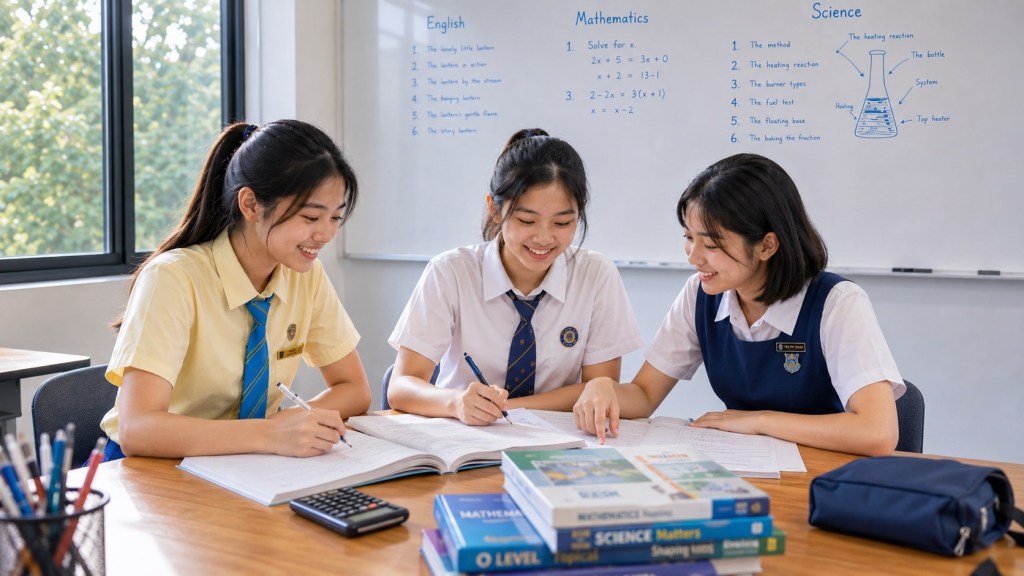
Primary 6 Mathematics is the point where years of Primary Mathematics are tested together. Parents searching for Primary 6 maths tuition, PSLE Mathematics tuition in Sengkang, PSLE math problem solving, PSLE revision, model method, ratio, speed, fractions, percentage or exam strategies are usually asking one practical question: how do we turn six years of knowledge into reliable performance under examination conditions?
The answer is not simply more full papers. PSLE Mathematics depends on content knowledge, representation, method selection, calculation fluency, working accuracy, time control and recovery when a question feels unfamiliar. A student may know every topic separately and still lose marks because these capabilities do not yet operate together.
For families in Sengkang and nearby Punggol, Primary 6 should therefore be managed as an integration year. Diagnose the first weak link, repair only what is blocking current performance, build mixed retrieval and transfer, then train examination behaviour. This is very different from repeating the entire Primary syllabus or chasing only the hardest questions.
Owner boundary: this Advanced Mathematics Tutorials page is retained as a PSLE problem-solving, revision and exam-control specialist. The canonical Primary 6 year owner is Primary 6 Mathematics: PSLE Readiness and Transfer; for error classification use PSLE Mathematics: Diagnose Topic, Representation, Procedure and Decision Errors.
The MOE Primary Mathematics syllabus places problem solving at the centre of the curriculum. SEAB’s 2026 PSLE examination format page provides the current official examination reference. Strong preparation should align to those official requirements while preserving deep mathematical understanding.
Quick answer: what does PSLE Mathematics readiness require?
PSLE readiness is not syllabus completion. It is the ability to retrieve, select, execute, check and recover across mixed Mathematics under time pressure.
- Stable number operations, fractions, decimals, percentages and ratio.
- Flexible model drawing, equations, tables and other representations.
- Method selection without chapter labels.
- Accurate unit handling and reasonableness checks.
- Multi-step problem solving with intermediate quantities.
- Retrieval of older concepts after delay.
- Time management across a complete paper.
- A personal checking routine based on recurring error patterns.
- Recovery when the first method does not work.
Primary 6 is an integration year
By Primary 6, most major content families have already appeared. The challenge is that examination questions can combine them. A ratio question may require fraction reasoning. A speed problem may require unit conversion. A geometry problem may depend on algebraic or proportional thinking.
This is why chapter-by-chapter strength can be misleading. If a child scores well immediately after practising one topic but struggles in mixed revision, the issue is not necessarily forgotten content. It may be method selection.
Mixed practice should therefore become a core part of Primary 6 preparation.
The PSLE problem-solving engine
- Read the final question and identify the target quantity.
- Mark the known quantities and units.
- Identify the relationship or invariant.
- Choose a representation: model, table, equation, diagram or logical decomposition.
- Find the first intermediate quantity.
- Continue only with information that moves toward the target.
- Estimate whether the result is plausible.
- Check that the final answer answers the exact question.
This routine is intentionally general. It works across many topics because it teaches the learner how to think before calculating.
Fractions, decimals, percentages and ratio should be connected
One of the strongest Primary 6 advantages is representational flexibility. A problem stated in percentage may become easier as a fraction. A ratio may be converted into units. A fraction of a whole may be represented as a bar model.
Students who see these topics as unrelated chapters often use longer methods. Students who see the common multiplicative structure have more options.
Revision should therefore include translation tasks: express the same relationship as a fraction, decimal, percentage and ratio when appropriate.
Ratio: units before arithmetic
A ratio such as 2:5 represents two equal units compared with five equal units. The first question is often what one unit represents.
If the total of seven units is known, divide to find one unit. If one quantity is known, use its number of units to recover the unit value.
The danger is applying arithmetic without identifying which quantities the ratio compares. Label the units before calculation.
Percentage: identify the base
Percentage questions often fail because the student uses the wrong whole. The same percentage can represent different absolute quantities depending on the reference base.
Before calculating, ask: percentage of what? That one question prevents many errors.
For increase and decrease problems, be alert that the base can change after the first operation.
Speed: keep the units visible
Speed connects distance and time. Errors often come from unit mismatch rather than the formula itself.
Students should write units through the working. Kilometres per hour, metres per second, minutes and hours are not interchangeable without conversion.
A quick reasonableness check is useful: if a walking-speed answer is hundreds of kilometres per hour, the calculation or unit conversion is wrong.
Geometry and mensuration
Primary 6 geometry requires students to read diagrams carefully, identify properties and sometimes combine shapes or infer missing quantities.
Do not trust appearance. A diagram is not evidence that two lines are equal or parallel unless the information or mathematical reasoning supports that conclusion.
For area and volume, units remain diagnostic. Square units describe area; cubic units describe volume.
Models: use them strategically
Bar models remain powerful, especially for ratio, comparison, before-and-after and part-whole problems. But Primary 6 learners should not draw a model automatically for every question.
The question is whether the representation reduces complexity. Sometimes a table, equation or logical list is better.
Mature problem solving means choosing a tool because it reveals structure.
Heuristics should not become magic tricks
Working backwards, making a systematic list, drawing a diagram, finding a pattern, making an assumption and using before-after models are useful heuristics.
The problem begins when a student memorises the heuristic name without recognising when it applies.
Teach each heuristic with contrasts: one problem where it works, one similar-looking problem where another route is better, and an explanation of the difference.
What a wrong PSLE Mathematics answer can mean
- Correct concept, wrong arithmetic: fluency or checking issue.
- Correct first step, then stuck: intermediate-quantity planning issue.
- No start: method-selection or representation problem.
- Long unnecessary working: inefficient representation or weak structure recognition.
- Correct answer, unclear working: reasoning may not be robust enough to reproduce.
- Wrong unit: dimensional control problem.
- Repeated sign or copying errors: execution routine needs repair.
- Strong topical worksheets, weak papers: mixed retrieval or examination control issue.
- Good first half, collapse at the end: pacing, fatigue or recovery strategy issue.
Why full papers are not the first solution
Full papers are useful when the student needs to integrate knowledge under realistic timing. They are inefficient when the same prerequisite error repeats across every paper.
If a learner repeatedly loses marks on ratio-unit reasoning, four more complete papers may simply create four more examples of the same weakness.
Use the paper diagnostically: identify the error family, repair it with targeted practice, then return to full-paper conditions.
Topical repair and mixed transfer
A useful Primary 6 cycle alternates between narrow and broad practice. Narrow practice repairs. Mixed practice tests selection. Full-paper practice tests integration and timing.
Each mode has a different purpose. Confusing them leads to either endless drills or endless mock examinations.
A student needs all three before PSLE.
Retrieval should be cumulative
Primary 6 revision must bring older topics back repeatedly. But cumulative review should be selective rather than random overload.
Prioritise high-dependency ideas: fractions, ratio, percentage, operations, measurement, model structures and recurring personal weaknesses.
Short retrieval at the start of lessons can reveal whether knowledge remains available without notes.
How to read a PSLE practice paper after marking
- Circle every wrong or blank question.
- Classify the error by concept, method selection, representation, arithmetic, unit, reading, timing or checking.
- Look for repeated causes across different topics.
- Choose the smallest repair that addresses the cause.
- Retest with a fresh question after a delay.
- Only then decide whether the skill is stable.
This turns a paper from a score generator into a learning map.
Time management is a mathematical skill
A student can know the Mathematics and still underperform if too much time is spent on one difficult question.
Teach a skip-return rule. If progress has genuinely stopped, mark the question, preserve working and move on. Returning later with reduced pressure can produce a fresh route.
Time control should be practised before the examination rather than invented on the day.
Checking should be personal
Generic advice to ‘check your work’ is too broad. Students should know their own recurring error patterns.
One child checks units. Another checks copied numbers. Another checks whether the final question was answered. Another substitutes answers back into relationships.
A small personal checklist is more usable than a long universal one.
Calculator control
Where calculators are permitted, they reduce routine computation but do not replace number sense. Students should estimate before keying and inspect whether the result is plausible.
Repeated keying errors often come from entering long expressions without structure. Break calculations into meaningful chunks when useful.
The calculator should support reasoning, not become the only source of confidence.
PSLE Mathematics revision in the final months
Late revision should become increasingly diagnostic. At this stage, the question is not how many worksheets remain unfinished. It is which errors still recur and whether they survive fresh testing.
Prioritise high-frequency personal weaknesses, mixed practice, delayed retrieval and exam-control routines.
Do not spend all remaining time on exotic challenge questions while routine marks remain unstable.
Primary 6 Mathematics tuition in Sengkang
The Primary 6 Mathematics Tuition Sengkang page explains the local PSLE Mathematics programme, while the Primary 6 Mathematics Learning Hub provides the detailed year-level learning route.
At eduKate Sengkang, groups of three allow close inspection of working. One student may need a ratio repair, another may need time management and another may need better model selection.
The lesson should therefore share useful Mathematics without pretending that every learner has the same bottleneck.
Why three students can be enough variation
Three students create opportunities to compare methods. One may use a bar model, another an equation and another a table. The tutor can ask which representation exposes the relationship most clearly.
At the same time, each learner remains visible. Independent working and explanation make it harder for one student’s answer to hide another student’s uncertainty.
The aim is transfer of control to the learner.
A twelve-week PSLE Mathematics route
Weeks 1-2: diagnose the whole system
Use a mixed sample rather than one topic. Identify recurring error families and timing patterns.
Weeks 3-4: repair the highest-leverage gap
Target the prerequisite that causes the most lost marks. Keep the repair narrow and purposeful.
Weeks 5-6: return to mixed work
Test whether the repaired skill can be selected without a chapter cue.
Weeks 7-8: strengthen transfer
Use unfamiliar but syllabus-aligned questions, alternative representations and comparison between methods.
Weeks 9-10: paper strategy
Practise timing, skip-return decisions, calculator control and personal checks.
Weeks 11-12: preserve confidence through evidence
Use targeted final revision based on remaining errors. Avoid destabilising the learner by changing every method at the last moment.
What parents can do during PSLE preparation
- Keep recent papers with working intact.
- Discuss error patterns rather than only total scores.
- Protect sleep and routine during heavy revision periods.
- Do not equate more hours with better learning.
- Ask the child to explain why a method applies.
- Use short retrieval of old topics.
- Practise full papers only when full-paper practice has a clear purpose.
- Keep the final weeks focused on stability and known high-value repairs.
Frequently asked questions
How many PSLE papers should my child complete?
There is no useful universal number. Complete enough to diagnose, integrate and rehearse timing. If the same error repeats, stop and repair it before adding more papers.
Should my child focus on difficult questions?
Only after routine and medium-difficulty marks are stable. Difficult questions should extend reasoning, not distract from recurring basic losses.
Are bar models still useful in Primary 6?
Yes, when they reveal relationships efficiently. They are tools, not compulsory rituals.
What if my child blanks during a hard question?
Teach a recovery routine: identify what is known, choose a representation, attempt one justified step, and use skip-return if progress stops.
When should revision become timed?
Timing should be added after methods are reasonably stable. Timing a weak method often measures confusion rather than readiness.
Continue beyond PSLE
Read Primary 5 Mathematics: Ratio, Percentage, Fractions, Decimals and Multi-Step Problems for the runway into this stage. Pair this article with How to Survive PSLE Mathematics Without Turning Revision Into Panic for the broader examination-survival route.
After PSLE, continue to Secondary G1, G2 and G3 Mathematics: Algebra, Problem Solving and the Secondary Reset. The Mathematics Hub connects the complete estate from Primary foundations through Secondary Mathematics and Additional Mathematics.
For Sengkang and Punggol families seeking support, bring the latest paper with every line of working preserved. The visible route usually reveals whether the next action should be concept repair, retrieval, method selection, checking or exam control.
