
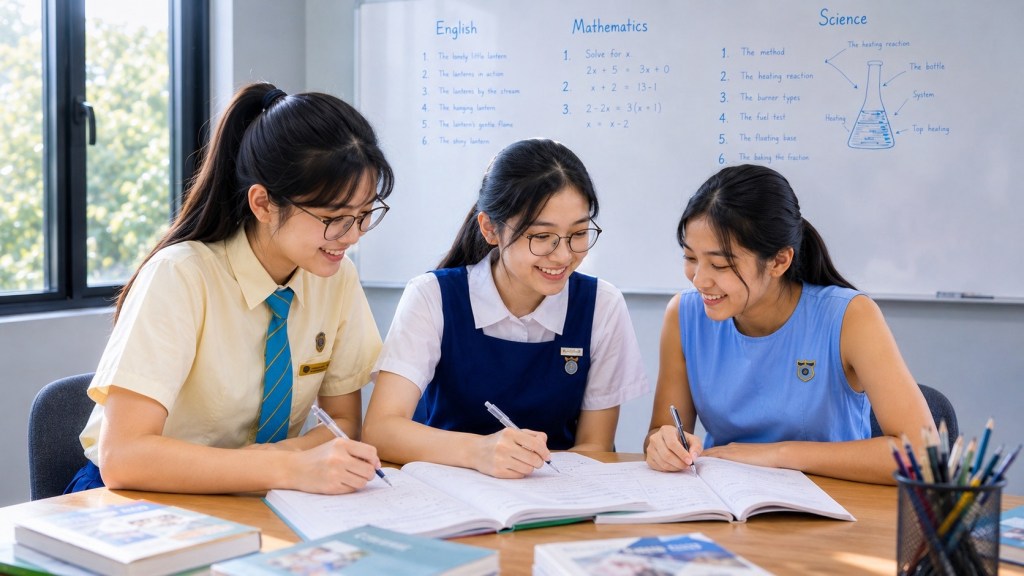
The tutor is not only watching whether the answer becomes correct.
The useful information often appears before the answer: what the learner notices first, how they begin, which representation they choose, where hesitation starts, what happens after a prompt and whether checking occurs without being requested.
The final answer is one data point. The route that produced it is often the teaching map.
The first thing we watch is the independent start
Before the tutor explains, what does the student do?
Do they read the whole question? Identify the target? Mark useful information? Draw a diagram? Write a relationship? Begin immediately with a familiar method? Wait for reassurance?
The first thirty seconds can tell us whether the learner recognises the problem structure or is relying on the adult to identify it.
Our Independent Start guide explores what a learner can begin without a prompt.
We watch the representation, not just the calculation
In Mathematics, a wrong representation can make perfect arithmetic useless. In Science, a student may know the facts but reconstruct the system incorrectly. In English, the learner may misunderstand what a question is asking before they ever begin writing.
So the tutor watches how the learner turns the task into something they can think with.
That can be a diagram, equation, verbal paraphrase, evidence mark-up, sequence of events, comparison table or simply a precise statement of what must be found.
We watch where the hesitation begins
Not all pauses mean the same thing.
A student may hesitate because the concept is missing, because there are two plausible methods, because retrieval is slow, because the wording is unfamiliar, or because they know the route but are afraid to commit.
The location of the pause matters. A learner who stalls before representing the problem may need a different intervention from one who reaches the final step and becomes inaccurate.
We watch what one small prompt changes
A prompt is useful not only because it helps the learner continue. It can reveal which part of the route was missing.
If “What quantity is the percentage referring to?” unlocks the whole problem, that tells us something different from a student who still cannot proceed after the reference quantity is identified.
The aim is not to pile on prompts until the work becomes correct. It is to use the smallest helpful intervention and notice what changes.
We watch how errors are detected
Some learners notice an unreasonable answer before anyone speaks. Others continue confidently until the tutor points to the exact line. Some know that something is wrong but do not know how to locate it.
Checking is therefore not simply “look through your work again”. We watch whether the learner has criteria: estimate the magnitude, reread the evidence, substitute the answer, check units, compare with the question or reconstruct the mechanism.
We watch recovery after a route fails
A wrong first method is not necessarily a serious problem. The more revealing question is what happens next.
Can the learner abandon the route? Identify why it failed? Try another representation? Return to the question? Or does one failure consume the rest of the task?
Recovery becomes especially important in examinations, where a student cannot wait for a tutor to reset the problem.
We watch whether the idea survives later
Immediate success after an explanation is useful but weak evidence of durable learning.
So the tutor may return to the idea after time has passed, remove the usual cue, mix it with another topic or change the wording. If the learner can still recognise and use the underlying relationship, confidence in the repair increases.
See How We Know Learning Has Really Held.
The tutor is also watching when not to intervene
Good observation does not mean constant interruption.
If the learner is productively struggling, an early prompt can steal evidence and independence. Sometimes the tutor should wait long enough to discover whether the student can recover.
Silence can therefore be an instructional decision.
What this page does not mean
A tutor cannot infer a child’s intelligence, personality or psychological state from a few gestures while working. Observation should remain tied to the specific task and conditions.
Nor should every hesitation be treated as a problem. Difficult learning should contain thinking time. The purpose is to distinguish productive struggle from a recurring break that needs teaching.
Where to go next
To see why this process matters even when the final answer is correct, continue to Why the Working Process Can Matter More Than the Final Answer. To see how three learners can receive different next moves, read How Can Three Students Share a Class Without Receiving the Same Teaching?. For the full set of parent decision routes, return to the Parents’ Guide.
eduKate Sengkang · We look at learning in motion, not only the answer after it has stopped.
