
Quick Read
A student receives a question and does nothing for twelve seconds.
An adult may feel an immediate urge to help.
But those twelve seconds can contain valuable evidence.
- The learner may be rereading.
- They may be searching for a representation.
- They may be comparing two possible methods.
- They may be waiting for the teacher to supply the first move.
- They may genuinely not know how to begin.
The Independent Start asks what the learner can do before the first external prompt changes the problem.
The One-Sentence Answer
How a learner orients, represents, chooses and begins before help arrives reveals which parts of the learning process have already moved inside the learner and where external support still begins.
An Independent Start Is Not the Same as a Fast Start
Fast is not automatically good.
A student can begin immediately because the task is familiar, because they recognised a misleading keyword, or because they are rushing.
A slower learner may be reading accurately, building a representation and checking the demand before committing.
This is why the existing reflection Slow Is Not a Diagnosis remains important.
The Curie question is not “How quickly did the learner start?” It is “What useful operations happened before outside help became necessary?”
What Can Happen Before the First Written Step?
| Operation | What it looks like | What it may reveal |
|---|---|---|
| Orient | Identify subject demand and likely structure | Problem classification |
| Reread | Return to key wording or information | Attention and question decoding |
| Represent | Draw, annotate, organise, translate or symbolise | Meaning construction |
| Retrieve | Recall a relevant idea or method | Accessibility of prior learning |
| Select | Choose between possible approaches | Method judgement |
| Check readiness | Notice uncertainty before acting | Metacognitive control |
| Begin | Take the first justified step | Independent execution |
These operations can happen quickly, but conceptually they are distinct. A learner can know the content and still fail to orient. Another learner can orient correctly but fail to retrieve the method.
Sometimes the Student Is Not Stuck. They Are Waiting.
Some students become highly efficient at reading the adult rather than the question.
They pause.
The adult supplies a hint.
The student continues.
Over time, waiting itself can become a strategy.
Our reflective article Sometimes the Student Is Not Stuck. They Are Waiting. names this elegantly.
The Curie Series asks how to test the difference between productive pause and learned waiting without shaming either one.
Diagnostic Silence
Sometimes the tutor’s most informative action is to remain silent for a little longer.
Not indefinitely.
Not as a test of character.
Only long enough to see what the learner tries before help changes the evidence.
- Does the student reread?
- Do they circle information?
- Do they draw?
- Do they try a simpler case?
- Do they look back at notes immediately?
- Do they wait for eye contact?
- Do they begin with a plausible but uncertain route?
This behaviour can tell the tutor where independent problem solving currently ends.
The First Prompt Changes the Evidence
If the teacher says, “Draw a model,” we no longer know whether the learner would have chosen representation independently.
If the teacher asks, “Which formula is relevant?” we have already supplied method orientation.
If the teacher points to the evidence line, we have changed the English comprehension task.
This is why the page on Prompt Dependence and The Independent Start are paired.
The moment before the first prompt is one of the cleanest windows into what the learner can initiate alone.
Knowing When to Ask for Help Is Also Independence
Independence does not mean refusing help.
A mature learner can often identify the boundary of their own knowledge.
“I understand the relationship, but I cannot remember the algebraic identity.”
“I know what the passage says, but I am unsure how much evidence the question requires.”
Those are good help requests because they preserve what the learner already owns and locate what is missing.
A Starting Independence Ladder
- Cannot orient: needs the task or concept identified.
- Can orient with cue: recognises the route after one prompt.
- Can represent: begins organising information independently but may need help selecting the method.
- Can choose: identifies a plausible route without external classification.
- Can begin and monitor: starts independently and notices when the route is failing.
- Can recover: changes strategy or asks a precise question when needed.
This ladder is descriptive, not a hidden score. A learner can occupy different positions in different subjects and topics.
English: What Does the Learner Do Before Answering?
An independent English start may involve:
- decoding the command word;
- identifying whose perspective matters;
- locating the likely evidence zone;
- noticing a contrast or causal relationship;
- and deciding what form the answer requires.
If the learner waits until the tutor asks “Where is the evidence?”, the interpretation process may still be partly external.
Mathematics: The First Representation Often Reveals the Real State
Before calculating, a Mathematics learner must often decide what the problem is.
Do they draw? Define a variable? Translate the relationship? Search for a formula? Try numbers? Write an equation?
The first representation can reveal more about conceptual organisation than the final arithmetic.
Science: Begin With the System, Not the Memorised Sentence
An independent Science start asks:
- What changed?
- What was observed?
- Which variable or relationship matters?
- What mechanism could connect the evidence?
A student who immediately searches memory for a model phrase may know the topic but not yet be reconstructing from the actual experiment.
Additional Mathematics: Starting Means Choosing the Mathematical World
A-Math increasingly requires the learner to recognise structure before execution begins.
The student must decide whether the problem is best approached through algebra, a function relationship, trigonometric identity, coordinate representation, differentiation or a combination.
A learner who can execute all of those methods separately but cannot select among them has a starting problem rather than a pure calculation problem.
Tutorial Should Preserve Some First Attempts
A Tutorial should not explain every task before the student touches it.
Some tasks should begin with the learner alone long enough to create genuine entry evidence.
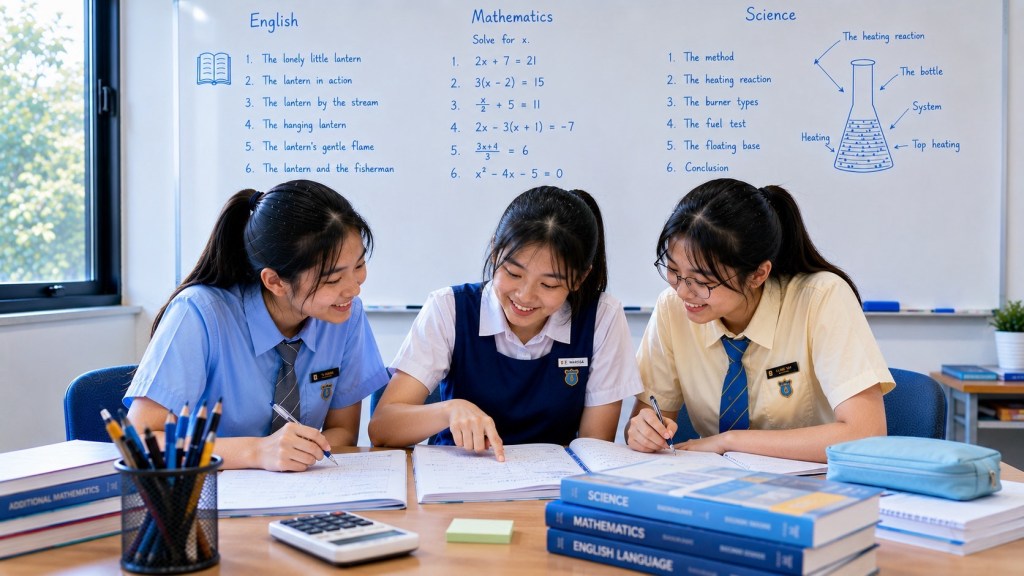
This is especially useful in a three-student class. While the tutor is working directly with another student, the learner has natural diagnostic space to orient and begin.
The tutor can then inspect not only the answer but the first moves that happened in the absence of immediate help.
What Tutor Should Say About Starting
The Tutor dashboard should avoid labels such as “lazy starter” or “dependent learner.”
Better:
“You can solve the method once it is identified, but you are not yet classifying unfamiliar questions independently.”
Or:
“You pause before starting, but your first representation is usually productive. The pause is currently part of your thinking, not evidence that you are stuck.”
That is the difference between observation and judgement.
What Parents Can Do When a Child Says “I Don’t Know”
Instead of immediately explaining, ask one smaller question:
- What do you know already?
- What is the question asking you to find?
- Can you represent the information somehow?
- Where exactly do you stop?
Then wait.
If the child still cannot begin, help is appropriate. But now the help can start at the actual boundary rather than replacing the whole process.
Voyage Changes How Much Starting Responsibility Should Be Internal
The Voyage Series makes independence developmental.
A young learner appropriately receives more adult framing. As schooling progresses, the student should increasingly own orientation, planning, method selection and checking.
By higher education and adulthood, the learner often has to define the problem before anyone can tell them how to solve it.
The Independent Start is therefore one small window into a much longer transfer of responsibility.
Darwin Asks When a Familiar Starting Strategy Has Expired
A student may have learned to start by searching for keywords, copying the nearest example or waiting for the chapter label to reveal the method.
Those strategies can work in simpler environments.
The Darwin Series asks when the environment has changed enough that starting itself must evolve toward structure, representation and judgement.
Boundaries
- A pause is not automatically confusion.
- Fast starting is not automatically stronger starting.
- New material may require explicit modelling before independence is reasonable.
- Do not withhold help merely to prove a point.
- Independence includes asking a precise question when appropriate.
- Starting behaviour is educational evidence, not a medical or psychological diagnosis.
The Core Rule of the Independent Start
Preserve enough space before the first prompt to see how the learner orients and begins, then place support at the first genuine boundary rather than performing operations the learner can already own.
Frequently Asked Questions
How long should a tutor wait before prompting?
There is no fixed number of seconds. Wait only long enough to see whether productive orientation begins; intervene sooner when the learner has no plausible route or the delay is becoming unhelpful.
What if the student starts with the wrong method?
That can be excellent evidence. Ask what feature led to the choice before correcting it. The classification rule may be the real weak link.
Does independent starting matter outside examinations?
Yes. Independent learning, university study and adult problem solving increasingly require people to define, orient and begin without a teacher supplying the first move.
Marie Curie Series · Prompt Dependence · Observed, Inferred, Unknown · Transfer Test · Tutor · Voyage · Darwin
eduKate Sengkang | Small groups of up to 3 | 1.5-hour tutorials | Properly Taught Kids Shine a Bright Light Into the Future.
