
Punggol Is the Local Door Into One Mathematics System
A parent may search for Mathematics tuition in Punggol because the centre has to be practical to reach. But the academic route should be determined by the learner, not by the postcode.
Punggol search → diagnose the learner → choose the stage → repair the first weak link → reconnect to the Mathematics Voyage.
Quick Read
Choosing Mathematics tuition in Punggol should begin with the learner’s mathematical route, not the location alone. The useful question is where the reasoning chain first loses control.
- Interpretation: does the child understand what the problem is asking?
- Representation: can the quantities and relationships be turned into a model, diagram, equation or graph?
- Route selection: can the child choose a method rather than wait for the worksheet to reveal it?
- Execution: are the calculations and transformations accurate enough to preserve the route?
- Verification: can the child check whether the answer is reasonable and fits the original problem?
“Careless” is not enough. A useful lesson identifies which part of this chain is unstable and repairs that part specifically.
What Can Actually Be Weak in Mathematics?
- number sense and fluency;
- fractions, ratios and earlier dependencies;
- representation and model selection;
- multi-step route planning;
- algebra and symbolic control;
- transfer to unfamiliar questions;
- working accuracy and error control;
- timing and examination execution.
“Careless” and “weak in Math” are not precise enough to decide the next lesson.
Choose the Correct Stage
For Primary school, start with Primary Mathematics Tuition Punggol | P1–P6.
For Secondary school, start with Secondary Mathematics Tuition Punggol | S1–S4.
Then Enter the Sengkang Mathematics Learning Route
The level pages hold the practical teaching route. Why Three Students Let Us See the Learning System explains the diagnostic method. The Voyage Series shows how mathematical capability develops across years.
Why Three Students Helps
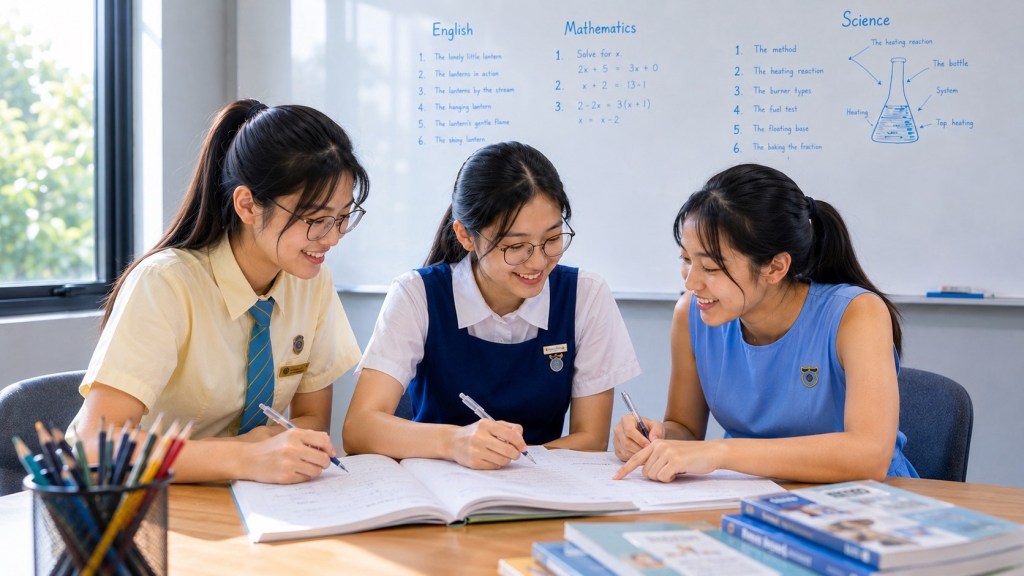
Mathematics exposes thinking through working. In a group of up to three, the tutor can inspect where the route actually breaks—interpretation, representation, method selection, calculation or checking—and then compare alternative methods without losing individual visibility.
What a Useful Mathematics Diagnosis Looks Like
A wrong answer is only the end of the chain. The teaching value comes from finding where control first disappeared. The child may have misunderstood the wording, represented the quantities incorrectly, selected the wrong method, executed a valid route inaccurately or failed to check the result.
The teaching loop is interpret → represent → choose route → execute → verify → change the surface → retest. A method is not fully owned if it only works when the worksheet looks familiar.
Why Three Students Changes the Mathematics Lesson
One learner can build the representation, another can challenge the route, and a third can verify the working and answer. The roles rotate. Comparing two valid methods also helps students distinguish the underlying Mathematics from one memorised procedure.
What Parents May Notice
- The child calculates accurately but cannot begin unfamiliar word problems.
- Models are drawn mechanically without representing the real relationship.
- A familiar method is used even when the conditions have changed.
- Repeated “careless” errors follow a pattern such as signs, units, copied values or omitted steps.
- The child can complete routine worksheets but struggles when topics are mixed.
- Answers are rarely checked against the original question.
How Parents Can Decide Whether Tuition Is Useful
Tuition is useful when it creates a clearer diagnosis and a more efficient repair than the learner is currently getting. A student who understands, transfers and checks independently may not need additional classes. A student with a recurring dependency, transition mismatch or unstable route can benefit from targeted support before the weakness compounds.
Frequently Asked Questions
Does Mathematics tuition mean doing more worksheets?
Not necessarily. Practice is useful after the correct concept and route are established. If the student repeatedly selects the wrong representation or method, volume alone can reinforce the wrong pattern.
Is a three-student class suitable for different ability levels?
Students can work toward a shared mathematical objective while receiving different levels of support, variation and challenge. Placement still needs to consider pace, syllabus position and class compatibility.
Local Convenience, Mathematical Continuity
A nearby centre makes the learning routine easier to sustain. The larger educational aim is continuity: preserve strong foundations, repair the earliest weak dependency, increase independence and help the student recognise the Mathematics even when the question changes its surface.
Local, but Connected
Lessons are at 83 Punggol Central near Punggol MRT. The Punggol page is therefore a genuine local entrance into the same connected Mathematics learning system.
Small groups of up to 3 | 1.5-hour lessons | 83 Punggol Central
More useful Punggol Mathematics routes
- Primary gateway: Enter the P1–P6 Mathematics learning system from Punggol
- Secondary gateway: Enter the S1–S4 Mathematics learning system from Punggol
- Primary 3 local route: When Mathematics becomes genuinely multi-step
- Primary 5 local route: Why the PSLE Mathematics runway starts in Primary 5
- Primary 6 local route: What changed in PSLE Mathematics 2026
- Secondary 1 local route: Full SBB, G1/G2/G3 and the Secondary 1 Mathematics reset
- Secondary 2 local route: When the old Mathematics study method starts to expire
- Secondary 3 local route: Why the upper-secondary Mathematics load compounds here
Legacy Punggol route preserved on eduKateSengkang
This page is being kept at its existing URL because it is part of the older eduKate estate and may still be useful to readers arriving through historical links or search. Current Punggol discovery and local-family routing now belongs to the eduKatePunggol Atlas.
If your question is about the learner rather than the location—what is blocked, fragile, stable, transfer-ready or examination-ready—return to the eduKateSengkang Learning Atlas V2.0. The URL is preserved; ownership is made explicit so the two estates do not compete for the same job.
