
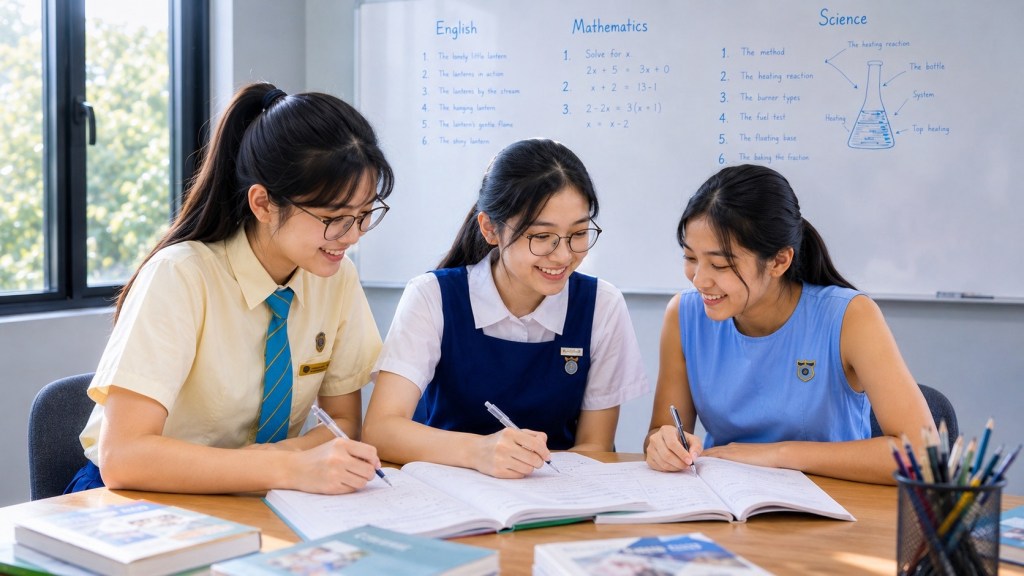
Quick Read: Primary Mathematics Is One Continuous Build
Primary Mathematics from P1 to P6 is not six separate school years. It is one connected development in which number sense becomes fluency, fluency supports representation, representation supports multi-step problem solving, and all of those capabilities eventually have to survive unfamiliar PSLE questions under time.
For Punggol families, the useful question is therefore not simply, “Which chapter is weak?” It is: where does the mathematical route first become unreliable?
P1 Number Sense → P2 Fluency & Models → P3 Multi-Step Routes → P4 Upper-Primary Complexity → P5 Transfer & PSLE Runway → P6 Examination Control.
eduKate Sengkang teaches Primary Mathematics in small groups of up to three students at 83 Punggol Central. The purpose of the small group is not merely a smaller classroom. It is to make each student’s mathematical thinking visible enough to diagnose, repair and extend accurately.
Locality routing note
This established eduKate Sengkang URL is retained as a P1–P6 learning-progression entry. The canonical Punggol locality route for Primary Mathematics now lives at Primary Mathematics Tuition in Punggol on eduKatePunggol. Use that site for Punggol-specific discovery and this page for the connected Mathematics learning framework.
The One-Sentence Answer
Primary Mathematics Tuition in Punggol works best when teaching follows the child’s actual dependency chain: secure the earliest weak capability, reconnect it to the current level, verify that the repair transfers, and then keep building towards independent PSLE problem solving.
Why Primary Mathematics Must Be Seen as a Developmental System
A P6 problem can appear to be about percentage, ratio, geometry or speed. But the visible topic is not always the original reason a student is stuck.
The student may be carrying an earlier weakness in:
- place value;
- multiplication facts;
- fractions;
- unit conversion;
- part-whole representation;
- comparison language;
- model drawing;
- multi-step sequencing;
- checking and estimation.
As the syllabus becomes more demanding, those weaknesses become expensive because newer Mathematics assumes earlier Mathematics is already available.
The current question tells us where the difficulty appeared. The student’s working tells us where the difficulty began.
The P1–P6 Mathematics Voyage
| Level | Main developmental job | What should become more independent |
|---|---|---|
| P1 | Number sense and representation | Seeing quantity, place value and simple relationships |
| P2 | Fluency and models | Basic operations, comparison and early problem structures |
| P3 | Multi-step coordination | Holding several operations and deciding their order |
| P4 | Upper-primary complexity | Fractions, decimals, richer models and method selection |
| P5 | Transfer and PSLE runway | Applying known Mathematics across unfamiliar combinations |
| P6 | Examination control | Executing, checking and recovering reliably under paper conditions |
This progression is not perfectly linear. A P4 student can still need P2 fluency repair. A P6 student can still have a P3 representation weakness. A strong P3 student may already be ready for harder transfer work.
School level gives us the current coordinate. It does not automatically tell us the correct intervention.
Primary 1: Number Has to Mean Something
Primary 1 Mathematics begins with a deceptively important task: numbers must stop being marks on a page and become representations of quantity and relationship.
A child may be able to recite numbers yet still have weak number sense. Stronger understanding appears when the child can:
- compare quantities;
- compose and decompose numbers;
- recognise part-whole relationships;
- explain why one quantity is greater or smaller;
- move between objects, pictures, words and numerals;
- check whether an answer is reasonable.
This is why we do not rush past foundations simply because the arithmetic looks easy. Later problem solving depends on the child being able to represent quantity flexibly.
Primary 1 Mathematics Tuition Sengkang →
Primary 2: Fluency Should Free Attention, Not Replace Thinking
Primary 2 adds greater calculation fluency and more structured word problems. Fluency matters because a student who spends excessive attention on basic computation has less attention available for the actual problem.
Automatic enough to think further; understood enough to know what the operation means.
We want the student to recognise relationships such as:
- part and whole;
- difference;
- equal groups;
- sharing;
- comparison;
- before and after change.
The aim is not only to calculate quickly. It is to know why addition, subtraction, multiplication or division belongs in the situation.
Primary 2 Mathematics Tuition Sengkang →
Primary 3: Mathematics Becomes Multi-Step
Primary 3 is often where students first feel that Mathematics has changed. One operation is no longer enough. The student must hold a sequence.
Understand situation → represent → choose first step → update the state → choose next step → answer → verify.
When a student gets lost, we inspect whether the problem is arithmetic, representation, sequencing or selection. Giving another twenty multi-step questions will not necessarily repair a child who never understood the first relationship.
Primary 3 Mathematics Tuition Sengkang →
Primary 4: The Upper-Primary Straddle Year
Primary 4 sits between foundational Primary Mathematics and the heavier PSLE runway. Fractions, decimals, geometry, measurement and more complicated problem structures begin competing for the same working memory.
This is a good year to ask:
- Can the student choose a representation without being told?
- Can the student identify what is known and unknown?
- Can fractions be handled conceptually, not only procedurally?
- Can units be kept consistent?
- Can the student explain the route after solving?
- Does the method survive when the wording changes?
Primary 4 is valuable because there is still enough time to repair the system before P5 and P6 compress the intervention window.
Primary 4 Mathematics Tuition Sengkang →
Primary 5: The PSLE Runway Starts Here
Primary 5 is where earlier dependencies begin to compound. The student meets more complex problem structures and must increasingly connect topics rather than solve them in isolation.
This is where a student who is strong by chapter may still struggle in mixed work. The missing capability is often not knowledge. It is selection and transfer.
Chapter practice asks, “Can you use this method?” Mixed practice asks, “Can you decide which method belongs?”
Primary 5 should therefore build retrieval, representation, transfer and error awareness before Primary 6 adds full examination pressure.
Primary 5 Mathematics Tuition Sengkang →
Primary 6: Mathematics Has to Perform
By Primary 6, students need both mathematical capability and examination control. They must retrieve methods, recognise structures, preserve accuracy, manage time, show working, check efficiently and recover after a difficult question.
The 2026 PSLE Mathematics format uses two papers across a combined 2 hours 30 minutes, with 45 questions and 100 marks in total. That format rewards more than speed. Students must manage the paper as a whole while maintaining mathematical precision.
Late-stage preparation should therefore distinguish between:
- a concept that is genuinely missing;
- a method that is known but not retrievable;
- a representation error;
- a route-selection problem;
- a local execution error;
- a timing or checking failure;
- a recovery problem after one difficult item.
Primary 6 Mathematics Tuition Sengkang →
The Eight Capabilities Behind Strong Primary Mathematics
| Capability | What it looks like |
|---|---|
| Number control | Quantities, place value, operations and magnitude make sense |
| Fluency | Routine operations do not consume all available attention |
| Representation | Words can become models, diagrams, equations or tables |
| Relationship recognition | The student sees comparison, part-whole, rate, ratio and change |
| Route selection | An appropriate method can be chosen without chapter labels |
| Transfer | The same Mathematics survives a different-looking question |
| Verification | Answers are checked through estimation, inverse operations or logic |
| Examination control | The student can perform under time and recover from uncertainty |
A score compresses these capabilities into one number. Tuition should expand the number again so we can see what to teach.
Why “Careless” Is Not Enough
A student loses six marks and says, “Careless.” That may be true, but it is not yet useful.
Was the error:
- a copied number;
- a dropped unit;
- a wrong operation;
- a sign error;
- a model that represented the wrong quantity;
- a question that was not fully answered;
- a correct method abandoned too early;
- a rushed final check?
Each has a different repair. Once errors are typed, the student can build a personal checking routine instead of receiving the vague instruction to “be more careful.”
Representation Is Often the Hidden Problem
A student can know every required operation and still fail because the problem was represented incorrectly.
Primary Mathematics asks students to move between:
words ↔ quantities ↔ diagrams ↔ models ↔ equations ↔ tables ↔ graphs.
A model is useful when it preserves the relationships in the problem. It is not useful merely because it looks neat.
This is why we sometimes ask a student to solve the same relationship using two representations. The goal is not to create extra work. It is to make the structure independent of one familiar surface.
Transfer: The Question After the Question
Correction is not the end of learning.
If a student can solve a problem only after seeing the correction, we have evidence of recognition. We do not yet have strong evidence of transfer.
After repair, change something:
- different numbers;
- different nouns;
- different diagram;
- reverse the direction;
- combine it with another topic;
- remove the chapter heading;
- return to it after a delay.
Repair becomes durable when the student can reconstruct the relationship without being told which route to use.
Catch Up, Keep Up or Move Ahead?
Catch Up
Find the earliest dependency that is limiting current Mathematics. Repair it carefully, then reconnect it to school-level work.
Keep Up
Stabilise current curriculum, reduce repeated errors and keep the student slightly ahead enough that school becomes a second encounter rather than constant first exposure.
Move Ahead
Increase unfamiliarity, mixed-topic demand, alternative representations, proof of reasoning and efficiency rather than simply racing through future chapters.
These are not permanent labels. The student’s state should change as the Mathematics improves.
Why Small Groups of Three Help Mathematics
Mathematics is unusually inspectable because the student’s working records decisions.
In a group of up to three students, the tutor can ask each learner:
- What did you think the question was asking?
- Why did you choose this model?
- What made you choose this operation?
- Where did you first become uncertain?
- How could you verify this answer?
Three students can reach the same wrong answer through three different routes. One may need concept repair, one representation repair and one checking discipline.
Same topic. Different weak link. Different next move.
What Parents Should Bring to a Mathematics Consultation
Recent work is more useful than a verbal description alone. Where possible, bring:
- two or three recent school papers;
- working for questions the student found difficult;
- corrections that keep repeating;
- teacher comments where relevant;
- an example of homework the child could not begin independently.
We are looking for patterns, not one embarrassing mistake. A repeated failure tells us more than a single bad day.
Frequently Asked Questions
Does every Primary student need Mathematics tuition?
No. A child who is secure, independent, appropriately challenged and able to recover from normal mistakes may not need additional tuition. Tuition becomes more useful when there is a persistent weak link, school pace is outrunning consolidation, or a strong learner needs higher-resolution challenge.
Should my child do more worksheets?
Only if the extra work has a clear job. More practice can build fluency and transfer, but repeating the same failure without changing the underlying capability simply produces more evidence of the same problem.
What if my child understands in tuition but cannot do school tests?
The gap may be retrieval, route selection, transfer, timing or examination control. Guided understanding is only one stage. The student eventually has to generate the route independently.
When should PSLE preparation begin?
The strongest PSLE preparation begins before full papers dominate. P5 is a valuable runway for stabilising fractions, ratios, percentage, representation, multi-step reasoning and transfer. P6 then has more time for integration and examination control.
Why only three students?
The class remains small enough for the tutor to inspect individual working while still allowing useful comparison between different solution routes. The advantage is educational resolution, not simply a smaller headcount.
Primary Mathematics Tuition in Punggol
eduKate Sengkang teaches Primary Mathematics at 83 Punggol Central, Singapore 828761, serving Punggol and Sengkang families. Classes are kept to up to three students and lessons are 1.5 hours.
The location is the local entry point. The Mathematics itself remains one connected P1–P6 system.
Explore the Mathematics Tuition Sengkang hub →
Final Thought: Build the Child Who Can Reconstruct the Mathematics
The long-term goal is not a student who waits for someone to name the chapter, draw the model or identify the method.
We want the control to move inward.
Read the situation → identify the relationships → represent them → choose a route → execute → verify → learn from the result.
That progression begins with number sense in Primary 1 and becomes examination-ready problem solving by Primary 6.
Properly taught, Primary Mathematics becomes more than a sequence of answers. It becomes a way of seeing structure, testing relationships and moving through unfamiliar problems with increasing independence.
Legacy Punggol route preserved on eduKateSengkang
This page is being kept at its existing URL because it is part of the older eduKate estate and may still be useful to readers arriving through historical links or search. Current Punggol discovery and local-family routing now belongs to the eduKatePunggol Atlas.
If your question is about the learner rather than the location—what is blocked, fragile, stable, transfer-ready or examination-ready—return to the eduKateSengkang Learning Atlas V2.0. The URL is preserved; ownership is made explicit so the two estates do not compete for the same job.
