
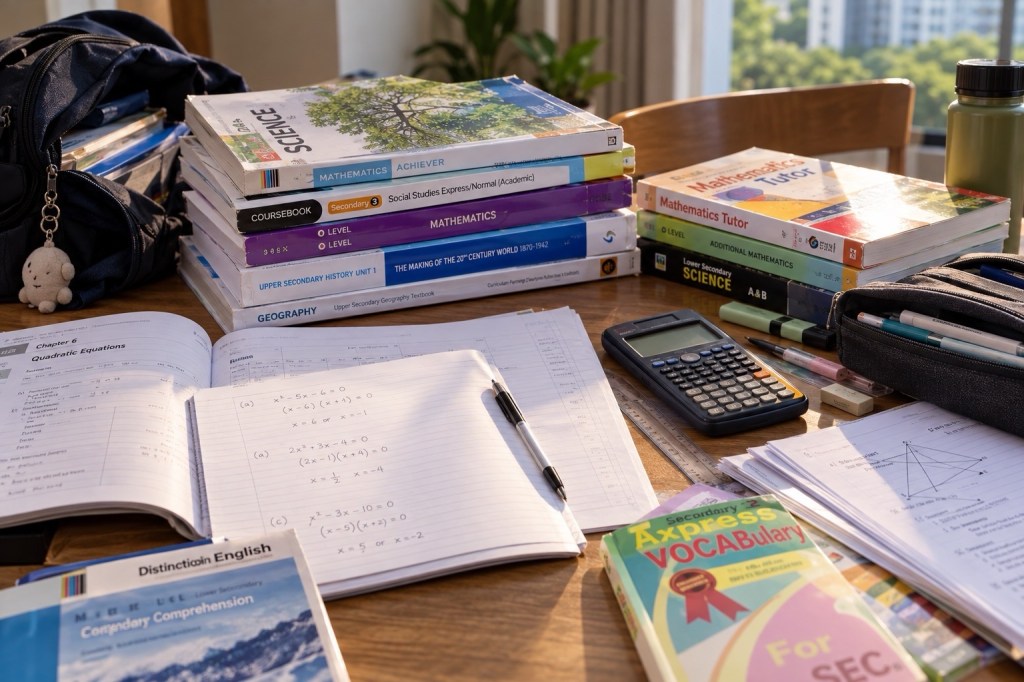
Quick answer: the Secondary 1 G2 Mathematics transition
What Mathematics will a PG2 pupil in Sengkang learn in Secondary 1? The child studies Mathematics at the G-level actually offered by the school. For a learner taking G2 Mathematics, the MOE lower-secondary curriculum includes prime factorisation, HCF and LCM, negative numbers, fractions and real numbers, algebraic expressions, linear equations, ratios, percentages, rates, geometry and statistics. PG2 is the admission Posting Group, not the name of the Maths syllabus.
The largest transition is not simply that the numbers become harder. Students must move from calculating with familiar numbers to representing unknown quantities, explaining why a method works, choosing a model and checking a result. A child who performed well in Primary 6 computation can still become confused when negative signs, variables or the phrase ‘at least’ change the structure of a question. A short diagnostic and one repaired misconception are more useful than a stack of untargeted papers.
- Confirm whether the actual timetable states G2 Mathematics or another subject level.
- Check the exact school textbook, current topic order and assessment notice for the 2027 cohort.
- Probe number-line reasoning, HCF versus LCM, fraction operations and what a letter represents.
- Teach one weak concept explicitly, practise it, then change the wording to test transfer.
- Use the child’s marked work and teacher’s feedback before deciding whether more-demanding-level G3 Mathematics is suitable.
What is verified—and what is only a school example?
MOE’s published G2 and G3 Mathematics syllabuses, issued by its Curriculum Planning and Development Division, provide the curriculum framework. An actual school organises lessons and weighted assessments within that framework. In a useful concrete example, Yishun Secondary’s 2025 Secondary 1 G2 Mathematics content outline places prime numbers, HCF/LCM, negative integers and fractions early, before algebraic notation, expansion and linear equations. It later covers patterns, percentages, ratios, rates, geometry, measurement and statistical representations.
The Yishun 2025 document is not the official weekly schedule for Sengkang in 2027. It explains why early transition work matters, but parents should not copy ‘Week 4 negative integers’ onto the child’s new school calendar. Different schools can teach topics in different sequences and use different assessment components. What is stable is the mathematical prerequisite structure: a child who cannot reason with integers will struggle to keep algebraic signs accurate.
| Source | What it tells the parent | What it cannot guarantee |
|---|---|---|
| MOE G2/G3 Mathematics syllabus | National content and learning expectations | A specific Sengkang school’s weekly order |
| 2025 Yishun Secondary G2 outline | A real example of lower-secondary topic progression | Any 2027 school-wide WA date |
| Child’s 2027 school booklist | Correct G-level materials and approved edition | Proof of mastery without seeing actual work |
| Marked class task and teacher feedback | Current performance against a particular skill | A guaranteed G2-to-G3 change |
Why Prime 6 Mathematics success can hide a Secondary 1 gap
A student may know many Primary 6 algorithms but rely on recognising familiar wording. They might identify an LCM question because the worksheet is labelled ‘LCM practice’, yet choose HCF in a mixed problem where no heading gives away the operation. That is a transfer problem: the method exists, but the pupil cannot select it when the structure changes.
Other pupils calculate quickly while carrying mistaken conceptions of negative numbers. They may learn that a negative sign means ‘subtract’, then interpret −3 − 5 as −2 because they silently replace each symbol with a memorised action. Secondary 1 needs a more precise number model. Similarly, children who can solve a fraction worksheet may not understand why dividing by one-half multiplies the value by two.
These gaps do not prove that a child was placed in the wrong Posting Group. They indicate what the next lesson must repair. The practical goal is to isolate the earliest weak step and make the pupil explain it independently, with new examples after feedback. A calm diagnostic gives the family a better plan than interpreting one low weighted assessment as a statement about intelligence.
HCF or LCM? Understand the story before using a formula
Highest common factor (HCF) concerns the greatest equal size that can divide all specified quantities without remainder. Lowest common multiple (LCM) concerns the first shared multiple, often useful when cycles align. Their abbreviations look alike, and both use prime factorisation, but their story structures differ.
Imagine 24 pencils and 36 erasers must be packed into identical sets with no remainder. If each set is to have the greatest possible equal number of an item while quantities divide evenly, the common-factor structure matters. Alternatively, imagine two reminders repeating every six and eight minutes: the first time they coincide after starting together is 24 minutes, using LCM. Ask the pupil to explain the units and why the chosen operation fits.
Do not teach a rigid rule that every question mentioning ‘groups’ must be HCF or every question mentioning ‘time’ must be LCM. A carefully altered scenario can reverse the appropriate method. Instead, make the student identify whether the question asks for a common divisor or a shared repeat. A learner who can explain the underlying structure can transfer the skill to a new context.
The negative-number engine: signs, order and the number line
A number line gives negative integers a position. Moving from −3 to 2 is a change of five units, not an instruction to ignore one minus sign. The order is important: −8 is less than −3 because it lies farther left on the number line, even though 8 is larger than 3 as a positive quantity.
Take −4 + 7. Begin at −4 and move seven units to the right, arriving at 3. Now compare −4 − 7, which moves seven to the left and gives −11. After modelling several cases, pupils should describe the operation without drawing a full line each time. The visual model is a route to reasoning, not a permanent crutch.
A common mistake is calling −(−3) ‘two negatives make positive’ without knowing what the expression means. The opposite of −3 is +3; subtracting −3 is equivalent to adding +3. Ask the student to verify 5 − (−3) = 8 by checking the difference between the numbers. If they cannot explain the relationship, practising another fifty sign questions may only reinforce a verbal trick.
Multiplication and division with signed numbers deserve separate attention. The student can verify a pattern with simple examples, then use the rules fluently. Once the meaning is secure, practise combined operations with brackets and deliberate checking. This helps prevent sign errors from spreading into algebraic equations.
Fractions, decimals and rational numbers need one coherent meaning
A fraction represents a quantity in relation to a whole, not merely two separate integers with a line between them. To add 1/2 and 1/3, the pieces must use a common-sized unit, giving 3/6 + 2/6 = 5/6. A pupil who adds the denominators to get 2/5 has not just made a careless error; they are misunderstanding what the denominator represents.
Division by a fraction is often learned as ‘keep-change-flip’. That can produce correct answers without conceptual understanding. Ask the child how many half-units fit into 3. There are six. Thus 3 ÷ 1/2 = 6, which makes the reciprocal rule intelligible. Then use an unfamiliar example such as 2/3 ÷ 1/6 and ask the pupil what the result counts.
Rational numbers can be represented as ratios of integers with nonzero denominator. Integers and terminating or recurring decimals are rational. Irrational numbers, such as √2, cannot be written as an exact ratio of integers. Both kinds sit in the real-number system. Secondary 1 students need enough conceptual clarity to locate and compare quantities rather than memorise disconnected definitions.
Whenever a student uses a calculator, estimate first. If 0.48 × 199 gives a result much larger than 200, something is wrong. Approximation and significant figures make more sense when the pupil can identify what precision is meaningful in a real task.
Algebra starts with the meaning of a letter
An algebraic letter can represent a number that changes, an unknown to find, or a quantity in a relationship. Consider 3x: it means three times x, not ‘three joined to the letter x’. A child might say x + x + x = 3x and then explain what x is counting. That is a conceptual bridge from arithmetic to algebra.
Now consider 2(x + 4). The bracket means two copies of the whole expression, so 2x + 8. A typical error is writing 2x + 4 because the pupil distributes only to the first term. Show the two groups explicitly: (x + 4) + (x + 4). After this is understood, the symbolic method becomes reliable.
Terms such as 3a and 5a can be combined into 8a because they refer to the same kind of quantity. Terms 3a and 5b cannot ordinarily be merged into 8ab because a and b could represent different things. Let the pupil substitute a = 2 and b = 7 to test whether an invented simplification preserves the original expression.
Substitution is also a checking tool. If a student claims that 2(x + 4) equals 2x + 4, choose x = 1. The first expression gives 10; the proposed expression gives 6. A short counterexample can expose a mistaken algebraic rule more effectively than repeating the teacher’s correction.
Linear equations: preserve equality rather than move symbols magically
The statement 3x + 4 = 19 says that two quantities are equal. To solve it, subtract four from both sides and then divide both sides by three, giving x = 5. An equation is not a puzzle where symbols jump across an equals sign and change sign by magic. Every valid step preserves the equality.
Check the solution: 3 × 5 + 4 = 19. For a word problem, first name what x represents, including its unit. If three identical tickets plus a $4 service charge cost $19, x can represent the price of one ticket. Without that sentence the pupil may calculate correctly yet produce a meaningless number.
To build transfer, change the task: the total is $4 less than three equal ticket prices, not $4 more. The correct equation is now 3x − 4 = 19. Ask the student to explain which words change the algebraic structure. The goal is independent modelling, not copying the answer sequence from a familiar worksheet.
Ratios, percentage changes and the important percentage-point trap
A ratio compares quantities. If a class activity uses red and blue cards in a ratio of 2:3, the total is five equal parts. If there are 25 cards, each part is five cards and the quantities are 10 and 15. A student should be able to explain why the denominator in a fraction-of-whole calculation is five, not three.
Percentages add another distinction. Moving from 40% to 50% is an increase of ten percentage points, whereas the relative percentage increase is (50 − 40) ÷ 40 × 100% = 25%. A pupil who uses the terms interchangeably may draw an inaccurate conclusion from a news report, class survey or store discount.
Reverse percentage demands careful reasoning. A price after a 20% discount is $80. That means $80 represents 80% of the original, so the original is $100. The wrong approach is to add 20% of $80, giving $96. Teach the pupil to identify the baseline before pressing calculator keys.
These are not merely textbook hurdles. Ratios and percentages appear in family budgets, CCA attendance, nutrition labels and transport spending. A concrete and well-defined context can help the child understand why the mathematical relationship matters.
Rates and speed: one unit system, one equation, one check
Rate connects a quantity to time or another measure. Speed is distance divided by time. If a journey covers 12 km in 30 minutes, the average speed is 24 km/h, not 0.4 km/h. The child must understand that 30 minutes is 0.5 hour before calculating a rate in kilometres per hour.
Ask which quantity is being requested and which unit should be used. A bus timetable may give minutes; a distance sign gives kilometres; a calculation using metres per second needs both quantities in compatible units. Converting units is part of solving the problem, not a last-minute decoration.
Real transport journeys often involve changing speeds and waiting. A calculated average does not establish the exact speed during every minute. That limitation is useful: students learn to distinguish a model from the full complexity of a real Sengkang bus or LRT trip.
Geometry, measurement and statistics are not afterthoughts
MOE’s G2 Mathematics content extends beyond numbers and algebra. Lower-secondary work also covers geometric reasoning, properties of shapes, length, area and volume, and statistical representation. A pupil who likes algebra may still need careful units in measurement; a child who draws diagrams easily may struggle with choosing a defensible graph scale.
A school survey illustrates several skills at once. The child collects a small set of permitted anonymous data, chooses a suitable table, identifies what a bar chart can show and explains what the sample cannot prove. A graph with a truncated axis can exaggerate a difference. Learning to question the display is part of mathematical literacy.
In geometry, ask students to mark known lengths and angles before solving. A diagram is evidence of relationships, but an attractive sketch cannot prove a property that is not given. Teach pupils to connect each calculation to a stated fact or theorem at the appropriate level.
A twenty-minute parent diagnostic before Sec 1
Use this as a conversation probe, not an official examination or score for school posting. If a child gets a question wrong, ask them to show the first step and explain the choice. The earliest incorrect model is the target for repair. Avoid presenting eight missed items as eight separate failures; several may share one underlying weakness.
Parents can record three short observations: what the pupil can do independently, what they can do after a hint, and what they cannot yet explain. This creates a workable starting point for a teacher or tutor. No private diagnostic can override the receiving school’s formal subject-level decisions.
| Probe | Illustrative question | What the answer reveals |
|---|---|---|
| HCF/LCM | Two alarms repeat every 6 and 8 minutes. When next together? | Can the pupil recognise common multiples? |
| Number line | Place −6, −2, 0 and 3 in ascending order. | Are signed quantities ordered meaningfully? |
| Negative operations | Calculate −5 − (−2) and explain. | Is subtraction understood beyond memorised slogans? |
| Fraction meaning | How many quarter-units fit into 1½? | Can division by a fraction be modelled? |
| Algebra | Explain the difference between 3x + 2 and 3(x + 2). | Does the child understand brackets and distribution? |
| Equation | Solve 4x − 3 = 17 and check by substitution. | Can the student preserve equality? |
| Percentage | A value moves from 40% to 50%. What is the point change? | Can the student distinguish two percentage concepts? |
| Rate | 12 km in 30 minutes: average km/h? | Can the student convert the time unit? |
The D/L/T learning-repair sequence in practical Mathematics
At the depth stage, identify the precise concept. A child who writes 2(x + 4) = 2x + 4 needs a representation showing two complete groups; copying a corrected final answer is insufficient. Once the meaning is understood, the load stage builds accurate and fluent execution through a manageable number of similar tasks.
Finally, transfer means changing the surface context: a ticket question becomes a stationery-cost question; a fraction division becomes a measurement problem. If the pupil can choose the correct method without being told the topic, the understanding is more likely to last. Review again after a delay rather than assuming same-day correct answers prove permanent mastery.
Do not confuse fluency with endless speed drills. A pupil can become very fast at one familiar equation format but unable to model a new one. Rotate explanation, execution and unfamiliar examples. Track evidence of each distinct outcome.
A realistic fourteen-day preparation schedule
These are short practice targets for a family, not a replacement for the 2027 school timetable. The order can change depending on the student’s actual gaps. A pupil already fluent in fractions may need more time on algebra, while another who struggles with signed numbers should not rush forward. Keep meals, sleep, school and CCAs in the week.
Parents can use the plan as a notebook of evidence for a subject teacher. One photograph of a successful method, one corrected misconception and a later independent attempt are more useful than counting pages completed.
| Days | Priority | Evidence of genuine progress |
|---|---|---|
| 1–2 | Probe HCF/LCM and signed-number concepts | Student explains the chosen operation, not just the answer. |
| 3–4 | Repair one weak integer or fraction concept | Correct response and written reasoning on a new example. |
| 5–6 | Introduce algebraic letters and bracket meaning | Student models terms and expands a fresh expression. |
| 7–8 | Practise simple equations and substitution checks | Student solves and verifies without coaching. |
| 9–10 | Apply ratios and percentage to a familiar context | Student identifies units and baseline. |
| 11–12 | Try mixed unfamiliar word problems | Student selects the method independently. |
| 13–14 | Retest after a delay and review mistakes | Reduced prompts, accurate explanations and appropriate checking. |
When a PG2 pupil is offered G3 Mathematics
MOE permits subject-level flexibility under Full SBB. Some pupils admitted through PG2 may offer Mathematics at G3 at the beginning of Secondary 1 when eligible, or be considered for a change later based on performance and readiness. A widely cited school benchmark for consideration at later junctures is an overall mark of 75% or more in a G2 subject, combined with holistic assessment; it is not an automatic promotion triggered by one WA.
Do not tell the student that an entire school stream changes when one Mathematics subject changes. Their academic timetable may combine different G levels, and the school determines its specific bridging arrangements. A realistic G3 decision asks whether the pupil handles unfamiliar problem structures, explanations and cumulative workload, not simply whether the family wants a more prestigious label.
Bring the actual school’s written offer, subject-level criteria and examples of work to a teacher discussion. Ask which topics differ, how the pupil would be supported, and what happens if the child needs additional help. Good subject placement gives appropriate challenge and a realistic chance to learn.
Parents’ common questions about G2 Mathematics
Does PG2 mean my child must take G2 Mathematics?
No. PG2 is the school admission group; a student may be eligible for individual subjects at other G levels. Check the official subject allocation.
Is HCF/LCM really a Secondary 1 topic?
Yes. It appears in MOE’s G2 Mathematics syllabus and in the school-published Secondary 1 example. The exact teaching week depends on the school.
Why does my child struggle with negative numbers after scoring well in PSLE?
Signed-number reasoning adds a new conceptual demand. Diagnose number-line and operation meaning before treating it as careless calculation.
Do I need to teach G3 algebra ahead of school?
Not automatically. Check the student’s current level and whether fundamental representations, expressions and equations are secure.
Will the 2027 school start with prime factorisation in Week 2?
Not necessarily. The cited Yishun schedule belongs to 2025 and serves only as a real example.
Does an 80% WA mean the pupil is ready to move to G3?
One weighted assessment is not sufficient to establish an official level change. Review overall results, teacher judgment and school criteria.
Can Foundation PSLE Mathematics pupils enter PG2?
Yes, if their official overall PSLE Score qualifies. Foundation A/B/C use the published AL mapping; entry and subject-level offers remain separate questions.
What if my child can calculate but cannot explain?
Work on meaning, representation and word-problem interpretation rather than only repeating an algorithm. Ask for a changed example after the correction.
Sources and the next Sengkang guide
Editorial review — 7 November 2026: The curriculum topics follow MOE’s published G2 syllabus; any school-by-week illustration is explicitly labelled historical. The mathematical examples, parent probes and study schedule are original teaching illustrations, not official assessment items. Check the pupil’s current school for the 2027 topic sequence, booklist, G level and assessment conditions.
- MOE — G2 and G3 Mathematics Syllabuses, Secondary One to Four (2024 copyright edition).
- Yishun Secondary — 2025 Secondary 1 G2 Mathematics Curriculum Outline, a real school example, not Sengkang’s 2027 teaching calendar.
- MOE — Full Subject-Based Banding.
- eduKate Sengkang — PG2 versus G2 subject levels.
- eduKate Sengkang — PSLE Foundation subjects and PG2 eligibility.
- eduKate Sengkang — G2-to-G3 subject progression.
- eduKate Sengkang — assessments, reports and parent meetings.
- eduKate Sengkang — Secondary 3 subject combinations.
- The Complete Sengkang Guide.
PG2 Sengkang 2027: subject-level learning and language arrangements: Secondary 1 G2 English: comprehension, grammar and writing · MTL exemptions, NTIL, Hindi and language in lieu · Secondary 1 G2 Geography, History and Humanities inquiry · The Complete Sengkang Guide. Check the actual school’s subject allocation, teacher materials and current MOE decisions.
