
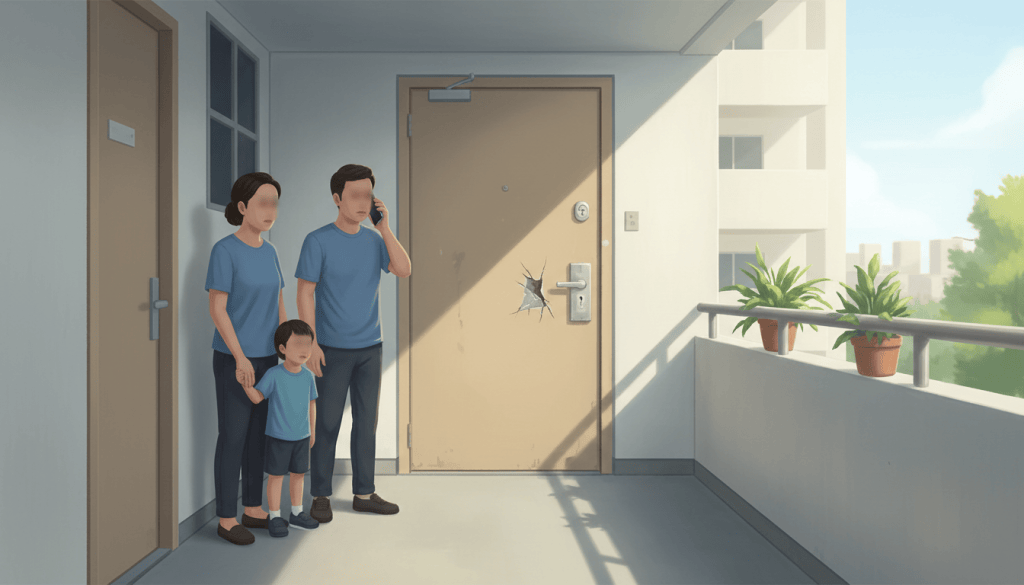
Hear someone forcing a door, discover signs of a break-in or see an intruder inside your Sengkang flat? Prioritise people, not possessions. Move to a safer place if you can do so without passing the intruder, and call 999 for immediate Police assistance. Do not confront, chase or try to detain the person. If you or a family member is seriously injured, trapped or needs urgent medical care, call 995 as well.
If you return home and the door appears forced or the flat may still contain an intruder, do not enter to check. Wait in a safe location, alert Police and tell them what you observed. If the intruder has left, avoid touching disturbed locks, drawers or objects unnecessarily until Police advise what to do. The Singapore Police Force and National Crime Prevention Council advise residents to prioritise family safety, remember details only if safe and contact Police promptly once it is safe.
Quick routing: active intruder, break-in in progress or immediate threat — Police 999; unsafe to speak — Police emergency SMS 70999; serious injury — SCDF 995; discovered property loss after the scene is safe — Police report and insurance follow-up. A housebreaking report is not an emergency ambulance request unless a person is injured or requires rescue.
The first minute if an intruder may be inside
- Do not enter or approach the intruder. If you are outside, stay outside. If inside, move away from the person using a safe route if possible.
- Get family members to safety. Do not send a child or older relative to investigate a noise.
- Call 999 from a safe place. Give your block, road, unit and what you have seen or heard.
- Stay on the line and follow Police instructions. Do not return to the flat to retrieve valuables or a phone charger.
- Avoid confrontation. Do not block the exit, threaten the intruder or try to recover property.
- Observe only if safe. Clothing, direction of travel and vehicle details may help, but do not move closer for a better view.
- Wait for Police in a safe location. Tell responding officers whether anyone may still be inside and whether there are weapons or other hazards, if known.
Who to call in Sengkang
- 999 — Singapore Police Force: immediate Police assistance for a break-in in progress, an intruder in the flat or a direct threat. SPF emergency contacts.
- 70999 — Police emergency SMS: use when you need immediate Police help and it is not safe to speak. State the exact location and situation.
- 995 — SCDF: serious injury, collapse, entrapment or urgent medical rescue. SCDF Emergency Medical Services.
- Police report e-service: for a past incident where there is no immediate danger, lodge a Police report online or attend a Neighbourhood Police Centre or Post as directed.
- Landlord, property manager or town council: after Police have attended, arrange repair of the door, grille, common access or shared property according to responsibility.
- Insurer: notify your home insurer after securing the scene and retaining the Police report reference and relevant evidence.
You return home to a forced door
A damaged lock, open gate or displaced grille is a reason to stop before entering. An intruder may still be inside, may have moved to another room or may have left recently. Do not assume that a quiet flat is safe.
Move to a neighbouring safe unit, staffed location or another place away from the door, then call Police. Tell them if children, older residents, domestic workers or pets may be inside. Do not use the lift or staircase to search for a suspect.
If the person has left, leave the scene as undisturbed as practical. Police may need to examine entry points and collect evidence. Avoid touching the door handle, drawers or items that appear to have been moved.
If you encounter an intruder while inside
Your aim is to get away from danger, not to defend a television or wallet. If there is a safe exit that does not bring you closer to the intruder, leave and call Police from a safe place. If you cannot leave safely, move to a room that can be secured, keep quiet and contact Police when possible.
Do not corner the intruder or attempt to wrestle them. An intruder may be frightened, intoxicated or armed; you cannot know their response. The NCPC advises residents to remain calm, prioritise family safety and contact Police once safe.
Do not shout details that reveal where children or other household members are hiding. Follow the Police operator’s instructions and remain away from the intruder’s route.
If the intruder threatens or injures someone
Call 999 for immediate Police help. If someone has a serious wound, head injury, difficulty breathing or has collapsed, call 995 for an ambulance. Give both operators the best available information and follow their directions.
Do not move a seriously injured person unnecessarily if a head, neck, spine or major fracture injury is possible, unless remaining in that place creates another immediate danger. Do not pursue the suspect while another person requires care.
If an intruder has left and a person is safe but frightened or distressed, offer calm support and a safe place. Medical or counselling help may be useful after the Police response.
What to observe without putting yourself at risk
- Appearance: clothing, approximate height or build and any distinctive feature you happened to notice.
- Direction: which corridor, staircase, exit or road the person used.
- Vehicle: colour, type and registration if observed safely.
- Time: when the suspicious activity began and when it was last seen.
- Entry point: door, window, grille, balcony or common access that appears damaged.
- Other people: whether anyone may still be inside or has been injured.
- Evidence: CCTV or door-camera details that Police or management may be able to preserve.
Do not follow the suspect, take a close photograph or stand in the corridor to obtain a vehicle registration. A partial observation is better than creating another victim.
After Police have secured the flat
Ask the attending officers what you should leave untouched and whether photographs or an inventory may be taken. Record the Police report reference and the officer’s contact details if provided. Keep receipts, serial numbers and photographs of stolen or damaged property for the investigation and insurance process.
Before arranging repairs, consider whether a damaged lock or broken window should be documented for Police. Once released, have the entry point made secure by a suitable contractor. If a shared gate, lift access system or common corridor door is affected, notify the responsible building manager or town council.
Do not publicise personal details of the suspected offender or publish unverified accusations in estate chats. Share relevant evidence with Police through the proper channel.
What if a child or older person was alone in the flat?
Tell Police immediately that a vulnerable person may be inside and provide the room or last known location if known. Do not ask the child or older resident to search for the intruder, open a door or approach a suspicious noise.
If a family member is missing after the incident or their safety cannot be confirmed, make that clear to the Police operator. The Sengkang missing-child and vulnerable-person guide gives separate guidance for a missing-person situation.
Housebreaking versus an ordinary lost-key problem
A lost key does not by itself prove that a burglary has occurred. Signs such as forced locks, damaged window grilles, missing property or an intruder may require Police attention. If no person is in danger and the only issue is a lockout, a verified locksmith or landlord is usually more appropriate than 999.
If an unknown person is trying keys or forcing entry while you are present, treat the active security threat seriously and call 999. Do not go out to challenge them.
How to report stolen property
Prepare an inventory of missing items after Police have secured the flat. Include make, model, serial number, distinctive marks and approximate value where known. For digital devices, note any device identifier available through your account or purchase records.
Do not exaggerate values or estimate from memory when a receipt or record is available. Insurance claims and investigations are easier to handle when information is factual and supported.
If cards, identity documents or a mobile phone are missing, secure those separately. See the Sengkang lost-wallet, NRIC and passport guide for bank, ICA, telco and Singpass steps.
Prevention for HDB flats and private homes
- Lock doors, grille gates and windows when leaving home or going to bed.
- Keep spare keys secure; avoid hiding them in obvious places near the entrance.
- Repair loose locks, broken window fittings or damaged grilles promptly.
- Keep corridors and entrances well lit where household and building rules permit.
- Consider a suitable alarm or camera system and keep access credentials private.
- Do not leave tools, ladders or other objects outside that could help someone enter.
- Arrange trusted checks for a flat left vacant for an extended period.
- During renovations, secure the unit and coordinate deliveries so valuable appliances are not left in an empty home.
What about CCTV and neighbours’ recordings?
If a corridor camera, doorbell camera or nearby building CCTV may have recorded the incident, tell Police and the property manager promptly. Footage may be overwritten or restricted by retention policies. Do not try to access another resident’s camera or publish recordings without consent.
A neighbour who witnessed suspicious activity can provide their own account to Police. Avoid coordinating a shared story or asking neighbours to speculate about who may be responsible.
Sengkang scenarios
You hear the grille being forced while your family is home
Move family members away from the entrance if safe, call 999 and follow instructions. Do not open the door to confront the person.
You return from work and find the lock damaged
Do not enter to inspect. Wait in a safe place and contact Police. Tell them whether anyone may be inside.
An intruder escapes with a phone and bank cards
Do not chase. Report the incident to Police, then contact the bank and telco to block cards and SIM access. Use the identity-document guide for any lost NRIC or passport.
A shared HDB corridor access door is damaged
If the incident is active, call Police. Once the area is safe, inform the responsible town council or building manager so the common access point can be secured.
Frequently asked questions
Should I enter my flat if the door is open unexpectedly?
No, not if a break-in is possible. Stay outside, move to safety and call Police 999.
Should I confront an intruder to protect my property?
No. Prioritise people and avoid confrontation. Call Police and follow their instructions.
What if the burglar has already left?
Once safe, contact Police, preserve the scene as practical and prepare a factual list of missing or damaged property.
Can I lodge a Police report online?
For an incident with no immediate danger, use SPF’s Police Report e-service or attend a Police station. If an intruder is present or a threat is active, call 999.
Who should repair a broken HDB door or window?
The flat owner is generally responsible for the flat’s own fixtures, while shared common property has a responsible town council or managing agent. Use appropriate qualified contractors and follow any Police scene instructions.
Related Sengkang emergency guides
- Suspicious packages, threats and Police help
- Sexual assault, medical care and survivor support
- Family violence and abuse
- Lost wallet, NRIC and bank cards
More Sengkang emergency guides: Scams, bank transfers and compromised accounts · Sexual assault, medical care and survivor support · Fallen power lines and exposed electrical cables.
Official sources and review date
- Singapore Police Force — Housebreaking: Prevention and Response
- National Crime Prevention Council — Housebreaking Safety Advice (updated 8 September 2026)
- SPF — Police Emergency and Contact Numbers
- SPF — Lodge a Police Report
- SCDF — Emergency Medical Services
Reviewed 7 November 2026. This guide is general home-safety information, not a substitute for Police instructions. If an intruder may still be inside or someone is under immediate threat, move to safety and call 999.
