
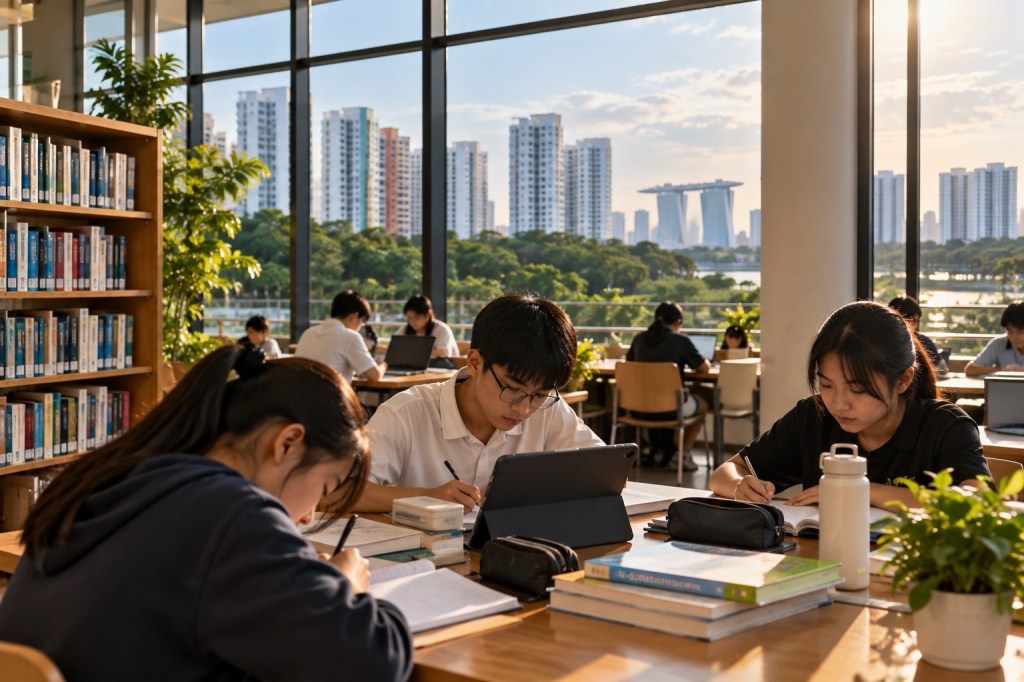
Learning G3 Science with a Limbang tutor should teach students to connect the measurement, mechanism and conclusion. A learner may remember a correct concept yet take the wrong difference from a graph, calculate a force without considering its direction or claim that an experiment proved a cause when several variables changed. Better tutoring makes the reasoning chain explicit and checks it again using unfamiliar data.
For parents near Limbang Shopping Centre and Choa Chu Kang North, G3 Science tuition must begin with the child’s actual enrolled Science subject codes. Physics, Chemistry and Biology share skills in data, explanations and fair investigations, but individual subjects and combined Science pairings do not have identical assessed content. This guide develops those habits through original numerical and conceptual clinics with safe, independent follow-up questions.
The 2027 SEAB G3 SEC school-candidate listing distinguishes individual Physics K323, Chemistry K324 and Biology K325 from combined Science (Physics, Chemistry) K326, Science (Physics, Biology) K327 and Science (Chemistry, Biology) K328. Preparation must match what the pupil actually takes. G3 identifies a subject level, not the year in school.
Where is teaching held? eduKate Sengkang lists 83 Punggol Central, Singapore 828761 as its teaching address, not Limbang. This locality study guide is not a claim of a nearby laboratory or a guaranteed class for every Science combination. Ask about current specialist teaching, fees, supervised practical facilities and the actual journey through eduKate Sengkang.
Scientific Reasoning Is a Chain
A strong answer connects the relevant concept to the mechanism, the mechanism to the evidence and the evidence to the conclusion.
Students who only memorise keywords may recognise a mark scheme without being able to construct the answer independently.
Science understanding becomes visible when the student can explain why the evidence supports the conclusion.
Physics
Physics is taught through quantities, relationships and models.
Students connect equations, graphs, diagrams and units. They learn to ask what each quantity means and whether the numerical result makes physical sense.
Chemistry
Chemistry requires movement between visible observation and particle-level explanation.
Students learn to separate what happened from why it happened and to use chemical vocabulary precisely.
Where calculations or equations are involved, the symbolic representation remains connected to the chemical process.
Biology
Biology becomes manageable when structures and processes are organised into systems.
Students connect structure to function, process to outcome and evidence to conclusion.
We use causal chains to prevent answers from becoming disconnected lists.
Graphs, Tables and Data
Students inspect axes, units, scale, trend and anomalies before making a conclusion.
We distinguish what the data directly shows from what can be inferred using scientific knowledge.
This protects the learner from vague claims and overgeneralisation.
Experimental Reasoning
Practical questions are trained through a stable framework.
- What is changed?
- What is measured?
- What is controlled?
- How is measurement carried out?
- What pattern would support the claim?
- What limitation weakens the evidence?
- What improvement directly addresses that limitation?
The apparatus may change, but the logic remains reusable.
Calculations and Units
Students identify known quantities, choose the relationship, substitute carefully, calculate and state the answer with suitable units.
A final result is checked for scientific reasonableness.
The eduKate G3 Science Runtime
1. Diagnose
We identify whether the weakness is knowledge, language, evidence, data, experimental reasoning or calculation.
2. Reconstruct
The concept is rebuilt from first principles.
3. Explain
The learner states the mechanism in their own words.
4. Change the context
The same concept appears in an unfamiliar situation.
5. Require evidence
Students point to the observation, data or principle supporting the answer.
6. Retrieve later
Earlier topics return after delay.
7. Mix concepts
The learner decides which scientific ideas belong together.
Three G3 Science Pathways
Repair
For a learner with gaps or low confidence, we rebuild core concepts and language.
Stabilise
For a learner who knows the notes but loses marks inconsistently, we train answer precision, data, calculations and experimental logic.
Extend
For a strong learner, we use unfamiliar contexts and deeper evidence evaluation.
When Should a Limbang Student Begin G3 Science Tuition?
- when the student memorises notes but struggles with application;
- when explanations contain keywords without a mechanism;
- when graphs and tables are often misread;
- when experimental variables are confused;
- when units and calculations are unreliable;
- when earlier topics are forgotten quickly;
- when combined or pure Science papers feel disconnected;
- when K323–K328 preparation needs a clearer system.
Limbang Convenience and the Actual Classroom Location
A Limbang Science tutor may make weekly attendance easier for local families.
Parents should also compare whether the teaching develops explanation, evidence use and experimental reasoning rather than simply adding more notes.
eduKate Sengkang is not located in Limbang. Our Sengkang/Punggol classroom is at 83 Punggol Central, Singapore 828761, by appointment.
Class Details
- Class size: up to 3 students
- Subject: G3 Science
- 2027 SEC routes: K323 Physics, K324 Chemistry, K325 Biology, K326 Physics/Chemistry, K327 Physics/Biology, K328 Chemistry/Biology
- Duration: 1.5 hours
- Focus: concepts, scientific language, data, experiments, calculations and application
- Method: diagnose → reconstruct → explain → evidence → independent attempt → retrieval → transfer
- Location: 83 Punggol Central, Singapore 828761
Learning G3 Science with a Limbang Tutor
Good G3 Science tuition should leave the learner with a stronger scientific method, not simply more notes.
The student should become better at identifying the concept, explaining the mechanism, interpreting the evidence, carrying out the calculation and judging whether the conclusion is justified.
For students who are behind, we rebuild. For students who are inconsistent, we stabilise. For students who are ready, we extend.
Task recognition
In G3 Science, this part of the learning system is trained through scientific vocabulary. The student is asked to do more than recognise a correct answer after it is shown. The learner must identify what the task requires, decide which knowledge or representation is useful, make an independent attempt and then inspect the result for signs that something has gone wrong. The tutor watches the decision process as carefully as the final answer because the same score can be produced by very different causes.
This matters for a student travelling from Limbang because tuition time has to produce something that survives the journey back into school. A correction that only works inside the lesson is not enough. The idea should return later, appear in a changed form and eventually sit beside other topics so the learner has to choose it without being told. That sequence—understand, attempt, correct, retrieve, mix and transfer—is what turns a short-term success into a usable capability.
As the capability becomes more stable, support is reduced. The tutor stops supplying the first move, waits longer before intervening and asks the student to explain why the chosen route belongs. This can feel slower than simply showing the answer, but it builds a learner who can continue when the task is unfamiliar. The standard is therefore not perfect performance during tuition; it is increasingly organised performance when the tutor is silent.
Building a reliable first move
In G3 Science, this part of the learning system is trained through causal mechanisms. The student is asked to do more than recognise a correct answer after it is shown. The learner must identify what the task requires, decide which knowledge or representation is useful, make an independent attempt and then inspect the result for signs that something has gone wrong. The tutor watches the decision process as carefully as the final answer because the same score can be produced by very different causes.
Correction that changes future work
In G3 Science, this part of the learning system is trained through graphs and tables. The student is asked to do more than recognise a correct answer after it is shown. The learner must identify what the task requires, decide which knowledge or representation is useful, make an independent attempt and then inspect the result for signs that something has gone wrong. The tutor watches the decision process as carefully as the final answer because the same score can be produced by very different causes.
Retrieval after delay
In G3 Science, this part of the learning system is trained through variables. The student is asked to do more than recognise a correct answer after it is shown. The learner must identify what the task requires, decide which knowledge or representation is useful, make an independent attempt and then inspect the result for signs that something has gone wrong. The tutor watches the decision process as carefully as the final answer because the same score can be produced by very different causes.
Choosing between methods
In G3 Science, this part of the learning system is trained through experimental design. The student is asked to do more than recognise a correct answer after it is shown. The learner must identify what the task requires, decide which knowledge or representation is useful, make an independent attempt and then inspect the result for signs that something has gone wrong. The tutor watches the decision process as carefully as the final answer because the same score can be produced by very different causes.
Working under mixed conditions
In G3 Science, this part of the learning system is trained through units. The student is asked to do more than recognise a correct answer after it is shown. The learner must identify what the task requires, decide which knowledge or representation is useful, make an independent attempt and then inspect the result for signs that something has gone wrong. The tutor watches the decision process as carefully as the final answer because the same score can be produced by very different causes.
Checking before submission
In G3 Science, this part of the learning system is trained through calculation. The student is asked to do more than recognise a correct answer after it is shown. The learner must identify what the task requires, decide which knowledge or representation is useful, make an independent attempt and then inspect the result for signs that something has gone wrong. The tutor watches the decision process as carefully as the final answer because the same score can be produced by very different causes.
Explaining the reasoning
In G3 Science, this part of the learning system is trained through evidence. The student is asked to do more than recognise a correct answer after it is shown. The learner must identify what the task requires, decide which knowledge or representation is useful, make an independent attempt and then inspect the result for signs that something has gone wrong. The tutor watches the decision process as carefully as the final answer because the same score can be produced by very different causes.
G3 Science in Limbang: match the actual 2027 SEC subject code first
Before discussing practice papers or tuition targets, identify what the learner is taking at school. For 2027 SEC school candidates, SEAB lists individual G3 sciences as K323 Physics, K324 Chemistry and K325 Biology. It also lists the combined Science pairings K326 Physics/Chemistry, K327 Physics/Biology and K328 Chemistry/Biology. These are not six interchangeable versions of one generic worksheet pack.
A student enrolled in Physics/Chemistry needs different coverage from a student studying Biology/Chemistry or individual Physics. The tutor should follow the school’s actual combination and current sequence, use the relevant syllabus documents and avoid presenting enrichment topics as if they were automatically assessed. A good plan still builds common scientific thinking: definitions that carry precise meaning, observation and explanation, variables and controls, graph interpretation, calculations, units and evidence-linked conclusions.
Families around Choa Chu Kang Street 51, Limbang, Choa Chu Kang North and Choa Chu Kang Street 51 can assess a tutor by asking how they determine the cause of an incorrect answer. A missing Physics relationship calls for one intervention, while misreading a graph, overclaiming a conclusion or writing vague Biology mechanism needs another. Tuition becomes efficient when the first weak link is identified rather than when the student completes the largest number of notes.
Worked Science clinic 1: distinguish speed, distance and time
A toy vehicle travels 150 metres in 30 seconds at a constant speed. Its speed is distance divided by time, 150/30 = 5 metres per second. The calculation is easy, but the student must recognise the required quantity and include the correct units. Reversing the numbers produces seconds per metre, a different measure. Omitting the units conceals which quantity has been calculated.
Now consider a journey that involves returning toward the starting point. Total distance and displacement no longer necessarily match. Average speed is total distance over total time, while average velocity depends on displacement and direction over the interval. A student who treats the two words as synonyms can reach a numerically plausible yet conceptually wrong result.
The tutor can draw a simple route and ask the student to explain the physical meaning before selecting a formula. Then change the time or route. The goal is not to memorise distance-speed-time as three letters, but to build an interpretation that works in unfamiliar motion questions.
Worked Science clinic 2: a stationary object can still experience forces
A book resting on a table is subject to gravity downward and an upward normal contact force from the table. In the simple vertical situation, the forces balance, and the book has no vertical acceleration. A weak answer might say “there are no forces because the book does not move”. That confuses zero resultant force with zero individual forces.
First select the exact Science route
A student preparing for K326 combined Physics/Chemistry has a different assessed scope from one taking individual Physics K323 and Chemistry K324. A learner taking K327 Physics/Biology should not be given a large Chemistry revision pack as though it were compulsory examined content.
Parents and tutor should confirm subject codes, school chapters and expected assessment components before selecting questions. Additional enrichment can be interesting, but it must not displace the material the student’s school actually teaches.
At review, compare the learning plan with recent schoolwork. The first diagnostic should be aligned to the real subject, not to a generic label that merely says G3 Science.
An observation does not prove every suggested cause
An invented investigation shows that one sample’s temperature fell after it was placed in a cooler environment. The recorded change is an observation. Explaining it through energy transfer requires the relevant information about the sample and surroundings, while claiming that every material always cools at the same rate would exceed this single result.
Ask the learner to separate what was measured, what scientific model helps explain it and what remains unknown. This distinction is useful across Physics, Chemistry and Biology even though the mechanisms differ.
For a new example, give a graph with only two endpoint readings. The student should calculate the total change without claiming a perfectly constant rate throughout the interval.
Controls make a causal comparison possible
A fictional investigation tests whether the exposed area of water affects its evaporation over a fixed duration. Surface area is deliberately changed; mass lost may be measured. Starting mass, environmental conditions and other relevant factors should be comparable for the chosen question.
If one dish also receives stronger airflow, a difference in mass lost cannot be attributed solely to exposed area. Naming a controlled variable is only useful when the learner can explain how the variable would otherwise confound the test.
Change the investigation to light intensity and a plant response. The suitable controls change with the process, while the reasoning about isolating a variable remains the same.
Repetition does not repair a systematic design error
Repeating a comparison ten times can help reveal variability, but if both water amount and temperature change between trial groups, repetition alone does not isolate their separate effects. A student who writes “repeat the experiment” for every design question may be using a stock answer rather than evaluating the actual weakness.
Ask whether the concern is inconsistent measurement, an uncontrolled condition, an inappropriate scale or insufficient observations. Each issue suggests a different improvement.
At review, offer a study with suitable controls but unusually scattered readings. Additional trials may be useful there, and the student should explain why the recommendation changes.
Scientific data clinic: final temperature and temperature change are different
Two fictional samples are warmed. A begins at 18°C and ends at 34°C, while B begins at 25°C and ends at 38°C. B ends at a higher temperature, but A has a larger recorded increase: sixteen degrees rather than thirteen. A student choosing thirty-eight for the largest increase has selected the wrong kind of quantity.
Mark initial, final, change and elapsed time in a small table. If only endpoints are provided, average temperature change can be calculated, but constant instantaneous heating is not established.
For transfer, change to a cooling experiment with unequal starting readings. The learner should compare the requested change without using a fixed shortcut that the largest printed number always wins.
A fair test needs its intended factor isolated
An original investigation compares plant growth in two containers, but the brighter container also receives more water. A difference in height does not establish that light alone caused it. The independent variable was not isolated because at least two relevant influences differed.
Ask what the study is trying to find, which outcome is measured and what should remain comparable. Repeating the same flawed arrangement ten times may provide more readings without removing the confound.
At review, provide a well-controlled but variable dataset. Now additional repeated observations may be useful for assessing variability. The proposed improvement must target the actual limitation.
A distance-time graph should not be confused with a velocity-time graph
On a distance-time graph, a positive straight-line gradient represents the rate of distance covered under the chosen scale. On a velocity-time graph, gradient represents acceleration, not speed. Two lines with similar shapes can therefore describe different quantities because their axes differ.
Read both labels, units and scales before performing any subtraction or division. A student who remembers a graph rule but ignores the axis may report a physical quantity in the wrong unit.
On a changed diagram, provide one distance-time and one velocity-time graph. The learner should state precisely what each gradient describes and what additional information is needed.
A bigger final reading is not the same as a larger increase
Two fictional samples warm for six minutes. A starts at 19°C and finishes at 36°C; B starts at 26°C and finishes at 40°C. B finishes hotter, but A rises seventeen degrees while B rises fourteen. Selecting forty because it is the largest visible number would answer a final-temperature question, not a change question.
Ask the learner to list start, finish, difference and elapsed time. A changed cooling task should be solved independently, with the conclusion naming the actual measurement requested. Endpoints alone cannot show whether the rate was constant every minute.
A rate of change needs a starting velocity
An invented vehicle changes velocity from 5 m/s to 17 m/s in four seconds. Its average acceleration is (17 − 5)/4 = 3 m/s², not 17/4. The initial velocity matters because acceleration measures change of velocity with time.
Have the student check directions and units before subtracting. In the later task the final velocity is smaller, and a negative signed acceleration must be interpreted according to the chosen positive direction.
A force diagram should distinguish applied and resultant forces
A fictional 4 kg object experiences a 20 N push to the right and an 8 N resisting force to the left. Its resultant is 12 N to the right, so acceleration is 12/4 = 3 m/s² to the right under the simplified model. Using the 20 N push alone would ignore the resisting interaction.
Draw and label arrows with directions. On an unfamiliar scenario, reverse the larger arrow and explain how that changes the direction and magnitude of the resultant before using Newton’s second law.
A stationary book still experiences forces
An object resting on a level shelf may have weight downward and a normal contact force upward under a simple balanced model. Its net vertical force is zero although individual forces exist. A student who says no forces act because nothing is moving confuses force balance with absence of interaction.
Ask which surface or body applies each force and how the forces combine. A new task introduces a horizontal push, requiring additional relevant arrows rather than repeating only the vertical pair.
Speed, distance and displacement are not interchangeable
An invented path moves four metres east followed by three metres north. The total distance is seven metres, while the resultant displacement magnitude is five metres because the two legs are perpendicular. Both numbers are valid, but they describe different quantities.
Ask which measurement the task requests and represent direction with arrows. For transfer, change the second leg west or south and require another vector diagram before calculation.
Power compares energy with time
A hypothetical machine transfers 840 J of energy in 28 seconds, giving average power 30 W. Another transfers the same 840 J in 56 seconds and therefore has half the average power. Equal total energy does not imply equal rate of transfer.
Require a predicted unit before calculation. Change the unknown to energy with supplied power and time in the later task, reversing the relationship and checking that the result is in joules.
A circuit has an arrangement, not simply a list of components
An invented ideal circuit has two resistors of 2 Ω and 4 Ω connected in series to a 12 V source. Its combined resistance is 6 Ω, and current is 2 A. The potential differences of 4 V and 8 V across the resistors add to the supply. Drawing the resistors near one another does not establish a series connection if the wires differ.
Trace the actual conducting path on a school-supplied diagram. In a changed circuit, rearrange the symbols and ask whether the connections remain series. Only appropriately supervised low-voltage practicals should be used.
An efficiency calculation needs the correct numerator
A fictional device receives 250 J and transfers 175 J to its stated useful output. The efficiency is (175/250) × 100% = 70%. The remaining energy is transferred or stored in other ways; it has not been destroyed.
Ask the pupil to name useful output and total input. A proposed efficiency over 100% in this conventional model signals reversed terms or a misunderstood boundary. Change the supplied efficiency and ask for useful output.
A wave diagram needs a labelled distance or time scale
An ideal wave travels at 15 m/s with frequency 5 Hz. Its wavelength is v/f = 3 metres. A sketch of several crests with no horizontal-axis unit does not independently specify whether the spacing represents physical distance or timing.
Read the labels before counting peaks and check dimensional consistency. A later example gives speed and wavelength and asks for frequency, requiring a fresh interpretation rather than a repeated division by five.
Mass conservation depends on what is counted
In a fictional closed vessel, total mass before and after a chemical reaction is conserved even if products include gas. If the vessel is opened and gas escapes, the measured mass of the remaining contents may decrease. That does not prove atoms disappeared, because the measurement no longer includes the escaped material.
Ask what boundary defines the system. A changed diagram showing a gas collection vessel should prompt the student to explain which masses the balance records.
Balanced equations cannot be repaired by changing substances
The equation 2Mg + O₂ → 2MgO has two magnesium atoms and two oxygen atoms on each side. Changing coefficients adjusts numbers of formula units; changing the subscript in MgO would change what chemical is represented.
Ask the pupil to count every element on both sides. A new reaction must be balanced through conservation rather than through a remembered pattern of coefficients.
Amount concentration needs a consistent solution volume
A fictional solution contains 0.30 mol of a solute in 0.75 L of solution, giving 0.40 mol/L. Dividing by 750 while retaining litres would be a unit conversion error. The numerical value depends on what units were used in the concentration relation.
Label amount, concentration and solution volume first. A changed task supplies 0.20 mol/L in 0.50 L and asks for amount: 0.10 mol. The learner should use multiplication and verify units.
Reaction speed and endpoint time need different comparisons
Two hypothetical reaction trials produce the same total measured volume of gas, but one reaches the endpoint in eight seconds and another in twelve. Under comparable conditions, the first has a greater average production rate to that endpoint. The largest elapsed-time number is not the fastest trial.
Change the setup so both trials run for the same time but produce different gas volumes. The student should decide which comparison is meaningful instead of using the word largest automatically.
An indicator result may support only a pH range
An invented school experiment records an indicator colour that corresponds to a pH interval on a supplied reference chart. That can support a range or broad classification. It does not support stating the exact pH to three decimal places if the method did not resolve that precision.
Separate the observed colour, the chart evidence and any requested chemical inference. Review using another reference table rather than mixing unknown household substances.
Diffusion and osmosis require distinct explanation
Diffusion concerns net movement of particles down a concentration gradient in an appropriate model. Osmosis specifically involves net water movement through a partially permeable membrane because of water-potential differences. Treating the two terms as simple synonyms can omit the key substance and interface.
Label what moves, across what barrier and under which conditions. The next diagram changes the external solution so the learner must construct a new direction of water movement.
Breathing, gas exchange and circulation answer different questions
Breathing moves air into and out of the lungs. Gas exchange transfers respiratory gases across suitable surfaces, and circulation transports blood and its contents around the body. A response about inhalation alone may not explain how oxygen reaches body cells.
Ask which process the question targets, then connect the necessary stages without listing unrelated organs. Do not turn homework into breath-holding challenges or collection of personal biological samples.
A genetic ratio describes probabilities, not a promise
Under a simple complete-dominance single-gene model, Aa crossed with aa yields the possible offspring genotypes Aa and aa in equal expected proportions. It is not a guarantee that a particular pair of real children must contain exactly one of each.
Use a Punnett square to show the allele from each parent. Change the parental genotypes in the follow-up and ask for a new distribution. Only use such topics when aligned to the student’s actual enrolled Biology syllabus.
A food-web arrow is evidence of a feeding connection
An imaginary herbivore feeds on two kinds of plants and is itself eaten by two predators. A decline in one plant might affect the herbivore and the predators, but other feeding routes limit the certainty of any prediction. Claiming immediate extinction of everything above that plant goes beyond the diagram.
Trace direct links first, then discuss plausible indirect effects and missing information. Add another feeding connection in the new task and ask how it changes the strength of the conclusion.
Repeating a flawed experiment can repeat the same error
A fictional investigation compares a large dish near a fan with a smaller dish in still air, then claims surface area alone caused a change in evaporation. Both surface area and airflow differed. More repetitions of that exact arrangement may reproduce the result without isolating the cause.
Identify the intended variable and uncontrolled influence, then propose comparable airflow and relevant other conditions. In a different study with controls already in place but scattered readings, repetition may have a more appropriate role.
The right Science syllabus must be selected before tuition
The 2027 G3 SEC routes include K323 individual Physics, K324 Chemistry, K325 Biology, plus paired combined Science K326, K327 and K328. The required topics, techniques and practical assessments differ by enrolled subject. One generic three-science folder may divert time from what the student actually takes.
Ask the provider which subject codes are supported and how tutoring uses the school’s current work. A combined Science student should not be assumed to have identical examination requirements to a student taking individual Chemistry or Biology.
Practical confidence can grow without unsafe home tasks
Graphs, apparatus diagrams, controlled-variable tables and teacher-provided experimental readings allow serious scientific reasoning without household mains circuits, unknown chemical mixtures, microbial cultures or personal sample handling. Safety is not merely a formality added after the lesson.
Ask what equipment, supervision and permissions exist for practical tuition. A new paper experiment can require the student to choose apparatus, explain controls and state a defensible limitation without recreating any risk.
Integrated G3 Science task: what can the measurements prove?
Two fictional samples warm for six minutes. Sample A starts at 19°C and finishes at 36°C; B begins at 26°C and finishes at 40°C. A records the larger increase of seventeen degrees, while B ends hotter. If the samples differ in mass or heating conditions, the comparison does not alone establish which material necessarily warms faster under matched conditions.
Ask what observations are supported, which relevant variables might need controls and what intermediate readings could help distinguish rate over time. In a changed cooling task the learner should form a new conclusion and limitation, rather than copy the original wording.
Six weeks of G3 Science practice and independent checking
Week one confirms the enrolled individual or combined Science codes and collects a short baseline in concepts, calculations, graphs and investigations. Week two repairs a consequential misconception. Week three changes the representation, week four tests retrieval after a delay, week five adds manageable time conditions and week six compares new independent work with the original attempt.
This is an illustrative plan, not a guarantee of a particular grade. A small group may benefit from shared scientific discussion, while each learner needs an unfamiliar final task to demonstrate what they can explain without a prompt.
Limbang family logistics and science resources
HDB’s Limbang Shopping Centre listing grounds the locality. The NLB library directory provides information about Choa Chu Kang Public Library at Lot One as an optional public reading resource in the wider area. Neither is an eduKate classroom, a laboratory or a guaranteed seat.
A tuition programme based at Punggol Central must account for the actual journey, school dismissal, CCAs, meals, remaining homework and rest. Safe homework on graphs, variables and explanations can often be more useful than attempting to re-create supervised experiments in unsuitable home conditions.
Frequently asked questions about G3 Science in Limbang
Does one G3 Science examination include Physics, Chemistry and Biology?
No. SEAB lists the individual K323–K325 subjects and defined two-science pairings K326–K328. Preparation must follow the student’s enrolment.
Why can an answer with the right keywords still lose marks?
Keywords need to be connected to the data, mechanism or investigation question. Naming a concept alone may not address what the evidence shows.
Can simply repeating a test establish cause?
Not if a second important factor changes. Appropriate controls and measurement choices matter for validity.
Is a Limbang science laboratory confirmed?
No. The provider’s stated classroom is at 83 Punggol Central; ask directly what supervised practical resources exist.
Are risky home experiments necessary for effective tuition?
No. Safe supplied data and properly supervised practicals can build real experiment reasoning.
Can a tutor guarantee grades?
No. Skills and independence can improve, but examination results depend on multiple factors.
Continue the G3 Limbang subject sequence
G3 English with Limbang Tutor · G3 Mathematics with Limbang Tutor · G3 Additional Mathematics with Limbang Tutor
The G2 Science Limbang guide covers separate K223–K225 pairings. Further support is in the SEC Science Learning Guide, the official SEAB 2027 G3 subject list and the G3 Yew Tee Science guide.
Discuss the correct Science combination and first missing explanation
Contact eduKate Sengkang with schoolwork and the student’s individual or combined Science codes. Ask which evidence-to-mechanism link needs repair, how independent progress will be checked and what actual supervised practical support and commute are available.
