
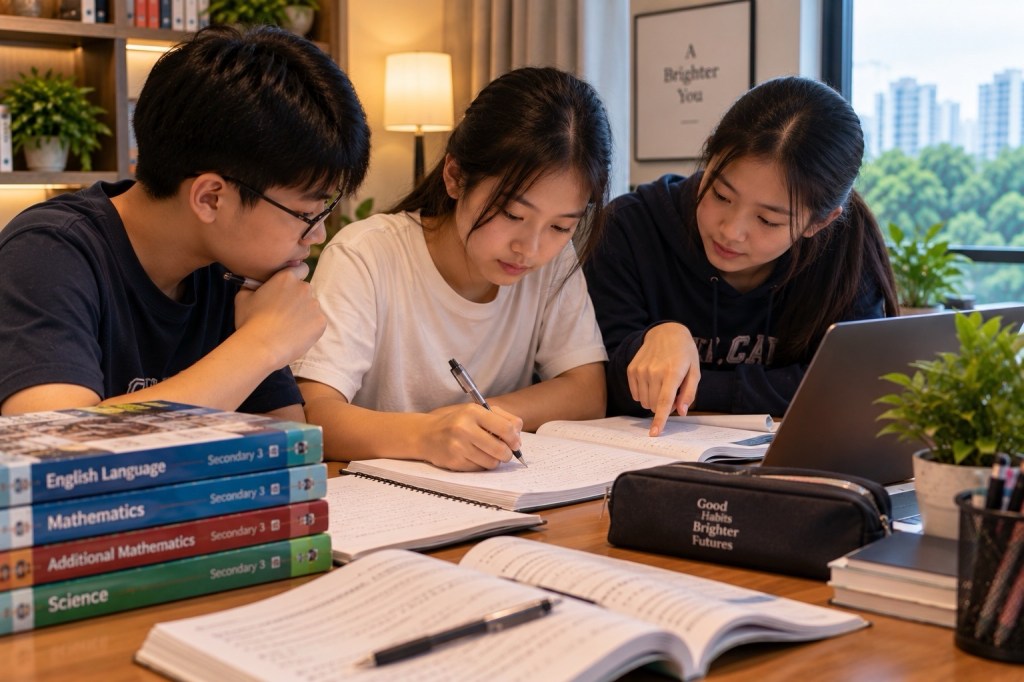
Learning G3 A-Math with a Limbang tutor should help students understand why a mathematical step remains valid. A pupil may correctly factorise the first line but forget the original denominator restriction, stop after one trigonometric angle or confuse a tangent gradient with the curve’s y-coordinate. More formulas will not necessarily repair these errors. The tutor needs to identify the first invalid transformation and help the learner check it independently.
For families near Limbang Shopping Centre and Choa Chu Kang Street 51, this Additional Mathematics guide connects quadratics, algebraic fractions, polynomials, functions, surds, logarithms, coordinate geometry, trigonometry and calculus. The common thread is an equivalence-and-domain audit: what does the question demand, what values are permitted and how can we verify the result using a different representation?
The 2027 official SEAB G3 subject list confirms Additional Mathematics K341, distinct from Mathematics K310. G3 is a subject level, not necessarily Secondary 3 or 4. Actual enrolment, school sequence and prerequisite fluency should guide tuition; neither subject placement nor grades can be guaranteed by private lessons.
Venue clarity: eduKate Sengkang is at 83 Punggol Central, Singapore 828761, not Limbang. A parent learning guide does not establish an outlet in Limbang or availability in a particular K341 group. Check current lessons, fees, group size and feasible weekly travel through the provider.
The Visible Topic Is Not Always the Real Problem
A calculus question may fail because the learner cannot rearrange an equation. A trigonometric question may fail because factorisation is slow. A graph question may fail because function notation is still unfamiliar.
The tutor therefore traces errors backwards until the first unstable dependency appears.
In A-Math, the shortest route forward is often to repair the earliest skill that should already be automatic.
Algebra
Algebra is the operating system of G3 Additional Mathematics.
Students practise simplification, expansion, factorisation, substitution and equation solving with enough repetition to make routine symbolic work efficient.
The tutor pays close attention to brackets, signs, indices and exact values because these small details often determine whether a long solution survives.
Functions and Graphs
Functions are taught as relationships rather than notation to memorise.
Students connect algebraic form to graphical behaviour and use graphs to reason about roots, intersections and turning behaviour.
Coordinate Geometry
Coordinate geometry sits at the intersection of algebra and space.
Students use gradients, equations, distances and geometric conditions, and they learn to use the diagram and the algebra as mutual checks.
Trigonometry
G3 A-Math trigonometry demands symbolic fluency.
Students distinguish identities from equations, manage intervals carefully and preserve a clear line of transformation.
The aim is to understand which steps are valid and why.
Differentiation
Differentiation is first understood as gradient and rate of change.
Students then practise rules, tangents, normals, stationary points and applications while keeping the concept connected to the graph or changing quantity.
Integration
Integration is taught as reverse differentiation and accumulation.
Students practise standard forms and applications while checking whether the final result has a sensible mathematical interpretation.
The eduKate G3 A-Math Runtime
1. Diagnose
We identify whether the problem is conceptual, algebraic, representational or procedural.
2. Repair
The earliest unstable prerequisite is strengthened.
3. Model
The tutor explains why the method applies.
4. Vary
The question form changes so the student must recognise the structure.
5. Remove support
The learner reconstructs the method independently.
6. Retrieve later
Earlier ideas return after delay.
7. Transfer
The student meets mixed problems where several methods may compete.
Three G3 A-Math Pathways
Repair
For a learner already struggling, we rebuild the earliest weak dependency.
Stabilise
For a learner who understands lessons but produces uneven test results, we train retrieval, checking and examination control.
Extend
For a strong learner, we use unfamiliar forms, multiple methods and deeper explanation.
When Should a Limbang Student Begin G3 A-Math Tuition?
- when algebra is slow;
- when the student can follow worked examples but cannot start a changed problem;
- when sign and bracket errors repeat;
- when functions and graphs feel disconnected;
- when trigonometric manipulation is fragile;
- when calculus rules are known but applications remain difficult;
- when topical work is strong but mixed papers are weak;
- when K341 preparation needs a clearer system.
Limbang Convenience and the Actual Classroom Location
A Limbang A-Math tutor may make weekly attendance easier for local families.
Parents should also compare whether the tutor diagnoses prerequisite gaps and tests corrected skills again after time has passed.
eduKate Sengkang is not located in Limbang. Our Sengkang/Punggol classroom is at 83 Punggol Central, Singapore 828761, by appointment.
Class Details
- Class size: up to 3 students
- Subject: G3 Additional Mathematics
- SEC route: K341 for 2027 school candidates
- Duration: 1.5 hours
- Focus: algebra, functions, coordinate geometry, trigonometry, calculus and examination control
- Method: diagnose → repair → model → vary → independent attempt → retrieval → transfer
- Location: 83 Punggol Central, Singapore 828761
Learning G3 A-Math with a Limbang Tutor
Good G3 A-Math tuition should make difficult mathematics reconstructible.
The learner should become better at seeing the structure, choosing a method, carrying out the symbolic work and checking the result.
For students who are behind, we rebuild. For students who are inconsistent, we stabilise. For students who are ready, we extend.
Task recognition
In G3 Additional Mathematics, this part of the learning system is trained through algebraic structure. The student is asked to do more than recognise a correct answer after it is shown. The learner must identify what the task requires, decide which knowledge or representation is useful, make an independent attempt and then inspect the result for signs that something has gone wrong. The tutor watches the decision process as carefully as the final answer because the same score can be produced by very different causes.
This matters for a student travelling from Limbang because tuition time has to produce something that survives the journey back into school. A correction that only works inside the lesson is not enough. The idea should return later, appear in a changed form and eventually sit beside other topics so the learner has to choose it without being told. That sequence—understand, attempt, correct, retrieve, mix and transfer—is what turns a short-term success into a usable capability.
As the capability becomes more stable, support is reduced. The tutor stops supplying the first move, waits longer before intervening and asks the student to explain why the chosen route belongs. This can feel slower than simply showing the answer, but it builds a learner who can continue when the task is unfamiliar. The standard is therefore not perfect performance during tuition; it is increasingly organised performance when the tutor is silent.
Building a reliable first move
In G3 Additional Mathematics, this part of the learning system is trained through functions. The student is asked to do more than recognise a correct answer after it is shown. The learner must identify what the task requires, decide which knowledge or representation is useful, make an independent attempt and then inspect the result for signs that something has gone wrong. The tutor watches the decision process as carefully as the final answer because the same score can be produced by very different causes.
Correction that changes future work
In G3 Additional Mathematics, this part of the learning system is trained through graphs. The student is asked to do more than recognise a correct answer after it is shown. The learner must identify what the task requires, decide which knowledge or representation is useful, make an independent attempt and then inspect the result for signs that something has gone wrong. The tutor watches the decision process as carefully as the final answer because the same score can be produced by very different causes.
Retrieval after delay
In G3 Additional Mathematics, this part of the learning system is trained through equations. The student is asked to do more than recognise a correct answer after it is shown. The learner must identify what the task requires, decide which knowledge or representation is useful, make an independent attempt and then inspect the result for signs that something has gone wrong. The tutor watches the decision process as carefully as the final answer because the same score can be produced by very different causes.
Choosing between methods
In G3 Additional Mathematics, this part of the learning system is trained through trigonometric identities. The student is asked to do more than recognise a correct answer after it is shown. The learner must identify what the task requires, decide which knowledge or representation is useful, make an independent attempt and then inspect the result for signs that something has gone wrong. The tutor watches the decision process as carefully as the final answer because the same score can be produced by very different causes.
Working under mixed conditions
In G3 Additional Mathematics, this part of the learning system is trained through coordinate geometry. The student is asked to do more than recognise a correct answer after it is shown. The learner must identify what the task requires, decide which knowledge or representation is useful, make an independent attempt and then inspect the result for signs that something has gone wrong. The tutor watches the decision process as carefully as the final answer because the same score can be produced by very different causes.
Checking before submission
In G3 Additional Mathematics, this part of the learning system is trained through differentiation. The student is asked to do more than recognise a correct answer after it is shown. The learner must identify what the task requires, decide which knowledge or representation is useful, make an independent attempt and then inspect the result for signs that something has gone wrong. The tutor watches the decision process as carefully as the final answer because the same score can be produced by very different causes.
Explaining the reasoning
In G3 Additional Mathematics, this part of the learning system is trained through integration. The student is asked to do more than recognise a correct answer after it is shown. The learner must identify what the task requires, decide which knowledge or representation is useful, make an independent attempt and then inspect the result for signs that something has gone wrong. The tutor watches the decision process as carefully as the final answer because the same score can be produced by very different causes.
G3 Additional Mathematics: build connections instead of collecting tricks
SEAB lists G3 Additional Mathematics as K341 for 2027 Singapore-Cambridge Secondary Education Certificate school candidates. This is a separate subject from G3 Mathematics K310 and from the G2 Additional Mathematics syllabus K232. A reliable tuition plan begins by checking the student’s actual school enrolment, sequence of topics and current weak areas. A young secondary student prepares toward future SEC assessments through schoolwork; the code does not mean every lesson should immediately resemble a final examination.
Additional Mathematics rewards symbolic fluency, but it also punishes shallow pattern matching. A student may know a differentiation rule and still find a wrong tangent because the coordinate came from the derivative instead of the original function. Another may cancel a term from an algebraic fraction without factoring first. Both need an explanation of the mathematical structure, not simply a model solution to memorise.
Families around Choa Chu Kang Street 51, Choa Chu Kang North, Limbang and Choa Chu Kang Street 51 should ask how a tutor distinguishes a conceptual gap from an error of recall, notation or method choice. The best learning evidence is a fresh independent problem solved after a delay, with every transformation preserving the meaning of the original question.
Worked clinic 1: factorisation is a checkable equivalence
Factorise 2x² + 7x + 3. One valid form is (2x + 1)(x + 3). Expanding gives 2x² + 6x + x + 3, which combines to the original expression. A learner who writes (2x + 3)(x + 1) has made a plausible-looking choice, but expansion produces 2x² + 5x + 3, showing the mismatch.
The tutor can ask the student to name which pair of terms must account for the middle coefficient and why testing by expansion is decisive. Students should distinguish the task “factorise the expression” from “solve the equation”. If 2x² + 7x + 3 = 0, the factorised form yields x = -1/2 or x = -3. Those values satisfy the equation; the factors themselves are not the final roots.
For transfer, change the coefficients and remove the factorisation heading. When a quadratic appears inside a rational expression or a graph question, the learner must recognise whether factorisation is useful without being prompted by the chapter name.
Worked clinic 2: completing the square explains the graph
Consider y = x² – 6x + 5. Rewrite it as y = (x – 3)² – 4. The completed-square form shows that the parabola opens upward and has a minimum point at (3, -4). Setting y equal to zero gives (x – 3)² = 4, so the roots are x = 1 and x = 5. The same curve can also be expressed as y = (x – 1)(x – 5).
A student who knows the factoring route may still struggle to locate the minimum without drawing a detailed table. Completing the square provides another view of the structure. The tutor should ask what each form reveals and verify that expansion produces the same original expression. Different representations are useful for different questions.
Change the squared term to (x + 3)² – 4 and ask which way the vertex moves. Students who guess that the positive three moves the curve right may need to substitute the vertex input and inspect the equality. Reasoning from the expression is stronger than memorising a visual slogan about translations.
Factorisation requires agreement in every coefficient
Consider 3x² − 11x + 6. A valid factorisation is (3x − 2)(x − 3), because expanding produces 3x² − 9x − 2x + 6. The roots of the equation 3x² − 11x + 6 = 0 are therefore x = 2/3 or x = 3.
A student who proposes (3x − 3)(x − 2) has found similar numbers but changed the middle coefficient when expanding. Ask the learner to check every term, not only the constant. Rewriting an expression and solving an equation are separate tasks.
At review, change the coefficients and remove the chapter heading. The student should decide when factorisation is useful and verify the resulting expression independently.
The discriminant is a classification, not merely a number
For 2x² + 3x + 5 = 0, the discriminant b² − 4ac is 9 − 40 = −31. Because it is negative, the equation has no real roots. This corresponds to a related upward-opening quadratic graph that does not intersect the horizontal axis.
Compare a zero discriminant with a positive discriminant. A repeated real root corresponds to one point of contact, while two distinct real roots correspond to two horizontal intercepts, under the usual quadratic conditions.
A student who forces a real square root of a negative value has ignored the domain. Ask for a graphical explanation as well as the algebraic classification.
Completing the square reveals the turning point
Write y = x² + 2x − 8 as y = (x + 1)² − 9. The square is non-negative, so the minimum point is (−1, −9). Setting y to zero gives x + 1 = ±3, producing horizontal intercepts at x = 2 and x = −4.
The factorised form (x − 2)(x + 4) reveals the roots more directly. Both representations must expand to the same expression. A learner should choose the form that exposes what the question requests.
At review, change the constant and ask how the minimum value changes. The student should reason from the completed square rather than sketch a guessed curve.
Algebraic fractions preserve excluded values
The expression (x² − 1)/(x − 1) simplifies to x + 1 by factoring the numerator as (x − 1)(x + 1), but only where x is not one. The original denominator cannot become valid at x = 1 merely because cancellation makes it disappear from the printed simplified form.
Compare the invalid cancellation of terms from (x + 1)/(x + 2). A numerical substitution can reject such a false identity, while the full explanation depends on common factors rather than matching symbols.
A fresh rational expression should be checked for excluded values before and after simplification. Domain reasoning is part of correct algebra, not optional extra notation.
Surds retain exact meaning through manipulation
Simplify √98. Since 98 = 49 × 2, the exact result is 7√2. The expression is equivalent to the original positive square root; a decimal approximation is useful for checking but is not always the requested answer.
Compare 2√3 + 5√3 = 7√3 with 2√3 + 5√2, which cannot be combined into one like surd by simply adding coefficients. The radical part matters just as a variable part does in algebra.
At review, present a fraction requiring rationalisation. The learner should multiply numerator and denominator by an appropriate equal factor and explain why the overall value remains unchanged.
Exponential and logarithmic expressions are inverses
The statement 3⁴ = 81 corresponds to log₃81 = 4. A logarithm identifies the exponent needed on a specified positive base other than one. It is not an ordinary instruction to divide the numbers printed next to the log symbol.
Ask why a real logarithm requires a positive argument and what changes when its base changes. For instance, log₂8 = 3 expresses a different base but the same inverse-exponent idea.
A new equation such as 2ˣ = 16 should be solved and checked by returning to the exponential form. The tutor should connect meanings rather than teach a disconnected list of log laws.
Binomial expansion is controlled multiplication
The expression (1 + 2x)³ expands to 1 + 6x + 12x² + 8x³. Multiplying one bracket at a time or using the binomial theorem can verify the coefficient pattern. A pupil who writes 1 + 8x³ has incorrectly distributed the power over addition.
Ask the learner to compare the constant term, the highest power and the middle terms. These features provide checks before the entire expression is expanded again. The binomial coefficients are connected to repeated multiplication, not arbitrary remembered numbers.
For a changed binomial with a negative second term, track alternating signs carefully and substitute a simple x value to reject an invalid expansion.
Inverse functions require one-to-one behaviour on the domain
For f(x) = 2x + 5, solving y = 2x + 5 for x gives x = (y − 5)/2. The inverse function on the appropriate domain is f⁻¹(x) = (x − 5)/2. Composing f with its inverse returns the original input.
Now compare f(x) = x² across all real inputs. Both x = 3 and x = −3 produce nine, so it does not have a single-valued inverse over all real numbers without restricting the domain appropriately.
The learner should identify when a restriction creates a valid inverse rather than assume every printed function can be reversed in one unique way.
Coordinate geometry turns slope into a line equation
A line through (1, 2) and (4, 11) has gradient (11 − 2)/(4 − 1) = 3. Its equation can be written y − 2 = 3(x − 1), simplifying to y = 3x − 1. Substituting both given coordinates verifies the relationship.
A non-vertical perpendicular line has gradient −1/3. Simply changing three to negative three would not produce a perpendicular relationship. The negative reciprocal follows from the geometry of orthogonal directions.
At review, give a new point and ask for a perpendicular line through it. Check both the gradient and the point instead of accepting the final equation merely because its algebra looks tidy.
A factorisation should recreate the middle term exactly
The quadratic 2x² − 9x + 4 factorises as (2x − 1)(x − 4). Expanding gives 2x² − 8x − x + 4, agreeing with every coefficient. Solving 2x² − 9x + 4 = 0 then gives roots x = 1/2 or x = 4. Factors alone are not the final answer if a question requests solutions.
Ask the child to expand the proposed factors and check both roots in the original equation. A fresh polynomial without a chapter heading should prompt the correct choice between expand, factorise and solve.
Completing the square gives a turning point before it gives roots
For y = x² + 8x + 3, completing the square gives y = (x + 4)² − 13. The vertex is (−4, −13), a minimum because the square has a positive coefficient. Solving y = 0 gives x = −4 ± √13. These are different features of the same quadratic.
Ask what the problem actually requests before selecting a representation. The student should verify the vertex by substitution and check the root relation separately. A changed quadratic with a negative leading coefficient can have a maximum instead.
A repeated root can imply two valid parameter values
Consider x² − 2kx + 9 = 0. For one repeated real root, its discriminant must be zero: 4k² − 36 = 0. Hence k² = 9 and k = 3 or −3. Reporting only positive three has dropped one sign branch.
Check by substituting both parameter values: the expressions become (x − 3)² and (x + 3)². Change the condition to two distinct real roots in another task and ask what inequality the discriminant must satisfy.
A rational expression keeps its original excluded input
The rational expression (x² − 16)/(x² − 8x + 16) factors as (x − 4)(x + 4)/(x − 4)² and simplifies to (x + 4)/(x − 4), provided x is not four. Cancelling one factor does not permit x = 4 because the original denominator is zero there.
List restrictions from the original expression before simplifying. A later fraction with a different factorisation should preserve all excluded inputs. Matching x symbols inside sums is not a legitimate shortcut for cancelling factors.
A conjugate preserves a surd fraction exactly
The expression 4/(√7 − √3) can be rationalised by multiplying numerator and denominator by √7 + √3. The denominator becomes 7 − 3 = 4 and the result simplifies to √7 + √3. Both forms are exactly equal.
Ask why the conjugate creates a difference of squares and why the multiplication leaves the fraction unchanged. In a new denominator, choose the appropriate conjugate independently; a calculator approximation can provide a magnitude check but not the algebraic proof.
Logarithms require a positive argument
Solving log₃(x + 2) = 2 means x + 2 = 3² = 9, so x = 7. The original logarithm requires x + 2 greater than zero, which seven satisfies. An algebraic candidate where the argument is zero or negative cannot be a real solution.
Translate between logarithmic and exponential statements, then check the domain and answer. A changed equation with another base should be solved without copying the first calculation.
Exponential equations reflect repeated multiplication
The equation 4ˣ = 64 has x = 3 because 4³ = 64. This is different from solving 4x = 64, which would give sixteen. An exponent is not an ordinary coefficient multiplying the variable.
Ask the child to explain powers as repeated multiplication and connect exponential and logarithmic forms where appropriate. A later non-integer exponent task should be checked against the actual allowed methods and school topics.
The order of function composition matters
Let f(x) = 2x + 1 and g(x) = x² − 4. Then f(g(x)) = 2x² − 7, while g(f(x)) = (2x + 1)² − 4 = 4x² + 4x − 3. In particular, at x = 1 the first gives −5 and the second gives 5. The same two functions in reversed order do not generally give the same result.
Use an input–output diagram to clarify which rule is applied first. For a fresh pair, ask the learner to evaluate both compositions and compare any domain restrictions.
An inverse expression requires one-to-one reasoning
For f(x) = 3x − 2, solving y = 3x − 2 for x gives f⁻¹(y) = (y + 2)/3. Checking f⁻¹(f(5)) returns five. But y = x² across all real x cannot have a single-valued inverse function without an appropriate domain restriction.
Ask what makes an inverse operation recover a unique input. A fresh function with a restricted domain should be analysed before the student declares its inverse.
Polynomial division starts from the correct test value
For P(x) = x³ − 3x² − 4x + 12, substitution gives P(3) = 27 − 27 − 12 + 12 = 0. Therefore x − 3 is a factor. Division yields x² − 4, and the complete factorisation is (x − 3)(x − 2)(x + 2).
Ask which input makes a candidate factor zero, then verify the complete product by expansion. An unfamiliar cubic should require factor testing and division without a worked method already selected.
Coordinate geometry needs a slope and a point
A line has gradient −2 and passes through (3,4). Its equation is y − 4 = −2(x − 3), or y = −2x + 10. Substitution confirms that x = 3 produces y = 4. Simply using the supplied y-coordinate as the intercept would be incorrect.
Change the point and ask for a perpendicular line, whose gradient is the negative reciprocal where defined. The learner should not confuse a point coordinate with the constant term of an equation.
The circle’s centre is encoded by opposite bracket signs
The equation (x + 2)² + (y − 5)² = 25 represents a circle with centre (−2,5) and radius five. A student choosing (2,−5) has read the bracket signs as though the coordinates were not differences from the centre.
Substitute the actual centre to make both square terms zero, then check the radius squared. In a changed problem expand and complete the squares to recover the geometrical data.
One trigonometric principal angle may omit the second branch
For 0° ≤ θ < 360°, sin θ = −1/2 has solutions θ = 210° and 330°. The reference angle is 30°, and sine is negative in the third and fourth quadrants. Reporting only the first calculator answer is incomplete.
Ask the learner to use a unit circle or graph and check each angle in the original. Change the sign or interval for the next task and require a newly determined solution set.
Cancelling sin θ during solving may lose valid roots
For 0° ≤ θ < 360°, sin 2θ = sin θ gives sin θ(2cos θ − 1) = 0. Solutions are 0°, 60°, 180° and 300°. Dividing both sides by sin θ without separately considering sin θ = 0 removes two valid possibilities.
Factor and solve each branch before checking interval restrictions. A changed equation should test the learner’s recognition of any excluded values created by dividing.
The derivative gives gradient, not the curve’s position
For y = x³ − 6x, the derivative is dy/dx = 3x² − 6. At x = 2 its gradient is six. The point on the original curve is (2,−4), so the tangent line is y + 4 = 6(x − 2), or y = 6x − 16.
Ask the pupil to obtain the slope from the derivative and the coordinate from the original function. Check that the tangent passes through (2,−4). On a changed task request the normal instead.
A chain-rule answer needs the inner multiplier
For y = (3x − 2)⁴, differentiation gives dy/dx = 4(3x − 2)³ × 3 = 12(3x − 2)³. Leaving out the three assumes the inner expression changes at the same rate as x.
Identify the outer power and inner function separately. A later problem changes both coefficient and exponent, requiring the student to rebuild the derivative from the structure.
Finding stationary x-values is not the entire task
For f(x) = x³ − 3x², f′(x) = 3x(x − 2), so stationary points occur at x = 0 and x = 2. Their coordinates are (0,0) and (2,−4). Since f″(x) = 6x − 6, the first is a local maximum and the second a local minimum.
Ask for complete coordinates and a valid classification, not simply solutions to f′(x) = 0. Use another polynomial with an unfamiliar turning-point structure for delayed independent practice.
Integration and a point determine the constant
An antiderivative of 6x − 4 is 3x² − 4x + C. If its curve passes through (2,10), then 10 = 12 − 8 + C, giving C = 6. Differentiating 3x² − 4x + 6 returns the required derivative.
Ask for both checks: derivative and known point. Change the integrand and condition next time so the learner constructs a new function rather than using the earlier constant.
An area optimum must respect positive dimensions
A fictional rectangle has perimeter 24 metres. If one side is x, the other is 12 − x, and its area is A = x(12 − x) = 36 − (x − 6)². The greatest area is 36 m² at x = 6, within the physical domain 0 < x < 12.
Ask what each factor represents and why numerical values outside that interval would not describe the intended rectangle. A changed task adds a minimum width, requiring the student to examine feasibility instead of copying a square-answer rule.
A binomial expansion can be checked in a special case
Expanding (1 + 2x)³ gives 1 + 6x + 12x² + 8x³. Setting x = 1 produces 27 on both the expanded and original forms. This numerical substitution is useful for rejecting an incorrect coefficient, but the algebraic expansion shows why the identity holds more generally.
Ask where the coefficients arise and whether all terms have appropriate powers. In the fresh task change the sign inside the bracket; the student should reconstruct the signs and coefficients rather than reproduce the old expansion.
Small groups still require independent A-Math answers
A pupil who can follow factorisation after another student suggests a first step may still struggle on an unlabelled question. Another child may recognise the method yet forget a domain restriction. Shared discussion is useful only if those distinct weaknesses are visible.
Keep unassisted starting work, the teacher’s hint, the correction and a later changed problem solved individually. Progress means fewer invalid transformations and fewer prompts, not simply a full worksheet completed with help.
Six weeks of additional mathematics progress without a placement promise
Week one checks current schoolwork and prerequisites in signed algebra, fractions, graphs, functions and relevant trigonometry or calculus. Week two repairs the first invalid transformation. Week three changes representation, and week four revisits after a delay. Week five uses manageable mixed timing and a complementary check; week six compares an unfamiliar independent response with the baseline.
This is an illustrative teaching cycle, not a guaranteed examination grade or school subject change. In a small group, the final task should reveal each learner’s thinking without another student’s opening line.
Limbang learning resources and sustainable travel
The HDB listing for Limbang Shopping Centre provides a local neighbourhood reference. Families can check NLB’s directory for Choa Chu Kang Public Library at Lot One as an optional wider-area study resource; the library is not a tuition classroom and does not guarantee a seat.
Before arranging lessons at 83 Punggol Central, check school dismissal, meals, CCAs, transport both ways, remaining homework and rest. Time for delayed retrieval and independent problem solving is part of a sound study routine, not an optional luxury.
Questions about G3 Additional Mathematics for Limbang families
Is G3 A-Math the same as G3 Mathematics?
No. SEAB lists Additional Mathematics K341 and Mathematics K310 as separate subjects.
Why can correct differentiation lead to a wrong tangent?
The derivative gives a gradient; the original function supplies a point. Both are required to form the tangent equation.
Do forbidden denominator values remain forbidden after simplification?
Yes. An algebraic cancellation does not make the original denominator defined at an excluded input.
How do parents know whether the child understands trigonometry?
Give a changed interval or function and check that every permitted solution is found and verified, without the tutor supplying the first branch.
Does this article confirm a Limbang teaching centre?
No. The provider’s stated teaching location is 83 Punggol Central, Singapore 828761.
Can a tutor guarantee an A-Math result or level change?
No. Tuition can develop symbolic fluency while examinations and school placement depend on wider factors.
Continue the Limbang G3 subject cluster
G3 English with Limbang Tutor · G3 Mathematics with Limbang Tutor · G3 Science with Limbang Tutor
The G2 A-Math guide explains the distinct K232 course. For wider study, use the Additional Mathematics Tuition hub, SEAB’s official G3 list and the Yew Tee G3 A-Math guide.
Discuss a first symbolic repair with the tutor
Contact eduKate Sengkang with recent unassisted Additional Mathematics work and the subject level. Ask which step first became invalid, what changed question will test the correction and whether current fees, places and travel are practical.
