
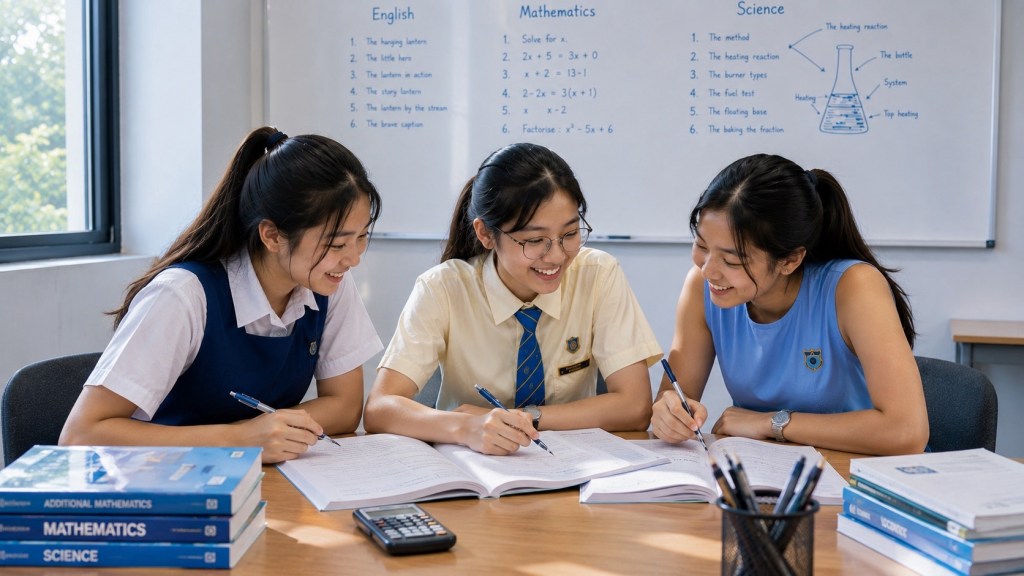
PG1 for Secondary Schools means Posting Group 1, one of the admission groupings used to facilitate entry into Secondary 1 under Singapore’s Full Subject-Based Banding system. By Secondary 2, PG1 is part of the learner’s admission history. It is not a Science subject level and should not be used as a permanent shorthand for the learner’s scientific capability.
For Secondary 2 Science, the practical question is not “My child entered through PG1 — what should I expect?” The useful question is: what level of Science is the learner actually taking now, and how independently can the learner observe, explain, measure and reason at that level?
This guide explains what Posting Group 1 means by Secondary 2, why PG1 is not the same as G1 Science, how Science can become a relative strength, and how parents can support scientific progress without treating an admission route as a permanent ceiling.
The Short Answer: What Does PG1 Mean in Secondary 2?
PG1 stands for Posting Group 1. Posting Groups are used to facilitate Secondary 1 admission. Under Full Subject-Based Banding, students can take individual subjects at G1, G2 or G3, so the learner’s actual subject-level profile becomes more important once school begins.
- PG1: admission route.
- G1/G2/G3 Science: the level at which Science is actually taken.
- Secondary 2 progress: evidence about current fit and readiness.
- School guidance: the route for later subject-level review.
PG1 Is Not G1 Science
Posting Group 1 describes how the learner entered Secondary 1. G1 Science describes an individual subject level. They are related, but they are not the same thing.
A learner who entered through PG1 may be taking Science at G1, or Science may have become a relative strength and be taken at a more demanding level according to the learner’s actual school pathway.
By Secondary 2, the current Science level should guide tuition, revision and parent expectations.
There Is No “PG1 Science” Curriculum
Science is organised by subject level. PG1 is not a fourth Science curriculum.
The first parent question should be:
What Science level is my child actually taking in Secondary 2?
That answer determines which content, assessment demand and support should guide the learner.
What Can Science Look Like for a PG1 Learner by Secondary 2?
Science at G1
The learner consolidates foundational scientific understanding, practical application, measurement, evidence use and increasingly independent explanation.
Read: What is G1 for Secondary Schools | Sec 2 Science.
Science at G2 or G3
If Science is a relative strength, the learner’s actual programme may include a more demanding Science level. The teaching should then match the subject-level demand rather than the original PG1 admission label.
Full Subject-Based Banding is useful precisely because strengths can differ by subject.
Why Secondary 2 Is an Important Science Review Year
By Secondary 2, enough scientific evidence has accumulated to see whether the learner’s habits are becoming stable.
- Can the learner distinguish observation from inference?
- Are variables identified correctly?
- Are units recorded consistently?
- Can graphs and tables be read accurately?
- Can the learner explain cause and effect?
- Can evidence be linked to a conclusion?
- Can earlier concepts be retrieved after a delay?
- Does performance remain stable when the context changes?
These behaviours tell us more about scientific readiness than the original Posting Group.
Three Common PG1 Secondary 2 Science Profiles
Profile 1 — Still Repairing Foundations
The learner has gaps in vocabulary, graph reading, units, experimental variables or explanation. The correct response is targeted repair while keeping the learner connected to current Secondary 2 work.
Profile 2 — Stable at the Current Science Level
The learner is appropriately placed and needs better consistency: stronger evidence use, clearer experimental reasoning, more accurate units and more complete explanations.
Profile 3 — Science Has Become a Clear Strength
The learner’s Secondary 1 and Secondary 2 evidence may show that Science is substantially stronger than the original posting profile suggested. Parents can discuss the current Science level and future options with the school.
Our First-Principles Method for PG1 Secondary 2 Science
- Confirm the current Science level. PG1 alone is not enough information.
- Diagnose the first weak link. Find the earliest cause of repeated errors.
- Fence the target skill. Reduce unrelated complexity while one scientific move is rebuilt.
- Make evidence visible. Identify which observation or measurement supports each claim.
- Explain mechanisms. Connect cause, principle and effect.
- Retrieve after delay. Bring old concepts back later.
- Transfer. Use the same principle in a changed context.
- Adjust challenge from evidence. Increase or reduce demand according to what the learner can sustain.
What Progress Looks Like
- uses scientific vocabulary more accurately;
- identifies variables more reliably;
- records units correctly;
- reads graphs and tables more independently;
- distinguishes observation from inference;
- explains cause and effect more clearly;
- connects evidence to conclusion;
- retrieves earlier ideas after a delay;
- applies concepts to unfamiliar examples;
- needs less tutor rescue.
PG1 and the SEC
Posting Group is not an SEC subject level. Students sit the Singapore-Cambridge Secondary Education Certificate in subjects at G1, G2 or G3.
A learner who entered through PG1 therefore does not sit a “PG1 Science” examination. The learner sits Science at the actual subject level taken. For current 2027 reference, SEAB lists G1 Science as K123.
Official reference: SEAB Singapore-Cambridge Secondary Education Certificate.
Frequently Asked Questions
Does PG1 still determine Science in Secondary 2?
No. PG1 describes the admission route. The learner’s current Science subject level is what matters for curriculum and assessment.
Is PG1 the same as G1 Science?
No. PG1 is an admission grouping. G1 Science is an individual subject level.
Can Science become a more demanding subject level by Secondary 2?
Full Subject-Based Banding allows mixed subject-level profiles and later review according to school guidance and evidence of readiness. Parents should check the learner’s actual school programme.
What should I tell a Science tutor?
Tell the tutor the learner’s current Science level, recent school topics, practical work, assessment results and repeated error patterns. PG1 alone is not enough for precise Secondary 2 support.
Helpful Reading
- What is G1 for Secondary Schools | Sec 2 Science
- What is PG1 for Secondary Schools | Sec 1 Science
- From PSLE to Secondary Science G1, G2 and G3: A Parent Guide
- MOE Full Subject-Based Banding
PG1 and Secondary 2 Science: Current Capability Is the Teaching Job
By Secondary 2, Posting Group 1 is background information. The learner’s current Science level, actual work and degree of independence should drive teaching.
At eduKate Sengkang, we confirm the level, diagnose the first weak link, rebuild what is missing, stabilise reliable scientific processes and increase the challenge when the evidence supports it.
Contact eduKate Sengkang if you want help interpreting your child’s Secondary 2 Science profile and identifying the next useful step.
