
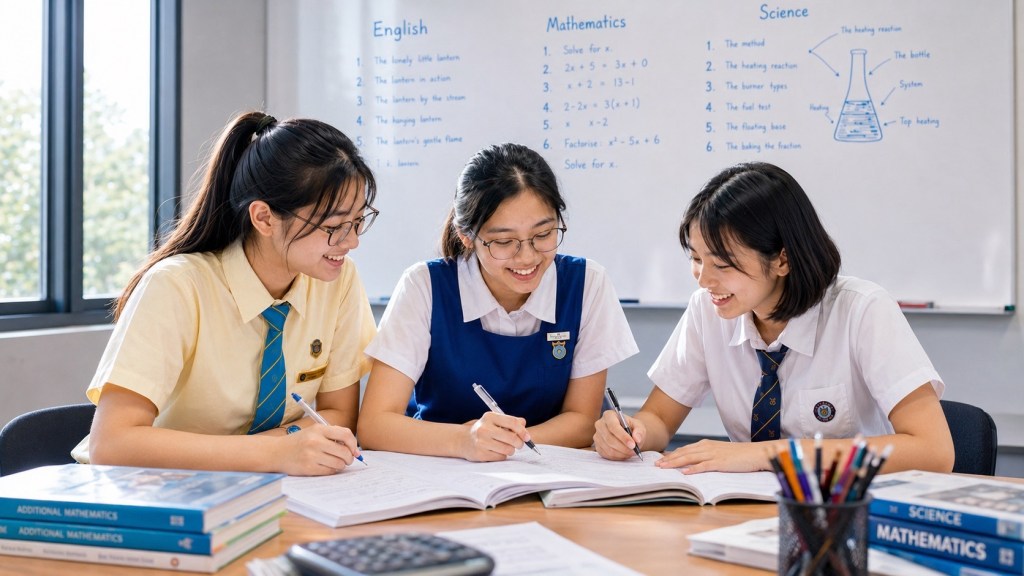
G1 for Secondary Schools is one of the three General subject levels used under Singapore’s Full Subject-Based Banding system. For a Secondary 2 learner taking Science at G1, the label describes the level at which Science is being taught and assessed. It does not describe the learner’s intelligence, potential, overall school identity or level in every other subject.
Secondary 2 G1 Science is a consolidation year. Secondary 1 introduces the new science environment; Secondary 2 should make scientific habits more dependable. The learner should increasingly distinguish observation from inference, identify variables, use units correctly, read tables and graphs, explain cause and effect, connect evidence to conclusions and apply familiar scientific ideas in unfamiliar situations.
This guide explains what Secondary 2 G1 Science means, what should become more secure during the year, how it differs from G2 and G3 Science, why G1 Science is not the same as Posting Group 1, and how parents can recognise genuine scientific progress rather than simple recall of familiar worksheets.
The Short Answer: What Is Secondary 2 G1 Science?
G1 means General 1. Under Full Subject-Based Banding, G1, G2 and G3 are individual subject levels. A learner can therefore take Science at G1 while taking another subject at a different level.
- G1 Science is an individual subject level.
- It is not the same thing as Posting Group 1.
- It should become increasingly independent by Secondary 2.
- It can be reviewed as strengths and readiness develop.
- Progress should be judged through actual scientific behaviour, not label prestige.
The useful question is: what scientific ideas can the learner observe, explain, measure and apply without constant prompting?
What Secondary 2 Adds to the G1 Science Job
Secondary 1 is about adapting to the new scientific language. Secondary 2 should make that language more stable.
- scientific vocabulary should become more precise;
- observations should be separated from conclusions;
- variables should be identified more reliably;
- measurements should include units and sensible precision;
- graphs and tables should be interpreted rather than merely copied;
- explanations should connect cause to effect;
- checking should become part of the learner’s own routine.
The learner is moving from remembering science facts to using science ideas.
Observation and Inference
One of the most important scientific habits is distinguishing what was directly observed from what was inferred from the observation.
For example, “the liquid changed colour” is an observation. “A particular substance is present” may be an inference based on a known test and that observation.
Students who blur the two may write conclusions that are stronger than the evidence allows. By Secondary 2, the learner should increasingly be able to state the evidence first and the conclusion second.
Variables and Fair Tests
Science becomes more reliable when the learner understands experimental control rather than memorising three labels.
- Independent variable: what is deliberately changed.
- Dependent variable: what is measured or observed.
- Controlled variables: what must be kept sufficiently constant for the comparison to be fair.
The learner should also understand why a poorly controlled variable weakens the conclusion.
Measurement and Units
Science often becomes mathematically fragile when units disappear. Secondary 2 G1 learners should build dependable habits around measurement.
- choose a suitable instrument;
- record the value with the correct unit;
- avoid inventing unnecessary decimal places;
- compare measurements on a common basis;
- recognise obviously unreasonable values;
- convert familiar units carefully.
A number without a unit may be incomplete scientific information.
Graphs and Tables
Secondary 2 learners should become more comfortable reading scientific information from graphs and tables.
- read scales accurately;
- identify the variable on each axis;
- describe trends using the data;
- notice unusual points cautiously;
- compare groups using the same measurement basis;
- avoid conclusions that the graph does not support.
The graph is not decoration. It is evidence in another form.
Scientific Explanation: Cause, Mechanism, Effect
Weak science answers often name a topic without explaining anything. A stronger answer links cause to mechanism and mechanism to effect.
- What changed?
- What scientific idea is relevant?
- What happens because of that idea?
- How does that explain the observation?
This structure makes explanations clearer and less dependent on memorised phrases.
A Secondary 2 G1 Science Runtime
- Decode: identify the command word and question target.
- Locate: identify the useful information, diagram or data.
- Recall: retrieve the relevant scientific principle.
- Connect: explain how the principle connects to the evidence.
- Write: answer at the required depth.
- Check: inspect units, command word and unsupported claims.
By Secondary 2, more of this process should happen without teacher prompting.
How G1 Science Differs From G2 and G3
- G1: builds foundational scientific understanding and practical application.
- G2: increases explanation depth, quantitative reasoning and experimental control.
- G3: increases abstraction, model use, precision and transfer further.
The right level is the one where challenge still produces understanding.
G1 Science Is Not Posting Group 1
Posting Group 1 describes the Secondary 1 admission route. G1 Science describes the current Science subject level. By Secondary 2, the learner’s actual Science level and performance matter more educationally than the original posting shorthand.
The Future SEC Endpoint
For current 2027 reference, SEAB lists G1 Science as K123. Students should always use the official syllabus for their own examination year because details can change.
Secondary 2 should therefore build the scientific engine for that later endpoint: vocabulary, evidence, variables, measurement, explanation, data and practical scientific reasoning.
Official reference: SEAB 2027 G1 Syllabuses for School Candidates.
Three Secondary 2 G1 Science Pathways
Repair
The learner still has a gap in vocabulary, graph reading, units, variable control or explanation. We repair the first weak link while keeping the learner connected to current school topics.
Stabilisation
The learner understands most concepts but answers inconsistently. Typical problems include missing units, weak command-word control, over-general conclusions or incomplete explanations.
Extension
The learner is secure and ready for more complexity. Extension should deepen data interpretation, experimental reasoning and unfamiliar application rather than simply increase worksheet volume.
Our First-Principles Method for Secondary 2 G1 Science
- Diagnose: identify the first scientific weak link.
- Fence: reduce unrelated difficulty while one skill is rebuilt.
- Observe: separate what was seen from what was inferred.
- Explain: connect evidence to scientific principle.
- Retrieve: bring vocabulary and concepts back after a delay.
- Interleave: mix old and new scientific ideas.
- Transfer: apply the same concept in a new context.
- Check: inspect units, command words and strength of conclusion.
What Progress Looks Like
- uses scientific vocabulary more accurately;
- records units without constant reminders;
- identifies variables more reliably;
- reads simple graphs and tables independently;
- distinguishes observation from inference;
- explains cause and effect more clearly;
- answers the command word rather than the topic;
- retrieves earlier concepts after a delay;
- applies a known idea to a new situation;
- needs less tutor rescue.
Frequently Asked Questions
What does G1 Science mean in Secondary 2?
It means Science is being taken at General 1, with the learner consolidating foundational scientific understanding, practical application and increasingly independent scientific reasoning.
Is G1 Science the same as PG1?
No. PG1 is an admission grouping. G1 Science is an individual subject level.
Can a Secondary 2 learner change Science level?
Subject levels can be reviewed according to school guidance, readiness and sustained performance. The decision should be based on learning evidence, not status.
What is the current SEC reference code for G1 Science?
SEAB lists G1 Science as K123 for 2027 school candidates. Always use the syllabus for the learner’s actual examination year.
Helpful Reading
- What is G1 for Secondary Schools | Sec 1 Science
- From PSLE to Secondary Science G1, G2 and G3: A Parent Guide
- How to Write a Science Lab Report
- SEAB 2027 G1 Syllabuses
Secondary 2 G1 Science: Make Scientific Thinking Repeatable
The central Secondary 2 G1 Science job is to make useful scientific behaviour repeatable: observe carefully, identify variables, measure properly, interpret data, explain mechanisms and check whether the conclusion is supported.
At eduKate Sengkang, we diagnose the first weak link, rebuild missing foundations, stabilise reliable scientific processes and deepen the work when the learner is ready.
Contact eduKate Sengkang if you want help reading your child’s Secondary 2 G1 Science work and identifying the next useful step.
