
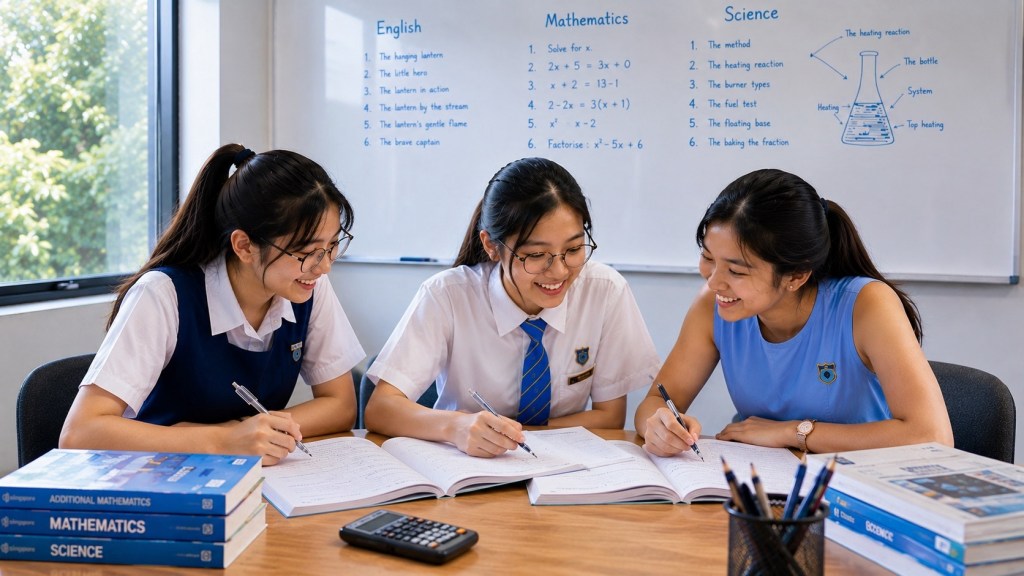
G3 for Secondary Schools is the most demanding of the three General subject levels used under Singapore’s Full Subject-Based Banding system. For a Secondary 2 learner taking Mathematics at G3, the label describes the level of mathematical content, abstraction and reasoning expected in that subject. It does not define the learner’s intelligence, potential or level in every other subject.
Secondary 2 G3 Mathematics is a consolidation year. Secondary 1 introduces the symbolic reset; Secondary 2 should make algebra, number sense, geometry, measurement, statistics and probability more connected. The learner should increasingly recognise structure, choose a representation, select a method, justify the steps, verify the answer and transfer the same idea into a new context.
This guide explains what Secondary 2 G3 Mathematics means, what should become secure during the year, how it differs from G1 and G2 Mathematics, why G3 Mathematics is not the same as Posting Group 3, what the later SEC endpoint looks like, and how parents can distinguish deep mathematical growth from mere acceleration.
The Short Answer: What Is Secondary 2 G3 Mathematics?
G3 means General 3. Under Full Subject-Based Banding, G1, G2 and G3 are individual subject levels. A learner can therefore take Mathematics at G3 while taking another subject at G2 or another appropriate level.
- G3 Mathematics is a subject level.
- It is not the same as Posting Group 3.
- It does not guarantee strength in every Mathematics topic.
- It still depends on stable number sense and algebraic meaning.
- It should become increasingly independent by Secondary 2.
The central Secondary 2 question is no longer “Can the learner follow the worked example?” It is: can the learner recognise the structure when the surface changes?
What Secondary 2 Adds to the G3 Mathematics Job
Secondary 1 introduces letters, expressions, equations, negative numbers and new representations. Secondary 2 should make these tools more stable and more transferable.
- algebraic notation should be read fluently;
- equations should be solved through equivalence rather than memorised moves;
- representation should become deliberate;
- geometry should be reasoned from properties;
- data should be interpreted, not merely calculated;
- multi-step problems should be planned before execution;
- checking should use an independent route where possible.
The learner is building a mathematical system that must survive unfamiliarity.
Algebra: Preserve Meaning While the Form Changes
Algebra is central because it compresses relationships. By Secondary 2, the learner should be able to manipulate expressions without losing sight of what remains equivalent.
- simplify expressions accurately;
- substitute values into expressions and formulae;
- expand and factor where appropriate;
- solve equations systematically;
- form algebraic relationships from worded situations;
- recognise patterns and generalise them;
- check a solution by substitution.
The weak algebra habit is “move this over”. The stronger habit is “apply an operation that preserves equality”. That difference becomes increasingly important as expressions become more complex.
Representation: The Skill Behind Difficult Problems
Many hard-looking questions become easier when represented correctly. A strong Secondary 2 G3 learner should move between words, equations, graphs, tables and diagrams with increasing confidence.
- translate a worded relationship into algebra;
- read a graph as a relationship between variables;
- use a table to expose a pattern;
- label a geometry diagram to reduce cognitive load;
- recognise when two different representations describe the same structure.
Representation is often the first place a problem is won or lost.
Geometry and Measurement: Properties Before Appearance
Secondary 2 geometry becomes more reliable when the learner stops trusting the picture and starts using properties.
- identify angle relationships;
- mark equal, parallel or perpendicular features;
- distinguish length, area and volume;
- track units carefully;
- use scale and similarity appropriately;
- justify why each property applies.
A diagram may not be drawn to scale. The mathematics must come from the information and properties, not visual guessing.
Statistics and Probability: Interpret Before Concluding
Data questions test both calculation and judgement. A learner should be able to describe a pattern, compare quantities fairly and recognise when the evidence is insufficient for a strong conclusion.
- read graph scales accurately;
- identify trends and exceptions;
- interpret averages in context;
- compare distributions carefully;
- express probability appropriately;
- avoid turning association into automatic causation.
A Secondary 2 G3 Mathematics Runtime
- Decode: translate the wording into mathematical language.
- Target: state exactly what must be found.
- Constraints: identify conditions, domains and limits.
- Represent: choose an equation, graph, table, diagram or other model.
- Plan: decide the sequence of steps.
- Execute: work accurately and visibly.
- Verify: use substitution, estimation, inverse operations, units or a second method.
- Interpret: connect the result back to the question.
By Secondary 2, more of this sequence should be internalised. The learner should not need the tutor to name the method before every problem.
How G3 Mathematics Differs From G1 and G2
- G1: dependable foundational Mathematics with strong practical application.
- G2: greater algebraic depth, abstraction and multi-step reasoning.
- G3: greater symbolic density, abstraction, mathematical modelling and transfer.
The three levels describe the degree of subject demand. They do not rank students as people.
G3 Mathematics Is Not Posting Group 3
Posting Group 3 is used to facilitate admission into Secondary 1. G3 Mathematics is an individual subject level. By Secondary 2, the learner’s actual Mathematics level and performance are more useful than the original posting shorthand.
Many PG3 learners will take Mathematics at G3, but the Full Subject-Based Banding architecture still treats subject levels individually.
The Future SEC Endpoint
For current 2027 reference, SEAB lists G3 Mathematics as K310 for the Singapore-Cambridge Secondary Education Certificate. Students should always use the official syllabus for their actual examination year.
Secondary 2 should build the mathematical engine for that later endpoint rather than imitate the final examination too early: algebraic meaning, representation, reasoning, checking, transfer and clear working.
Official reference: SEAB 2027 G3 Syllabuses for School Candidates.
Three Secondary 2 G3 Mathematics Pathways
Repair Hidden Foundations
Strong learners can still carry hidden gaps in fractions, negative numbers, algebraic meaning, units or graph interpretation. These weaknesses may stay invisible until problem complexity increases.
Stabilise High Performance
The learner understands concepts but loses marks through signs, brackets, incomplete working, poor verification or time pressure. The teaching job is process stability.
Extend Through Depth
The learner is secure and needs challenge. Extension should increase unfamiliarity, mathematical reasoning, alternative representations and independent verification before merely increasing worksheet volume.
Our First-Principles Method for Secondary 2 G3 Mathematics
- Find the first divergence. Trace the working to the earliest wrong assumption, representation or transformation.
- Fence the target skill. Reduce unrelated complexity while the key idea is rebuilt.
- Expose structure. Show equivalence, proportionality, constraint, function and invariance underneath the procedure.
- Require explanation. Ask why each step is valid.
- Retrieve after delay. Bring earlier methods back later.
- Interleave. Mix problem types so selection becomes part of learning.
- Transfer. Change the surface while preserving the underlying structure.
- Verify independently. Use a second route where possible.
What Progress Looks Like
- reads symbolic notation accurately;
- forms equations independently;
- chooses representations deliberately;
- shows logically connected working;
- uses geometry properties explicitly;
- checks signs, brackets and units;
- recognises equivalent mathematical structures;
- explains why a method applies;
- handles unfamiliar variants without waiting for a template;
- verifies answers before submission.
Frequently Asked Questions
What does G3 Mathematics mean in Secondary 2?
It means Mathematics is being taken at General 3, with the greatest degree of algebraic abstraction, symbolic complexity and independent reasoning among the three General subject levels.
Is G3 Mathematics the same as PG3?
No. PG3 is an admission grouping. G3 Mathematics is an individual subject level.
Should a strong Secondary 2 G3 learner start Additional Mathematics early?
Not automatically. Strong algebra, representation, reasoning and checking are more valuable than premature acceleration. Extension should deepen mathematical thinking first.
What is the current SEC reference code for G3 Mathematics?
SEAB lists G3 Mathematics as K310 for 2027 school candidates. Always use the official syllabus for the learner’s own examination year.
Helpful Reading
- What is G3 for Secondary Schools | Sec 1 Mathematics
- What is G2 for Secondary Schools | Sec 2 Mathematics
- Secondary G1, G2 and G3 Mathematics: Algebra, Problem Solving and the Secondary Reset
- Why Representation Errors Become Algebra Errors
- SEAB 2027 G3 Syllabuses
Secondary 2 G3 Mathematics: Precision Before Acceleration
The strongest Secondary 2 G3 learner is not the student who has raced furthest ahead. It is the learner who can recognise structure, select a representation, justify a method, control the working and verify the result independently.
At eduKate Sengkang, we diagnose the first divergence, repair hidden foundations, expose mathematical structure, retrieve after delay and transfer learning into unfamiliar problems. Precision is what makes later speed useful.
Contact eduKate Sengkang if you want help reading your child’s Secondary 2 G3 Mathematics work and deciding whether the next job is repair, stabilisation or extension.
