
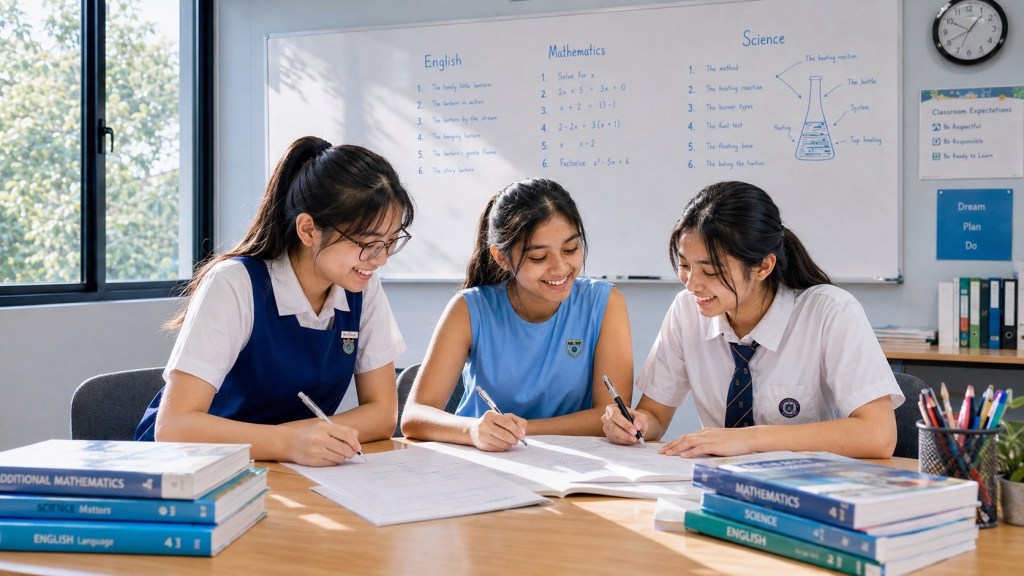
G2 for Secondary Schools is a subject level under Singapore’s Full Subject-Based Banding system. For a Secondary 3 learner taking Mathematics at G2, the label describes the degree of mathematical abstraction, algebraic reasoning and independent problem-solving expected in that subject. It is not a permanent stream identity and does not determine the level of every other subject.
Secondary 3 G2 Mathematics is where lower-secondary foundations need to become upper-secondary performance. Algebra, number, geometry, measurement, statistics and probability are no longer isolated chapters. The learner must increasingly recognise which mathematical structure is present, select a method, control the working and verify the answer under mixed conditions.
This guide explains what Secondary 3 G2 Mathematics means, how it differs from G1 and G3, why it is not the same as Posting Group 2, what the current K210 SEC endpoint means for preparation, and how to build exam-ready mathematical independence rather than worksheet dependence.
The Short Answer: What Is Secondary 3 G2 Mathematics?
G2 means General 2. Under Full Subject-Based Banding, G1, G2 and G3 are individual subject levels. A learner may therefore take Mathematics at G2 while taking another subject at a different level.
By Secondary 3, a useful G2 learner should move from “I can follow this example” toward “I can identify the structure, choose the method and explain why it applies.”
What Changes in Secondary 3 G2 Mathematics?
- Algebra becomes more central across topics.
- Problem structures become less obvious.
- Representations need to be chosen rather than supplied.
- Geometry requires logical use of properties.
- Graphs and data require interpretation.
- Mixed-topic questions make method selection important.
- Checking must become independent under time pressure.
Algebra: Preserve Equivalence
At G2, algebra should become a system rather than a collection of memorised moves. The learner should understand what remains equivalent after each transformation.
- simplify expressions;
- substitute values;
- expand and factor where appropriate;
- form equations from worded relationships;
- solve equations systematically;
- manage signs and brackets carefully;
- check solutions by substitution.
Representation: The Hidden Skill Behind Hard Questions
Many difficult questions become manageable once the relationship is represented correctly. The learner should move between words, equations, tables, graphs, ratios and diagrams.
- identify the target quantity;
- choose a representation;
- mark constraints;
- translate the situation into mathematical language;
- keep enough working visible to inspect the reasoning.
Geometry and Measurement: Properties Before Appearance
The learner should reason from stated properties, not visual impression. Diagrams may not be to scale, so labels, relationships and units matter.
Statistics and Probability: Interpretation Matters
A calculated number is not always the final answer. The learner should understand what the result says about the data, whether the comparison is fair and whether the conclusion is stronger than the evidence allows.
A Secondary 3 G2 Mathematics Runtime
- Decode: rewrite the wording in mathematical language.
- Target: identify exactly what must be found.
- Constraints: identify relevant conditions.
- Represent: choose an equation, graph, table or diagram.
- Plan: sequence the steps.
- Execute: calculate accurately.
- Verify: use a second route where possible.
- Communicate: present enough working for the logic to be visible.
How G2 Mathematics Differs From G1 and G3
- G1: dependable foundational Mathematics with strong practical application.
- G2: greater algebraic depth, abstraction and multi-step reasoning.
- G3: greater symbolic density, modelling and mathematical transfer.
G2 Mathematics Is Not Posting Group 2
Posting Group 2 describes the Secondary 1 admission route. G2 Mathematics is an individual subject level. By Secondary 3, the learner’s current Mathematics level and actual performance matter more than the original posting shorthand.
The SEC Endpoint: K210
For current 2027 reference, SEAB lists G2 Mathematics as K210. Students should always use the official syllabus for their actual examination year. Secondary 3 should be exam-aware while still strengthening algebraic meaning, representation, reasoning, checking and transfer.
Official reference: SEAB 2027 G2 Syllabuses for School Candidates.
Three Secondary 3 G2 Mathematics Pathways
Repair
The learner appears weak in current topics, but the real cause may be an older gap in fractions, ratio, percentage, negative numbers or algebraic meaning. We repair the prerequisite rather than endlessly repeat the current chapter.
Stabilisation
The learner understands concepts but performance fluctuates through sign errors, skipped constraints, incomplete working or weak checking. The job is process control.
Extension
The learner is secure and ready for more unfamiliar applications, alternative representations, justification and independent verification. Extension is deeper mathematical thinking, not merely harder worksheets.
Our First-Principles Method
- Find the first divergence in the working.
- Fence the target skill.
- Expose the structure underneath the procedure.
- Require explanation for each transformation.
- Retrieve earlier methods after a delay.
- Interleave problem types so selection becomes part of the work.
- Transfer the same structure into new contexts.
- Verify through substitution, estimation, inverse operations or units.
A 90-Minute Small-Group Mathematics Lesson
- Retrieval of prerequisites.
- Concept instruction.
- Worked reasoning with visible representation.
- Guided practice.
- Independent application.
- Error analysis.
- Mixed or timed transfer work.
- Focused continuation practice.
In a three-student class, the tutor can see whether the learner’s error begins in interpretation, representation, algebra, arithmetic, notation or checking. The wrong final answer is only the visible end of the chain.
What Progress Looks Like
- starts by identifying the target;
- chooses representations deliberately;
- uses algebraic notation accurately;
- shows logically connected working;
- recognises structure inside unfamiliar wording;
- uses geometry properties correctly;
- tracks signs and units;
- retrieves earlier methods after a delay;
- verifies answers independently;
- needs less tutor prompting.
Frequently Asked Questions
What does G2 Mathematics mean in Secondary 3?
It means Mathematics is being taken at General 2, with stronger demands for algebraic reasoning, representation, multi-step problem-solving and independent method selection than at G1.
Is G2 Mathematics the same as PG2?
No. PG2 is an admission grouping. G2 Mathematics is an individual subject level.
What is the current SEC reference code?
SEAB lists G2 Mathematics as K210 for 2027 school candidates. Always use the official syllabus for the learner’s own examination year.
Secondary 3 G2 Mathematics: Build Exam-Ready Independence
The strongest Secondary 3 learner is not the student who has seen every possible question. It is the learner who can recognise mathematical structure when the surface changes and select a valid method without waiting for the chapter title to give the answer away.
At eduKate Sengkang, we diagnose the first divergence, rebuild missing prerequisites, expose structure, retrieve after delay and transfer learning into unfamiliar problems. Contact eduKate Sengkang if you want help interpreting your child’s Secondary 3 G2 Mathematics work.
