
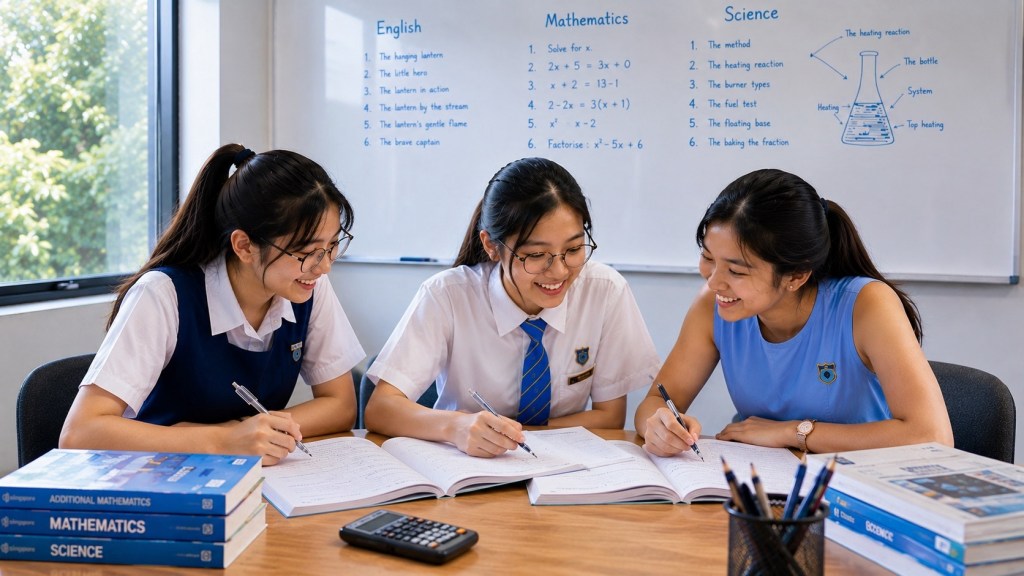
G3 for Secondary Schools is the most demanding of the three General subject levels used under Singapore’s Full Subject-Based Banding system. For a Secondary 3 learner taking Mathematics at G3, the label describes the level of mathematical abstraction, symbolic fluency and reasoning expected in that subject. It does not define the learner’s intelligence, future potential or level in every other subject.
Secondary 3 is the beginning of the upper-secondary performance stretch. Algebra, geometry, measurement, statistics and probability now have to work as one mathematical system. A strong learner cannot depend only on chapter recognition or memorised templates. The learner must identify structure, translate information into mathematics, choose a valid method, show a logical chain of working and verify the result.
This guide explains what Secondary 3 G3 Mathematics means, how it differs from G1 and G2 Mathematics, why it is not the same as Posting Group 3, what the current SEC K310 endpoint means for preparation, and how parents can distinguish deep mathematical growth from superficial acceleration.
The Short Answer: What Is Secondary 3 G3 Mathematics?
G3 means General 3. Under Full Subject-Based Banding, G1, G2 and G3 are individual subject levels. A learner may therefore take Mathematics at G3 while taking another subject at G2 or another appropriate level.
- G3 Mathematics is a subject level.
- It is not the same as Posting Group 3.
- Secondary 3 is an upper-secondary preparation year.
- Algebra, representation and reasoning become increasingly central.
- Exam familiarity matters, but transferable mathematical structure matters more.
What the Current G3 Mathematics Syllabus Is Building
For the 2027 Singapore-Cambridge Secondary Education Certificate, SEAB lists G3 Mathematics as K310. The syllabus is organised around Number and Algebra, Geometry and Measurement, and Statistics and Probability. It also assesses mathematical processes such as reasoning, communication, application and problem-solving.
The useful implication for Secondary 3 is clear: Mathematics should not be taught as a catalogue of procedures. Students need to connect ideas, translate between representations, select relevant information, interpret results and justify mathematical statements.
Official reference: SEAB 2027 G3 Syllabuses for School Candidates.
Secondary 3: Where Algebra Becomes the Working Language
By Secondary 3, algebra should no longer feel like a separate chapter. It is the language through which relationships across many topics are expressed.
- simplify and transform expressions accurately;
- substitute into formulae;
- form equations from worded relationships;
- solve equations systematically;
- control brackets, signs and indices;
- recognise equivalent forms;
- check solutions by substitution or another valid route.
The strongest algebra habit is not speed. It is preserving equivalence while the form changes. A learner who understands that principle can recover when memory fails.
Representation: The Hidden Skill Behind Hard Questions
Many difficult questions are difficult because the correct mathematical representation is not supplied. The learner has to decide how to express the situation.
- an equation for an unknown relationship;
- a table to expose a pattern;
- a graph to show how one quantity changes with another;
- a labelled diagram to make geometric constraints visible;
- a ratio or proportion statement;
- an inequality or boundary condition where not every numerical answer is valid.
A good representation compresses complexity. A poor representation creates unnecessary cognitive load.
Geometry and Measurement: Reason From Properties
Secondary 3 G3 geometry should be increasingly logical. The learner should justify each step from a known property rather than trust how a diagram looks.
- mark given information;
- identify relevant angle and shape properties;
- use similarity or proportionality where appropriate;
- track length, area and volume correctly;
- keep units and scale visible;
- justify why a relationship applies.
Statistics and Probability: Interpret, Do Not Merely Calculate
Data work becomes more sophisticated when the learner asks what a result means. A correct average, probability or graph reading can still be an incomplete answer if the question asks for interpretation.
- read axes and scales accurately;
- compare distributions using a fair basis;
- identify trends and anomalous values;
- distinguish association from causation;
- interpret probabilities in context;
- avoid conclusions stronger than the evidence supports.
A Secondary 3 G3 Mathematics Runtime
- Decode: translate the wording into mathematical language.
- Target: identify exactly what must be found.
- Constraints: identify conditions, domains, units and limits.
- Represent: choose an equation, graph, table, diagram or other model.
- Plan: decide the order of steps.
- Execute: work accurately and visibly.
- Verify: use substitution, estimation, inverse operations, graph behaviour or a second method.
- Interpret: connect the result back to the question.
This is the difference between doing a method and solving a problem.
How G3 Mathematics Differs From G1 and G2
- G1: dependable foundational Mathematics with strong practical application.
- G2: greater algebraic depth, abstraction and multi-step reasoning.
- G3: greater symbolic density, modelling, reasoning precision and transfer.
These are levels of subject demand, not rankings of students as people.
G3 Mathematics Is Not Posting Group 3
Posting Group 3 is used to facilitate admission into Secondary 1. G3 Mathematics is an individual subject level. Many PG3 learners will take Mathematics at G3, but the terms are not interchangeable. By Secondary 3, the current Mathematics level and actual performance are more useful than the original posting shorthand.
Three Secondary 3 G3 Mathematics Pathways
Repair Hidden Foundations
A high-performing learner may still carry one weak foundation: fractions, negative numbers, algebraic meaning, graph interpretation, geometry notation or unit control. These gaps can remain hidden until upper-secondary complexity increases. Repairing them now is more efficient than compensating later.
Stabilise Strong Performance
The learner understands concepts but loses marks through signs, brackets, incomplete working, premature rounding, poor calculator discipline or weak verification. The teaching job is process control.
Extend Through Depth
The learner is secure and ready for challenge. Extension should increase unfamiliarity, modelling, alternative methods, proof-like justification and independent verification before merely increasing worksheet volume.
Our First-Principles Method for G3 Mathematics
- Find the first divergence. Trace the working to the earliest wrong assumption, representation or transformation.
- Fence the target. Reduce surrounding difficulty while one idea is strengthened.
- Expose structure. Show equivalence, proportionality, function, constraint and invariance underneath procedures.
- Require explanation. Ask why each step is valid.
- Retrieve after delay. Bring earlier methods back later.
- Interleave. Mix problem types so method selection becomes part of performance.
- Transfer. Change the surface while preserving the mathematical structure.
- Verify independently. Use a second route whenever practical.
A 90-Minute Small-Group Mathematics Lesson
- Retrieval of prerequisite number or algebra skills.
- Concept teaching around one relationship.
- Worked reasoning with visible representation.
- Guided application with decreasing prompts.
- Independent problem-solving.
- Error analysis: identify the first divergence.
- Mixed or timed transfer work.
- Focused continuation practice.
In a three-student class, the tutor can see whether an error begins in reading, representation, algebra, arithmetic, notation or checking. The wrong final answer is only the visible end of the chain.
What Progress Looks Like
- reads symbolic notation accurately;
- forms equations independently;
- chooses representations deliberately;
- shows logically connected working;
- uses geometry properties explicitly;
- controls signs, brackets and units;
- recognises equivalent structures;
- explains why a method applies;
- handles unfamiliar variants without waiting for a template;
- verifies answers before submission.
Frequently Asked Questions
What does G3 Mathematics mean in Secondary 3?
It means Mathematics is being taken at General 3, with the greatest degree of symbolic complexity, abstraction and independent mathematical reasoning among the three General subject levels.
Is G3 Mathematics the same as PG3?
No. PG3 is an admission grouping. G3 Mathematics is an individual subject level.
What is the current SEC reference code for G3 Mathematics?
SEAB lists G3 Mathematics as K310 for 2027 school candidates. Always use the official syllabus for the learner’s actual examination year.
Should a strong Secondary 3 learner simply accelerate into more advanced material?
Not automatically. Strong algebra, representation, reasoning and checking are more valuable than premature acceleration. Extension should deepen mathematical thinking before it widens the syllabus.
Secondary 3 G3 Mathematics: Precision Before Acceleration
The strongest Secondary 3 learner is not the student who has raced furthest ahead. It is the learner who can recognise structure, choose a valid representation, justify a method, control the working and verify the result independently.
At eduKate Sengkang, we diagnose strong learners as carefully as struggling learners. Precision, transfer and independent verification are what turn early strength into durable mathematical performance. Contact eduKate Sengkang if you want help interpreting your child’s Secondary 3 G3 Mathematics work.
