
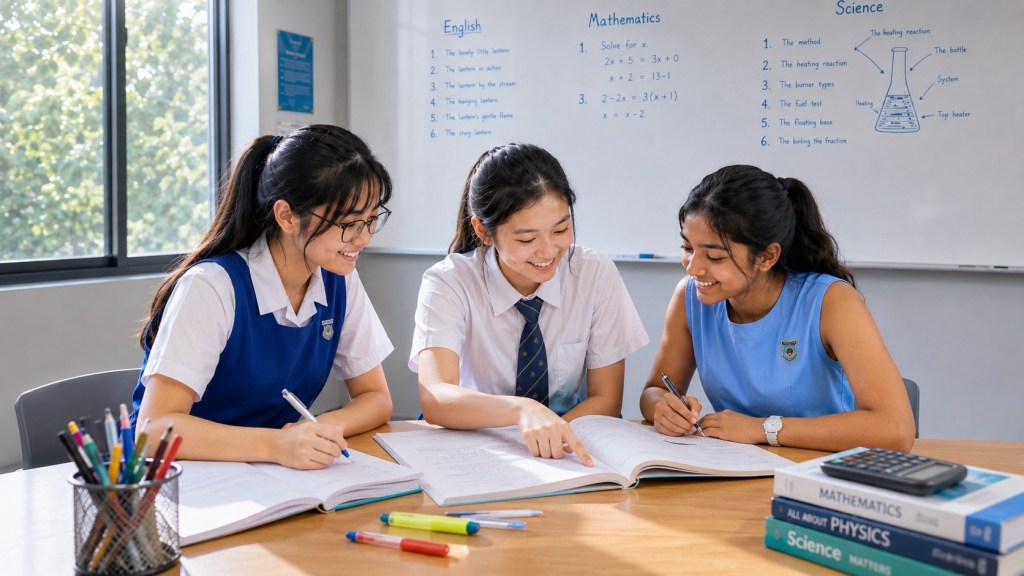
G1 for Secondary Schools is one of the three General subject levels used under Singapore’s Full Subject-Based Banding system. For a Secondary 3 learner taking Mathematics at G1, the label describes the level at which Mathematics is taught and assessed. It does not define the learner’s intelligence, potential or level in every other subject.
Secondary 3 G1 Mathematics is an upper-secondary performance year. The learner is closer to the SEC endpoint, so number sense, algebra, geometry, measurement, statistics and probability need to become more reliable under mixed and timed conditions. The goal is not to memorise more procedures. It is to recognise the mathematical structure, choose a valid method, show enough working and verify the answer.
This guide explains what Secondary 3 G1 Mathematics means, how it differs from G2 and G3, why it is not the same as Posting Group 1, what the current K110 SEC endpoint looks like, and how to build exam-ready Mathematics without creating dependence on paper repetition.
The Short Answer: What Is Secondary 3 G1 Mathematics?
G1 means General 1. Under Full Subject-Based Banding, G1, G2 and G3 are individual subject levels. A learner may therefore take Mathematics at G1 while taking another subject at a different level.
- G1 Mathematics is a subject level.
- It is not the same as Posting Group 1.
- Secondary 3 is an upper-secondary preparation year.
- Exam familiarity matters, but mathematical structure matters more.
- The learner’s actual working should guide support.
What Changes in Secondary 3 Mathematics?
- Earlier number skills must remain accessible.
- Algebra should become more automatic without becoming mindless.
- Multi-step problems need better planning.
- Geometry needs properties and labelled diagrams.
- Data questions need interpretation, not only calculation.
- Units, signs and calculator use require stronger discipline.
- Checking must become routine under time pressure.
Secondary 3 is the point where weak foundations begin to compound quickly. It is also the point where targeted repair can still produce large gains before the final examination year.
Number Sense Still Matters
Upper-secondary Mathematics still depends on integers, fractions, ratio, percentage, rates, estimation and units. Algebra does not replace number sense; it sits on top of it.
- estimate before trusting a calculator;
- compare magnitudes;
- track signs;
- recognise unreasonable answers;
- convert units carefully;
- use benchmarks and inverse operations for checking.
Algebra: Meaning Before Speed
By Secondary 3 G1, algebra should be understood as a language of relationships. The learner should know what a variable represents, what an equation asserts and why each operation preserves or changes the relationship.
- simplify expressions;
- substitute values;
- form equations from situations;
- solve equations systematically;
- work carefully with brackets and signs;
- check solutions by substitution.
Geometry and Measurement: Read the Diagram as a System
- label known values;
- identify relevant properties;
- distinguish length, area and volume;
- track units;
- avoid visual guessing;
- explain why a geometric step is valid.
Statistics and Probability: Interpret the Result
A numerical answer is not always the end of the problem. The learner should understand what a graph, average, probability or comparison means in context and avoid drawing a stronger conclusion than the data supports.
A Secondary 3 G1 Mathematics Runtime
- Decode: identify what the problem is really asking.
- Target: state the unknown.
- Represent: choose a diagram, equation, table, ratio or graph.
- Plan: decide the order of steps.
- Execute: work accurately and visibly.
- Verify: estimate, reverse, substitute or inspect units.
- Interpret: state the answer in context.
How G1 Mathematics Differs From G2 and G3
- G1: dependable foundational Mathematics with strong practical application.
- G2: greater algebraic depth, abstraction and multi-step reasoning.
- G3: greater symbolic density, mathematical abstraction and transfer.
G1 Mathematics Is Not Posting Group 1
Posting Group 1 describes the Secondary 1 admission route. G1 Mathematics describes an individual subject level. By Secondary 3, the learner’s actual Mathematics level and performance matter more than the original posting shorthand.
The SEC Endpoint: K110
For current 2027 reference, SEAB lists G1 Mathematics as K110. Students should always use the official syllabus for their actual examination year. Secondary 3 should therefore be exam-aware while still strengthening the mathematical engine underneath examination technique.
Official reference: SEAB 2027 G1 Syllabuses for School Candidates.
Three Secondary 3 G1 Mathematics Pathways
Repair
The learner still has a prerequisite gap in fractions, percentage, ratio, negative numbers or algebraic meaning. We repair the first missing link while keeping the work relevant to current school topics.
Stabilisation
The learner understands concepts but loses marks through signs, units, skipped working, poor method selection or weak checking. The job is process stability.
Extension
The learner is secure and ready for deeper application, unfamiliar problem structures and more independent reasoning. Extension should improve structure recognition before simply increasing difficulty.
Our First-Principles Method
- Diagnose the exact cause of error.
- Fence one target skill before increasing complexity.
- Make representations visible.
- Require the learner to explain why a method works.
- Retrieve earlier skills after a delay.
- Interleave topics so method selection becomes part of the work.
- Transfer the same structure into a new context.
- Verify through estimation, substitution, reverse operations or units.
A 90-Minute Small-Group Mathematics Lesson
- Retrieval of prerequisite number or algebra skills.
- Concept teaching around one relationship.
- Worked example with visible representation and reasoning.
- Guided practice with decreasing prompts.
- Independent application.
- Error analysis: identify the first divergence.
- Mixed or timed transfer work.
- Focused continuation practice.
What Progress Looks Like
- starts questions with less hesitation;
- shows clearer working;
- uses algebra more confidently;
- handles signs and units more reliably;
- chooses useful representations;
- recognises structures in unfamiliar wording;
- checks calculator results against estimation;
- retrieves older methods after a delay;
- verifies answers without reminders;
- needs less tutor rescue.
Secondary 3 G1 Mathematics: Build Reliable Performance
The strongest Secondary 3 preparation is not the student who has memorised the most question types. It is the learner who can recognise mathematical structure, choose a valid method and verify the result under pressure.
At eduKate Sengkang, we diagnose the first weak link, rebuild missing foundations, stabilise reliable methods and deepen the work when the learner is ready. Contact eduKate Sengkang if you want help interpreting your child’s Secondary 3 Mathematics work.
