
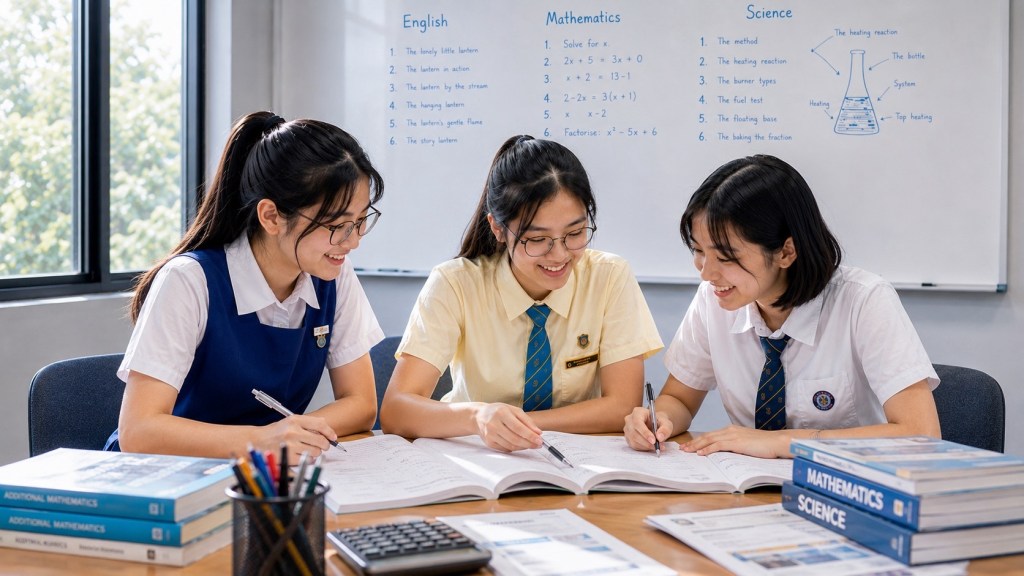
Some families use two Mathematics tutors at the same time: a school-based tutor and a private tutor, an E-Math tutor and an A-Math tutor, a regular small-group programme plus short-term private repair, or two different providers because one focuses on exams and the other on foundations. Parents searching for Secondary Mathematics tuition in Sengkang, whether two Math tutors are too much, or whether a child should have more than one Mathematics teacher usually need a coordination framework rather than a simple yes-or-no answer.
Two tutors can help when they perform clearly different jobs and share enough information to avoid duplication. They can also create a hidden learning tax: conflicting methods, doubled homework, repeated reteaching, unclear revision priorities and a student who becomes dependent on adults deciding every move. More support is only better when the support functions are complementary and the learner still owns the Mathematics.
At eduKate Sengkang, this Advanced Mathematics Tutorials article owns the dual-tutor coordination job. It is distinct from the Private Tutor vs Small-Group Mathematics Tuition owner, which compares formats, and the School vs Tuition Mathematics Methods owner, which resolves method differences. This page asks whether two simultaneous tutors can form one coherent support system rather than two competing Mathematics programmes.
Quick answer: can a student have two Mathematics tutors at the same time?
Yes, but only if each tutor has a distinct, necessary job, the workload remains sustainable, method differences are controlled, and the student still develops independent practice and revision decisions. If both tutors do the same job, dual support usually adds duplication before it adds learning.
- Good dual support: one tutor repairs a bounded prerequisite while another maintains the live school route.
- Good dual support: one tutor owns E-Math and another owns A-Math.
- Good dual support: a regular group continues while short-term private support fixes one urgent gap.
- Risky dual support: both assign full homework programmes.
- Risky dual support: both teach different methods without a primary route.
- Risky dual support: both pre-teach the same school chapter.
- Risky dual support: the student waits for one tutor to correct the other.
- Risky dual support: the learner loses independent study time.
The first question: are there really two different jobs?
Before paying for two tutors, name the distinct function of each. If the descriptions sound nearly identical—“help with school Math”, “improve marks”, “do more practice”—the overlap risk is high.
Useful job split 1: E-Math and A-Math
Two tutors can make sense when each owns a separate subject, especially in Secondary 3–4. Shared algebra should still be coordinated so the learner is not taught incompatible working habits.
Useful job split 2: foundation repair and current-school continuity
A student with one serious algebra gap may temporarily receive individual repair while staying in a regular group that follows current school work. The private repair should have an exit condition.
Useful job split 3: exam-control consultation and weekly teaching
A regular tutor may own syllabus learning while another specialist temporarily reviews papers, time management or a bounded exam-performance issue. The second role should not become another full curriculum unless evidence justifies it.
Useful job split 4: temporary transition support
During tutor switching, there may be a short overlap between old and new support. Keep the overlap brief and define which tutor owns homework and current-school continuity.
Useful job split 5: school consultation plus tuition
A school teacher or school consultation is not “another tutor” in the same commercial sense, but the student may receive guidance from both. The learner should keep one coherent primary method and use each source for appropriate questions.
The overlap problem: both tutors teach the same chapter
Repetition can help, but two full explanations of the same content may consume time without adding a new function. Ask whether the second tutor is providing retrieval, transfer, correction or simply repeating the first lesson.
The overlap problem: both tutors assign full homework
This can double volume while reducing quality. The student rushes both sets, corrects neither deeply and loses time from school work. One tutor should normally own the main continuation workload.
The overlap problem: both tutors diagnose independently
Two tutors may reach different conclusions because they see different tasks and support conditions. Parents should compare evidence rather than choosing the more alarming diagnosis.
The overlap problem: method conflict
Different valid routes can confuse a fragile learner. Decide which method is primary for school use and ask both tutors to respect that unless a change has a clear purpose.
The overlap problem: progress claims become impossible to attribute
If marks improve, families may not know which intervention helped. That is not fatal, but it becomes harder to remove unnecessary support later. Use bounded goals and review one change at a time where possible.
The overlap problem: the learner becomes the messenger
Students should not carry messages such as “Tutor A says your method is wrong.” Adults can coordinate through the learner’s work and a simple parent summary instead of turning the child into the communication channel.
The overlap problem: homework becomes a negotiation
A student may choose whichever tutor’s work feels easier or say the other tutor assigned something else. Clear ownership reduces ambiguity.
The overlap problem: no one owns the weekly plan
If both tutors assume the other is maintaining old topics, gaps can appear. If both assume they own revision, overload appears. One weekly plan should integrate the two jobs.
The overlap problem: tuition replaces independent study
Two tutors can occupy so much of the week that the student has little time to retrieve, practise and correct alone. This is especially risky in Secondary 4, where independent paper management matters.
The dual-tutor map
- Tutor A job.
- Tutor B job.
- Shared skills.
- Primary method conventions.
- Homework owner.
- School-work owner.
- Assessment-preparation owner.
- Progress-review owner.
- Exit condition for temporary support.
The one-owner-per-function rule
For each learning function, identify one primary owner. One tutor can own weekly homework; another can supply a bounded repair task. One can own E-Math; another A-Math. Clarity prevents duplicated work.
The one-primary-method rule
Where both tutors teach the same Mathematics, the student should have one primary school-compatible method per question family. Alternatives can be introduced explicitly as backup or enrichment, not as competing defaults.
The one-progress-review rule
Parents can synthesise both tutors’ evidence into one monthly view: what is stable, what is active, what support is still necessary, and whether the second tutor still adds distinct value.
The one-homework-calendar rule
All Mathematics practice should fit one weekly workload. Two tutors should not each plan as though the other does not exist.
The one-exam-plan rule
Before WA, EOY or prelims, decide which tutor owns the exam plan. Conflicting revision priorities close to an assessment can be more harmful than imperfect coordination earlier in the term.
Secondary 1 and two tutors
Dual support is rarely needed long-term in Secondary 1 unless there is a specific gap or transition issue. Too many adult methods can confuse a learner still building symbolic foundations.
Secondary 2 and two tutors
A temporary second tutor can make sense for a bridge weakness, but the student should not carry two full lower-secondary programmes. Keep one current-school owner.
Secondary 3 and two tutors
The clearest justified dual-tutor model is often separate E-Math and A-Math ownership. Shared algebra, workload and homework still need coordination.
Secondary 4 and two tutors
Near examinations, overlapping tutors can create scheduling and paper-strategy conflicts. Keep the system lean: one main exam plan, one paper/error language, and only distinct specialist support if necessary.
The three-student group plus private tutor
This can work as a temporary repair model. The group maintains current learning and peer comparison; private support fixes one high-impact dependency. The private tutor should not create a parallel full syllabus.
Two private tutors
This arrangement needs especially clear job separation because both may naturally behave as the main tutor. Write the function boundary explicitly.
Two tuition centres
Two centres often carry their own notes, homework and sequences. The duplication risk is high. Families should ask why both are needed and what unique function each adds.
One tuition centre plus school consultation
This is usually easier to coordinate because school remains the official route. Tuition should support understanding, practice and exam readiness without competing with teacher expectations.
Temporary second tutor after poor results
A disappointing paper can justify a short specialist review, but avoid panic-enrolling in a second full programme. First identify what the current tutor can and cannot address.
Temporary second tutor before prelims
Use only if the additional tutor fills a defined gap such as paper analysis or a specific concept. Adding another broad programme at this stage can consume valuable independent paper time.
Temporary second tutor during holidays
A holiday specialist can repair one prerequisite or provide enrichment while the regular tutor pauses or continues lightly. The temporary programme should hand the learner back cleanly.
The exit condition matters
If the second tutor was added for algebra repair, define what evidence ends the repair: delayed independent accuracy, mixed transfer and current-school access. Without an exit condition, temporary dual support can become permanent by inertia.
Where this dual-tutor guide sits in the Mathematics estate
Use the private-vs-small-group owner to choose format, the switching-tutor owner when replacing support, the methods-conflict owner when procedures differ, and this page when two Mathematics tutors are active at the same time and the family needs one coherent operating system.
Two tutors should not create two versions of the student
Tutor A may see a careful learner in a quiet small group. Tutor B may see the same student in an intensive private lesson after school. Their impressions can differ because the tasks, support and time of day differ. Families should not force one tutor’s description to defeat the other. Compare the conditions.
A student can look strong in direct private work and fragile in mixed group work. That is not necessarily contradiction; it may reveal a transfer or support gap.
The evidence-integration rule
- What task was observed?
- What support was available?
- Was the work direct, mixed or timed?
- Was the student fresh or already fatigued?
- Was the task current school work, old-topic retrieval or enrichment?
- Did the same pattern repeat elsewhere?
Only after these conditions are visible should parents compare diagnoses.
Dual tutors should share a learner-state vocabulary
They do not need identical terminology, but the family benefits if both can describe whether a skill is blocked, fragile, stable, transfer-ready or exam-ready. This keeps discussion focused on capability rather than tutor identity.
Dual tutors should separate stable strengths from active weaknesses
If both tutors keep practising already-secure topics because neither knows the other has verified them, the student pays twice for the same maintenance. Stable skills should be named explicitly and moved to low-volume retrieval.
The duplication audit
- Same chapter taught twice.
- Same worksheet function assigned twice.
- Same formula notes rewritten twice.
- Same paper corrected twice without a new purpose.
- Same prerequisite diagnosed by both but never assigned an owner.
- Same revision decision made independently by two adults.
One duplicate can be harmless; chronic duplication consumes time the learner could use for independent study, other subjects or sleep.
The gap audit
Dual support can also create gaps because each tutor assumes the other owns a function. Common examples include old-topic retrieval, error-log maintenance, school-homework checking or paper timing.
- Who owns current school homework?
- Who tracks old-topic maintenance?
- Who reviews WA/EOY/prelim papers?
- Who coordinates exam schedule?
- Who monitors overload?
- Who decides when a repaired topic returns to maintenance?
The homework-owner rule
Choose one primary homework owner. The second tutor can assign a small specialist task, but should avoid launching a full independent workload without coordination.
The paper-owner rule
Near examinations, one tutor should own the main paper strategy and error language. The other can address a bounded topic or specialist need. Two competing paper plans can create more hesitation than support.
The revision-calendar rule
The student should have one weekly Mathematics calendar, not separate private calendars from each tutor. E-Math, A-Math, school homework and maintenance need to coexist in one time budget.
The school-route rule
Both tutors should know what school is currently teaching and what assessment is next. Even when one tutor works on foundations or enrichment, current school access should not become invisible.
The method-map rule
When two tutors teach shared algebra, maintain a method map: primary school-compatible method, optional alternative, and any topic where one tutor’s route is deliberately preferred. This prevents accidental method wars.
The notation-map rule
Different notation can feel like different mathematics. Where possible, tutors should use or at least recognise the student’s school notation. Alternative notation should be introduced explicitly rather than silently replacing what the learner already knows.
The calculator-rule coordination
If one tutor teaches different calculator routines, the student needs one reliable default for degrees/radians, exact values, rounding and bracket entry. Execution consistency matters under assessment conditions.
The correction-rule coordination
One tutor may correct immediately and another delay feedback. Both approaches can be useful in different phases. The family should understand that the difference serves task purpose, not inconsistency.
The progress-report coordination
Parents do not need two long reports. A monthly synthesis can ask: what did Tutor A improve, what did Tutor B improve, what is still shared, and which support is becoming unnecessary?
The parent should not become a full-time project manager
If dual tuition requires constant adult mediation to prevent conflicts, the system may be too complex. Coordination should be lightweight enough that the learner and tutors can operate without daily parent arbitration.
The student should not maintain two error logs
Use one error language and one active error list where practical. The same sign, unit or method-selection issue should not be recorded in separate parallel systems.
The student should not maintain two formula systems without reason
If one tutor uses a compact formula card and another a large notes pack, decide which reference the student uses routinely. Multiple resources are only helpful when their roles differ.
The student should not have two default revision methods
One tutor may favour topic blocks; another mixed papers. A coherent programme can use both at different stages, but the learner should know which is current and why.
The short-term dual-tutor model
The strongest use case is often temporary: one main tutor plus a second bounded intervention. Examples include algebra repair, exam-paper analysis, recovery after illness or a transition into A-Math.
The long-term dual-tutor model
Long-term dual support is more defensible when the subjects or jobs are genuinely distinct, such as one tutor for E-Math and one for A-Math. Even then, weekly workload and shared algebra should be coordinated.
The emergency dual-tutor model
Families sometimes add a second tutor after a sudden mark drop. Before doing so, ask whether the current tutor can adapt. If the second tutor is added, define a short diagnostic window and exit condition rather than allowing panic support to become permanent.
The exam-season dual-tutor model
During Secondary 4, extra exam support can be useful for a specific weakness. However, the student also needs independent paper time. Every new tuition hour displaces another use of the week, so the second tutor must earn that opportunity cost.
The holiday dual-tutor model
A temporary holiday specialist can work on a bounded gap or enrichment project. The handoff back to the regular tutor should include what was taught, what became stable and what still needs maintenance.
The A-Math specialist plus E-Math tutor model
This is the cleanest dual structure when subject ownership is explicit. Shared algebra should not generate duplicated homework. If the A-Math tutor repairs a shared algebraic weakness, the E-Math tutor can reduce redundant practice and use the regained fluency in E-Math application.
The foundation specialist plus exam tutor model
One tutor can repair deep prerequisites while another owns exam papers. This only works if the exam tutor knows which foundational skills are currently unstable and does not interpret every failure as paper technique.
The school-homework tutor plus enrichment tutor model
This can work for a strong student if the school-support tutor truly needs to exist. But families should ask whether the learner could manage ordinary school homework independently and use only enrichment support. Dual tutoring should not preserve unnecessary dependence.
Two tutors can create a false sense of security
The family may feel that every weakness is covered because there are two adults. Yet the student can still lack independent retrieval, self-correction and revision planning. Measure what the learner can do alone.
Two tutors can create fragmented confidence
The learner may feel strong with one tutor and weak with another because task conditions differ. Help the student understand the conditions rather than attaching identity to each adult’s class.
Two tutors can create assessment confusion
One tutor may encourage one paper order or checking method, while another teaches another. Choose one primary exam operating routine before high-stakes assessments.
Two tutors can create scheduling fatigue
Travel, back-to-back sessions and duplicated homework can erode sleep and self-study. Evaluate the whole learning week, not the perceived quality of each tutor in isolation.
Two tutors can reduce the student’s responsibility
When every problem has an adult owner, the learner can stop making decisions. Build explicit student-owned functions: choose some revision priorities, complete independent papers, identify questions and maintain one weekly plan.
The dual-tutor independence test
- Can the student start ordinary homework without either tutor?
- Can they choose a method without asking which tutor’s way applies?
- Can they retrieve old topics between lessons?
- Can they analyse a paper before either tutor comments?
- Can they plan at least part of the Mathematics week?
- Can they identify which tutor to ask for a specific problem?
The dual-tutor workload test
List all school and tuition Mathematics tasks for one week. If duplicated or low-value work is crowding out independent practice or other subjects, reduce the dual load before assuming the student needs better time management.
The dual-tutor method-conflict test
Give the learner a fresh question without saying which tutor’s method to use. If the student freezes because they are choosing between adults rather than reading the structure, method coordination is inadequate.
The dual-tutor progress-attribution test
If a targeted capability improves, ask which intervention likely caused the change. Perfect attribution is impossible, but if no one can explain what changed, the system may be too diffuse to manage well.
The dual-tutor exit test
Ask what would have to be true for one tutor to become unnecessary. If the family cannot answer, the second support may have no defined endpoint.
The four-week dual-support trial
- Week 1: define jobs and baseline.
- Week 2: coordinate methods and homework.
- Week 3: test independent transfer.
- Week 4: review whether both tutors still add distinct value.
The eight-week dual-support review
By eight weeks, the family should see whether the second tutor is solving a distinct problem or merely adding volume. Compare independent performance, workload, error recurrence and school transfer.
The one-term dual-support review
A full term is long enough for temporary support to become inertia. Reassess subject ownership, progress and whether one tutor can now step back.
The stop-one-tutor trial
If both tutors seem useful but overlap is high, pause the lower-value role for a bounded period and observe whether schoolwork, retrieval and assessment performance remain stable. This can reveal whether dual support is actually necessary.
The reduce-frequency alternative
Instead of stopping one tutor completely, convert one role into fortnightly consultation or pre-assessment review. A lighter specialist layer may preserve value without duplicating the weekly programme.
The consultation-only alternative
Strong learners may need occasional expert help rather than a second scheduled course. This preserves access to specialised feedback without occupying a permanent weekly slot.
The clean handoff when the second tutor exits
Record what was repaired, what remains stable, the maintenance routine and any method conventions. The main tutor should inherit the result without reteaching the entire temporary programme.
Worked dual-tutor profile 1: E-Math and A-Math are clearly separated
Tutor A owns E-Math, Tutor B owns A-Math. Shared algebra is coordinated through one notation and one homework calendar. This can be a healthy long-term model because the subjects are distinct and each tutor adds a clear function.
Worked dual-tutor profile 2: small-group tuition plus temporary algebra repair
The student remains in a three-student Secondary 2 group but has one recurring algebraic manipulation gap. A private tutor works on that gap for four weeks. The group tutor reduces duplicate algebra homework and keeps current school topics moving. Once delayed fresh questions become stable, the private repair ends.
Worked dual-tutor profile 3: two broad E-Math programmes
Both tutors teach the same syllabus, assign full worksheets and prepare the same school assessments. The student spends more time but produces little additional independent learning. This is the strongest signal that one programme is redundant.
Worked dual-tutor profile 4: regular tutor plus exam-paper specialist
The regular tutor owns weekly learning. A second tutor reviews two prelim papers and builds a bounded timing/checking intervention. The specialist exits once the learner can analyse and manage papers independently. This is a clean temporary dual model.
Worked dual-tutor profile 5: parent adds a second tutor after one poor WA
The current tutor has not yet been asked to review the paper. The second tutor begins a new programme based on the low score alone. The safer sequence is to read the WA, identify the actual gap and add specialist support only if the existing arrangement cannot address it.
Worked dual-tutor profile 6: strong student with enrichment plus school support
One tutor helps with school alignment; another offers enrichment. The family should still ask whether the learner genuinely needs school-support tuition or could self-manage ordinary homework. The more independent the student becomes, the more the remedial layer should reduce.
Worked dual-tutor profile 7: one tutor teaches faster methods, the other school-compatible methods
The learner begins switching methods mid-question and loses signs. Both tutors should agree on a primary route. The faster method can remain an optional alternative until the student can use it reliably under time.
Worked dual-tutor profile 8: two tutors assign conflicting exam strategies
One advises doing difficult questions first; another advises strict paper order. The student spends mental energy deciding which strategy belongs to whom. Choose one evidence-based primary routine and use the alternative only if a specific paper structure justifies it.
Worked dual-tutor profile 9: one tutor is excellent but the timetable is unsustainable
The issue is not tutor quality. Two tuition sessions plus school and CCA leave little independent study time. Reduce one support layer or frequency. A coherent weekly system matters more than preserving every good provider.
Worked dual-tutor profile 10: one tutor becomes unnecessary after recovery
The student originally needed private repair plus group tuition. The repair succeeds, homework is independent and fresh mixed questions remain strong. Keeping the private tutor because “it is working” misunderstands the point. Success is the reason to release the temporary support.
The parent coordination meeting can be five minutes
Parents do not need formal conferences between tutors. A short shared summary can prevent most conflict: current school topic, active gap, primary method, homework owner, next assessment and any temporary specialist task.
The student should hear one coherent explanation
If two tutors explain the same issue differently, the student needs a final practical decision: what method to use, what to practise and which tutor owns the question. Ambiguity should not be left for the learner to resolve under pressure.
The dual-tutor weekly plan
- School-required Mathematics.
- Tutor A continuation work.
- Tutor B specialist work.
- Independent retrieval.
- Assessment preparation.
- One recovery/rest buffer.
The week should be planned as one system. If there is no room for independent work or rest, the support stack is too large.
The dual-tutor homework ceiling
The student should not receive two full extra homework loads by default. One tutor owns the main workload; the second adds only what is unique to their job.
The dual-tutor lesson-frequency ceiling
Two tutors can easily create three or four Mathematics contacts a week. More contact is justified only if each session has a distinct function and the learner’s total week remains sustainable.
The dual-tutor method ceiling
A fragile learner should not carry multiple alternatives from each tutor. Keep one primary method and add only the alternatives that solve a real problem.
The dual-tutor notes ceiling
Avoid maintaining two parallel master note systems. Choose one main reference and add specialist material only where necessary.
The dual-tutor progress-report ceiling
Parents should not need to reconcile two complex dashboards. A short synthesis of capability and next action is enough.
The dual-tutor assessment-week rule
During assessment week, simplify. One tutor should own the revision plan and the other should avoid launching new large tasks unless they address a specific gap.
The dual-tutor WA rule
For a narrow WA, both tutors should not prepare independently from scratch. The main tutor coordinates scope; the second works only on the defined specialist need.
The dual-tutor EOY rule
Broader revision may justify both subject owners being active, especially E-Math/A-Math. Still maintain one total workload and one calendar.
The dual-tutor prelim rule
Prelims expose paper-level errors. One tutor should own the full-paper analysis. The other can address a bounded concept gap without introducing a second paper system.
The dual-tutor final-exam rule
As the final examination approaches, reduce novelty and coordination cost. Independent paper work often has higher value than adding another tutor hour.
The dual-tutor holiday rule
Holiday overlap is easier to justify when one tutor runs a temporary repair or enrichment block. The exit should be built into the holiday plan from the start.
The dual-tutor regression rule
If marks improve and then fall, do not assume one tutor is failing and add more support automatically. Use the regression framework to identify what changed before altering the tutor stack.
The dual-tutor missed-lesson rule
If one tutor’s lesson is missed, do not automatically ask the other tutor to recreate it. Recover the learning function only if it affects their own route or current school access.
The dual-tutor attention/stamina rule
Two tutors can reduce the student’s cognitive reserve through scheduling alone. Avoid back-to-back long Mathematics sessions unless the second session is deliberately lighter and the arrangement is temporary.
The dual-tutor quiet-student rule
A quiet learner can disappear between two programmes if each tutor assumes the other sees the hidden confusion. Both should collect enough individual evidence to know what the student can do independently.
The dual-tutor difficulty-fit rule
One tutor may operate at a very high challenge level while another stays remedial. This can be coherent if the jobs are explicit. It becomes confusing when the learner cannot tell whether they are being repaired, stretched or examined.
The dual-tutor trial-lesson rule
Before adding a second tutor permanently, use the trial to identify the unique value the second support would add. The second provider should not simply replicate the first programme under different branding.
The dual-tutor switching rule
If the family intends to replace Tutor A with Tutor B, keep overlap short and hand over cleanly. Running both indefinitely “just in case” can create method and workload conflict.
The dual-tutor release ladder
- Both weekly and intensive.
- One weekly, one fortnightly.
- One weekly, one consultation-only.
- One main tutor, specialist on demand.
- Single tutor or independent study.
A strong system can move down this ladder as the learner becomes more capable.
The dual-tutor red flags
- The student cannot explain why both tutors are needed.
- Homework from both tutors regularly goes unfinished.
- Methods conflict without a primary route.
- Parents spend substantial time mediating tutors.
- Independent study time is disappearing.
- The second tutor has no exit condition.
- The learner’s marks are stable but dependence is rising.
- Both tutors are solving the same problem.
The dual-tutor green flags
- Jobs are distinct.
- Homework is coordinated.
- Methods are coherent.
- Progress evidence is shared or synthesised.
- The student still practises independently.
- One tutor can reduce as capability improves.
- The system fits the weekly workload.
- The learner knows which tutor owns which question.
The one-term decision: keep both, lighten one, or end one
After one term, make an explicit decision rather than letting dual tutoring continue by inertia. Keep both only if each still adds distinct value. Lighten one when the job is mostly consultation. End one when the learner can carry that function independently or the overlap exceeds the benefit.
The mature learner outcome
The student should eventually need fewer adults coordinating their Mathematics, not more. They should be able to integrate methods, choose practice, analyse papers and seek specialist help only when a real need appears.
The coordination file should be one page, not a bureaucracy
Dual tutoring becomes unmanageable when coordination itself becomes a project. A one-page operating note is enough: tutor jobs, primary methods, homework owner, current school topic, next assessment and the exit condition for temporary support.
A one-page dual-tutor operating note
- Tutor A role.
- Tutor B role.
- Shared skill conventions.
- Homework owner.
- Exam-plan owner.
- Current high-impact gap.
- School topic.
- Next assessment.
- Support that should fade.
- Review date.
Parents should not carry technical messages between tutors indefinitely
Where direct tutor communication is not practical, the learner’s work and the one-page summary should do most of the coordination. Parents should not become responsible for translating algebraic methods or adjudicating every diagnostic disagreement.
Tutors do not need to agree on everything
Different tutors can have different styles, examples and teaching sequences. Coordination is needed where those differences affect learner coherence: primary method, homework load, exam strategy and the ownership of active repair.
The student should know what happens when tutors disagree
The learner should default to the school-compatible primary method and bring the difference to a review, rather than switching randomly mid-question or deciding which adult is “right”.
The parent should know what happens when tutors disagree
Ask for the mathematical reason and the practical default. A disagreement can often be resolved by identifying whether both methods are valid and which one the student can use most reliably.
The tutors should know what happens when diagnoses differ
Use fresh work under comparable support conditions. A diagnosis supported by one heavily guided worksheet should not override independent school-paper evidence without review.
Dual tutors and the learner’s school teacher
School remains the formal learning route. Both tutors should avoid creating an alternative curriculum that makes school explanations harder to follow. Specialist teaching can deepen understanding while preserving school access.
Dual tutors and family expectations
Parents may expect two tutors to produce twice the improvement. Learning does not scale linearly with adult attention. Extra support can have diminishing returns and can even reduce independent study time.
Dual tutors and the learning budget
Every added tutor hour uses time, money and cognitive capacity. The family should ask what capability the second hour produces that the first programme, school or independent practice does not.
Dual tutors and the time budget
- School Mathematics lessons.
- School homework.
- Tutor A lesson.
- Tutor A homework.
- Tutor B lesson.
- Tutor B specialist task.
- Independent retrieval.
- Independent paper practice.
- Other subjects.
- CCA, sleep and recovery.
If the system only works by squeezing the last three items, it is not sustainable.
Dual tutors and the financial-value question
This article does not set fees. The relevant educational question is whether each tutor supplies a distinct high-value function. When one role becomes redundant, continuing it is not automatically better simply because the tutor is competent.
Dual tutors and the subscription-inertia problem
Recurring tuition can continue because the timetable is established. A termly review protects the family from paying for a support function the learner can now carry alone.
Dual tutors and the “just in case” problem
Families can retain a second tutor because stopping feels risky. A lower-frequency or stop-one-tutor trial creates evidence without requiring a permanent decision immediately.
The stop-one-tutor trial: baseline
Before the pause, record ordinary homework independence, retrieval, current assessment performance and the function the paused tutor was providing.
The stop-one-tutor trial: during the pause
Do not secretly replace the paused tutor with extra parent help or more work from the remaining tutor. The trial should show whether the learner can carry the function with the existing system.
The stop-one-tutor trial: review
After several weeks or a school assessment, compare the baseline. If performance and independence remain stable, the second tutor may no longer be needed. If one bounded function deteriorates, targeted consultation may be enough.
The dual-tutor pause rule
A temporary pause can be more informative than immediately terminating a good tutor. It allows the family to test necessity without framing the decision as a judgement on provider quality.
The dual-tutor reactivation rule
If the paused support is genuinely needed later, reintroduce it for the specific function that failed. Avoid recreating the full previous arrangement automatically.
The dual-tutor escalation rule
Increasing both tutors simultaneously should be rare. If a major gap emerges, identify which tutor is better positioned to own it rather than doubling every support channel.
The dual-tutor de-escalation rule
As soon as the specialist job stabilises, reduce frequency, homework or scope. De-escalation should be designed from the beginning rather than negotiated only after the family is exhausted.
The dual-tutor handoff after a repaired gap
- Capability repaired.
- Evidence supporting repair.
- Maintenance frequency.
- Primary method.
- Known error risk.
- Current school connection.
The main tutor should inherit this concise handoff and continue forward.
The dual-tutor handoff after exam season
If a paper specialist was added temporarily, end with the student’s personal paper-control routine, not a dependence on the specialist’s presence.
The dual-tutor handoff after A-Math transition
If a temporary algebra tutor supported the move into A-Math, transfer stable algebra maintenance to the ongoing subject tutors and close the temporary role.
The dual-tutor handoff after school change
If a second tutor was added to manage a school transition, review whether current school access is now stable. Temporary alignment support should not continue indefinitely.
The dual-tutor system during a strong term
Strong results should trigger a reduction review. Ask which tutor’s job has become maintenance or reassurance rather than necessary teaching.
The dual-tutor system during a weak term
Weak results should trigger diagnosis, not automatic addition. The existing two-tutor system may already be overloaded or poorly coordinated. Identify the failure mechanism first.
The dual-tutor system during regression
If marks improve and fall again, compare maintenance, support and workload. A third programme is rarely the first answer.
The dual-tutor system during holiday periods
Holiday time can be used to simplify the support stack: finish a temporary repair, consolidate handoff, and enter the new term with clearer ownership.
The dual-tutor system during prelims
Prelims should reduce coordination complexity. One tutor owns the paper plan; the second addresses a specific gap only. The student needs time to execute papers independently between contacts.
The dual-tutor system during final examination weeks
Avoid competing last-minute advice. Primary methods, checking routines and paper order should already be stable. Additional support should clarify, not redesign.
The dual-tutor system for a quiet learner
Both tutors should ensure they have individual evidence rather than assuming the other sees hidden confusion. Quietness can otherwise disappear between programmes.
The dual-tutor system for a strong learner
Strong students may receive two programmes because adults want constant challenge. Ask whether one enrichment route plus independent study would produce more ownership and less scheduling burden.
The dual-tutor system for a fragile learner
Too many methods and materials can increase cognitive load. Keep the primary route simple and give the second tutor a narrow repair function.
The dual-tutor system for a dependent learner
More tutor time can deepen dependence if both adults rescue quickly. Include explicit independent blocks and support fading in both settings.
The dual-tutor system for a highly independent learner
The case for two weekly tutors becomes weaker when ordinary schoolwork, retrieval and revision are self-managed. Specialist consultation may still add value, but scheduled duplication should be questioned.
The dual-tutor parent checklist
- Can I name each tutor’s distinct job?
- Is there one main homework calendar?
- Are methods coherent?
- Is school alignment clear?
- Does my child still have independent study time?
- Does the second tutor have an exit condition?
- Can one support reduce if progress holds?
- Is the total week sustainable?
The dual-tutor tutor checklist
- Do I know another tutor is involved?
- What function do I own?
- Am I duplicating work?
- Am I creating method conflict?
- What stable skills can I stop practising heavily?
- What evidence would let my role reduce?
The dual-tutor student checklist
- I know which tutor owns which subject or problem.
- I know my primary methods.
- I have one homework plan.
- I still practise independently.
- I can analyse my own mistakes before asking both tutors.
- I know when one tutor’s support is becoming unnecessary.
Final principle: more adults should create more clarity, not more noise
Two Mathematics tutors can be useful when their jobs are distinct and the learner’s operating system remains coherent. The test is not whether both tutors are good. The test is whether the combination produces capabilities the student could not obtain more efficiently through one tutor plus independent work.
The best dual-tutor system is often temporary or clearly divided by subject. It has one workload, one primary method set, one exam plan and a visible path toward less support as the learner becomes more capable.
Worked handoff 1: temporary algebra specialist exits
The specialist records that sign control, factorisation and equation rearrangement are now independently stable on delayed mixed questions. Maintenance becomes one short retrieval block inside the main tutor’s programme. The specialist exits cleanly rather than keeping a weekly slot “to make sure”.
Worked handoff 2: exam-paper specialist exits after prelims
The specialist has helped the learner build question triage, timing checkpoints and a personal checking routine. The student can now analyse a new paper independently. The regular tutor inherits the paper-control routine and the specialist role closes before the final examination weeks become over-scheduled.
Worked handoff 3: private repair returns student to three-student group
The student originally needed private help because the group was too advanced for one algebra dependency. Once fresh group-level questions are manageable without continuous rescue, private repair ends and normal group support resumes.
Worked handoff 4: second tutor reduces to consultation
The learner remains strong but occasionally needs specialist A-Math support. Weekly contact becomes fortnightly or on-demand consultation. This preserves expertise while returning more of the week to independent work.
Worked handoff 5: family keeps both because jobs remain genuinely distinct
Tutor A owns E-Math, Tutor B owns A-Math. Both subjects remain active, school workload is sustainable, and the student practices independently. The family keeps the arrangement because each tutor still adds distinct value and the overlap cost is low.
Worked handoff 6: family stops one tutor because overlap dominates
Both tutors are teaching the same chapters and assigning similar papers. The student is tired, independent study is shrinking and no distinct specialist function remains. The family pauses one tutor and monitors schoolwork and assessments. Performance remains stable, confirming that the second programme was redundant.
Worked handoff 7: family pauses both extra tutors temporarily
A highly independent Secondary 4 learner needs more unsupervised paper time than instruction. The family pauses the specialist layer and reduces regular tutoring frequency during a short exam window. The goal is to test whether the student can carry revision independently.
The dual-tutor trial should begin with a hypothesis
Examples: “The second tutor is needed because algebraic manipulation is blocking current work,” or “The second tutor is needed because A-Math is outside the main tutor’s scope.” A clear hypothesis makes later review possible.
The dual-tutor trial should have evidence criteria
- Specific capability improves.
- School access becomes easier.
- Independent work increases.
- Repeated error narrows.
- Workload stays sustainable.
- Method conflict remains low.
- The student knows which tutor owns what.
The dual-tutor trial should have a failure criterion
If workload rises, method confusion grows, independent work shrinks or the targeted capability does not improve, the second layer should be redesigned rather than allowed to continue automatically.
The dual-tutor trial should have an expiry date
Temporary support should be reviewed on a specific date, often after several weeks or a relevant assessment. Without a review date, temporary support can quietly become a permanent subscription.
The dual-tutor trial should have a handoff plan from the beginning
Ask before starting: if the intervention succeeds, who will maintain the capability afterwards? This prevents the second tutor from remaining the only person who understands the repair.
The dual-tutor system should not require duplicated assessments
Two tutors do not need separate large diagnostics every month. Use school papers, shared fresh questions and representative work. Assessment time should not crowd out learning.
The dual-tutor system should not require duplicated parent updates
Parents can request one concise summary from each role when needed, then synthesise. Long duplicated communication can become another burden without improving the student.
The dual-tutor system should not require the student to carry two identities
The learner is not “weak with Tutor A” and “strong with Tutor B”. They are one student performing under different conditions. Use task-based language instead of adult-based identity.
The dual-tutor system should protect ordinary school consultation
Students should still use school teachers appropriately. Two private tutors should not make school consultation feel unnecessary or irrelevant.
The dual-tutor system should protect error ownership
The student should be able to analyse a wrong question before either tutor explains it. Otherwise two adults can create twice the rescue and half the self-correction.
The dual-tutor system should protect revision ownership
By Secondary 4, the learner should choose some revision priorities from papers and error patterns. Two tutors can review the choices, but the student should not wait for two separate schedules.
The dual-tutor system should protect downtime
Rest is not wasted academic time. If dual tuition eliminates all recovery periods, the system can reduce attention and performance. The whole week matters.
The dual-tutor system should protect other subjects
Mathematics can absorb unlimited extra support if families allow it. The question is whether another tutor hour is more valuable than study time for English, Science, humanities or sleep.
The “two good tutors” fallacy
Two individually good tutors do not automatically form a good combined system. The interaction between their programmes matters: methods, homework, timing, sequencing and ownership.
The “more difficult work” fallacy
A second tutor may look valuable because they provide harder questions. If the learner’s real need is retrieval or exam control, harder content can add noise without solving the live problem.
The “more attention” fallacy
More live adult attention can improve supported performance while weakening independence. The student still needs unsupported work between and inside both tutoring environments.
The “different style” fallacy
Different styles can be beneficial, but style diversity is not a sufficient reason for two full programmes. The learner needs distinct educational functions.
The “backup tutor” fallacy
Keeping a second tutor solely as insurance can make sense briefly during transition, but long-term backup support should usually become consultation rather than another weekly course.
The “high-stakes year” fallacy
Secondary 4 is important, but high stakes increase the need for efficient coordination. They do not automatically justify maximal tutoring hours.
The “A-Math needs more Math” fallacy
A student taking A-Math may indeed need more subject support, but the answer should distinguish E-Math and A-Math jobs rather than simply add another generic Mathematics programme.
The “one bad paper means add help” fallacy
A single weak assessment should first be diagnosed. A second tutor is a high-cost intervention and should correspond to a real gap the current system cannot address.
The dual-tutor decision after a strong assessment
A strong assessment should trigger a reduction review. Which tutor still has a distinct job? Which support can move to maintenance or consultation?
The dual-tutor decision after a weak assessment
A weak assessment should trigger paper analysis. If the failure lies in overload or conflicting methods, adding more support can worsen the problem.
The dual-tutor decision after a stable term
Stability is not evidence that both tutors are necessary. Test whether one support can reduce without performance loss.
The dual-tutor decision after rapid improvement
Rapid improvement should accelerate release of temporary support. The student should not remain on two programmes because success feels reassuring.
The dual-tutor decision after no improvement
If two tutors produce no meaningful change, widen the diagnosis. Workload, school access, practice quality, support dependence or route fit may be the real bottleneck.
The dual-tutor system and student voice
Ask the learner what each tutor helps with and where the two programmes conflict. Student perception is not the only evidence, but confusion about ownership is itself important.
The dual-tutor system and parent restraint
Parents should resist adding tasks from both programmes manually. Let the designated homework owner coordinate volume. Parent-created third layers of practice can defeat the purpose of coordination.
The dual-tutor system and tutor restraint
Each tutor should resist expanding scope simply because they can. Stay inside the agreed job unless fresh evidence justifies a role change.
The dual-tutor system and learner release
The mature endpoint is a student who can use tutors strategically: one for specialist feedback, another for a distinct subject, and neither for routine rescue the learner can perform independently.
Final release criteria for the second tutor
- Target capability is stable.
- Fresh changed questions succeed.
- Delayed retrieval holds.
- School work is independently manageable.
- The main tutor can maintain the capability.
- The learner can choose methods without conflict.
- Independent practice has resumed.
- The second tutor’s remaining value is mainly reassurance.
Final keep-both criteria
- Jobs remain distinct.
- Both jobs remain necessary.
- Workload remains sustainable.
- Method and exam routines are coherent.
- Independent study time remains protected.
- The learner can explain the ownership map.
- No support can yet reduce without losing a needed capability.
Final parent rule
Do not ask only whether both tutors are good. Ask whether both tutors are still necessary together.
Final tutor rule
Do not prove value by expanding your role. Prove value by solving the agreed job and making your support smaller when the learner can carry more.
Final student rule
The goal is not to have enough tutors to remove uncertainty. The goal is to become good enough at Mathematics to know when specialist help is useful and when independent work is the better next step.
Closing standard
Two Mathematics tutors at the same time can form a strong system when they are coordinated around distinct jobs, one workload and increasing learner independence. They become a weak system when they duplicate content, multiply methods and consume the time the student needs to think alone.
More support helps only when it creates more capability than complexity. The moment complexity begins to dominate, simplify.
The final coordination review after one assessment cycle
After a WA, EOY or prelim paper, compare the dual system with the actual result. Did each tutor’s job show up in the paper? Did the algebra repair hold? Did paper timing improve? Did A-Math and E-Math workload remain manageable? The assessment should either confirm the current division of labour or trigger simplification.
If both tutors claim the same improvement
Perfect attribution is not necessary. Ask whether both interventions were needed to produce the change. If the capability now holds independently, the more important decision is whether one support can reduce.
If neither tutor can explain the weak result
The system is too diffuse. Return to fresh independent evidence and identify one live bottleneck. More coordination meetings will not replace diagnosis.
If one tutor solves the other’s problem
This can be useful, but ownership should then be updated. Do not let both continue assigning the same repair once the function has migrated.
If the student prefers one tutor strongly
Preference matters, but compare learning evidence and workload. A preferred tutor may also be the one who gives more reassurance or easier work. Fit should remain educationally grounded.
If the student dislikes one tutor but learns well
Again, read the reason. A more demanding style is not automatically poor fit; persistent inability to ask questions, reveal mistakes or understand explanations is more relevant.
If one tutor is unavailable temporarily
The other tutor should not automatically absorb the whole role. Recover only the live function if needed. This preserves the ownership map and avoids permanent scope creep.
If one tutor changes methods abruptly
Pause and compare with the student’s primary route. A new method should have a clear advantage before both programmes reorganise around it.
If one tutor increases homework
Recalculate the total week before accepting the increase. The second tutor may need to reduce specialist work temporarily.
If one tutor recommends more lessons
Ask what additional contact will do that the current dual system cannot. Increased frequency should have a defined target and exit condition.
If one tutor recommends less support
Treat that as potentially positive evidence. A tutor who believes the learner can carry more independently may be recognising real progress.
If the school recommends focusing on one method
Both tutors should respect the need for coherent school performance while still teaching underlying understanding. Method variety should not make school work harder to interpret.
The dual-tutor parent review every month
- What is Tutor A’s current job?
- What is Tutor B’s current job?
- What stable capability can leave active practice?
- What homework is duplicated?
- What method conflict appeared?
- How much independent Mathematics happened?
- What could become lower-frequency next month?
The dual-tutor tutor review every month
- What am I uniquely contributing?
- What is the other tutor already doing?
- What can I stop assigning?
- What evidence shows my intervention transferred?
- What would let my role reduce?
The dual-tutor student review every month
- Which tutor do I ask about which subject or problem?
- Am I doing the same work twice?
- Do I have one primary method?
- Can I still study Mathematics alone?
- Which support could I probably do without now?
The coordination system should become lighter over time
At the beginning of dual support, families may need explicit ownership and notes. Once jobs are stable and the learner becomes more independent, coordination should require less adult management. A system that becomes more bureaucratic over time is moving in the wrong direction.
The learner should eventually become the integration layer
The mature student can carry methods across tutors, decide which specialist to consult, maintain one revision plan and recognise duplicated work. This does not mean the learner manages adults; it means they understand their own Mathematics well enough that different sources of support no longer fragment the subject.
The best dual-tutor systems have a natural end
Some end when a repair closes. Some end when A-Math and E-Math become independently manageable. Some convert into occasional specialist consultation. The existence of an endpoint is a sign that tutoring is serving capability rather than perpetuating dependence.
The worst dual-tutor systems have no endpoint
Both tutors remain because each programme has become part of the timetable. Homework continues because it always has. Parents are afraid to remove either layer. The student has no chance to test independence. This is support inertia.
The support-inertia test
- Would anyone know what capability would justify stopping one tutor?
- Has either tutor reduced workload after progress?
- Has the learner ever tested a lower support dose?
- Is the second tutor solving a current problem or an old problem?
- Would removing one tutor actually remove a needed function?
The final simplification sequence
- Remove duplicated homework.
- Agree on primary methods.
- Assign one exam-plan owner.
- Reduce specialist frequency.
- Run a bounded lower-support trial.
- Keep only the functions that fail without support.
Simplification should preserve capability. It is not cost-cutting for its own sake; it is a test of whether the student now owns more of the Mathematics.
The final educational value test
If two tutors remain, each should be able to answer: what can the student now do because of my specific role that they could not do with the other tutor plus independent study? If the answer is unclear, the system should be reviewed.
The final family value test
The combined arrangement should leave the household with a more capable learner, not simply a fuller timetable. Time, travel, homework, money and stress are all part of the true support cost.
The final learner value test
The student should become more able to start, select, practise, correct and revise without adult orchestration. If two tutors make the learner less able to operate alone, the system is over-supporting.
Final synthesis: dual support should converge, not diverge
Two tutors can begin from different roles, but their effect on the learner should converge into one coherent Mathematics system: one set of dependable methods, one workload, one paper routine and growing independence.
The best dual support solves a distinct problem and then gets smaller. The student keeps the capability, not the complexity.
The final one-term review
After a full term, the family should stop and decide deliberately whether the two-tutor structure still earns its place. Do not let the next term begin automatically. Compare school results, independent homework, retrieval, mixed-question performance, workload and how much each tutor still contributes uniquely.
If both tutors remain necessary, the reasons should still be easy to state. If one role has narrowed to reassurance, occasional difficult questions or generic revision, reduce that layer to consultation or release it entirely. A termly decision keeps the system from becoming permanent through habit.
The final coordination principle for E-Math and A-Math
Separate subject ownership but coordinate shared algebra, weekly load and examination timing. The student should not receive two different versions of the same algebraic foundation simply because the subjects have different tutors. Shared skills should become common infrastructure rather than duplicated content.
The final coordination principle for repair and current-school work
The repair tutor fixes the specific dependency; the main tutor keeps the learner connected to the live school route. Once the dependency is stable, the repair layer exits. If the repair tutor starts teaching the whole syllabus, the system has lost its boundary.
The final coordination principle for exam support
The student needs one paper strategy and one error language. A specialist can sharpen timing or checking, but should not create another competing exam operating system. Under pressure, coherence is more valuable than abundance.
The final coordination principle for homework
One main workload, one weekly calendar, and only specialist additions with a reason. If both tutors want more practice, something else must be removed. There is no unlimited Mathematics time hidden inside the school week.
The final coordination principle for independence
Every month of dual support should leave the learner slightly more able to manage ordinary Mathematics alone. If both tutors remain equally necessary for routine homework, method choice and revision planning after many months, the family should ask whether the support itself is preventing transfer.
The final decision tree
- Distinct subjects or jobs + sustainable workload → dual support can continue.
- Temporary repair + stable main programme → keep both only until repair evidence holds.
- High overlap + duplicated homework → simplify.
- Method conflict + student hesitation → establish one primary route.
- Stable performance after one tutor pauses → release the paused support.
- Performance drops in one bounded function → restore targeted help, not the whole duplicate programme.
- Independent study is disappearing → reduce tutor contact before adding more.
The final parent question
“What does each tutor still do that my child cannot yet do independently or obtain from the other tutor?” This question cuts through reputation, habit and fear. It returns the decision to educational value.
The final tutor question
“If my intervention succeeds, what part of my role should become smaller?” A tutor who can answer this is treating learner independence as an outcome rather than a threat.
The final student question
“Which parts of Mathematics can I now manage without either tutor?” The answer is the clearest evidence that two sources of support are converging into one learner-owned system.
Dual tutoring is strongest when it is precise, temporary where possible, clearly divided where permanent, and always moving toward greater learner control.
The last simplification test
Imagine the student had to keep only one tutor for the next month. Which capability would become genuinely unsupported? If the family cannot identify one, the second tutor may now be optional. If the answer is precise—such as A-Math ownership, one unresolved algebra dependency or a temporary paper-control intervention—the case for continued dual support is clearer.
This test should not be used to dismiss a useful relationship casually. It is a way to separate emotional reassurance from instructional necessity. A tutor can be excellent and still no longer be essential to the learner’s current job.
The last complexity test
Count the systems the student must carry: two sets of notes, two homework queues, two revision plans, two method languages, two sets of deadlines and two progress conversations. If the learner spends substantial energy coordinating support instead of learning Mathematics, simplify the architecture.
Coordination should remove cognitive load from the learner, not add another layer of project management.
The last independence test
Give the learner an ordinary mixed set, a recent school paper and one week without extra adult planning. Can they identify what to practise, choose methods, correct several errors and decide which tutor—if any—they need to consult? The more of this the student can do, the less justification there is for overlapping full programmes.
The durable endpoint
The mature endpoint is not a perfectly coordinated network of tutors. It is a learner who can use support selectively. One tutor may remain for A-Math, another may disappear after repair, or both may become occasional consultation. The Mathematics itself becomes integrated inside the student rather than distributed permanently across adults.
That is the standard: distinct jobs while support is needed, one coherent learning system while both tutors are active, and a visible path toward fewer external functions as the learner becomes more capable.
A final practical rule for families
If two tutors are active, the family should be able to explain the arrangement in one sentence. For example: “One tutor owns E-Math, one owns A-Math,” or “the group tutor owns current school work while the private tutor is repairing algebra for four weeks.” If the arrangement needs a long explanation, the support architecture may already be too complicated.
The same simplicity should appear in the student’s week. One calendar, one primary method set, one exam plan, and enough unsupervised Mathematics to prove that the learner is integrating what both tutors teach. The adults can remain different; the student’s operating system should become more coherent.
A final practical rule for tutors
When another tutor is involved, do not compete by adding more. Compete with the problem: solve the specific educational job you own, avoid duplicating what is already secure, and make your intervention easy to hand off when the learner no longer needs the same level of support.
That is how dual tutoring becomes disciplined rather than noisy: each adult contributes something distinct, the learner keeps enough time to think alone, and success gradually simplifies the system.
One final measure is whether the student can explain the system without referring to adult personalities. “Tutor A is nicer” and “Tutor B is stricter” are weak operating descriptions. “Tutor A owns E-Math papers; Tutor B owns A-Math content; I use one algebra method and one weekly plan” shows that the learner understands the structure rather than merely experiencing two classes.
When the learner can integrate support this way, dual tutoring can remain coherent for as long as the two jobs are genuinely needed. When the jobs begin to merge, the system should simplify. Capability should accumulate inside the student while coordination burden declines outside them.
The final question is therefore not whether two tutors can coexist. They can. The question is whether the learner is becoming more capable of combining what they learn, discarding duplication, choosing the right support and eventually carrying more of Mathematics without either adult organising every step. If that independence is growing, the dual system is serving learning. If complexity is growing faster than capability, simplify.
Dual support should become simpler as the learner becomes stronger. The student keeps the Mathematics, the tutors keep only the distinct functions still needed, and the family keeps enough space in the week for independent work, other subjects and recovery. That is coordinated support rather than duplicated tuition.
More support should create more learner control, not a more complicated dependency system.
Continue through the Mathematics Learning Hub for routes by concept and level, the Complete Mathematics Index for the wider estate, or Mathematics Tutor Sengkang when the question is specifically about tutoring support.
Two tutors need one learning system
When two Mathematics tutors are involved, the main risk is not merely duplicate teaching. It is two separate diagnoses, two practice plans and two definitions of progress. Use The Tutor System to define the tutoring job, ownership and review route. Parents can use How to Work With Your Child’s Tutor; tutors can use The Tutor Handbook for continuity, evidence and handoff decisions.
