
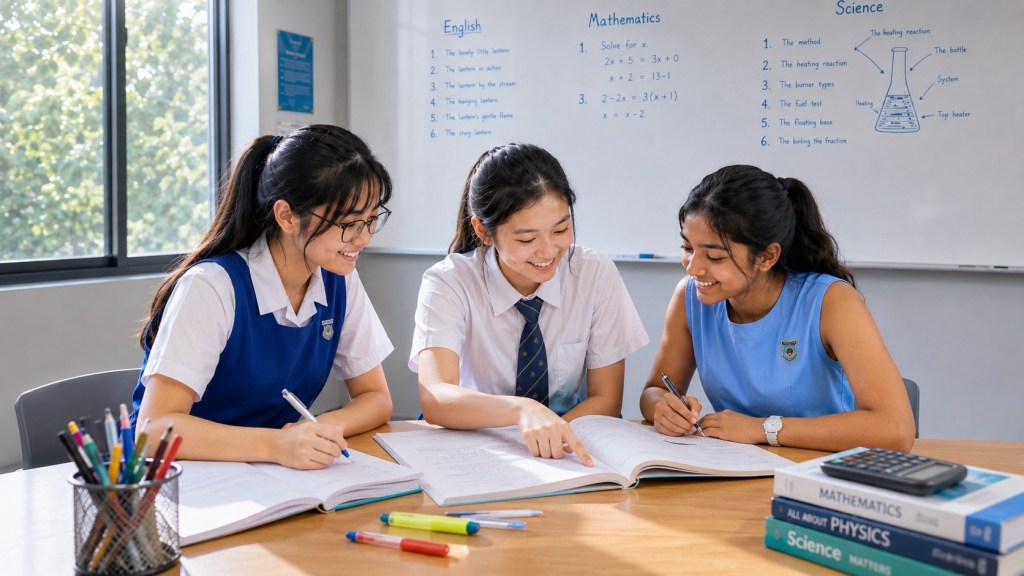
School and tuition can teach the same Mathematics differently without either side being wrong. Parents searching for Secondary Mathematics tuition in Sengkang, conflicting Math methods, different school and tutor methods, or why a child says “my teacher taught it another way” are often dealing with a translation problem rather than a mathematical contradiction. One method may be longer but familiar, another shorter but less transparent, and a third may be mathematically elegant but poorly aligned with the student’s current school expectations.
The educational job is not to make the student choose sides. It is to decide which differences are merely notation or style, which are genuinely different but valid methods, which route best protects understanding and assessment reliability, and whether one method should remain primary for school while another is kept as an alternative. The student should understand enough structure to see how the routes relate instead of carrying two memorised scripts that compete under pressure.
At eduKate Sengkang, this Advanced Mathematics Tutorials article owns the conflict-resolution job when school and tuition teach Mathematics differently. It is distinct from the School Homework vs Tuition Materials owner, which decides what materials tuition should use, and from the resource guides. This page addresses method conflicts: what to do when the school, tutor, textbook, parent, AI tool or another teacher offers a different mathematical route.
Quick answer: what should students do when school and tuition use different Mathematics methods?
First determine whether the methods are mathematically equivalent, merely notationally different, or genuinely incompatible. Keep one primary method that the student understands and can use reliably under school assessment conditions; learn alternatives only when they add understanding, efficiency or transfer.
- Do not assume different means wrong.
- Do not assume shorter means better.
- Do not assume school method is the only valid mathematics.
- Do respect school assessment conventions where they matter.
- Ask what relationship both methods preserve.
- Choose one primary route for routine exam use.
- Keep alternatives as secondary tools until they are genuinely understood.
- Avoid switching methods mid-question without a mathematical reason.
- Use fresh questions to check which route the student can reproduce independently.
Difference 1: notation difference
Sometimes the mathematics is identical but notation differs. One teacher may write a transformation in one line while another separates it across two lines. One may use one variable name or diagram label while another uses a different one. These are usually low-risk differences once the student understands the equivalence.
Difference 2: sequencing difference
Two tutors may use the same operations in a different order. In algebra, one route may simplify first while another rearranges first. Both can be valid if each transformation preserves equivalence.
The student should understand why both routes work and choose the one that is easiest to execute and check.
Difference 3: representation difference
One method may use equations, another a table or graph, another a diagram. These can all model the same relationship. Representation differences are especially useful for transfer when the student understands how the forms connect.
Difference 4: heuristic difference
Teachers can use different problem-solving heuristics: work backwards, draw a model, define variables, use a ratio table or reorganise information. Heuristics guide attention rather than create different mathematics.
Difference 5: genuinely different but valid methods
Some questions have more than one valid solution. A simultaneous-equation problem can be solved through substitution or elimination. A geometry problem may allow more than one theorem sequence. A graph intersection can sometimes be found graphically or algebraically.
The tutor should help the student compare method conditions, efficiency and reliability.
Difference 6: shortcut versus full method
A shortcut may be valid after the structure is understood. If introduced too early, it can create brittle memorisation. School may teach the fuller method because it exposes the reasoning; tuition may offer the shortcut for efficiency.
The right question is whether the student can explain why the shortcut works and whether it is safe under the examination context.
Difference 7: school convention versus mathematically valid alternative
Schools may prefer particular working conventions for clarity, pedagogy or marking consistency. A mathematically valid alternative can still create confusion if the student cannot present it clearly in school assessments.
Tuition should teach understanding without unnecessarily creating conflict with the conventions the student is expected to use.
Difference 8: genuinely wrong method
Not every difference is valid. A method can contain an algebraic error, false rule or context mismatch. The tutor should identify the first invalid step and explain the mathematical reason rather than appeal only to authority.
The first question: are the two methods equivalent?
Take a simple example and run both methods carefully. Do they preserve the same relationships and produce the same result? If yes, the issue is usually preference, efficiency or presentation rather than correctness.
The second question: which method is more transparent to this student?
A method that is shorter for the tutor may be less transparent for the learner. During first learning, a slightly longer route can be safer because each step is visible and recoverable.
The third question: which method is more reliable under time?
Once understanding is secure, the student can compare how many transformations, copied values or calculator inputs each route requires. Fewer fragile steps can improve exam control.
The fourth question: what does the school expect?
The student should be able to follow the school’s method even if tuition later introduces an alternative. This allows participation in class, understanding of teacher feedback and compatibility with school marking conventions.
The fifth question: is the alternative method worth the cognitive cost?
Adding a second method is useful only if it deepens understanding, improves efficiency or provides a backup route. If it merely creates another script to remember, keep one primary method.
The primary-method rule
For routine exam use, most students benefit from one primary method per question family. The primary method should be understood, reliable and compatible with expected working. Alternatives remain available but secondary.
The backup-method rule
A second method can be valuable when the first route becomes awkward, when checking is needed or when the question structure changes. Backup methods are strongest when the student knows when to switch rather than memorising them indiscriminately.
The explanation test
Ask the student to explain why both methods work. If they can reproduce steps but cannot explain the relationship, the alternative may still be surface-level.
The fresh-question test
Give a changed question and let the student choose the method. This reveals whether they own the route or are simply copying the most recent demonstration.
The school-return test
After tuition introduces an alternative, return to a school-style question. Can the student still recognise and use the school’s method? A new method should not erase classroom access.
The no-method-war rule
Adults should not force the student to mediate disagreements. If tutor and school teacher differ, clarify the mathematical relationship. The child should not be told that one adult “doesn’t know how to teach” merely because methods differ.
When tuition should follow the school method closely
- The method is mathematically sound.
- The student understands it.
- The school uses it consistently.
- Assessment expectations favour clear use of it.
- An alternative adds little value.
- The student is already overloaded by too many scripts.
When tuition can introduce an alternative
- The school method is understood but inefficient for this learner.
- The alternative reveals deeper structure.
- The alternative is useful for checking.
- The alternative handles a wider class of questions.
- The student is strong enough to compare methods without confusion.
- The alternative creates a valuable representation link.
When tuition should explicitly correct a school misunderstanding
If the student copied a rule incorrectly, misheard the teacher or recorded a mathematically invalid statement, tuition should correct the mathematics while preserving professional respect. The issue may not reflect the teacher’s actual instruction.
When tuition should verify before contradicting school material
If a school worksheet or note seems wrong, verify carefully. Typos exist, but tutors should avoid declaring school material incorrect without checking context, notation and the exact question.
When parents should not step into a method conflict
Parents do not need to adjudicate every algebraic route. They can ask whether both methods are valid, which one the child should use routinely, and whether the child understands why.
When parents should step in
If the student is visibly confused, homework takes much longer because of conflicting instructions, or tutor and school expectations are genuinely incompatible, parents can ask for clarification from the tutor and, where appropriate, the school.
The role of the textbook
A stable textbook or official syllabus resource can help resolve whether two methods are both valid and whether a particular convention is expected. It should not be used as a blunt authority against either teacher.
The role of AI in method conflicts
AI can generate alternative solutions, but generated methods should be checked for correctness and syllabus fit. A third method is not automatically helpful when the student is already confused between two.
The role of worked examples
Worked examples can make equivalence visible. Place two correct routes side by side and identify the shared mathematical invariants.
The role of self-explanation
Ask the student what changes in each method and what stays the same. This shifts the focus from memorising teacher-specific steps to understanding mathematics.
Secondary 1 method conflicts
Secondary 1 students are especially vulnerable to confusing scripts because algebra is new. Prefer one transparent primary method and introduce alternatives only when they reinforce meaning.
Secondary 2 method conflicts
Secondary 2 students can begin comparing methods more deliberately, especially in factorisation, equations and graphs. Contrast can strengthen structural understanding if the fundamentals are stable.
Secondary 3 method conflicts
Upper-secondary students may encounter more efficient algebraic and trigonometric routes. Tuition can teach method choice, but E-Math and A-Math methods should remain clearly distinguished where subject conventions differ.
Secondary 4 method conflicts
Final-year students should avoid changing primary methods too close to major examinations unless the current route is genuinely unreliable. Stability has value under pressure.
G1/G2/G3 method conflicts
A method that is appropriate in one subject level may introduce content or assumptions outside another route. Keep alternatives aligned with the student’s actual syllabus and assessment conditions.
Method conflict in simultaneous equations
Substitution and elimination are both legitimate. The student can learn the conditions under which one is more efficient, but should retain one reliable default if decision time becomes costly.
Method conflict in algebraic rearrangement
Some teachers use language such as “move the term”; others emphasise applying the same operation to both sides. The second formulation exposes equality more explicitly. Students can learn the conceptual meaning even if classroom shorthand remains familiar.
Method conflict in percentages
One method may use multipliers, another unitary reasoning, another direct percentage calculation. The student should understand the reference quantity first; the method follows from that structure.
Method conflict in rate problems
Formula triangles, unit analysis and algebraic equations can all appear. The learner should understand the relationship among distance, rate and time rather than depend on one visual cue.
Method conflict in graphs
A graph can sometimes be interpreted visually or solved algebraically. The required accuracy and question wording should guide method choice.
Method conflict in geometry
Different theorem sequences can reach the same result. The student should choose a route that makes assumptions explicit and is easy to verify.
Method conflict in trigonometry
Different labelling habits and formula arrangements can confuse students. Anchor the method to side/angle relationships and calculator conditions, then choose a consistent working format.
Method conflict in statistics
Alternative formulas or calculator functions may be available. Students should know what the examination expects, what working should be shown and which method they can use reliably.
Method conflict in real-world application questions
One student may model with a table, another an equation. Multiple representations can be useful if the final reasoning remains interpretable and context-aware.
The conflict-resolution conversation for the student
“Both methods are valid. School uses Method A. Tuition is showing Method B because it makes the relationship clearer. Use A as your primary school method for now; keep B as a checking or extension method until you can choose confidently.”
The conflict-resolution conversation for parents
“Your child is not being asked to reject the school method. We are making the underlying structure explicit and keeping one primary route for assessment reliability.”
The conflict-resolution conversation with school where necessary
If clarification is genuinely needed, ask about expected working or conventions without framing the conversation as a dispute. The tutor can adapt to the school’s official requirements while preserving conceptual understanding.
The method-switch cost
Every method change carries cognitive cost: new notation, new steps, new error risks. Do not switch for elegance alone when the current method is already reliable.
The method-lock risk
The opposite risk is rigidly refusing alternatives even when the current route is inefficient or fails on changed questions. Strong learners benefit from method flexibility after the primary route is secure.
The two-method ceiling for fragile learners
Students who are still fragile often do better with one primary route and at most one well-motivated alternative. Too many methods can create selection paralysis.
The method-comparison ladder
- Stage 1: learn one transparent method.
- Stage 2: execute it independently.
- Stage 3: understand an alternative.
- Stage 4: compare efficiency and conditions.
- Stage 5: choose between them on a fresh question.
- Stage 6: use one method to check the other.
Where this methods guide sits in the Mathematics estate
Use the Representation Choice owner when the main difference is equation/table/graph/diagram, the Self-Explanation owner for explaining method structure, and this page when the practical problem is conflicting school and tuition methods.
The student needs a method hierarchy, not a method collection
When several adults teach Mathematics, students can accumulate methods without knowing which one is primary. The result is not flexibility but hesitation. A method hierarchy solves this: one primary route for routine use, one secondary route for comparison or checking, and additional methods only when they serve a clear purpose.
This hierarchy can change as the learner matures. A transparent school method may be primary in Secondary 1; a more efficient route may become primary in Secondary 4 after the student understands the structure deeply enough to use it safely.
The primary route should satisfy four conditions
- The student understands why it works.
- The student can reproduce it independently.
- The working is compatible with school assessment expectations.
- The route is reliable enough under time.
The secondary route should have a reason to exist
- Provides a useful check.
- Handles a special case better.
- Makes a hidden relationship clearer.
- Connects two representations.
- Becomes more efficient in certain questions.
- Prepares the learner for a later topic without replacing current school participation.
The student should know when not to switch methods
Changing methods mid-question can waste time and create inconsistent working. Students should switch only when the current route is genuinely unproductive, a condition has changed, or the alternative provides a clear mathematical advantage.
The student should know when switching is useful
A second method is valuable when it resolves a stuck state, checks a doubtful answer, reduces a long chain of fragile steps or reveals a relationship that the first method hides.
Method conflict often begins with adult shorthand
Teachers and tutors frequently use compressed language such as “move it over”, “cancel”, “cross multiply” or “just invert”. Experienced mathematicians understand the preserved relationship underneath. Students may interpret the shorthand as an arbitrary rule.
A good tutor can preserve the familiar classroom shorthand while making the underlying operation explicit enough that the learner knows when it is valid.
The “move it over” example
A school teacher may say “move 3 to the other side and change the sign”. Tuition may insist on subtracting 3 from both sides. These are not competing equations if the shorthand is correctly understood. The second explanation makes balance explicit; the first is a compact classroom description.
A fragile learner should understand the balance operation before relying on the shorthand. A stable learner can use the shorthand mentally while preserving correct working.
The “cross multiply” example
Cross multiplication can be a convenient shorthand for equivalent operations on a proportion. The student should know the conditions under which it applies and what equality relationship is being preserved.
If the learner treats “cross multiply” as a universal response whenever fractions appear, the shortcut has detached from structure.
The “cancel” example
Cancellation is often taught as a visual operation. The learner should understand that common factors are being divided, and that cancellation across addition is not generally valid. Tuition can make this structure explicit without telling the student the school language is wrong.
The “formula triangle” example
Formula triangles can support memory for simple three-variable relationships. Algebraic rearrangement may be a more general method. A student can use the triangle as a memory scaffold while still learning the algebra underneath.
The “model method versus algebra” example
A student transitioning from Primary Mathematics may prefer a bar model where school is introducing algebra. Both can represent the same relationship. Tuition can use the model to establish meaning, then translate into the algebraic form the Secondary route increasingly requires.
The “table versus equation” example
A proportional or linear relationship can be organised in a table or expressed algebraically. The table may be more transparent during first learning; the equation may be more efficient once symbolic control is stable.
The “graph versus algebra” example
Intersections and relationships can sometimes be read from a graph or solved algebraically. The required precision and the question wording should determine which method is primary.
The “substitution versus elimination” example
Both methods solve simultaneous equations. If one equation already isolates a variable, substitution may be efficient. If coefficients align easily, elimination may be cleaner. The student does not need to declare one method universally superior.
The “complete the square versus formula” example
In contexts where both methods are within the student’s syllabus, each exposes different structure. One may be better for transforming a quadratic; another may be better for direct root-finding. The student should understand conditions and purpose rather than memorise tutor preference.
The “exact value versus decimal” example
One teacher may preserve exact values while another moves to decimals earlier. The better choice depends on the problem, required accuracy and downstream calculations. Early decimal rounding can introduce avoidable error; exact forms can sometimes become unwieldy.
The “degrees versus radians” issue
In trigonometry, a method can be conceptually correct while calculator mode makes the result wrong. School and tuition should agree on the relevant mode for the syllabus. This is not a stylistic difference; it is an execution condition.
The “one-line algebra versus multi-line algebra” issue
Compact algebra can be efficient for a strong learner and unsafe for a fragile learner. School may prefer more visible working. Tuition should adjust compression to the student’s error profile rather than treat shorter working as inherently more advanced.
The “mental arithmetic versus written working” issue
Mental steps can save time when secure. If they repeatedly create copying or sign errors, more written structure is justified. The correct amount of working changes with learner stability and examination demand.
The “teacher answer versus tutor answer” issue
If two correct methods produce the same final result, the student should compare assumptions and accuracy. If the answers differ, locate the first line where the routes diverge. Do not decide by authority alone.
The “AI answer versus school answer” issue
Generated solutions can use methods outside the student’s course, omit expected working or contain mistakes. AI should not become the tie-breaker simply because it sounds confident.
The “parent method” issue
Parents may remember methods from a different curriculum or era. Those methods can still be mathematically valid. If they confuse the child, preserve one school-compatible primary route and keep parent alternatives out of ordinary homework unless they add real clarity.
Method conflict is most dangerous during first learning
When the student is building a new concept, multiple routes can increase cognitive load before the underlying relationship is stable. Early teaching should usually favour one transparent method.
Method diversity becomes more valuable after stability
Once the learner can execute and explain one route, comparing alternatives strengthens transfer, efficiency and mathematical flexibility.
The stability-before-variety rule
- Understand one route.
- Execute it accurately.
- Retrieve it after delay.
- Use it in a changed question.
- Then compare alternatives.
The assessment-proximity rule
The closer the student is to a major assessment, the higher the cost of unnecessary method changes. Introduce alternatives only when the current route is failing or the new route offers a clear advantage that the student can stabilise quickly.
The transition-year rule
Secondary 1 students often need consistency while they adapt to symbolic Mathematics. Secondary 2 can tolerate more method comparison. Secondary 3 can use method flexibility for upper-secondary breadth. Secondary 4 should balance flexibility with examination reliability.
The strong-student rule
Strong students can benefit from multiple methods, but even they need a default route under time. Method comparison should deepen structure, not create a contest for cleverness.
The fragile-student rule
Fragile students should not be exposed to several equivalent procedures merely because the tutor knows them. One stable route plus one carefully motivated alternative is often enough.
The method-confusion diagnostic
- Student starts one method and switches without reason.
- Working combines incompatible steps from two methods.
- Student asks “Which teacher’s way should I use?” instead of reading the question.
- Errors increase after an alternative is introduced.
- Student can reproduce both methods but cannot explain either.
- Homework time increases because every question is solved twice.
- School feedback becomes harder to interpret because tutor notation differs.
The method-flexibility diagnostic
- Student can explain why both routes work.
- Student chooses based on question structure.
- Alternative method improves efficiency or checking.
- Working remains consistent within a solution.
- Student can return to the school method when required.
- Fresh questions do not create selection paralysis.
The method-reset protocol
If a student becomes confused, pause the alternatives. Choose one primary method, explain the underlying relationship and use several fresh questions until the route is stable again. Then reintroduce the second method only if it adds value.
The method-compare protocol
- Solve one question using Method A.
- Solve the same or parallel question using Method B.
- Mark the common relationship.
- Count the fragile steps.
- Identify where each route is most useful.
- Choose a primary method.
- Use the other as backup/checking only.
The school-convention protocol
If school requires or strongly teaches a specific working convention, ensure the student can use and understand it. Tuition can still teach deeper structure underneath. Conceptual understanding and school compatibility are not opposites.
The tutor-convention protocol
A tutor should explain when a personal preferred method is optional. Students should not assume every tutor technique is an examination requirement.
The parent-convention protocol
Parents can ask one question: “Which method should my child use by default in school?” This keeps home support consistent.
The conflict log
If method conflict repeatedly appears, keep a small log: question family, school method, tuition alternative, primary route chosen, and reason. This prevents the same debate from recurring every week.
The method language map
Students can learn that different words may describe the same operation. For example, “transpose” or “move” may refer to an operation that algebraically involves adding or subtracting both sides. Building this translation map reduces teacher-specific dependence.
The representation language map
One adult may say “draw a model”, another “make a table”, another “define a variable”. The learner should ask what relationship each representation is trying to make visible.
The checking language map
One tutor may say “substitute back”; another “verify the solution”. Students should recognise the common checking function.
The first-wrong-line protocol when two methods disagree
Place the two workings side by side and compare them until the first non-equivalent line appears. The earlier shared lines remain valid. This focuses correction on Mathematics rather than authority.
The counterexample test
If someone states a shortcut or rule, test it on a simple counterexample. If the rule fails, identify the missing condition. This is especially useful for overgeneralised algebra shortcuts.
The unit test
When methods produce different numerical results in applied questions, check units and quantity meaning. A method can perform correct arithmetic on the wrong quantity.
The magnitude test
Estimate whether the answer is plausible. This can reveal which route contains an input or transformation error without resolving every line immediately.
The inverse-operation check
Where appropriate, reverse the operation or substitute the result back. A second method can function as verification rather than competition.
Method conflict during homework
The student should use the primary school-compatible route for ordinary homework unless the tutor has a clear reason to practise the alternative. Mark uncertain questions for tuition rather than switching randomly between methods.
Method conflict during tuition
The tutor can compare methods more freely, but should close the loop by stating which route the student should use independently next.
Method conflict during school lessons
The student should follow the teacher’s explanation and note any difference to discuss later. Interrupting every lesson to defend a tuition method can harm classroom learning and relationships.
Method conflict during tests
Use the most reliable method that meets the question and expected conventions. Examination conditions are not the time to experiment with a recently learned alternative.
Method conflict during corrections
If the school correction uses another valid route, students can compare it after first understanding why their own route succeeded or failed. Corrections are a good place for method comparison because the time pressure is removed.
Method conflict during enrichment
Enrichment is the ideal environment for multiple valid methods, because method comparison itself becomes part of the learning target.
Method conflict during catch-up
Keep the system simple. A learner repairing foundational gaps benefits from one transparent route. Alternatives can wait until the core method stabilises.
Method conflict during tutor switching
A new tutor should preserve useful existing methods and change them only when there is evidence of confusion, inefficiency or error. The Switching Tutors owner explains continuity.
Method conflict during a trial lesson
The new tutor should not prove value by immediately replacing the student’s school method. First see whether the existing method works and whether the learner understands it.
The three-student group and method diversity
A small group naturally exposes students to peers’ methods. This can deepen understanding if the tutor gives private think time first and then compares routes. It can create confusion if students copy whichever answer appears fastest.
The one-to-one tutor and method diversity
Private tuition can explore alternatives deeply, but the tutor should still protect a primary route so the learner does not become dependent on bespoke tutor methods that are hard to use in school.
Method conflict and progress reviews
A progress review can record when a new method was introduced and whether it improved accuracy, speed or transfer. If performance worsened, the programme should be willing to revert or simplify.
Method conflict and support dependence
Students can become dependent on a tutor-specific method cue. Teach structural recognition so the student can enter the question even when the tutor’s preferred phrasing is absent.
Method conflict and confidence
Too many methods can make a student feel less certain despite greater knowledge. Confidence should be calibrated to one reliable route first; flexibility comes after.
Method conflict and speed
A shorter method is only faster if the student can retrieve and execute it reliably. A familiar longer route may be more efficient overall if it reduces hesitation and errors.
Method conflict and working marks
A compressed alternative may hide essential working. Students should know what must remain visible for marking and recovery.
Method conflict and calculator use
Two routes may produce the same mathematical expression but different calculator sequences. Choose the input method with fewer bracket or mode risks.
Method conflict and exactness
If one method rounds earlier, compare whether the question expects an exact value or specified accuracy. Method choice should preserve required precision.
Method conflict and proof or justification
A method that gives the correct number may not provide the explanation a question asks for. Read the command: calculate, show, prove, explain and justify can require different visible reasoning.
The parent escalation rule
Most method differences can be resolved within tuition. Escalate to school clarification only when the student cannot reconcile expectations, marking is affected or the tutor needs confirmation of an official convention.
The tutor restraint rule
Do not contact school over every method preference. Respect the school’s role and keep communication focused on genuine ambiguity or student access.
The learner-agency rule
The end goal is not for the student to memorise whose method belongs to whom. The learner should increasingly recognise mathematical structure and choose a route based on the question.
A one-page method decision card
- Question family.
- Primary method.
- Why it works.
- School convention.
- Optional alternative.
- When alternative is useful.
- Common error risk.
- Checking method.
A card like this can reduce repeated conflict without becoming another large note system.
The method-release rule
Once the student can choose and justify methods independently, the tutor can stop prescribing a fixed route for every question. Method flexibility becomes learner-owned.
Worked method comparison: linear equations
Suppose school teaches explicit balancing: subtract 5 from both sides, then divide by 3. Tuition uses the shorthand “move 5 across, then divide”. Both can produce the same answer if the student understands that the shorthand represents equivalent operations. The tutor should preserve the school’s conceptual language until the learner can explain why the shorthand is safe.
The primary route for a fragile Secondary 1 student should probably remain explicit balance. A stable Secondary 3 student may use the shorthand mentally while keeping the written algebra correct. The method choice changes with learner stability, not with adult preference.
Worked method comparison: simultaneous equations
If one equation already gives x in terms of y, substitution may be transparent. If coefficients align conveniently, elimination may be faster. A student should not choose by memorised loyalty. They should inspect the structure and use the route that creates fewer fragile steps.
During first learning, the tutor can designate one primary method. After stability, the student solves a second example with the alternative and compares the working. This creates flexibility without early confusion.
Worked method comparison: percentage change
One teacher may use the formula for percentage change; another may reason through old value, change and new value; another may use a multiplier. All are useful when the reference quantity is correctly identified. The real danger is not the method difference but forgetting “percentage of what?”.
Tuition should therefore anchor method comparison to the invariant: the base quantity. Once that is stable, students can use the route that is fastest and clearest for the question.
Worked method comparison: ratio
A ratio problem can be solved through unitary reasoning, scaling, algebra or a table. Younger or fragile learners may see the relationship most clearly through scaling. Older students may prefer algebra when the unknown is embedded. The tutor should connect the methods so the student sees one proportional structure rather than unrelated tricks.
Worked method comparison: speed, distance and time
A formula triangle can support recall; dimensional reasoning and algebra provide a more general structure. If the triangle helps the student remember the relationship without creating misuse, it can remain a scaffold. The student should still understand that distance, speed and time are quantities linked multiplicatively.
Worked method comparison: linear graphs
Gradient may be found from two coordinates, read from a graph or inferred from an equation. These are not competing topics. They are different representations of the same linear relationship. Strong tuition makes the connection visible.
Worked method comparison: coordinate geometry
Distance, midpoint and line relationships can sometimes be handled through formulas or geometric reasoning. The student should know what each formula represents rather than using it as an isolated memory object.
Worked method comparison: trigonometry
One tutor may teach a mnemonic, another labels opposite/adjacent/hypotenuse explicitly, another emphasises ratio definitions. The mnemonic is useful only if the learner can identify the sides correctly. Tuition should not mistake memorising SOHCAHTOA for understanding the triangle.
Worked method comparison: area and mensuration
A composite area can be found by adding parts or subtracting a missing region from a larger shape. Both are valid. Method choice should consider which route produces fewer measurements and fewer opportunities to copy the wrong value.
Worked method comparison: probability
A probability problem may be organised by listing outcomes, drawing a tree or reasoning through complements. The tutor should teach the student to choose a representation that matches the event structure rather than always defaulting to one diagram.
Worked method comparison: statistics
A calculation can sometimes be completed directly, with a table or through calculator functions. The student should know which quantities need to be shown and what the output means. A calculator shortcut should not remove interpretation.
Worked method comparison: algebraic fractions
One route may factor first, another search for a common denominator immediately. The safest method depends on structure. If factorisation exposes cancellation and restrictions, it may reduce later complexity. The student should inspect before executing.
Worked method comparison: quadratic equations
Where syllabus and question permit, factorisation, completing the square and a formula may all solve a quadratic. A student should not use the quadratic formula automatically when factorisation is immediate, nor avoid the formula when factorisation is awkward. Method choice is part of mathematical maturity.
Worked method comparison: real-world modelling
One student may model a transport problem with equations, another with a table. If both preserve the constraints and produce a defensible conclusion, the representation choice can be discussed rather than ranked absolutely.
Method comparison should focus on invariants
Ask what must remain true across all valid methods: equality, proportionality, geometric properties, units, constraints and definitions. Invariants help students see through surface differences and reduce dependence on one teacher’s script.
The method-comparison worksheet
- Question family: ______
- School method: ______
- Tuition method: ______
- Both valid? yes / no / conditionally
- Shared mathematical relationship: ______
- Primary route: ______
- Why primary: ______
- Backup route: ______
- When backup is useful: ______
- Common conflict/error: ______
When a shortcut should be rejected
Reject a shortcut when the student cannot state its conditions, when it repeatedly creates errors, when it hides essential working or when it only works on a narrow surface form the student cannot recognise reliably.
When a shortcut should be kept
Keep it when the structure is understood, the conditions are known, it reduces fragile steps and it remains compatible with assessment expectations.
When a school method should remain primary even if tuition knows a faster route
Keep the school method primary when the learner is still fragile, the alternative adds little practical benefit, the school expects visible working in a particular form, or the assessment is close. Stability can be more valuable than elegance.
When the tuition method can become primary
An alternative can become primary when the learner understands it structurally, reproduces it independently, gains meaningful efficiency and remains able to interpret school instruction and corrections.
The exam-season method freeze
In the final weeks before a major examination, avoid unnecessary method churn. Keep the student’s reliable primary routes unless there is a clear recurring failure. Practice should improve execution, selection and checking rather than continuously introduce clever alternatives.
The post-exam method review
After the paper, compare whether the primary method was efficient and reliable. If it caused repeated time or working problems, the next teaching cycle can explore alternatives without immediate exam pressure.
Method conflict after a teacher correction
If the school teacher corrects a solution using another method, the student should first understand the correction. Then compare it with the tuition route. If both are valid, choose whether the school method should remain primary for classroom coherence.
Method conflict after tutor correction
If tuition changes a school method, the tutor should state why: conceptual clarity, fewer steps, broader applicability, or correction of a genuine error. Unexplained replacement creates confusion.
Method conflict after parent help
Parents can avoid escalating confusion by asking the child to show the school method first. If the parent knows an alternative, they can mention it later only if the student is stable enough to benefit.
Method conflict after AI help
AI often produces routes that are mathematically sophisticated but outside the student’s current syllabus or notation. Treat them as optional comparisons unless they are verified and genuinely helpful.
How to ask the school teacher about a method
A student can ask: “Is this alternative method acceptable if I show the working clearly?” This is more constructive than “My tutor says your method is wrong.” The aim is clarification, not confrontation.
How the tutor should respond if school prefers another valid method
Respect the school convention where it affects assessment or classroom participation. The tutor can keep the alternative as a conceptual or checking method without forcing it into every school solution.
How the tutor should respond if school feedback is mathematically mistaken
Verify carefully. Explain the mathematics to the learner without undermining the teacher personally. Where the issue materially affects assessment or recurring instruction, parents or the student can seek clarification through the school.
How parents should read conflicting adult confidence
Both school teacher and tutor may sound certain. Parents do not need to choose authority by confidence. Ask for the mathematical relationship, the expected school convention and the student’s independent reliability with each route.
How students should read conflicting adult confidence
The learner can say: “I need one method I understand and can use in school. Please show me how the alternative connects.” This reframes the conflict around learning rather than loyalty.
Method conflict and lesson efficiency
Too much method comparison can consume lesson time without improving performance. Compare methods selectively on high-value questions, then return to independent practice.
Method conflict and homework efficiency
Students should not solve every homework question twice just because two methods exist. Use one primary route and reserve alternatives for checking, difficult cases or designated practice.
Method conflict and confidence calibration
If a student believes every difference means they are wrong, method comparison can lower confidence unnecessarily. Show equivalence explicitly and use fresh evidence to establish which route they can trust.
Method conflict and progress reporting
A progress review can note: “The school method is understood and remains primary. The tuition alternative is now used only for checking.” This reassures parents that the programme is not creating a competing curriculum.
Method conflict and tutor switching
When changing tutors, carry the student’s primary methods forward. The new tutor can evaluate them from fresh work before replacing them. This preserves continuity and reduces transition friction.
Method conflict and trial lessons
A trial tutor should not demonstrate value by immediately replacing the student’s method. First observe whether the existing route is understood and reliable.
Method conflict and three-student groups
Different students may use different valid methods. The tutor can compare them after private attempts and help each student maintain a reliable primary route. The group should broaden understanding without forcing one peer’s method onto everyone.
A method-conflict progress checklist
- Student can explain the primary method.
- Student knows whether the alternative is valid.
- Student knows when the alternative is useful.
- School working remains understandable.
- Fresh questions do not trigger method paralysis.
- Homework time has not increased unnecessarily.
- Exam execution remains stable.
A method-conflict parent checklist
- My child can state one default method.
- The tutor can explain how it aligns with school.
- Alternative methods have a clear purpose.
- No adult is asking the child to take sides.
- Method differences are not increasing homework burden.
- Assessment conventions are respected.
A method-conflict tutor checklist
- Have I checked whether the school method is already valid and understood?
- What does my alternative add?
- Is the learner stable enough for method comparison?
- Have I made equivalence explicit?
- Have I named the primary route?
- Can the student return to school work without confusion?
- Have I avoided unnecessary method churn near exams?
A method-conflict student checklist
- I know which method I use first.
- I know why it works.
- I know whether another method is optional or required.
- I can recognise when the alternative helps.
- I do not switch methods randomly mid-question.
- I can explain my working to my school teacher.
Final principle: different methods should increase understanding, not adult competition
Mathematics is rich enough to allow more than one valid representation and route. Students benefit when those differences reveal structure, efficiency and flexibility. They suffer when every adult presents a new script without connecting it to what the learner already knows.
Keep one reliable primary method, connect alternatives through shared mathematical relationships, respect school conventions where they matter, and introduce variety only when the learner is ready to use it. The goal is not to decide which adult owns the right method. The goal is a student who understands enough Mathematics to choose and justify a method independently.
Worked conflict case: Secondary 1 equations
The school teaches balance explicitly. Tuition introduces “move and change sign” because it appears faster. The student begins moving terms incorrectly when negatives are involved. The problem is not that the shortcut is always wrong; the shortcut has been introduced before the equality structure is stable.
The repair is to restore explicit balance as the primary route, use the shorthand only after the student can explain it, and retest on negative coefficients. The tuition method can remain as internal shorthand later.
Worked conflict case: Secondary 2 factorisation
The school teaches a systematic factorisation procedure. Tuition teaches pattern recognition and a faster route. The student understands both but hesitates because they do not know which is “allowed”. The tutor should state that both are valid where conditions fit, keep the school route primary for routine work, and use pattern recognition as efficiency training.
Worked conflict case: Secondary 2 linear graphs
The school emphasises gradient formula from two points. Tuition teaches reading rise-over-run directly from the graph. Both represent the same relationship. The student should know when a graph gives enough visual information and when coordinate calculation is needed for precision.
Worked conflict case: Secondary 3 trigonometry
The school uses a mnemonic-heavy approach. Tuition teaches ratio definitions and diagram labelling. The tutor should not forbid the mnemonic if it helps recall; instead, make side identification and angle reference explicit so the mnemonic cannot be used blindly.
Worked conflict case: Secondary 3 formula manipulation
The school teacher uses compact rearrangement. Tuition writes every inverse operation. The student is accurate but very slow. Once equality is secure, tuition can teach controlled compression and let the student adopt a more efficient primary route.
Worked conflict case: Secondary 4 simultaneous equations under time
The student knows both substitution and elimination. In timed papers, they spend too long deciding. The tutor designates a default: use elimination when coefficients align cleanly, substitution when one variable is already isolated. The student practises classification until choice becomes quick.
Worked conflict case: Secondary 4 exact versus approximate answers
The school keeps exact values; tuition often rounds early for speed. The student loses accuracy later in multi-step questions. The tutor should keep exact or sufficient-precision values through intermediate steps and round according to the question’s requirement.
Worked conflict case: school method is longer but safer
A tutor may prefer a compact technique, but the student repeatedly loses signs when using it. The longer school method produces correct work and clearer recovery. Efficiency should be measured by total reliable completion time, not number of written lines.
Worked conflict case: tutor method is longer but clearer
The school uses a compressed shortcut the student memorised but does not understand. Tuition expands the reasoning into several steps. Marks may initially look slower, but the deeper route can create better transfer. Once stable, the working can be compressed again.
Worked conflict case: parent introduces an old method
A parent remembers a valid method from their own schooling. The child becomes confused because the school uses different notation. The best home response is to let the child show the school method first and bring unresolved differences to tuition rather than teaching a third script during homework.
Worked conflict case: AI introduces an out-of-syllabus method
An AI solver gives a correct but advanced route. The student copies it and cannot explain the method. Tuition should return to the syllabus-compatible relationship, then use the AI method only as an enrichment comparison if the learner is ready.
Worked conflict case: tutor changes after several years
The new tutor prefers different algebra notation. Instead of forcing an immediate reset, the tutor asks the student to solve fresh questions using their existing method. If it is sound, keep it. Change only what produces errors or blocks later work.
Method conflict before WA
Keep method choice simple. Use the school-compatible primary route and avoid adding alternatives unless the current route is failing. The assessment window is too short for unnecessary experimentation.
Method conflict before EOY
Broader revision provides more opportunity to compare methods, but the learner should still know which route is default for each question family. Variety should improve transfer rather than increase hesitation.
Method conflict before prelims
Prioritise reliability. A new elegant method is justified only if it solves a recurring problem quickly enough to stabilise before the paper. Otherwise preserve the existing primary route and improve execution.
Method conflict after prelims
Paper evidence can reveal that a primary method is too slow or fragile. The post-prelim window can justify a targeted method change if the student has enough time to practise and retest it before the final examination.
Method conflict in holiday revision
Holidays are safer periods for exploring alternatives because immediate assessment pressure is lower. Use them to deepen structure, not to collect tricks for their own sake.
Method conflict during catch-up
Catch-up students need clarity. Use one transparent route until the repaired capability is stable. Alternatives can be reintroduced after the learner rejoins current schoolwork.
Method conflict during enrichment
Enrichment is where method comparison can become a target itself: find two solutions, compare assumptions, generalise conditions and decide which representation is most informative.
Method conflict during support fading
A learner can become dependent on a tutor-specific script. Fading support means the student should recognise the structure without hearing the tutor’s preferred cue. Mixed questions are a useful test.
The parent–tutor communication rule
When a child reports conflicting methods, parents can ask the tutor to explain whether the methods are equivalent and which one the student should use by default. This is more productive than asking the tutor to prove the school wrong.
The parent–school communication rule
Where school convention genuinely matters, parents can ask whether a valid alternative method is accepted and what working should be shown. Keep the question focused on assessment clarity.
The tutor–student communication rule
The tutor should say explicitly whether a new method is replacement, backup, checking method or enrichment. Ambiguity is what turns variety into conflict.
The student–teacher communication rule
Students can ask respectful, concrete questions: “I used this method and got the same result. Is this working acceptable?” This keeps classroom dialogue mathematical rather than adversarial.
The adult-alignment note
When a recurring conflict affects homework or marks, one short note can settle the system: school method, tuition alternative, default route and conditions for the alternative. The learner no longer needs to re-litigate the difference every week.
How method conflict affects homework time
Students can waste substantial time deciding which adult’s route to use or solving the same question twice. A primary-method decision can reduce this friction immediately.
How method conflict affects confidence
If every method difference is framed as right versus wrong, students can lose trust in their own reasoning. Showing equivalence and conditions helps confidence become evidence-based.
How method conflict affects working quality
Mixing notation from two routes inside one solution can make working hard to follow. Students should complete a solution consistently using one chosen method unless they deliberately restart.
How method conflict affects checking
Alternative methods can be powerful checking tools. Solve with the primary route, then verify through substitution, graphing, estimation or another method where efficient.
How method conflict affects memory
Too many unconnected scripts increase retrieval burden. Connecting methods through shared structure reduces memory load because the student remembers relationships rather than separate recipes.
How method conflict affects transfer
Once one method is stable, comparing alternatives can strengthen transfer because the student sees the same structure from different angles. Variety is most valuable after stability.
How method conflict affects exam speed
Hesitation between methods can consume more time than calculation. Timed mixed sets can reveal whether flexibility is helping or creating selection cost.
How method conflict affects strong students
Strong students may enjoy elegant alternatives, but the tutor should still maintain a reliable exam route. Mathematical sophistication includes knowing when not to use the cleverest method.
How method conflict affects fragile students
Fragile students benefit from fewer, clearer routes. Multiple methods should be introduced only when they reduce confusion rather than signal sophistication.
How method conflict affects the three-student class
Three learners can legitimately use different primary methods. The tutor should compare methods at useful moments without demanding uniformity where mathematics allows choice. Shared standards are correctness, clarity, syllabus fit and independent reliability.
How method conflict affects progress reviews
A report can state whether an alternative method improved speed or accuracy and whether the student remains compatible with school work. If the alternative created confusion, it should be retired.
The retire-an-alternative rule
- Retire it if it increases errors.
- Retire it if the student cannot explain its conditions.
- Retire it if it creates school-working confusion.
- Retire it if it adds no meaningful efficiency or understanding.
- Retire it if it causes selection paralysis near exams.
The keep-an-alternative rule
- Keep it if the student understands why it works.
- Keep it if it is reliably reproduced.
- Keep it if it reduces fragile steps.
- Keep it if it helps checking.
- Keep it if it deepens representation or transfer.
- Keep it if the student can still use the school method when needed.
The promote-an-alternative rule
An alternative can become the new primary route when it is better understood, more reliable and more efficient than the old method, and when school compatibility remains intact.
The return-to-school-method rule
If an alternative becomes fragile under exam pressure or school feedback, return to the familiar school-compatible route and stabilise performance. Flexibility includes knowing when to simplify.
The method-choice mastery checkpoint
- Can explain primary method.
- Can execute it accurately.
- Can recognise its conditions.
- Can explain alternative method.
- Can state when alternative helps.
- Can choose on a fresh question.
- Can remain consistent within one solution.
- Can meet school working expectations.
The final parent decision
Parents do not need school and tuition to teach identically. They need the differences to be mathematically coherent, explained to the student and managed so one primary route remains reliable. Ask whether the alternative adds value and whether the student can still function confidently in school.
The final tutor decision
Before introducing another method, ask: what problem am I solving? If the answer is only “this is how I prefer to do it”, the learner may not need the change. If the method exposes structure, improves reliability or broadens transfer, teach it deliberately and connect it to the existing route.
The final student decision
Use the method you understand, can justify and can execute reliably under the conditions that matter. Learn alternatives as tools, not as competing loyalties. The Mathematics should become more coherent as methods multiply, not less.
Closing principle: one Mathematics, several valid routes
School and tuition do not need identical scripts. They do need a shared commitment to correct mathematics, clear working and learner understanding. When methods differ, compare structure, conditions, reliability and assessment fit.
The mature outcome is a student who can see that different methods may express the same mathematical relationship, choose a primary route without confusion, and use alternatives strategically. At that point, the method belongs to the learner rather than to the adult who taught it.
The method-change threshold
A tutor should change a student’s primary method only when there is a clear educational reason. The current route may be mathematically wrong, too fragile, too slow, too narrow for the question family, or poorly understood. A new route should solve one of those problems rather than exist because the tutor prefers it.
If the current method is correct, independently reproducible and compatible with school assessment, the burden of proof belongs to the proposed replacement. A method change creates new retrieval and error costs, so the gain should be visible.
The method-keep threshold
- The student understands the route.
- Fresh questions are solved independently.
- Working is clear enough for school assessment.
- Errors are not concentrated in the method itself.
- Time cost is acceptable.
- The student can recover from a mistake.
- The method transfers to changed questions.
When these conditions hold, tuition should hesitate before replacing the route merely to demonstrate another technique.
The method-change trial
If a new route appears promising, test it on a bounded set rather than converting every question immediately. Compare accuracy, time, working clarity and student explanation. Then use a delayed retest. This turns method change into an evidence-based intervention rather than a style preference.
The method-change rollback rule
If the alternative increases error rate, hesitation or school confusion, return to the former reliable method while preserving any conceptual insight the comparison produced. Reverting is not failure. It is responsive teaching.
The method-change stabilisation rule
If the alternative genuinely improves performance, stabilise it before promoting it to primary status. Use direct practice, changed questions, delay and mixed selection. The student should be able to choose it for mathematical reasons, not because tuition used it most recently.
The school-compatibility checkpoint before promoting a new method
- Can the student still follow school explanations?
- Can the student read school corrections?
- Is the working acceptable for the assessment context?
- Does the method use content within the student’s route?
- Can the learner explain the alternative if questioned?
The examination-reliability checkpoint
A method that works beautifully in slow tuition conditions may fail under time. Before making it the exam default, test it inside realistic mixed and timed work. The student should not have to consciously remember “what tuition said” while the clock is running.
The revision rule: fewer methods, deeper control
As a major examination approaches, revision should increasingly stabilise the routes the student will actually use. Alternative methods can remain in the background as checking or recovery tools, but the core method set should become compact and familiar.
The enrichment rule: more methods, deeper comparison
Outside high-pressure windows, strong learners can explore alternatives more freely. Compare elegance, generality, representation and efficiency. Enrichment is where multiple routes can become mathematical insight rather than exam noise.
The catch-up rule: one route first
A learner who is behind should not carry several competing scripts while repairing the foundation. Choose one transparent route, stabilise it, then introduce alternatives after the student can rejoin current school work.
The parent rule: protect consistency at home
Parents can support by asking the child to use the agreed primary method for homework. If another adult shows a different route, record it for later discussion rather than turning the kitchen table into a method debate.
The tutor rule: explain every alternative’s status
When introducing a new route, say whether it is a replacement, optional alternative, checking method or enrichment method. One sentence can prevent weeks of confusion.
The school rule: preserve classroom access
The student should be able to participate in school even if tuition prefers another method. Tuition should not make the learner dependent on a private language that disconnects them from classroom instruction.
The learner release point
Eventually, the student should no longer think “this is my teacher’s method” and “this is my tutor’s method”. They should recognise the mathematical structure, know which route is reliable, and be able to justify method choice from the problem itself.
That release point is the real resolution of method conflict. Adult-specific scripts fade, structural understanding remains, and the learner can move between school, tuition, homework and examinations without feeling that the Mathematics changes whenever the adult changes.
Final summary: preserve coherence before cleverness
Different methods are educationally valuable when they reveal the same Mathematics more clearly, make a route safer, provide a checking mechanism or expand transfer. They are harmful when they multiply scripts faster than the learner can connect them.
Keep the student’s primary method coherent, school-compatible and independently usable. Add alternatives only with a clear purpose. Test them on fresh work, keep or retire them based on evidence, and let the student’s understanding—not adult loyalty—decide what survives.
A final conflict-resolution script for students
When two methods collide, the student can use a simple internal script: “Are both methods valid? What relationship do they preserve? Which one does school expect me to understand? Which one can I use most reliably? Does the alternative add a real advantage?” This turns method conflict into a mathematical comparison instead of an authority conflict.
If the student cannot answer those questions, keep one primary route and ask for clarification before adding complexity. The learner should never have to carry several unexplained methods simply because several adults are involved in their education.
A final conflict-resolution script for tutors
Before replacing a school method, the tutor can ask: “Is the current method wrong, fragile, slow or poorly understood? What exactly will my alternative improve? How will I show the connection? How will I know if the change worked? Can the student still function in school?” If those questions have no clear answer, keep the existing route and deepen understanding instead.
A final conflict-resolution script for parents
Parents can ask one practical question: “Which method should my child use first in ordinary school work, and why?” That answer should be enough to restore consistency at home. Alternative routes can then be discussed in tuition without turning homework into a contest between adults.
The aim is a coherent learner, not identical adults. School and tuition can remain different while the student’s Mathematics becomes more unified, because the learner understands the structure beneath the methods and knows which route to trust when it matters.
The last coherence check
After several weeks of school and tuition using different methods, ask whether the student is becoming more coherent or more fragmented. Can they explain why the methods work? Do they have one dependable default? Can they follow school corrections? Can they choose an alternative for a reason rather than from memory of who taught it?
If the answers are yes, method diversity is strengthening the learner. If the student is increasingly hesitant, mixes incompatible steps or spends more time deciding than solving, simplify the system. Remove unnecessary alternatives, restore one primary route and reconnect every remaining method to the same underlying relationship.
This is the practical endpoint: school and tuition may continue to look different on the page, but they no longer feel like different Mathematics to the student. The learner sees one structure, several legitimate representations and one reliable route they can execute under pressure. At that point, the conflict has been resolved where it matters most—inside the learner’s own mathematical understanding.
The final test is whether the student can enter a fresh school question without first asking which adult’s method applies. If they can identify the mathematical structure, select the agreed primary route, complete the working consistently and explain an alternative only when useful, the system is coherent.
That coherence should remain visible in homework, classwork, tuition and examinations. Method diversity is then an asset: it strengthens checking, transfer and flexibility without increasing hesitation. If coherence is lost, simplify first and rebuild the connection between methods before adding anything new.
The learner should ultimately be able to say: “I understand why both methods work. This is the method I use first in school because it is reliable for me. I know when the alternative is useful, and I can switch only when the question gives me a reason.” That is method ownership.
Once method ownership is established, school and tuition can remain stylistically different without creating cognitive conflict. The student carries the invariant mathematics across both systems and uses each adult’s language as context, not as a separate set of rules.
That is enough coherence for reliable school work, tuition learning, homework and examination performance.
Method ownership matters.
Continue through the Mathematics Learning Hub for routes by concept and level, the Complete Mathematics Index for the wider estate, or Mathematics Tutor Sengkang when the question is specifically about tutoring support.
Different methods still need one coherent learning route
When school and tuition use different Mathematics methods, the goal is not to decide which adult wins. Use The Tutor System to keep the learner, school demand and tutor function coherent. Parents can use the parent guide to bring school evidence into the review; students can use the student guide to explain which representation or method is actually becoming usable.
