
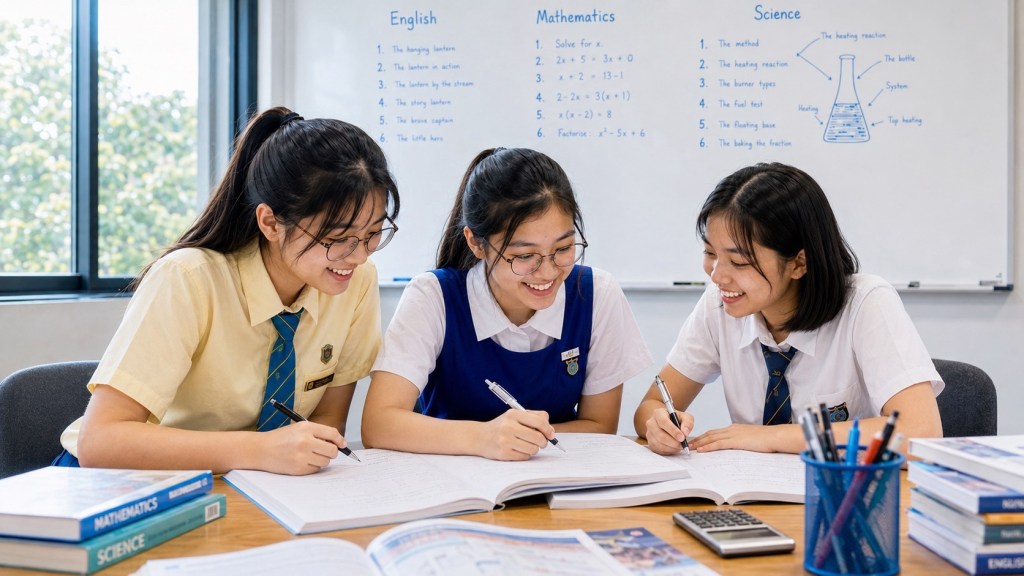
Should Mathematics tuition follow the school syllabus exactly, teach ahead of school, or run its own independent curriculum? Parents searching for Secondary Mathematics tuition in Sengkang, whether tuition should follow school pace, whether a tutor should pre-teach chapters, or why tuition is teaching something different from school are usually asking an architecture question.
A strong tuition programme should neither behave like a homework club nor ignore the school route. School provides the live curriculum, assessment sequence and official learning environment. Tuition adds value by diagnosing prerequisites, repairing gaps, building transfer, maintaining old topics, preparing for examinations and sometimes previewing future concepts when that preview solves a real educational need. The best architecture is therefore anchored to school but not trapped by school.
At eduKate Sengkang, this Advanced Mathematics Tutorials article owns that architecture decision. It is distinct from the School Homework vs Tuition Materials owner, which decides what materials to use, the School vs Tuition Methods owner, which resolves procedural differences, and the existing teach-ahead pages. This page asks how the whole tuition curriculum should relate to the school’s sequence over a term and year.
Quick answer: should Mathematics tuition follow school pace?
Tuition should stay close enough to school that current learning and assessments are supported, but independent enough to repair prerequisites, maintain old knowledge, train transfer and prepare for future demands. School alignment should anchor the programme; learner evidence should determine the exact sequence.
- Follow school closely when the student needs current-topic access.
- Step behind school temporarily to repair a live prerequisite.
- Step ahead selectively when preview reduces transition cost.
- Run independent retrieval and transfer even when school is elsewhere.
- Do not create a competing full syllabus without a clear reason.
- Do not reduce tuition to homework completion.
- Use assessment dates and learner evidence to rebalance the mix.
The three curriculum positions
School-following
Tuition largely teaches the same topics school is teaching now. This provides immediate alignment and can help students who are lost in current lessons.
School-anchored independent curriculum
Tuition knows the school route but organises lessons around capability: prerequisites, retrieval, current topics, transfer and exam control. This is often the most robust model.
Independent or accelerated curriculum
Tuition follows its own sequence, sometimes ahead of school. This can suit strong learners or specialist goals, but carries higher alignment and workload risks.
School-following strengths
- High relevance to current homework.
- Easy assessment alignment.
- Immediate support for school lessons.
- Lower risk of method/context mismatch.
- Parents can see the connection easily.
School-following risks
- Tuition can become homework club.
- Old prerequisites may never be repaired.
- Students may depend on pre-teaching.
- Old topics may decay.
- Transfer and mixed practice may be postponed.
- School sequence can dictate tuition even when the learner needs something else.
Independent-curriculum strengths
- Can repair foundations deliberately.
- Can space retrieval.
- Can build mixed practice before exams.
- Can teach concepts in a coherent dependency sequence.
- Can enrich strong learners.
- Can protect learning from school-to-school sequence variation.
Independent-curriculum risks
- Can drift away from current school needs.
- Can add a second syllabus workload.
- Can create method or notation conflicts.
- Can teach future content before foundations are ready.
- Can make school feel like review rather than learning.
- Can consume time needed for current assessments.
The school-anchored independent model
This model uses school as the external timetable and learner evidence as the internal teaching logic. Each week asks: what is school teaching, what prerequisite does the student need, what old knowledge needs maintenance, and what transfer or exam skill should tuition add?
The four-lane tuition curriculum
- Lane 1: Current school access.
- Lane 2: Prerequisite repair.
- Lane 3: Retrieval and transfer.
- Lane 4: Assessment or enrichment.
Not every lesson needs equal time in every lane. The mix changes by year, term and learner state.
Lane 1: current school access
The student should understand enough of the current school topic to participate, complete homework independently and learn from teacher feedback. Tuition should not ignore live school difficulty while following a beautiful internal sequence.
Lane 2: prerequisite repair
If current work fails because of an earlier dependency, tuition can step behind school temporarily. The repair should be narrow and reconnect quickly to the current topic.
Lane 3: retrieval and transfer
School often moves chapter by chapter. Tuition can add spaced retrieval, mixed questions and representation changes so older knowledge remains usable.
Lane 4: assessment or enrichment
Before assessments, exam control and paper practice become more important. For strong learners outside urgent exam windows, enrichment can take more space.
The weekly curriculum question
What does the learner need this week to benefit from school and become more independent? This prevents both mechanical school-following and detached tuition sequencing.
The term curriculum question
Which foundations, retrieval routines and assessment capabilities should be stronger by the end of the term, regardless of exact school chapter order?
The annual curriculum question
What should the learner be able to carry into the next school year? This includes content, but also working habits, method selection, maintenance and revision independence.
When tuition should follow school almost exactly
- Student is currently lost in class.
- WA or EOY scope is near.
- School sequence introduces an important new topic.
- The learner needs alignment after absence or school change.
- Method consistency matters during a fragile transition.
When tuition should step behind school
- A prerequisite blocks current work.
- School pace has outrun the learner.
- Repeated errors trace to an earlier concept.
- Current homework cannot be completed independently because the foundation is missing.
When tuition should step ahead of school
- Preview reduces transition cost.
- The learner is secure and under-challenged.
- A future concept depends on a relationship already mastered.
- Holiday timing provides space without current-assessment pressure.
- The preview is deliberately light rather than a second full syllabus.
When tuition should ignore school sequence temporarily
During a bounded repair, paper-control intervention or enrichment project, tuition may focus elsewhere. The tutor should still know what school is doing and protect current access.
The pre-teaching risk
If every school topic is taught in tuition first, the learner may become dependent on pre-exposure. School stops functioning as a first learning environment and the student may feel lost whenever tuition has not “covered” the chapter yet.
The pre-teaching benefit
Light preview can give vocabulary, representation and one organising idea that lets the student benefit more from school. The benefit comes from reduced entry cost, not from fully replacing school teaching.
Preview versus full pre-teaching
Preview: key idea, vocabulary, one representation, one simple example. Full pre-teaching: complete chapter explanation and substantial practice before school. Strong programmes use the lighter version unless there is a clear reason for more.
The teach-ahead ceiling
Future content should not crowd out current transfer, maintenance or examination readiness. Acceleration is one possible use of tuition time, not the default reward for strong marks.
The repair-behind ceiling
A learner should not remain permanently several chapters behind tuition’s live route. Repair should reconnect to current school work as soon as evidence allows.
The homework-club floor
Tuition should do more than help finish school homework. Homework can provide evidence, but the tutor should also teach the relationship, diagnose the error and test a fresh question.
The competing-school ceiling
Tuition should not become a second institution with an entirely separate syllabus, assessment calendar and workload unless there is a deliberate specialist reason. The learner already attends school.
Secondary 1 curriculum architecture
Stay relatively close to school while installing symbolic foundations, homework independence and retrieval. Heavy acceleration can create unnecessary complexity during transition.
Secondary 2 curriculum architecture
School alignment remains important, but tuition can increasingly run a bridge curriculum: algebra, factorisation, graphs, proportion and mixed selection that prepares the learner for upper-secondary demand.
Secondary 3 curriculum architecture
E-Math and A-Math workload require selective sequencing. Tuition should coordinate current school topics, shared algebra maintenance and upper-secondary transfer without doubling the student’s Mathematics week.
Secondary 4 curriculum architecture
The centre of gravity shifts from chapter sequence toward paper integration, retrieval, error-led repair and exam control. School still sets the official route, but tuition can organise revision from evidence rather than school chapter order.
G1/G2/G3 curriculum architecture
Tuition should follow the learner’s actual subject route. Independent enrichment can deepen the current level without silently replacing it with another syllabus.
School sequencing differences
Different schools may teach the same year in different orders. A concept-led tuition curriculum can reduce this problem by organising around capabilities while still differentiating current school alignment.
Where this curriculum-architecture guide sits in the Mathematics estate
Use the school-homework vs tuition-materials owner for resource choice, school-vs-tuition-methods for procedure conflict, teach-ahead owners for preview decisions, and this page for the larger question of how the entire tuition curriculum should relate to school across the year.
The curriculum should be built from dependency, not calendar alone
School calendars matter because assessments and teacher pacing are real. But Mathematics also has dependencies. A student cannot use factorisation reliably if expansion and algebraic manipulation remain fragile. Tuition should therefore read both the school calendar and the mathematical dependency map.
The dependency map
- Current school concept.
- Prerequisite knowledge.
- Earlier skills that need maintenance.
- Representation demands.
- Likely assessment use.
- Next topic that depends on the concept.
This map lets tuition step behind, beside or slightly ahead of school without losing coherence.
The school-calendar map
- Current chapter.
- Upcoming WA scope.
- EOY timing.
- Prelim timing.
- School holidays.
- Known project/CCA load.
- Teacher feedback and correction cycle.
The curriculum architecture sits at the intersection of dependency and calendar.
A school-anchored curriculum can still have its own sequence
For example, school may move from algebra to geometry while tuition continues a short weekly algebra retrieval block because algebra is high-impact infrastructure. This is not misalignment. It is maintenance layered on top of school access.
A school-anchored curriculum can deliberately step behind for one lesson
If geometry work fails because equation rearrangement is unstable, the tutor can spend part of the lesson on the prerequisite and reconnect immediately. The tuition programme is not “behind”; it is fixing the dependency that school currently needs.
A school-anchored curriculum can deliberately step ahead lightly
If Secondary 2 is approaching Secondary 3, a short preview of upper-secondary notation or A-Math readiness can reduce transition cost. The preview should not replace current-school transfer and maintenance.
The current-topic trap
A programme that always mirrors school can spend months following chapter order without ever revisiting the weak algebra that keeps causing new failures. School alignment is valuable, but alignment without diagnosis can preserve the problem.
The independent-sequence trap
A programme that proudly follows its own “optimal” sequence can ignore a student who is failing tomorrow’s school homework. Mathematical coherence is not enough if the learner loses access to the live classroom.
The best sequence can change weekly
One week may be school-heavy because a WA is near. Another may be repair-heavy because a prerequisite collapses. Another may be retrieval-heavy during a stable period. The architecture is stable even when weekly emphasis changes.
The 50/25/15/10 example
A normal week for one learner might use roughly half the lesson on current-school or current-year work, a quarter on repair, some time on retrieval/transfer and a small portion on enrichment or exam skill. This is only an example; evidence should determine the mix.
The 70/20/10 exam-window example
Before a narrow assessment, the lesson may become predominantly current scope, with a smaller repair component and minimal enrichment. This temporary rebalancing is sensible because opportunity cost has changed.
The 30/30/20/20 holiday example
During a quieter holiday, current-school urgency falls. Tuition can allocate more time to repair, retrieval, transition preview or enrichment. The learner’s actual gaps still matter more than a preset ratio.
The 20/20/20/40 strong-student example
A strong learner with secure school work may spend less tuition time on current chapters and more on transfer or enrichment. This is justified only while school performance and retrieval remain stable.
School alignment should be measured by access, not identical chapter order
The student should be able to understand school lessons, complete homework, interpret corrections and prepare for assessments. Tuition does not need to be on the exact same page number to achieve this.
Independent curriculum should be measured by added capability
Its value appears in repaired prerequisites, durable retrieval, mixed method selection, exam control, enrichment and learner independence—not merely the fact that tuition is “ahead”.
The ahead-of-school illusion
Parents may see future chapters as visible value because they are easy to count. But a student who has “covered” next term without durable current understanding may be less prepared than one who has deepened present foundations.
The behind-school illusion
A tutor working on an earlier prerequisite can look behind when they are actually solving the reason current work fails. The key is whether repair reconnects to the school route quickly.
The homework-club illusion
A tutor who completes all current school homework can appear perfectly aligned. If the student still cannot solve fresh questions alone, alignment has not become capability.
The independent-curriculum illusion
A beautifully structured internal programme can look sophisticated. If the learner cannot understand this week’s school lesson, it is failing the live educational environment.
The curriculum should have one current owner and several supporting lanes
Current school access is the anchor. Repair, retrieval, transfer, enrichment and exam control support the anchor. They should not compete as unrelated curricula.
The curriculum should explicitly mark “current”, “repair”, “maintenance” and “extension” work
This helps students understand why tuition is sometimes on a different topic from school. It also prevents repair from feeling like demotion and enrichment from feeling like random extra work.
Current work
The Mathematics the student needs now in school, homework or upcoming assessment.
Repair work
The earlier dependency that is preventing current work from functioning.
Maintenance work
Previously secure knowledge kept accessible through low-volume retrieval.
Transfer work
Changed representation, context or mixed selection that proves understanding extends beyond familiar exercises.
Extension work
Richer problems, modelling, alternative methods or future content introduced because current capability is genuinely secure.
Exam-control work
Timing, triage, checking, stamina, paper integration and error-led revision.
The curriculum architecture should change after a strong assessment
Reduce remedial volume on secure topics, test transfer, and consider enrichment or lower support. Do not automatically accelerate just because the mark is high.
The curriculum architecture should change after a weak assessment
Read the paper. Increase repair only where the error mechanism requires it. Keep secure topics out of emergency reteaching.
The curriculum architecture should change after regression
If marks improved and then fell, identify what faded. Restore maintenance, transfer or paper control rather than resetting the whole sequence.
The curriculum architecture should change after absence
Recover the live dependency and current school access. Do not force the learner through every missed internal lesson before rejoining the programme.
The curriculum architecture should change after tutor switching
Preserve useful learner history and current school alignment. The new tutor can change sequence only after fresh evidence shows the old sequence is no longer appropriate.
The curriculum architecture should change after group movement
A new group may have a different shared core. The tutor should map the learner’s current school route and maintenance needs into the new group rather than letting placement dictate the whole curriculum.
The curriculum architecture should change when tuition frequency reduces
More of the curriculum decisions transfer to the learner. Independent school work, retrieval and revision planning must fill the space previously organised by the tutor.
The curriculum architecture should change when tuition stops
The student should still have a school-anchored independent system: follow current lessons, retrieve old knowledge, repair specific gaps and prepare for assessments from paper evidence.
The school teacher’s role in the architecture
The school teacher owns the official classroom curriculum, assessment instructions and school feedback. Tuition should support access to that system while adding capabilities school time may not individualise deeply.
The tutor’s role in the architecture
The tutor owns diagnosis, targeted teaching, practice design, transfer, retrieval, exam preparation and support fading within the private programme. They should not pretend to replace the school.
The parent’s role in the architecture
Parents protect workload and communicate major school changes. They do not need to manage the chapter sequence minute by minute if the tutor has a coherent architecture.
The student’s role in the architecture
As the learner matures, they should know why tuition is on a different topic from school and begin identifying which lane—current, repair, maintenance, transfer or exam control—they need next.
The weekly curriculum review
- What is school teaching now?
- What is the next assessment?
- What prerequisite is live?
- What old topic needs retrieval?
- What transfer is missing?
- Is enrichment currently worth the time?
- What support can fade?
The monthly curriculum review
Look for whether the programme is stuck in one mode. Four weeks of nothing but school homework may indicate homework-club drift. Four weeks of future-year acceleration while current school marks fall indicates competing-school drift.
The termly curriculum review
At the end of a term, identify what became stable, what should enter maintenance, what repair remains, what next-term transition is approaching and whether school alignment was strong enough.
The annual curriculum review
Ask whether the learner is better prepared to carry the next year independently. Content coverage matters, but so do retrieval, method selection, working, paper control and self-directed practice.
Secondary 1: school-following should dominate early, then loosen
The first Secondary year introduces new symbolic language, formal working and a new school environment. Tuition should stay close enough to school that students understand what teachers are doing and can complete homework independently. At the same time, the tutor should establish retrieval and algebraic foundations so the programme does not become chapter-by-chapter reaction.
Secondary 1: preview should be light
Future topics can be previewed through vocabulary, representation or one simple example. Full pre-teaching is usually unnecessary unless the learner is already struggling to access school lessons.
Secondary 1: repair should reconnect quickly
If signed numbers or equation balance is weak, repair it directly and return to current school algebra. Long detours into old Primary content should require evidence that those gaps are genuinely live.
Secondary 1: enrichment should deepen current Mathematics
Patterns, multiple representations and modelling can challenge strong learners without racing into far-future chapters.
Secondary 2: build an upper-secondary bridge curriculum
Secondary 2 is where tuition can become more structurally independent. School remains the anchor, but the tutor should deliberately stabilise algebra, factorisation, graphs, proportion and geometry because these become infrastructure later.
Secondary 2: school order may not equal dependency order
A school may teach topics in an order that works administratively. Tuition can connect them conceptually: expansion before factorisation, equations before graph relationships, ratio before rate. This helps the learner see a system rather than isolated chapters.
Secondary 2: mixed practice becomes more important
Even when school is teaching one chapter, tuition can mix several bridge skills in short sets so method selection develops before upper Secondary.
Secondary 2: readiness review before Secondary 3
At the end of the year, tuition should ask whether the learner can carry upper-secondary algebra, homework independence and mixed selection. The curriculum can then transition deliberately rather than simply starting the next textbook chapter.
Secondary 3: subject coordination becomes part of curriculum
For students taking A-Math, E-Math and A-Math should not become two disconnected universes. Shared algebra can be coordinated, while subject-specific content remains separate. Tuition architecture should protect E-Math maintenance from being crowded out.
Secondary 3: school-following becomes more selective
Current topics still matter, but the tutor may need to preserve old E-Math knowledge, repair one shared algebra weakness or manage paper integration. Following every school chapter exactly can be too narrow for the year’s workload.
Secondary 3: teach-ahead has a higher opportunity cost
Students already have heavier subjects. Future content should earn its place. If current E-Math/A-Math work is secure and the learner has capacity, preview can help. If workload is strained, maintenance and school access are usually more valuable.
Secondary 4: the curriculum should increasingly become paper-led
By the final year, chapter order matters less than what full-paper evidence shows. Tuition should still repair concepts, but revision priorities increasingly come from lost marks, timing, checking and retrieval across the whole syllabus.
Secondary 4: school pace still matters
School prelims, revision packages and teacher priorities remain important. Tuition should coordinate rather than create a competing final-year programme that overloads the learner.
Secondary 4: full pre-teaching should reduce
There is little value in staying “ahead” for its own sake once examination integration becomes the central job. Future JC content has high opportunity cost unless the learner is exceptionally secure and the exam window allows it.
Secondary 4: curriculum should become student-readable
The learner should increasingly know why a week is focused on retrieval, algebra repair, a timed paper or checking. This prepares the student to continue revision without tutor orchestration.
The WA curriculum shift
Weighted Assessments usually have bounded scope. Tuition can temporarily move closer to school and assessed topics, while keeping one small maintenance thread alive. Avoid allowing every short WA to erase the longer capability plan.
The EOY curriculum shift
EOY broadens scope. Tuition should increase retrieval, mixed practice and old-topic maintenance. School chapter order becomes less important than the ability to select among methods across the year.
The prelim curriculum shift
Prelims require examination realism. Full-paper analysis, timing, high-cost error repair and independent revision planning should dominate. Tuition curriculum becomes evidence-led by papers rather than by a prewritten chapter sequence.
The post-prelim curriculum shift
The prelim script is now the curriculum map. Rank errors by recoverability and mark cost. Repair high-value gaps, retest, and preserve stable topics on light maintenance.
The holiday curriculum shift
Holidays reduce immediate school urgency. Tuition can repair broad foundations, consolidate the year, preview transitions or offer enrichment. The exact mix should be chosen from learner evidence rather than a universal holiday syllabus.
The January curriculum shift
The start of a new school year should recheck the learner rather than assume December preparation held perfectly. Use school sequence, fresh retrieval and early homework to calibrate the first term.
The June curriculum shift
Mid-year holidays are often best used for repair and consolidation because the learner remains inside the same school year. Preview should be selective.
The November/December curriculum shift
Year-end transition gives more room for review and light preview. The tutor should identify what next year’s curriculum assumes and repair only the high-impact prerequisites.
Different schools, different sequences
A tuition centre serving students from several schools cannot follow all school chapter orders identically. The solution is a capability-led core with differentiated current-school alignment. Shared teaching can focus on common Mathematics; branch work can address school-specific timing.
Same school, different classes
Even within one school, teacher pacing can differ. Do not assume classmates are identical. Current homework and assessment scope remain the best local evidence.
The multi-school three-student group
A group can work when students share a meaningful capability even if schools are on different chapters. The tutor needs branch tasks that reconnect each learner to their own current school demands.
The same-school three-student group
Same school simplifies alignment, but the tutor should still diagnose different readiness and support needs. A shared school chapter is not enough to guarantee one identical curriculum path.
School pace too fast
Tuition should prioritise access: repair the live dependency, teach the current concept clearly and minimise unrelated enrichment until the learner can participate in school again.
School pace too slow for a strong learner
Tuition can add depth and selective preview without making the student disengage from school. The learner should still be able to follow classroom methods and complete school tasks efficiently.
School changes topic unexpectedly
A robust tuition architecture can pivot without losing the whole plan. Move current-school access up temporarily, then return to repair, retrieval or enrichment once the learner is stable.
School teaches a topic in a different method
Keep the curriculum architecture separate from the method dispute. Resolve method coherence while maintaining the same learning job. The student should not need two curricula because adults use different routes.
School homework is enough practice
Tuition does not need to assign another full worksheet. Use school homework as the execution volume and add only missing retrieval, variation, timed work or correction.
School homework is too easy
Tuition can deepen the same concept with changed representations, unfamiliar contexts or mixed method selection. This is independent curriculum adding a missing challenge function.
School homework is too hard
Use the homework diagnostically. Step down to the prerequisite, teach it, then return to the school task. Tuition should not simply solve the hard worksheet for the student.
The own-curriculum temptation: branded completeness
Centres may want a standard internal syllabus because it is easy to plan and sell. Standardisation can improve coherence, but the learner should not be forced through low-value content merely because it appears in the programme sequence.
The school-following temptation: visible relevance
Parents like seeing the same chapter because the value feels immediate. But if tuition never addresses old retrieval or mixed transfer, the student may remain dependent on familiar current-topic practice.
The balanced curriculum should be explainable to parents
A parent should be able to ask, “Why is tuition on a different topic this week?” and receive a precise answer: prerequisite repair, delayed retrieval, exam-control work or enrichment.
The balanced curriculum should be explainable to students
Students should know whether a task is current, repair, maintenance, transfer or extension. This helps them understand the purpose rather than assuming tuition is randomly off-topic.
The curriculum should have an escalation rule
If school access deteriorates, current-school support rises in priority. If a prerequisite repeatedly blocks several topics, repair rises. If current work becomes secure, transfer or enrichment rises.
The curriculum should have a de-escalation rule
Once a repair holds, move it to maintenance. Once an assessment passes, reduce narrow exam scope. Once preview becomes unnecessary, return time to current learning or independence.
The curriculum should have an exit rule
When ordinary school Mathematics, retrieval and revision are independently manageable, routine tuition may no longer need to own the curriculum at all. The student can run the same architecture independently.
The tuition-curriculum dashboard
- Current school access.
- Active prerequisite gap.
- Maintenance status.
- Transfer status.
- Assessment status.
- Enrichment readiness.
- Homework load.
- Support dependence.
- Next rebalancing date.
The curriculum should react to support dependence
If the student understands school only after tuition pre-teaches every topic, reduce preview and build first-learning resilience. Tuition should not make itself a prerequisite for school.
The curriculum should react to strong independence
If the learner can manage school, homework and retrieval alone, tuition can shift toward selective enrichment, advanced feedback or lower frequency.
The curriculum should react to regression
Restore the faded function—maintenance, transfer, timing—not the whole old programme. The regression owner provides the diagnostic.
The curriculum should react to missed lessons
Recover live dependencies and rejoin current work. Do not force the learner through every missed internal lesson before they can move forward.
The curriculum should react to relief/substitute tutors
Temporary tutors should inherit the live curriculum state rather than imposing their usual sequence. This preserves the architecture across staffing changes.
The curriculum should react to dual tutors
If two tutors are active, assign curriculum ownership clearly. One tutor should not teach ahead while the other repairs the same current chapter without a shared weekly plan.
The curriculum should react to class difficulty
If the student is under-challenged, increase depth before acceleration. If overloaded, reduce irrelevant complexity and repair prerequisites. Curriculum sequence and task difficulty are related but not identical.
The curriculum should react to quiet learners
A quiet learner may not report that school alignment is failing. Use school homework, fresh questions and marked uncertainty to keep the curriculum responsive.
The curriculum should react to attention stamina
A coherent programme should not pack every lane into one exhausting lesson. Sequence functions across the week and lesson so the learner can sustain quality.
Worked curriculum profile 1: Secondary 1 student lost in current algebra
School is teaching equations, but the student still struggles with negative signs and equality. Tuition should not follow school mechanically and simply do more equations. Spend a bounded repair block on signs and balance, then reconnect to the school worksheet. The curriculum steps behind for a reason and returns quickly.
Worked curriculum profile 2: Secondary 1 student far ahead of school
The learner handles current work easily. Instead of racing through Secondary 2 chapters, tuition adds representation, changed questions, modelling and explanation. A light preview of future algebra can be included, but depth remains the main challenge.
Worked curriculum profile 3: Secondary 2 school sequence is unusual
School teaches geometry before factorisation. Tuition maintains an internal bridge strand on algebra because upper-secondary work will need it, while still supporting the live geometry homework. The programme stays school-anchored without becoming school-ordered.
Worked curriculum profile 4: Secondary 2 student preparing for A-Math
The tutor does not start a full A-Math syllabus early. They strengthen algebraic manipulation, graphs and mathematical independence, then preview only the language or structure that reduces the Secondary 3 transition cost.
Worked curriculum profile 5: Secondary 3 student takes A-Math and E-Math
School sequencing creates heavy A-Math weeks. Tuition reduces duplicate E-Math homework, keeps one E-Math retrieval lane and uses shared algebra deliberately. The curriculum is workload-aware rather than chapter-count driven.
Worked curriculum profile 6: Secondary 3 student does not take A-Math
Tuition does not treat the absence of A-Math as a deficit. It deepens E-Math through transfer, modelling, graphs, statistics, geometry and exam-control work within the student’s actual route.
Worked curriculum profile 7: Secondary 4 school is revising chapter by chapter
Tuition uses school revision for current alignment but adds mixed paper sections and error-led retrieval so the learner does not remain trapped in chapter blocks. The independent curriculum adds examination integration.
Worked curriculum profile 8: Secondary 4 school is already doing full papers
Tuition avoids duplicating every full paper. It uses school scripts as evidence, repairs high-cost gaps and adds targeted checking, timing or maintenance where the paper reveals need.
Worked curriculum profile 9: strong learner wants acceleration
Fresh mixed and delayed evidence confirms current mastery. Tuition first increases depth and learner-owned problem solving. Future-year acceleration is added only if it serves a clear goal and the week has enough capacity.
Worked curriculum profile 10: weak learner receives full pre-teaching every week
The student understands school only because tuition teaches every chapter first. The programme gradually reduces preview to vocabulary and one organising idea, then lets school become the first full encounter. Tuition shifts toward post-school clarification and retrieval.
Worked curriculum profile 11: school homework is the entire tuition lesson
The learner finishes homework successfully with the tutor but cannot solve fresh parallel questions. Tuition keeps representative homework as evidence but creates time for diagnosis, explanation and independent transfer.
Worked curriculum profile 12: tuition is far ahead but school marks fall
The programme pauses acceleration and returns to current school access, old-topic maintenance and paper evidence. Future content is not valuable enough to justify losing present performance.
The school-following red flags
- Every lesson begins with “What homework do you have?”
- No retrieval of old topics.
- No fresh questions beyond school sheets.
- No explicit prerequisite repair.
- No transfer or mixed practice.
- The student cannot work when school has no homework.
- Tuition value disappears during holidays.
The independent-curriculum red flags
- Student cannot explain why tuition is on a different topic.
- School homework remains blocked.
- Future content crowds out current assessment preparation.
- Homework load becomes a second school.
- Methods conflict with school without explanation.
- The learner relies on tuition preview to understand class.
- Internal curriculum continues unchanged despite weak school evidence.
The balanced-curriculum green flags
- School access remains strong.
- Prerequisites are repaired when needed.
- Old topics remain retrievable.
- Fresh and mixed questions appear regularly.
- Assessment mode changes before exams.
- Enrichment appears only when readiness is genuine.
- Homework burden stays sustainable.
- The student understands why different lanes exist.
The curriculum-drift audit
Every month, ask whether the programme has drifted toward one extreme. Too much school following creates homework-club dependence. Too much internal sequencing creates school disconnection. Rebalance before either becomes chronic.
The school-disconnection warning
The student says tuition is “doing another chapter” while current school work remains confusing. This is a strong signal to increase school alignment temporarily.
The homework-club warning
The student can finish school worksheets in tuition but cannot retrieve or transfer without them. This is a signal to reclaim time for independent tuition evidence.
The acceleration warning
The student is learning future chapters but current working, checking or mixed selection remains fragile. Stop measuring value through chapter lead.
The repair-overhang warning
The tutor remains on old foundations long after the student can handle current work. Move repaired skills to maintenance and rejoin the live curriculum.
The exam-mode warning
The programme stays topical until very late in Secondary 4. Add mixed and timed paper work earlier so examination integration does not arrive suddenly.
The enrichment-overhang warning
Rich projects or hard questions continue while a major assessment is near and current exam performance is weak. Opportunity cost should rebalance the curriculum.
The curriculum architecture before WA
- Current assessed scope dominates.
- Repair only live prerequisites.
- Keep maintenance light.
- Use one changed/mixed check.
- Pause low-priority enrichment.
The curriculum architecture after WA
Read the script. If the assessed capability held, return attention to longer-term repair, retrieval or enrichment. If a live error emerged, integrate it without allowing one WA to hijack the whole term.
The curriculum architecture before EOY
- Broader retrieval.
- Mixed method selection.
- Old-topic maintenance.
- Targeted repair.
- Some timed or paper work.
- Minimal unrelated acceleration.
The curriculum architecture after EOY
Use the paper to identify what must be repaired before the next year, what is stable enough for maintenance, and what transition preview is justified.
The curriculum architecture before prelims
- Full-paper evidence.
- High-cost error repair.
- Timing and triage.
- Checking routine.
- Independent revision planning.
- Low novelty.
The curriculum architecture after prelims
The prelim script becomes the final recovery map. Stop broad internal sequencing and use mark-loss evidence to prioritise the remaining weeks.
The curriculum architecture after final examinations
The programme can return to reflection, maintenance, enrichment or transition preview. Avoid carrying exam-mode intensity indefinitely once the high-stakes window closes.
The teach-ahead decision matrix
- Current work fragile → repair/current alignment first.
- Current work stable but transfer weak → deepen current level.
- Current work and transfer stable, workload tight → maintenance, not acceleration.
- Current work and transfer stable, workload healthy → selective preview.
- Assessment imminent → prioritise assessed route.
- Holiday transition with strong readiness → preview may be useful.
The repair-behind decision matrix
- Prerequisite directly blocks current work → repair now.
- Old gap appears but current work remains strong → maintenance, not full repair.
- Broad old gaps after absence → prioritised catch-up.
- Repair no longer affects current work → move to maintenance.
- School is moving rapidly → use two-track repair + current access.
The school-alignment decision matrix
- School work blocked → alignment rises.
- School work independently secure → alignment can reduce.
- School assessment near → alignment rises.
- School holiday → alignment can reduce.
- Strong learner bored → deepen/enrich.
- Regression in current topic → diagnose before changing whole sequence.
The curriculum should include explicit maintenance
Without maintenance, independent curricula can become serial novelty: each new topic replaces the old one. Spaced retrieval keeps important foundations available across the year.
The curriculum should include explicit transfer
Coverage is not enough. Each major topic should eventually appear in changed wording, another representation or mixed context.
The curriculum should include explicit release
When a topic is secure, reduce practice. When the learner can manage school independently, reduce current-topic tutoring. When the learner can plan revision, transfer curriculum decisions gradually to them.
The curriculum should not be fully hidden from the learner
Older students should know the logic: “This week is current school work plus one retrieval block,” or “We are stepping back to repair algebra because it blocks trigonometry.” This builds metacognition.
The learner should begin to choose lanes
By Secondary 3–4, students can help identify whether they need current clarification, repair, retrieval, mixed practice or a timed section. The tutor reviews their choice rather than owning every curriculum decision.
The student-owned curriculum map
- What is school teaching?
- What am I weak on?
- What old topic is fading?
- What assessment is next?
- What practice type fits the evidence?
- What support can I reduce?
The tutor-to-student handoff
Early Secondary: tutor designs most of the mix. Middle Secondary: tutor explains and offers choices. Upper Secondary: student proposes priorities from papers and school work; tutor refines them.
The final architecture is learner-owned, school-anchored
The student eventually does for themselves what good tuition has modelled: follow the live school route, repair dependencies, retrieve old knowledge, test transfer, prepare for assessments and choose enrichment only when foundations are secure.
Curriculum ownership should be explicit inside a tuition programme
Parents should know whether the programme’s centre of gravity is school alignment, concept-led sequencing, exam performance, enrichment or some combination. A clear architecture makes later changes easier to interpret.
A concept-led curriculum still needs school checkpoints
If tuition follows a dependency map rather than school order, schedule regular checks against current homework, tests and teacher feedback. This prevents elegant internal sequencing from drifting too far away from the student’s real school environment.
A school-led curriculum still needs capability checkpoints
If tuition follows school closely, schedule independent checks on retrieval, mixed selection and old-topic maintenance. This prevents current chapter fluency from being mistaken for durable Mathematics.
The curriculum should distinguish “covered” from “usable”
A chapter is not complete because it appeared in tuition. It becomes usable when the learner can retrieve the method, select it in mixed work, handle changed questions and use it under relevant assessment conditions.
The curriculum should distinguish “ahead” from “ready”
A student can be months ahead in chapter exposure and still be fragile in current Mathematics. Readiness is capability, not calendar position.
The curriculum should distinguish “behind” from “repairing”
A learner can temporarily work on an earlier dependency while remaining appropriately placed overall. Repair is a targeted intervention, not an identity.
The curriculum should distinguish “extension” from “extra”
Extension adds depth, representation or transfer. Extra work merely increases volume. A strong own-curriculum programme should know the difference.
The curriculum should distinguish “preview” from “replacement”
Preview helps the student enter school learning. Replacement makes school redundant because tuition has already taught the entire chapter. The former can support independence; the latter can create dependence if used constantly.
The curriculum should distinguish “exam preparation” from “paper consumption”
Exam preparation uses papers to diagnose and improve selection, timing, checking and retrieval. Simply completing many papers is not an architecture.
The curriculum should distinguish “maintenance” from “remediation”
Maintenance is low-volume preservation of secure knowledge. Remediation actively repairs a weakness. Mixing these roles can create unnecessary workload.
The curriculum should distinguish “school support” from “school duplication”
Support helps the student learn from school better. Duplication reproduces the same worksheet or explanation without adding a new function.
The school-alignment ratio can change by learner state
- Blocked learner: more current access + repair.
- Fragile learner: current access + stabilisation + retrieval.
- Stable learner: current access + mixed transfer + maintenance.
- Transfer-ready learner: less duplication + more enrichment.
- Exam-ready learner: paper-led revision + targeted repair.
The school-alignment ratio can change by term
Early term may support new-topic access, mid-term may support transfer and retrieval, pre-assessment periods may move closer to school scope, and post-assessment periods can reopen broader repair or enrichment.
The curriculum should absorb teacher feedback
If the school teacher repeatedly flags unclear working, slow classwork or one topic weakness, tuition should test the observation and integrate it when supported. It should not ignore school feedback because an internal programme is already planned.
The curriculum should absorb student feedback
If the learner reports that school feels easy but tuition work is repetitive, test transfer and readiness. If school feels impossible despite tuition being “ahead,” alignment is failing.
The curriculum should absorb parent observations selectively
Homework duration, support dependence and assessment stress can affect the mix. Parent observations should inform the architecture without replacing fresh mathematical evidence.
The curriculum should absorb timetable reality
A theoretically perfect plan can fail if the learner’s week has no capacity. Curriculum quality includes choosing what not to assign.
The curriculum should absorb holidays without turning them into syllabus races
Holidays offer time, not an obligation to accelerate. Use the period according to learner state: repair, maintenance, transition preview or enrichment.
The curriculum should absorb school camps, illness and absences
Return through the current-school route and live prerequisites. Avoid reconstructing every internal lesson that was missed if later evidence makes some of it unnecessary.
The curriculum should absorb strong results
Strong results should reduce redundant support, not automatically increase chapter speed. Ask what new function now adds the most value.
The curriculum should absorb weak results
Weak results should narrow the diagnosis. They should not automatically pull the whole programme into remediation.
The curriculum should absorb tutor absence
Relief tutors need the current curriculum-state map so temporary coverage does not introduce a different sequence or workload. This is why curriculum architecture should be documented rather than living only in one tutor’s head.
The curriculum should absorb multiple tutors where necessary
If E-Math and A-Math are split across tutors, one weekly Mathematics plan should coordinate school demands, shared algebra and total workload. Two independent curricula can otherwise overload the learner.
The curriculum should absorb school change
When a student changes school, re-map sequence, notation and assessment timing while preserving stable capability. Do not rebuild the whole programme from zero.
The curriculum should absorb subject-level change
If the student’s official Mathematics route changes, update depth, paper format and materials. The tuition architecture must follow the actual target rather than historical habit.
The curriculum should absorb class-placement change
A new tuition group may use a different shared core, but the learner’s current school and maintenance lanes still belong to them. Placement should not erase personal curriculum needs.
The curriculum should include explicit review dates
A programme that never reviews its sequence can keep teaching yesterday’s problem. Monthly and termly checks should ask whether current-school access, repair and extension are still balanced.
The curriculum should include explicit release conditions
Every repair, preview or temporary emphasis should know what ends it. This keeps the programme dynamic rather than accumulating more and more lanes.
The curriculum should include explicit ownership transfer
As students mature, more decisions should move from tutor to learner: what to retrieve, what paper error to repair, whether current school work needs help, and when enrichment is appropriate.
The student’s first curriculum decision
A Secondary 1 learner may choose which of two practice tasks to do first. This is small, but it begins curriculum ownership.
The student’s Secondary 2 curriculum decision
The learner can identify an old topic needing retrieval and a current topic needing practice. The tutor checks the priorities.
The student’s Secondary 3 curriculum decision
The learner should balance E-Math, A-Math where relevant and current school deadlines, then propose a weekly Mathematics plan.
The student’s Secondary 4 curriculum decision
The learner should read paper evidence and decide whether the week needs retrieval, targeted repair, a timed section or a full paper. Tuition becomes increasingly consultative.
The final tuition-curriculum handoff
- Follow current school teaching.
- Repair prerequisites when they block access.
- Keep old knowledge retrievable.
- Use fresh and mixed questions.
- Prepare for assessments from evidence.
- Choose enrichment only when foundations are secure.
- Reduce support when the learner can self-manage.
The school-anchored learner can survive different school sequences
Because the student understands dependencies and can retrieve old knowledge, a school moving topics around creates less disruption. Tuition has built a mathematical operating system rather than a chapter calendar.
The school-anchored learner can survive tutor changes
Primary methods, repair logic and revision routines increasingly live with the learner. New tutors can plug into the system rather than replacing it.
The school-anchored learner can survive missed lessons
The student can identify the missed prerequisite, recover it and rejoin the live route without demanding a full replay of every tuition session.
The school-anchored learner can survive a lighter tuition schedule
Once ordinary school access, retrieval and revision are self-managed, tuition can reduce frequency without the whole learning system collapsing.
The school-anchored learner can eventually stop tuition
The architecture remains useful after tuition ends. The student continues to follow school, repair gaps, retrieve old knowledge and prepare for exams independently.
The final parent curriculum checklist
- Can I explain how tuition relates to school?
- Does tuition do more than homework?
- Are prerequisites repaired when necessary?
- Are old topics maintained?
- Is teach-ahead selective rather than automatic?
- Does exam preparation change the sequence appropriately?
- Does the learner understand why tuition is sometimes off-topic?
- Is support becoming more learner-owned?
The final tutor curriculum checklist
- Am I anchored to school without being trapped by it?
- Do I know the live prerequisite?
- Am I maintaining old knowledge?
- Am I testing transfer?
- Am I accelerating for a reason?
- Do assessments change my priorities?
- What lane can reduce now?
- What curriculum decision can the learner own next?
The final student curriculum checklist
- I know what school is teaching.
- I know what old skill is supporting it.
- I know what I need to retrieve.
- I know whether I need repair or stretch.
- I can explain why tuition may be on a different topic.
- I can increasingly choose useful revision work myself.
Closing principle: school is the anchor, not the cage
Mathematics tuition should respect the live school curriculum because that is where the student learns, is assessed and receives official feedback. It should also add what a school sequence alone cannot individualise: prerequisite repair, spaced retrieval, transfer, enrichment, paper control and support fading.
The best tuition curriculum is therefore neither a shadow copy of school nor a competing school. It is a responsive bridge between the learner’s current classroom and the capabilities they need next.
School alignment and tutor independence need one owner
Tuition should neither copy school automatically nor create a competing curriculum without reason. Use The Tutor System to define whether the current job is repair, keeping pace, preview, transfer or examination performance. Parents can use the parent guide to keep the family, school and tutor routes coherent.
The strongest tuition curriculum usually has two clocks
One clock follows the student’s live school reality: current chapter, homework, WA scope, teacher feedback and examination calendar. The second clock follows the learner’s actual capability: prerequisites, retrieval, transfer, error patterns and enrichment readiness. Strong Mathematics tuition does not blindly choose one clock. It keeps both visible and decides which one should lead at each point.
This prevents two common failures. A tuition programme that follows school mechanically can inherit every school pacing problem and never repair old gaps. A tuition programme that ignores school entirely can become intellectually coherent but practically disconnected from the questions the learner must answer this week.
Mode 1: school-synchronous tuition
School-synchronous tuition stays close to the school’s current sequence. It is useful when the learner mainly needs explanation, guided practice, homework support and assessment preparation around live school topics.
- Best for students who are broadly keeping pace.
- Best when school sequence is coherent and current access matters most.
- Best near WAs or short school assessments.
- Risk: tuition can become reactive and never repair deeper dependencies.
- Risk: the learner may receive duplicated practice rather than distinct value.
Mode 2: capability-led tuition
Capability-led tuition follows the student’s dependency structure rather than the calendar. The tutor may step back from the current chapter to repair algebra, fractions, graph interpretation or another bottleneck before reconnecting to school work.
- Best for students whose current difficulty is caused by an older dependency.
- Best during catch-up or after a broad diagnostic.
- Best when school homework is impossible because prerequisite access is weak.
- Risk: the learner can drift too far from current school demands if reconnection is delayed.
- Risk: parents may interpret temporary easier work as low standards unless the bridge back is explicit.
Mode 3: independent curriculum / enrichment tuition
An independent curriculum can deepen current-level Mathematics, develop modelling, compare methods, explore unfamiliar problems or move ahead selectively. It is most appropriate when ordinary school Mathematics is already secure and the programme has a clear reason to depart from the school sequence.
- Best for strong, independent learners.
- Best when current school work is secure and repetitive.
- Best for structured enrichment or carefully justified acceleration.
- Risk: future-year content can crowd out current precision and assessment demands.
- Risk: the learner can become dependent on pre-teaching and stop using school as a first learning environment.
The hybrid rule
Most effective long-term programmes move among all three modes. A student can be school-synchronous during an assessment week, capability-led during holiday repair, and enrichment-led once current work is independently stable. Curriculum ownership is therefore dynamic rather than ideological.
When tuition should follow school closely
- The learner is broadly on pace but needs clearer explanation.
- An assessment is near.
- School homework reveals the same active weakness tuition is addressing.
- The school method and notation need reinforcement.
- A new school chapter depends on current classroom language.
- The learner is changing schools or adjusting to a new subject route.
When tuition should temporarily step away from school pace
- A prerequisite gap blocks current work.
- The same error appears across several chapters.
- School is moving too quickly for durable understanding.
- The learner missed substantial instruction.
- A regression needs reactivation before more current content.
- The current chapter is not the highest-value problem.
When tuition should deliberately go beyond school
- Current syllabus work is independently stable.
- Retrieval survives delay.
- Changed and mixed questions are secure.
- Homework load is sustainable.
- The learner can still participate fully in school.
- The extension has a clear purpose: transfer, modelling, method comparison or selective acceleration.
Pre-teaching is useful when it creates access
Selective pre-teaching can help a learner enter a difficult upcoming school topic with enough vocabulary or representation to benefit from the classroom lesson. The strongest form is a bridge, not a full replacement for school teaching.
Pre-teaching becomes risky when it becomes mandatory
If every school chapter must first be taught in tuition or the learner cannot follow school, tuition has become an entry dependency. The programme should gradually shorten previews and test whether school can again function as a genuine first learning environment.
The preview ladder
- Full pre-teaching.
- Short concept preview.
- Vocabulary / representation preview.
- One diagnostic question only.
- No preview; use school as first exposure.
As the student’s independence grows, the tuition system should move down this ladder where possible.
School pace is not the same as syllabus completeness
A school can move through chapters while individual dependencies remain fragile. Tuition should not assume that “covered” means “learned”. Fresh independent evidence determines whether the student can use the Mathematics.
Tuition pace is not the same as learning pace
A tuition programme can be several chapters ahead while the learner remains dependent on tutor cues. Progress should be measured by capability, not calendar position.
The curriculum-gap map
- School topic now.
- Tuition topic now.
- Prerequisite status.
- Old-topic retrieval status.
- Next school assessment.
- Current error family.
- Enrichment or acceleration status.
- Point of reconnection.
This map prevents “ahead” or “behind” from becoming vague labels.
Secondary 1: school alignment matters more than acceleration
Secondary 1 is a major symbolic transition. Tuition should prioritise signed numbers, variables, equations, graphs, working habits and independent homework. Going far ahead is lower value if the learner has not yet built a stable Secondary Mathematics operating system.
Secondary 2: capability-led repair and mixed transfer become more important
Secondary 2 is a bridge year. Tuition can follow school while deliberately strengthening factorisation, formula manipulation, proportion, graphs and mixed method selection. Selective independence from school pace is useful when these bridge skills need extra attention.
Secondary 3: curriculum ownership must distinguish E-Math and A-Math
A-Math can create a second mathematical sequence. The tuition programme should state whether it owns E-Math, A-Math or both, and protect E-Math maintenance rather than letting a faster A-Math curriculum silently consume all Mathematics time.
Secondary 4: examination calendar increasingly constrains curriculum freedom
Final-year tuition should become more evidence-led by papers, prelims and high-cost gaps. Independent enrichment can continue selectively, but exam-control and current assessment readiness take priority as high-stakes papers approach.
G1/G2/G3: curriculum must follow the learner’s actual route
A programme should not use another subject level as the default way to create challenge. Deepening transfer, application and explanation within the correct route is often more appropriate.
The school-synchronous failure mode: tuition becomes homework completion
If tuition only completes school worksheets, the tutor may never teach the learner how to start, retrieve, transfer or correct independently. School work should provide evidence and context, not consume the entire teaching system.
The capability-led failure mode: tuition becomes disconnected remediation
Repair can continue too long and leave the learner permanently one chapter behind. Every repair block should have a reconnection condition tied to current school Mathematics.
The independent-curriculum failure mode: tuition creates a parallel school
A second full curriculum can double workload and create method conflicts. Independent curriculum should add distinct value, not reproduce another complete school system.
The acceleration failure mode: future content creates current fragility
Students can learn future formulas while current algebra, working and transfer remain weak. Acceleration should follow robust foundations, not substitute for them.
The revision failure mode: tuition follows the textbook instead of the evidence
Near examinations, a rigid curriculum sequence can waste time on secure chapters. Paper evidence should reorder priorities around recoverable marks and active weaknesses.
The one-owner-per-purpose rule
School can own the formal syllabus route while tuition owns diagnosis, repair, transfer, exam control and selective enrichment. This division gives tuition distinct value without unnecessary competition.
The one-reconnection-point rule
Whenever tuition departs from school pace, name the point where it will rejoin. “We are spending two weeks repairing algebra, then returning to the school’s graph unit” is clearer than open-ended remediation.
The one-assessment-plan rule
Before a school assessment, curriculum freedom narrows. Tuition should align enough to ensure the learner is prepared for the actual scope while preserving only the most important long-term repair.
The one-maintenance-layer rule
When tuition follows current school work closely, add a small old-topic retrieval layer so earlier knowledge does not disappear. School synchronisation should not erase long-term maintenance.
The one-enrichment-layer rule
When the learner is strong, one rich transfer or modelling task can create more value than racing through an entire future chapter.
Worked curriculum profile 1: Secondary 1 learner broadly keeping pace
School and tuition stay close. Tuition clarifies equations, checks signed-number errors and uses changed questions after school homework. No need for a separate future-year curriculum.
Worked curriculum profile 2: Secondary 2 learner whose school is moving ahead while algebra is fragile
Tuition temporarily departs from school pace to repair rearrangement and factorisation while maintaining one current-school bridge each week. Reconnection happens once fresh mixed questions become usable.
Worked curriculum profile 3: Secondary 3 student taking A-Math
A-Math tuition follows its own subject sequence while E-Math tuition remains aligned to school plus maintenance. Shared algebra is coordinated so practice is not duplicated.
Worked curriculum profile 4: Secondary 4 after prelims
The tuition curriculum stops following chapter order and becomes paper-led: error categories, timing, high-cost gaps and retests. The official syllabus remains the boundary, but evidence determines sequence.
Worked curriculum profile 5: strong student bored by school pace
Tuition keeps school compatibility but adds unfamiliar transfer, method comparison and modelling. Selective acceleration is considered only after current-level depth remains secure.
Worked curriculum profile 6: student dependent on pre-teaching
Tuition gradually reduces preview depth. The learner receives only key vocabulary or one representation before school, then uses the school lesson as the main first exposure. Tuition follows up from the student’s actual questions.
Worked curriculum profile 7: student returning after absence
Tuition does not resume its private calendar blindly. It maps current school position and recovers the live dependency before returning to the normal route.
Worked curriculum profile 8: student has two Mathematics tutors
One tutor owns current school E-Math; another temporarily repairs algebra. The second tutor does not create another full curriculum. Exit occurs when the repair transfers back to current school questions.
The curriculum review after four weeks
- Is school access improving?
- Is the active dependency improving?
- Is old-topic retrieval protected?
- Is workload sustainable?
- Is pre-teaching becoming less necessary?
- Is independent transfer improving?
- Does the current curriculum mode still match the learner’s job?
The curriculum review after one assessment
Use the paper to test whether school alignment, repair or independent enrichment is producing the intended result. A strong school result does not automatically mean tuition should move further ahead; it may justify deeper transfer or lighter support.
The curriculum review after one term
Ask whether tuition still adds distinct value beyond school. If the learner now manages school independently, the programme may shift toward enrichment, lower frequency or eventual release rather than maintaining a parallel weekly curriculum indefinitely.
Final parent rule
Parents should not ask only whether tuition is ahead of school. Ask whether the programme is solving the learner’s most important current job while preserving school access, durable foundations and independence.
Final tutor rule
Do not follow school mechanically and do not ignore it. Use school as the formal route, learner evidence as the diagnostic route, and tuition as the place where the two are reconciled intelligently.
Final student rule
The learner should increasingly know why tuition is doing something different from school: repair, transfer, maintenance, exam control or enrichment. When the difference has a clear purpose, curriculum independence becomes coherent rather than confusing.
Closing standard
Strong Mathematics tuition is neither a shadow copy of school nor a competing school of its own. It is a responsive system that follows school when alignment matters, departs when capability requires repair or stretch, and reconnects before the learner loses access to the live educational route.
The final curriculum test: can tuition explain every departure from school?
Whenever tuition moves ahead, steps back or spends time on something school is not currently teaching, the tutor should be able to explain the reason in one sentence. “We are repairing algebra because it is blocking the current graph unit.” “We are adding mixed transfer because direct school work is already secure.” “We are previewing one representation so tomorrow’s school lesson becomes accessible.” Purpose makes curriculum independence coherent.
If the explanation is simply “our programme is always three chapters ahead” or “we follow our own materials”, parents should ask what learner evidence justifies that sequence. A house curriculum can be well designed, but it still needs to serve the actual student rather than treating every learner as the same calendar.
The final school-alignment test
The learner should still be able to understand school explanations, complete school homework independently and prepare for actual school assessments. If tuition’s sequence or methods make those tasks harder to access, the programme has drifted too far from the live route.
The final independence test
A strong tuition curriculum should reduce the need for constant pre-teaching over time. The student increasingly enters school lessons with enough foundations to learn there, then uses tuition for diagnosis, transfer, feedback, paper control or enrichment where those functions still add value.
That is the mature balance: school supplies the formal route, tuition supplies responsive depth, and the learner becomes capable of moving between both without needing one system to replace the other.
The final measure is whether curriculum choice produces better present Mathematics and stronger future independence at the same time. If school alignment remains intact, prerequisites become more secure, assessments become more manageable and the learner needs less pre-teaching, the balance is working. If tuition becomes a second full school that the student cannot function without, simplify and reconnect.
A serious programme should therefore be able to change modes without changing its standards: align when school access matters, repair when dependencies fail, enrich when current work is secure, and return the learner to ordinary school participation with more capability than before.
That balance keeps tuition distinct without becoming disconnected: school remains usable, tuition remains purposeful, and the student increasingly understands enough Mathematics to benefit from both without depending completely on either system.
Responsive curriculum follows evidence, protects school access and becomes lighter as the learner gains independent control.
Purpose first.
Continue through the Mathematics Learning Hub for routes by concept and level, the Complete Mathematics Index for the wider estate, or Mathematics Tutor Sengkang when the question is specifically about tutoring support.
