
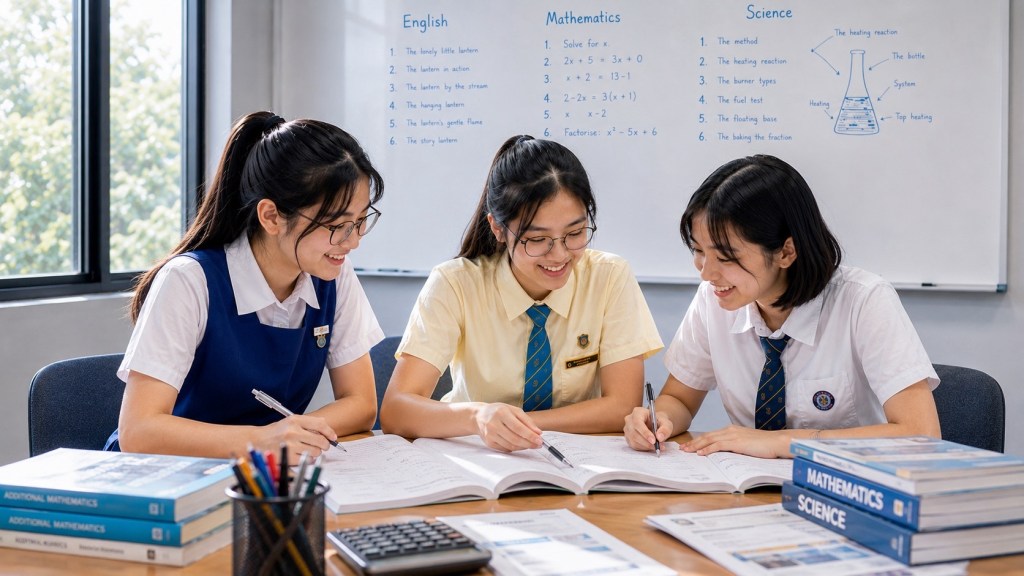
Secondary Mathematics tuition should not look the same in Secondary 1, Secondary 2, Secondary 3 and Secondary 4. Parents searching for Secondary Mathematics tuition in Sengkang, Sec 1 Math tuition, Sec 2 Math tuition, Sec 3 E-Math tuition or Sec 4 Mathematics exam preparation are often comparing year levels as though the only difference is harder content. The deeper difference is the teaching job.
Secondary 1 is a transition into symbolic Mathematics and new school routines. Secondary 2 is a bridge year where algebra, graphs, proportion and geometry must become infrastructure for upper secondary. Secondary 3 increases content breadth and often adds Additional Mathematics, changing the workload and transfer demands. Secondary 4 compresses syllabus completion, prelims and national-examination control into one year. A useful tuition system should change what it observes, teaches, practises and measures at each stage.
At eduKate Sengkang, this Advanced Mathematics Tutorials article owns the cross-year parent decision job: why Secondary 1–4 Mathematics tuition should change its teaching function instead of repeating the same worksheet model every year. The commercial year-level owners remain Secondary 1, Secondary 2, Secondary 3 and Secondary 4 Mathematics Tuition Sengkang. This page explains how those jobs differ and how a three-student tutorial should respond.
Quick answer: what changes from Secondary 1 to Secondary 4?
Secondary 1 installs the new language. Secondary 2 stabilises the bridge. Secondary 3 manages upper-secondary transfer and workload. Secondary 4 converts the whole system into reliable examination performance.
- Secondary 1: transition, algebra foundations, signed numbers, equations, graphs, working habits.
- Secondary 2: bridge skills, factorisation, formula manipulation, proportion, graphs, geometry, readiness for upper secondary.
- Secondary 3: E-Math stability, upper-secondary breadth, possible A-Math coordination, transfer and workload.
- Secondary 4: full-syllabus integration, prelims, papers, timing, checking, recovery and exam readiness.
The mistake: treating all four years as one continuous worksheet ladder
A common tuition model simply increases question difficulty year by year. That misses the changing developmental and assessment demands. A Secondary 1 student who needs to understand equation balance should not receive the same lesson architecture as a Secondary 4 student who understands equations but cannot finish a full paper.
The subject is continuous; the teaching job is not identical.
What remains constant across Secondary 1–4
Some principles should remain stable. The tutor should inspect working, diagnose the first weak link, require independent attempts, use feedback precisely, revisit old knowledge, test transfer and avoid creating permanent dependence.
The content and balance of those activities change with the year.
Secondary 1: the Primary-to-Secondary reset
Secondary 1 students enter a new school environment at the same time Mathematics becomes more symbolic. Primary techniques may have produced strong results without requiring the same level of algebraic notation, formal equations or graphical interpretation.
The tuition job is therefore partly academic and partly procedural: help the learner understand the new language, organise working, retrieve prerequisites and become independent inside a new routine.
Secondary 1 priority 1: signed numbers and number meaning
Negative numbers create errors that later spread into algebra, graphs and substitution. Tuition should make sign meaning visible before demanding speed.
Number lines, simple comparisons and explicit sign-sensitive working can be more valuable than immediate hard questions.
Secondary 1 priority 2: algebraic notation
Variables, coefficients, terms and expressions need to become meaningful objects rather than mysterious letters. Students should be able to explain what can combine and why.
Worked examples are useful early, but support should fade quickly into independent reconstruction.
Secondary 1 priority 3: equation balance
Students should understand equality as a relationship, not memorise “move it to the other side and change sign”. This reduces later fragility in formula manipulation and more complex equations.
Secondary 1 priority 4: graphs as relationships, not pictures
Axes, scale, coordinates and gradient meaning should be taught as mathematical relationships. Students who merely plot points by procedure can struggle later when graphs become analytical.
Secondary 1 priority 5: working habits
Secondary school questions increasingly require traceable working. Tuition should establish one meaningful transformation per line where risk is high, clear substitution and units where appropriate.
Secondary 1 priority 6: homework independence
The student should learn to enter homework without waiting for a parent or tutor. A small amount of closed-book retrieval before homework can reduce dependence on examples.
A 90-minute Secondary 1 lesson
- 10 minutes retrieval of number/algebra foundations.
- 20 minutes explicit teaching of one new symbolic idea.
- 20 minutes guided practice with fading prompts.
- 20 minutes independent changed questions.
- 10 minutes school homework connection.
- 10 minutes review and one delayed-retest plan.
Secondary 1 warning signs that need tuition attention
- Long pauses before any algebraic first step.
- Repeated sign errors.
- Uses arithmetic reasoning but cannot express it algebraically.
- Homework is correct only with notes open.
- Graphs are copied procedurally without understanding scale.
- Secondary Mathematics feels globally “hard” despite strong Primary results.
Secondary 2: the bridge year
Secondary 2 is where earlier algebra stops being a chapter and starts becoming infrastructure. Factorisation, graphs, proportion, geometry and formula manipulation require old skills to be available simultaneously.
The tuition job shifts from installing the language to strengthening connections and preparing the learner for upper-secondary breadth.
Secondary 2 priority 1: expansion and factorisation as reversible structure
Students should see factorisation as the reverse of expansion, not as an isolated trick. This structural view supports quadratic work and A-Math readiness later.
Secondary 2 priority 2: formula manipulation
Changing the subject, substitution and rearrangement should become fluent enough that applied topics are not constantly blocked by algebra.
Secondary 2 priority 3: proportional reasoning
Ratio, percentage, rate and scale should be understood as relationships among quantities. These ideas travel into finance, geometry, graphs and real-world problems.
Secondary 2 priority 4: graph interpretation
Students should move between tables, equations, points and line behaviour. The representation-switching skill becomes increasingly important.
Secondary 2 priority 5: geometry and early trigonometric thinking
Diagram reading, property identification and side/angle relationships should become reliable before upper-secondary trigonometry increases complexity.
Secondary 2 priority 6: mixed method selection
Topical success is no longer enough. Short mixed sets should become normal so the student practises recognising which method applies.
A 90-minute Secondary 2 lesson
- 10 minutes retrieval from Secondary 1 infrastructure.
- 15 minutes diagnostic bridge check.
- 20 minutes current concept teaching.
- 20 minutes targeted practice.
- 15 minutes mixed-method questions.
- 10 minutes school alignment and readiness review.
Secondary 2 warning signs
- Algebra works only when chapter is labelled.
- Factorisation is memorised but not linked to expansion.
- Graphs and equations feel like separate topics.
- Homework time is increasing sharply.
- Old Secondary 1 skills must be relearned repeatedly.
- Student wants A-Math but current algebra is fragile.
Secondary 3: the upper-secondary workload shift
Secondary 3 expands breadth and often introduces Additional Mathematics. The tuition job now includes coordination: keeping E-Math stable while the learner manages new subject demands and more complex assessment formats.
A student can be mathematically capable but become overloaded. Tuition should therefore manage practice architecture and workload as carefully as content.
Secondary 3 priority 1: preserve E-Math infrastructure
Algebra, graphs, geometry and statistics need maintenance even when A-Math or other subjects absorb attention.
Secondary 3 priority 2: distinguish E-Math from A-Math
Shared algebra can be repaired once, but the subjects have different goals and question structures. Tuition should not turn E-Math into an A-Math preview programme.
Secondary 3 priority 3: trigonometry and diagram reading
Longer geometric and trigonometric questions require better representation, working and calculator control.
Secondary 3 priority 4: multi-step problem planning
Students need to identify final unknowns, generate subgoals and preserve intermediate values. Calculation before planning becomes increasingly costly.
Secondary 3 priority 5: mixed-paper transfer
As topic breadth grows, method selection becomes a larger part of performance. Mixed practice should increase even before full-paper season.
Secondary 3 priority 6: workload efficiency
One Mathematics subject should not consume the entire week. Retrieval, targeted repair and selective homework are essential.
A 90-minute Secondary 3 lesson
- 10 minutes mixed retrieval.
- 15 minutes E-Math maintenance check.
- 20 minutes current upper-secondary teaching.
- 20 minutes differentiated repair or transfer.
- 15 minutes mixed/timed application.
- 10 minutes workload and continuation planning.
Secondary 3 warning signs
- E-Math marks fall after A-Math starts.
- Homework is correct but mixed tests collapse.
- Algebra errors appear in both subjects.
- Student knows formulas but cannot plan multi-step questions.
- Working becomes compressed and error-prone.
- Weekly Mathematics time becomes unsustainable.
Secondary 4: the examination-conversion year
Secondary 4 shifts the centre of gravity again. Content still matters, but full-syllabus integration, prelim evidence, timing, checking and recovery become central. Tuition must stop behaving like a chapter-by-chapter class and begin behaving like a performance system.
Secondary 4 priority 1: finish essential content without delaying integration
Students should not wait until every chapter feels perfect before using mixed papers. Topical repair and paper integration need to overlap intelligently.
Secondary 4 priority 2: prelim preparation
Prelims test the full operating system: retrieval, selection, working, timing and stamina. Tuition should build those behaviours before the paper rather than merely correct them afterwards.
Secondary 4 priority 3: after-prelim recovery
The returned prelim paper should become an error map. Rank recoverable marks, recurring error categories and deep gaps by impact.
Secondary 4 priority 4: paper pacing
Students need question triage, efficient starts, working that preserves recovery and a realistic checking budget.
Secondary 4 priority 5: precision
Strong students often plateau on the last few marks because of sign, unit, calculator, rounding or method-efficiency errors. Tuition should become more precise as conceptual gaps shrink.
Secondary 4 priority 6: release and independence
By the final examination, the student should not need the tutor to manage every revision decision. Tuition should increasingly test self-regulation rather than replace it.
A 90-minute Secondary 4 lesson
- 10 minutes full-syllabus retrieval.
- 20 minutes error-led repair.
- 25 minutes timed mixed section or paper extract.
- 15 minutes first-failure review.
- 10 minutes targeted checking/precision drill.
- 10 minutes independent revision planning.
Secondary 4 warning signs
- Topical work is strong but full papers are unfinished.
- Same errors recur across prelim papers.
- Student does full papers without repairing patterns.
- Revision volume is high but retrieval remains weak.
- Checking is global and inefficient.
- Tutor support is still required for every study decision.
The four-year teaching job in one table
- Secondary 1 → install language and habits.
- Secondary 2 → connect and stabilise infrastructure.
- Secondary 3 → coordinate breadth, transfer and workload.
- Secondary 4 → integrate and convert into exam performance.
Why the same notes should not simply be reused every year
Notes can be vertically aligned, but their function changes. Secondary 1 notes may explain notation. Secondary 2 notes may emphasise connections. Secondary 3 notes may become reference maps. Secondary 4 notes should become compact retrieval tools rather than another textbook.
Why the same homework volume should not be reused every year
Secondary 1 may need more focused skill practice. Secondary 3 may need lower extra volume because A-Math and other subjects expand. Secondary 4 may need fewer topical worksheets and more paper-led practice.
Why the same feedback timing should not be reused every year
Younger Secondary learners may need faster correction while building new symbolic habits. Older students need longer unsupported stretches so examination independence becomes visible.
Why the same difficulty model should not be reused every year
Difficulty should shift from clean structure to varied transfer to integrated problems to examination complexity. Simply making numbers larger misses the developmental job.
Why the same progress metric should not be reused every year
Secondary 1 progress may be faster independent starts and cleaner algebra. Secondary 2 progress may be better mixed selection. Secondary 3 progress may be workload stability. Secondary 4 progress may be full-paper completion and reduced mark leakage.
The G1/G2/G3 overlay
Year level and subject level interact. Secondary 2 G2 and Secondary 2 G3 share a year but not an identical syllabus demand. Tuition should therefore map both dimensions: what changes because of age/year and what changes because of subject level.
Enrichment, repair and exam control should be calibrated to the actual route rather than using another level as a prestige benchmark.
Secondary 1 across G1/G2/G3
The transition job remains: symbolic language, independence and confidence. The exact depth and content vary by subject level, but teaching should still reduce representational shock and build usable foundations.
Secondary 2 across G1/G2/G3
The bridge job remains: make current skills reliable enough for the next stage. Subject-level expectations determine which topics and complexity are relevant.
Secondary 3 across G1/G2/G3
The workload and upper-secondary transition remain central. Students need a sustainable route that fits their actual subjects and examination pathway.
Secondary 4 across G1/G2/G3
The performance job remains: convert the correct syllabus into reliable paper execution. Exam formats and content must follow the student’s actual level and year.
What a three-student tutorial should look like in Secondary 1
The tutor can keep the group tightly focused on one foundation while varying prompt strength. Observation should be frequent because errors are often forming into habits.
What a three-student tutorial should look like in Secondary 2
The group can benefit from method comparison and mixed sets. Students should increasingly explain why a method applies.
What a three-student tutorial should look like in Secondary 3
Differentiation becomes more important because subject combinations and workloads diverge. One learner may need E-Math maintenance, another algebra repair, another transfer.
What a three-student tutorial should look like in Secondary 4
Independent timed work should occupy more of the lesson. Tutor intervention shifts later, after the attempt, because exam-day independence is now the target.
The parent mistake: expecting visible acceleration every year
Progress does not always mean covering future chapters. In Secondary 2, stabilising algebra may be more valuable than acceleration. In Secondary 4, finishing a paper reliably may be more valuable than learning something beyond the syllabus.
The parent mistake: waiting for failure before changing the teaching job
A student can outgrow a lesson design even while marks remain acceptable. If Secondary 3 workload rises, the homework architecture should change before burnout appears.
The provider mistake: using one teaching script across all levels
A centre can have a consistent philosophy without using identical lesson mechanics. Consistency should live in the evidence loop, not in the worksheet count.
The student mistake: using last year’s study method unchanged
Secondary Mathematics becomes broader and more cumulative. A method that worked in Secondary 1—redoing the latest worksheet—may be insufficient by Secondary 4, when old-topic retrieval and paper integration matter.
How tuition should change at the start of each school year
Begin with a handover review: what held from last year, what decayed, what new demands are coming, and what workload changes are expected. Do not assume the previous year’s plan should continue unchanged.
How tuition should change after the first WA
Use the paper to update the learner state. Secondary 1 may reveal transition gaps; Secondary 2 may reveal bridge fragility; Secondary 3 may reveal workload/transfer issues; Secondary 4 may reveal paper-control issues.
How tuition should change mid-year
Review whether the original support mode is still correct. Repair may have succeeded; enrichment may be possible; workload may have become the new constraint.
How tuition should change after EOY or prelims
Use broad assessment evidence to plan the next transition. Do not begin the next year by simply continuing the last chapter.
A parent decision checklist by year
- Secondary 1: Is my child adapting to algebra and independent homework?
- Secondary 2: Are the foundations strong enough for upper secondary?
- Secondary 3: Is E-Math stable under the heavier workload?
- Secondary 4: Can my child convert knowledge into a complete, accurate paper?
Frequently asked questions
Is Secondary 2 really more important than Secondary 1?
They are important in different ways. Secondary 1 installs the new language; Secondary 2 reveals whether it has become infrastructure.
When should exam preparation begin?
Exam-control habits can begin early through mixed practice and checking, but full high-stakes paper preparation should increase as the student approaches major assessments.
Should Secondary 3 tuition teach A-Math inside E-Math lessons?
Not by default. Shared algebra can be coordinated, but the subjects have distinct owners and learning jobs.
Should Secondary 4 tuition stop teaching concepts and only do papers?
No. Paper evidence should lead back to targeted concept repair where needed. The difference is that repair becomes increasingly error-led and integrated.
Where this cross-year guide sits in the Mathematics estate
Use the year-level Mathematics Tuition Sengkang pages for current commercial and teaching routes. Use this article when the parent question is how the role of tuition itself should change as the learner moves from Secondary 1 to Secondary 4.
The four years are one mathematical journey, but useful tuition changes its job as the learner changes.
The teaching job should change because the evidence changes
A student should not receive the same Mathematics lesson architecture simply because the timetable still says “tuition”. The amount of explanation, the kind of practice, the feedback timing, the role of school homework, the use of past papers and the amount of independent work should all change as the learner moves through Secondary school.
This is not change for novelty. It is a response to a changing problem. Secondary 1 asks whether the new symbolic language has been installed. Secondary 2 asks whether that language has become infrastructure. Secondary 3 asks whether the learner can carry upper-secondary breadth and workload. Secondary 4 asks whether the whole system can operate reliably under examination conditions.
The cross-year diagnostic rule
- Secondary 1 diagnosis asks: what did the Primary-to-Secondary transition expose?
- Secondary 2 diagnosis asks: which foundations are still too fragile to carry upper-secondary work?
- Secondary 3 diagnosis asks: what breaks when breadth, A-Math and workload increase?
- Secondary 4 diagnosis asks: where are marks leaking in full-paper conditions?
The same wrong answer can therefore mean different things in different years. A slow algebraic start in Secondary 1 may reflect first exposure to symbolic thinking. The same delay in Secondary 4 may be a retrieval or fluency problem that should already be automated.
Secondary 1 diagnosis: the transition audit
A Secondary 1 diagnostic should sample signed numbers, algebraic notation, equation balance, ratio/rate, graph reading, units and working habits. It should also observe how the student starts: do they read, represent and attempt, or wait for confirmation?
The goal is not to produce a large baseline score. It is to find the first part of Secondary Mathematics that feels structurally new to the learner.
Secondary 2 diagnosis: the bridge audit
A Secondary 2 diagnostic should check whether expansion and factorisation connect, whether equations can be rearranged without scripts, whether graphs are understood beyond plotting, and whether proportion and geometry can be used in unfamiliar forms.
A student who performs well only when chapter labels are present may still be fragile. Mixed questions become more important at this stage because they reveal whether the infrastructure can be selected, not merely executed.
Secondary 3 diagnosis: the upper-secondary audit
Secondary 3 diagnosis needs two layers: capability and workload. The tutor should ask what the student can do, but also what they can sustain across the week. Strong E-Math performance can decay if all Mathematics time shifts to A-Math. A capable student can appear weak simply because retrieval and maintenance disappear.
The tutor should also separate shared algebraic weaknesses from subject-specific demands. One sign-control issue may appear in both E-Math and A-Math, but a trigonometric or functions problem may belong clearly to one route.
Secondary 4 diagnosis: the performance audit
Secondary 4 diagnosis should increasingly use authentic papers and timed sections. The tutor needs to know whether lost marks come from knowledge, selection, execution, time, working, calculator control, checking or recovery after a difficult question.
A broad chapter diagnosis is often too coarse. The final year rewards error-category precision.
The material system should change each year
Secondary 1 benefits from clear models, guided examples, short repair sets and changed questions. Secondary 2 needs more contrast pairs, mixed sets and representation switching. Secondary 3 needs selective maintenance, differentiated E-Math/A-Math work and workload-aware practice. Secondary 4 needs papers, timed sections and error-led micro-repairs.
The same assessment book can technically be used for several years, but the function of the material should change.
Secondary 1 material mix
- Short diagnostic probes.
- Worked examples that make notation visible.
- Guided practice with prompts fading quickly.
- Direct independent questions.
- Changed questions that vary wording or representation.
- School homework as a live transfer test.
- Small delayed retrieval sets.
Secondary 2 material mix
- Bridge-skill diagnostics.
- Contrast pairs.
- Mixed-topic sets.
- Graph/equation/diagram representation switching.
- Current school homework for alignment.
- Short timed micro-sets where fluency is stable.
- Selective A-Math readiness work only when justified.
Secondary 3 material mix
- E-Math retrieval maintenance.
- Upper-secondary topic practice.
- Shared algebra repair across E-Math and A-Math where appropriate.
- Mixed E-Math sections.
- A-Math-specific material kept distinct.
- Workload-sensitive continuation work.
- Fresh independent retests.
Secondary 4 material mix
- Prelim and past-paper evidence.
- Targeted correction drills.
- Timed mixed sections.
- Full-paper simulation at the right stage.
- Precision and checking routines.
- Delayed retests for recurring errors.
- Low-volume maintenance for secure topics.
Homework should change from year to year
Secondary 1 homework can legitimately contain focused practice because the student is building new routines. Secondary 2 homework should begin mixing methods. Secondary 3 homework should become more selective because subject load increases. Secondary 4 homework should increasingly be driven by assessment evidence rather than chapter completion.
A fixed “twenty questions every week” policy ignores these changing jobs.
Secondary 1 homework: build independence, not volume
The best Secondary 1 homework helps the learner begin without notes, practise one or two new symbolic habits, and return to the task after a delay. Repetition is useful only while it creates fluency rather than fatigue.
Secondary 2 homework: connect methods
Homework should increasingly mix algebra, graphs, proportion and geometry so the learner practises selection. One changed question can sometimes add more value than another page of the same format.
Secondary 3 homework: protect bandwidth
The tutor should inspect school E-Math and A-Math volume before adding more. Extra work should serve a missing function—retrieval, repair, transfer or timing—not simply prove that tuition assigned homework.
Secondary 4 homework: use the paper as the generator
A returned paper can generate one algebra repair, one checking drill and one timed section. This is more efficient than assigning another unrelated topical worksheet.
Feedback timing should change from Secondary 1 to Secondary 4
Early Secondary students may need faster feedback while symbolic habits are forming. By Secondary 4, students need longer unsupported stretches so tutors can observe what happens under examination conditions.
The support system should therefore move from more immediate correction toward more delayed review as independence grows.
Secondary 1 feedback
Correct major sign, equality and notation misconceptions quickly, but still require the student to complete the thought. Use small prompts rather than giving the whole method.
Secondary 2 feedback
Allow enough time to reveal method selection before intervening. A student who always receives the method name from the tutor never develops the selection skill needed for mixed papers.
Secondary 3 feedback
Use a mixture: fast feedback on a targeted repair drill, delayed feedback on mixed work, and post-attempt discussion on workload or planning.
Secondary 4 feedback
During timed sections and mocks, delay feedback until the attempt ends. The tutor is collecting performance evidence, not merely teaching the next line.
The role of school homework should change each year
Secondary 1 school homework reveals transition problems. Secondary 2 school homework reveals whether bridge skills connect. Secondary 3 homework reveals workload and maintenance. Secondary 4 school papers reveal examination control.
Tuition should therefore read school materials differently at each stage instead of treating them as generic practice sheets.
The role of notes should change each year
Secondary 1 notes may need to be explanatory. Secondary 2 notes can become relational maps. Secondary 3 notes should become concise reference tools because workload grows. Secondary 4 notes should support retrieval and precision, not become the main study activity.
The role of retrieval should change each year
Secondary 1 retrieval protects new symbolic habits. Secondary 2 retrieval protects bridge skills. Secondary 3 retrieval protects old E-Math while upper-secondary work expands. Secondary 4 retrieval keeps the entire syllabus accessible under paper conditions.
The role of mixed practice should change each year
Secondary 1 mixed practice can be small and simple. Secondary 2 mixed practice should become regular. Secondary 3 mixed practice should bridge topical learning into upper-secondary papers. Secondary 4 mixed work becomes the default environment for exam preparation.
The role of enrichment should change each year
Secondary 1 enrichment can deepen patterns, representations and modelling without racing forward. Secondary 2 enrichment can strengthen generalisation and upper-secondary readiness. Secondary 3 enrichment must respect the E-Math/A-Math workload. Secondary 4 enrichment should be selective and relevant to transfer, precision or mathematical interest.
The role of acceleration should change each year
Acceleration should never be automatic. In Secondary 1, current symbolic foundations matter more than chapter speed. In Secondary 2, readiness for upper-secondary Mathematics should be evidence-based. In Secondary 3, future content competes with a heavier workload. In Secondary 4, future curriculum often has high opportunity cost relative to exam preparation.
The role of paper practice should change each year
Secondary 1 students do not need constant full-paper practice. Secondary 2 can use short mixed sections. Secondary 3 can begin broader paper integration as coverage grows. Secondary 4 needs systematic full-paper and mock-exam work once enough syllabus content is stable.
The role of checking should change each year
Secondary 1 checking is about building simple habits: signs, units, final question. Secondary 2 adds graph scale and method selection. Secondary 3 adds calculator discipline, multi-step recovery and mixed-topic errors. Secondary 4 checking becomes targeted to the learner’s personal error profile.
The role of speed should change each year
Secondary 1 should protect accuracy before timing. Secondary 2 can build fluency in bridge skills. Secondary 3 should monitor workload and mixed-question start time. Secondary 4 must convert fluency into full-paper pacing.
The role of self-explanation should change each year
Secondary 1 students may explain why equation balance works. Secondary 2 students explain why one method fits rather than another. Secondary 3 students explain subgoal planning. Secondary 4 students use short internal explanations for method selection without slowing the paper.
The role of error logs should change each year
Secondary 1 logs should be simple: sign, notation, unit, graph. Secondary 2 can track method-selection and transfer. Secondary 3 can separate E-Math and A-Math error patterns. Secondary 4 should rank errors by mark cost, recurrence and exam impact.
The role of parents should change each year
Secondary 1 parents may need to support routines and transition. Secondary 2 parents can reduce direct homework involvement as independence grows. Secondary 3 parents should monitor workload and coordination. Secondary 4 parents should protect time, sleep and revision conditions while allowing the student increasing ownership.
The parent handoff: Secondary 1 to Secondary 2
By the end of Secondary 1, parents should expect less live homework rescue and more independent use of notes, retrieval and corrections. If support remains as intensive as the first term, ask what has not yet transferred.
The parent handoff: Secondary 2 to Secondary 3
This transition is a major workload decision point. The family should review algebra stability, study routine, subject combination and whether the student is ready for Additional Mathematics where relevant.
The parent handoff: Secondary 3 to Secondary 4
By the end of Secondary 3, the learner should have a working revision system. Secondary 4 is not the year to invent every study habit from scratch.
The tutor handoff: Secondary 1 to Secondary 2
Move from explicit installation toward more mixed selection. Keep foundational retrieval, but reduce routine scaffolding where the learner is already secure.
The tutor handoff: Secondary 2 to Secondary 3
Review bridge skills and workload before adding new complexity. Plan E-Math maintenance deliberately if A-Math begins.
The tutor handoff: Secondary 3 to Secondary 4
Shift the programme from breadth-building toward paper integration, precision and independent revision management.
The student handoff: Secondary 1 to Secondary 2
The learner should begin knowing how to retrieve, use notes selectively and ask precise questions rather than waiting for the tutor to organise every task.
The student handoff: Secondary 2 to Secondary 3
The student should become more intentional about weekly planning because Mathematics workload can increase sharply.
The student handoff: Secondary 3 to Secondary 4
The learner should be able to use papers, error logs and revision schedules with less adult management.
A cross-year material decision table
- Sec 1: use materials to teach structure.
- Sec 2: use materials to connect structures.
- Sec 3: use materials to maintain breadth and manage workload.
- Sec 4: use materials to convert evidence into performance.
A cross-year feedback decision table
- Sec 1: quicker correction on forming habits.
- Sec 2: more observation before hints.
- Sec 3: differentiated feedback by subject and workload.
- Sec 4: delayed feedback during realistic timed work.
A cross-year assessment decision table
- Sec 1: read tests for transition gaps.
- Sec 2: read tests for bridge fragility.
- Sec 3: read tests for transfer and workload failures.
- Sec 4: read tests for mark conversion and paper control.
A cross-year homework decision table
- Sec 1: enough repetition to stabilise new language.
- Sec 2: more mixed and varied practice.
- Sec 3: lower redundant volume, protect maintenance.
- Sec 4: error-led and paper-led continuation work.
The year-level collision problem
A cross-year guide must not replace the specific Secondary 1, 2, 3 or 4 tuition owners. Those pages own the commercial and year-specific route. This article owns the comparison: why the teaching job changes.
That ownership distinction matters for both readers and search architecture. A parent deciding “What should change next year?” belongs here; a parent looking for Secondary 2 Mathematics tuition belongs on the Secondary 2 owner.
Worked profile: Secondary 1 student who looks weak after strong PSLE results
The student is accurate with arithmetic but slow with variables and equation balance. Tuition should not interpret the drop as global weakness. The job is transition repair: symbolic meaning, working habits and independent retrieval.
Worked profile: Secondary 2 student with good marks but poor transfer
The student completes topical homework quickly but freezes on mixed tests. Tuition should reduce repetitive topical worksheets and increase method classification, representation switching and changed questions.
Worked profile: Secondary 3 student whose E-Math falls after A-Math begins
The learner may not need more E-Math teaching. They may need E-Math maintenance protected in the weekly schedule, plus one shared algebra repair across both subjects.
Worked profile: Secondary 3 student who does not take A-Math
The teaching job should not assume an A-Math pathway. E-Math can still be deepened through modelling, transfer, graphs, geometry, statistics and exam control within the student’s actual route.
Worked profile: Secondary 4 student who knows content but cannot finish
The lesson should shift from chapter teaching toward speed diagnosis, question triage, stamina, working and targeted checking. More topical content is not the first need.
Worked profile: Secondary 4 student with one major concept gap
Paper season does not mean concept teaching stops. Use paper evidence to locate the gap, repair it with simple examples, then return immediately to paper-level application.
How to know the Secondary 1 teaching job is complete
- Algebraic notation is no longer mysterious.
- Signed numbers are reasonably stable.
- Homework begins independently.
- Graph basics are understood.
- Working is traceable.
- Support can be faded on ordinary tasks.
How to know the Secondary 2 teaching job is complete
- Bridge algebra is reliable.
- Methods survive changed questions.
- Mixed sets no longer collapse.
- The student is ready for upper-secondary workload.
- A-Math readiness decisions can be made from evidence rather than hope.
How to know the Secondary 3 teaching job is complete
- E-Math remains stable under the heavier year.
- A-Math, if taken, is coordinated without swallowing all time.
- Multi-step planning is improving.
- Mixed-paper transfer is visible.
- The weekly system is sustainable.
How to know the Secondary 4 teaching job is complete
- The student can manage realistic papers independently.
- Recurring high-cost errors are controlled.
- Revision decisions are increasingly self-directed.
- Checking is targeted.
- The student can recover after difficult questions.
- Tutor dependence is reducing before the final examination.
When tuition should reduce frequency in Secondary 1
If the transition has stabilised quickly and schoolwork is independently manageable, the family can reduce support rather than keep the same frequency by default.
When tuition should reduce frequency in Secondary 2
If the bridge skills are stable and the learner maintains them independently, tuition can shift toward consultation, enrichment or lower-frequency support.
When tuition should reduce frequency in Secondary 3
If workload rather than content is the main constraint, reducing tuition volume may improve the overall week even if the subject remains important.
When tuition should reduce frequency in Secondary 4
Close to examinations, some students benefit from frequent consultation; others need more independent paper time and less scheduled tuition. The correct frequency depends on what the student can carry alone.
When tuition should increase temporarily
Short-term increased contact can help after absence, before a major assessment, or during a bounded catch-up programme. Every increase should have a purpose and an exit condition.
The four-year independence gradient
The most important long-term change is that tutor control should reduce. Secondary 1 may require more explicit modelling. Secondary 2 should require more self-selection. Secondary 3 should require more self-management. Secondary 4 should require the student to plan and review much of their own revision.
A learner who reaches Secondary 4 still dependent on the tutor for every next step may know the Mathematics but remain operationally fragile.
The four-year workload gradient
Academic workload generally becomes broader and more cumulative. Tuition homework should therefore become more selective over time, not automatically heavier.
The programme should add precision as the year advances, not merely volume.
The four-year assessment gradient
Assessment moves from shorter school tests toward broader cumulative examinations and national paper conditions. Tuition should mirror that shift gradually, not wait until the final term.
The four-year error gradient
Secondary 1 errors often expose foundational meaning. Secondary 2 errors expose structural connections. Secondary 3 errors expose transfer and workload. Secondary 4 errors expose performance reliability.
The tutor should interpret mistakes in that developmental context.
The four-year parent question gradient
- Sec 1: Can my child understand and carry Secondary Mathematics?
- Sec 2: Are the foundations strong enough for the next stage?
- Sec 3: Can my child sustain upper-secondary Mathematics alongside the rest of school?
- Sec 4: Can my child turn what they know into a complete, reliable examination performance?
Final synthesis: same subject, different job
Secondary Mathematics is one continuous subject family, but tuition should change its centre of gravity every year. Secondary 1 establishes the language. Secondary 2 strengthens the bridge. Secondary 3 manages breadth, transfer and workload. Secondary 4 integrates the system under examination pressure.
A useful tutor should be able to explain not only what chapter is being taught, but why the lesson looks different now from the year before—and what evidence would make it change again.
The assessment cycle should change by year
Weighted Assessments, EOY examinations, prelims and final examinations create different teaching demands. A useful tuition system should not treat every returned paper as the same kind of event.
Secondary 1 assessments
Read early tests for transition evidence. Are the mistakes mainly signs, notation, working, graph reading or question interpretation? The paper should tell the tutor which new Secondary habits are not yet stable.
Secondary 2 assessments
Read tests for bridge integrity. If expansion, factorisation, formula manipulation and graphs fail in several contexts, those skills are not yet carrying the next stage.
Secondary 3 assessments
Read tests for transfer and workload. Does E-Math weaken only after A-Math periods intensify? Are mixed questions weaker than topical ones? Is homework quality falling because time is compressed?
Secondary 4 assessments
Read papers for mark conversion. Which losses are conceptual? Which are execution? Which are caused by pace, checking, stamina or poor recovery? The paper should generate a highly selective revision plan.
The WA teaching job across four years
- Sec 1 WA: confirm transition foundations.
- Sec 2 WA: test bridge skill reliability.
- Sec 3 WA: monitor E-Math stability and mixed transfer.
- Sec 4 WA: use as exam-control rehearsal where appropriate.
The EOY teaching job across four years
- Sec 1 EOY: consolidate the first Secondary mathematical language.
- Sec 2 EOY: verify upper-secondary readiness.
- Sec 3 EOY: identify what must be repaired before the final year.
- Sec 4 broad exams/prelims: integrate full-syllabus performance.
The holiday teaching job across four years
School holidays should not be used identically. Secondary 1 holidays can repair transition foundations. Secondary 2 holidays can stabilise the bridge into Secondary 3. Secondary 3 holidays can repair high-cost weaknesses before the final year. Secondary 4 holidays are increasingly constrained by examination priorities.
The June holiday versus December holiday
June often sits inside the same school year, so repair and consolidation are usually more important than acceleration. December often sits at a transition, so the tutor can review what held, repair what will become expensive next year, and preview only the minimum language or structure needed for the next stage.
The lesson-opening routine should evolve
Secondary 1 opening
Begin with short retrieval and a confidence-safe entry. The tutor wants to see whether new notation and number relationships are becoming familiar.
Secondary 2 opening
Begin with mixed retrieval from several bridge topics. The student should increasingly identify the method family without the tutor naming it.
Secondary 3 opening
Begin with a broader sample and a quick workload check. Is E-Math being maintained? Is A-Math dominating? Which school deadlines shape the week?
Secondary 4 opening
Begin with paper evidence, retrieval from across the syllabus, or a timed micro-set. The lesson should immediately connect to exam readiness.
The lesson-closing routine should evolve
Secondary 1 closing
Confirm one independent success and one clear continuation task.
Secondary 2 closing
Confirm one transfer question and one readiness note for future topics.
Secondary 3 closing
Confirm the weekly Mathematics allocation across E-Math/A-Math and one delayed retest.
Secondary 4 closing
Confirm the next paper/revision decision and what the student will manage without the tutor.
The role of the tutor’s voice should change
Secondary 1 may require more explicit modelling and verbal guidance. By Secondary 4, the tutor should speak less during independent paper work and more during post-attempt analysis. The balance should move from explanation toward observation and feedback as the learner matures.
The role of peer learning should change
In Secondary 1, peers can compare representations and basic methods. In Secondary 2, they can compare method selection. In Secondary 3, they can compare efficient routes and workload strategies. In Secondary 4, peer discussion should never replace independent paper evidence, but it can improve post-paper analysis.
The role of tutor-created notes should change
Early Secondary notes can be explanatory and spacious. Later notes should become more compact because the student should increasingly retrieve and organise knowledge themselves.
By Secondary 4, a useful note may be a one-page error-risk or formula-reference map rather than another chapter booklet.
The role of digital tools should change
Younger Secondary students should use AI and solver tools cautiously because first-move decisions are still forming. Older students can use tools for comparison, variation and analysis, but closed-tool practice remains essential.
The role of calculators should change
Secondary 1 students need correct basic calculator habits. Secondary 2 should integrate calculator use into graphs and formula work. Secondary 3 should manage trigonometry, precision and longer inputs. Secondary 4 should use calculator control as part of exam execution and checking.
The role of real-world Mathematics should change
Secondary 1 real-world tasks can make new algebra and ratio ideas concrete. Secondary 2 can use scale, rate and graphs. Secondary 3 can integrate geometry, statistics and multi-step modelling. Secondary 4, especially in G3 Paper 2 contexts, may require broader real-world application and interpretation.
The role of formula memory should change
Secondary 1 focuses on relationships and notation more than memorisation volume. Secondary 2 expands the set of reusable structures. Secondary 3 requires better formula/application control. Secondary 4 requires knowing what is provided, what must be retrieved, and how to use formulae under time.
The role of estimation should change
Secondary 1 estimation protects number sense. Secondary 2 uses it to check proportional and graph results. Secondary 3 uses it in trigonometry, mensuration and calculator work. Secondary 4 uses it as a fast error-detection tool under paper conditions.
The role of representation should change
Secondary 1 should learn that equations, tables, graphs and diagrams are different ways to hold relationships. Secondary 2 should switch between them. Secondary 3 should choose representations for efficiency. Secondary 4 should use representation choice as part of rapid problem solving.
The role of multi-step planning should change
Secondary 1 starts with simple two-step routes. Secondary 2 builds dependency chains. Secondary 3 coordinates several mathematical systems. Secondary 4 needs to plan multi-step questions efficiently under time.
The role of structural transfer should change
Secondary 1 transfer means surviving changed numbers or wording. Secondary 2 adds changed representation. Secondary 3 adds changed context and combined topics. Secondary 4 requires rapid recognition of familiar structure inside unfamiliar examination presentation.
The role of confidence calibration should change
Secondary 1 students often need confidence rebuilt after a transition shock. Secondary 2 needs evidence-based confidence about upper-secondary readiness. Secondary 3 needs calibrated confidence across E-Math and A-Math separately. Secondary 4 needs accurate confidence for triage and checking decisions.
The role of mastery checkpoints should change
Secondary 1 mastery should confirm foundational structure. Secondary 2 mastery should confirm bridge readiness. Secondary 3 mastery should include workload sustainability and transfer. Secondary 4 mastery should include mixed and timed performance.
The role of enrichment should change after mastery
In Secondary 1, enrichment can build curiosity and pattern sense. In Secondary 2, it can prepare deeper mathematical reasoning. In Secondary 3, it should fit around heavier workload. In Secondary 4, it should be highly selective so it does not compete with exam priorities.
The role of release should change
Secondary 1 release may mean reducing homework help. Secondary 2 release may mean reducing remedial practice. Secondary 3 release may mean reducing tutor control over weekly planning. Secondary 4 release means the student can manage revision, papers and corrections increasingly independently.
A year-by-year evidence ladder
- Sec 1 evidence: can the learner enter new symbolic tasks independently?
- Sec 2 evidence: can bridge skills transfer across topics?
- Sec 3 evidence: can the learner sustain capability under broader workload?
- Sec 4 evidence: can the learner reproduce capability under full-paper conditions?
A year-by-year support ladder
- Sec 1: more modelling, clearer scaffolds, shorter independent bursts.
- Sec 2: more selection, more variation, fewer routine cues.
- Sec 3: more differentiation, more workload-aware practice.
- Sec 4: more unsupported timed work, later feedback, more self-management.
A year-by-year parent communication model
Parents should hear different kinds of updates as the student matures. In Secondary 1: “The transition skill we are building is equation balance.” In Secondary 2: “Factorisation is now stable; mixed selection is next.” In Secondary 3: “E-Math is stable, but A-Math workload is crowding maintenance.” In Secondary 4: “Content is secure; the remaining mark loss is timing and checking.”
This language helps families understand why tuition is changing even if the weekly lesson length remains the same.
The cross-year mistake: equating harder content with better tuition
A Secondary 1 programme that rushes into Secondary 2 content may look advanced while failing to stabilise algebra. A Secondary 4 programme that teaches future JC content may look ambitious while the student still leaves exam questions blank.
The best next content is the content that serves the learner’s current job.
The cross-year mistake: keeping the same support dose
If a student needed intensive help in Secondary 1, that does not mean the same dose is appropriate in Secondary 3. Support should respond to capability, workload and independence.
The cross-year mistake: adding more homework every year
As school workload increases, tuition homework should become more selective. The programme should gain precision, not weight.
The cross-year mistake: delaying paper practice until Secondary 4
Students can begin mixed selection and short timed sections earlier. Full-paper pressure should increase gradually rather than appear suddenly in the final year.
The cross-year mistake: treating Secondary 4 as papers only
Paper practice without repair can rehearse the same mistakes. Concepts still need targeted intervention when paper evidence reveals a gap.
The cross-year mistake: treating Secondary 1 as purely foundational
Foundations matter, but Secondary 1 students should also learn transfer, explanation and independent habits. A foundation is useful because it can be used, not because it has been drilled in isolation.
How to redesign tuition when the student changes school
Year-level teaching should be rechecked against the new school’s sequence and assessment style. The tutor should preserve core capability goals while updating alignment.
How to redesign tuition when subject level changes
If a student changes G-level or assessment route, material, pace and exam practice must be updated to the correct syllabus. Do not keep using the previous route by inertia.
How to redesign tuition when A-Math is added
Do not simply double Mathematics homework. Map shared algebra skills, separate subject-specific content, and protect E-Math maintenance.
How to redesign tuition when A-Math is dropped
The time freed should not automatically become more E-Math volume. Decide whether the student needs repair, exam control, enrichment or simply a more sustainable week.
How to redesign tuition when marks improve quickly
Reduce remedial work. Introduce more mixed transfer, independence or enrichment. Improvement should change the lesson.
How to redesign tuition when marks do not improve
Recheck the target, support conditions, opportunity to learn, workload and first weak link. Do not simply intensify the same worksheet programme.
How to redesign tuition when the student becomes anxious
Reduce unpredictability without lowering the mathematical goal. Use clearer task boundaries, calibrated difficulty, successful independent attempts and precise feedback.
How to redesign tuition when the student becomes bored
Test whether the boredom reflects mastery. If yes, increase depth or variation. If not, the issue may be task design or motivation rather than readiness for acceleration.
How to redesign tuition when homework takes too long
Use a time map. Determine whether the delay is retrieval, method selection, execution, checking or dependence. Then change the lesson and homework architecture accordingly.
How to redesign tuition when the student is very strong
Strong students still benefit from evidence. Reduce routine practice, increase structural transfer, comparison and modelling, and consider whether tuition frequency itself can be reduced.
How to redesign tuition when the student is consistently weak
Avoid global “weak in Math” labels. Identify the first recurring dependency, repair it, retest, and see what capability changes. Broader weakness should be decomposed into manageable jobs.
A four-year family planning view
Families do not need a four-year tuition contract. They need a sequence of evidence-based decisions. Secondary 1 support may be temporary. Secondary 2 may need readiness work. Secondary 3 may need workload coordination. Secondary 4 may need intensive paper control. The correct duration can change.
A four-year tutor planning view
The tutor should maintain continuity of learner knowledge while changing intervention. Knowing the student’s earlier error history is useful, but old assumptions should not override new evidence.
A four-year learner planning view
The learner should gradually own more of the system: choosing resources, scheduling retrieval, analysing mistakes, selecting practice and deciding when help is needed.
A final cross-year consultation checklist
- What is the dominant job this year?
- What from last year has held?
- What from last year has decayed?
- What new workload demand exists?
- What assessment demand is emerging?
- What support can be reduced?
- What new independence should be expected?
- What would make the lesson architecture change next term?
A final cross-year progression map
- Sec 1: model → guide → fade.
- Sec 2: connect → vary → select.
- Sec 3: coordinate → transfer → sustain.
- Sec 4: integrate → time → recover → release.
This progression is not rigid. A Secondary 4 learner may still need explicit modelling on one new or weak concept. A Secondary 1 learner may already be ready for transfer on another topic. The map describes the changing centre of gravity, not a prohibition on other teaching moves.
Final principle: tuition should become more precise and less controlling
Across four Secondary years, the tutor should know more about the learner while controlling less of the learner’s work. Early teaching may need more structure. Later teaching should increasingly test whether the student can plan, practise, correct and recover independently.
That is the long arc of useful Secondary Mathematics tuition: not simply harder chapters, but a learner who can carry increasingly complex Mathematics with increasingly less external control.
Year-to-year transition case: Secondary 1 to Secondary 2
A student may finish Secondary 1 with acceptable marks but still rely heavily on chapter labels, notes and familiar question layouts. The transition review should therefore test more than the report-book score. Use closed-book retrieval, mixed questions and a small number of changed representations.
If the student can execute but not select, Secondary 2 tuition should emphasise method classification early. If algebra remains fragile, repair it before factorisation and formula manipulation increase the load.
Year-to-year transition case: Secondary 2 to Secondary 3
This is one of the most important handovers because the student’s subject combination, workload and possible A-Math route change together. The tutor should review algebra fluency, graph understanding, homework independence, weekly study capacity and response to unfamiliar questions.
A student who wants A-Math but needs constant help on basic rearrangement is not necessarily incapable of A-Math, but the readiness job is clear: strengthen the algebraic engine before upper-secondary content compounds.
Year-to-year transition case: Secondary 3 to Secondary 4
The final-year handover should identify which topics are stable enough for maintenance, which still need repair and which examination behaviours are missing. The programme should enter Secondary 4 with a map, not with a blank slate.
This reduces the chance that the first prelim becomes the first serious full-paper diagnostic.
Year-to-year transition case: strong learner moving into a harder workload
A student who has always been strong may not need more content; they may need a better operating system. Secondary 3 and 4 can expose planning, prioritisation and stamina limits even when conceptual Mathematics remains strong.
Tuition should protect the learner from turning strength into overwork by replacing redundant practice with selective high-value tasks.
Year-to-year transition case: struggling learner who finally stabilises
A student who spent Secondary 1 or 2 in repair should not remain permanently on the same remedial track after the evidence changes. Once current work is independently manageable, reduce repair and introduce more mixed transfer and enrichment.
The tuition system should recognise recovery as a reason to change the lesson, not simply celebrate the same lesson more enthusiastically.
Assessment-season shift: before WA
Before a short Weighted Assessment, narrow the work to the school scope and the prerequisites that support it. Secondary 1 may need direct topic stabilisation. Secondary 2 may need a small mixed set. Secondary 3 may need workload triage. Secondary 4 may use the WA as a small exam-control rehearsal.
Assessment-season shift: before EOY
EOY revision broadens the scope. The tutor should increase retrieval of older topics, mix methods and identify which foundations have decayed. The younger years still need concept support; the older years should begin showing stronger integration.
Assessment-season shift: before prelims
Prelims are primarily a Secondary 4 performance event. Teaching should move heavily into full-paper integration, timing, checking and recovery while still allowing targeted concept repair. The tutor’s role becomes increasingly diagnostic and post-attempt.
Assessment-season shift: after prelims
The returned paper should determine the final-stage plan. Do not keep the pre-prelim programme unchanged. Rank mark loss by cause and recoverability, repair the biggest recurring categories, then retest under realistic paper conditions.
The parent release rule by year
- Sec 1: reduce homework supervision when the learner starts independently.
- Sec 2: reduce remedial support when bridge skills survive mixed questions.
- Sec 3: reduce tutor control when the learner can manage the weekly Mathematics load.
- Sec 4: reduce revision management when the learner can plan and review papers independently.
Parents should expect support to become lighter in some dimensions even if lesson frequency stays the same for a period.
The tutor release rule by year
- Sec 1: fade worked examples and prompts.
- Sec 2: fade chapter cues and increase mixed selection.
- Sec 3: fade weekly planning support and protect independent maintenance.
- Sec 4: fade live rescue during papers and shift feedback after the attempt.
The learner release rule by year
- Sec 1: attempt before asking.
- Sec 2: choose the method before seeking confirmation.
- Sec 3: manage practice priorities across Mathematics subjects.
- Sec 4: decide what revision evidence requires next.
Evidence that should trigger a change from repair to stabilisation
- The student can explain the repaired idea.
- Direct questions are accurate.
- Prompts are no longer needed for the first step.
- A changed question succeeds.
- The same error no longer appears repeatedly.
Evidence that should trigger a change from stabilisation to maintenance
- The method survives delayed retrieval.
- Mixed selection is reasonably independent.
- Homework no longer needs live rescue.
- School assessments show the repaired capability holding.
- Practice volume can fall without performance collapsing.
Evidence that should trigger a change from maintenance to enrichment
- Current syllabus work is secure.
- Changed questions remain stable.
- The learner can compare methods or representations.
- Old topics remain accessible with low-volume retrieval.
- The student’s weekly workload has room for richer work.
Evidence that should trigger a change toward exam control
- The syllabus is sufficiently covered.
- Topical accuracy is higher than mixed-paper performance.
- Time or checking causes significant mark loss.
- The learner needs question triage and stamina work.
- Assessment season is approaching and paper evidence is now more informative than another topic worksheet.
Evidence that should trigger reduced tuition
- Schoolwork is independently manageable.
- The student plans revision without substantial tutor input.
- Old topics remain retrievable.
- Errors are increasingly self-corrected.
- Tuition is mostly confirming capability the student already carries alone.
- Another use of the learner’s time would add more value.
How a tutor should explain a year-level change to parents
The explanation should connect the new lesson design to the new educational job. For example: “Secondary 2 is no longer mainly about learning each chapter; we are increasing mixed selection because upper-secondary Mathematics will assume those methods can be chosen independently.”
Or: “In Secondary 4 we are reducing routine topical homework because prelim papers now give us better evidence about where marks are leaking.”
How a tutor should explain a year-level change to students
Students should know why the lesson feels different. A Secondary 3 learner may hear: “You know the algebra. Now we are testing whether you can keep it available while handling A-Math and other subjects.” A Secondary 4 learner may hear: “I will help less during this timed section because we need honest evidence of what happens in the paper.”
This transparency turns changing support into a learning progression rather than an arbitrary increase in difficulty.
How to avoid making Secondary 4 feel like four years of fear compressed into one
Examination preparation should be built gradually. Retrieval, mixed questions, checking and independent correction can begin earlier in age-appropriate forms. Secondary 4 then becomes an integration year rather than a sudden transformation of the entire study system.
How to avoid making Secondary 1 feel like an early Secondary 4
The opposite mistake is premature exam pressure. Secondary 1 needs time to build symbolic meaning, routines and confidence. Full-paper intensity and constant timing can distort the first year before the foundations are secure.
The role of quiet luxury in Mathematics teaching
A strong Secondary Mathematics programme does not need to advertise intensity through constant urgency. The work can be calm, precise and demanding. One carefully selected question can reveal more than a thick worksheet. One accurate diagnosis can save weeks of unfocused practice.
The teaching job should become quieter as the system becomes more precise: less noise, clearer evidence, better questions and increasingly independent students.
The four-year promise should not be “we will always be needed”
The long-term teaching goal is not permanent tuition dependence. It is a learner who can enter new Mathematics, use resources, practise, retrieve, analyse errors, manage assessments and ask for help precisely.
Tuition remains useful only while it adds a capability the student cannot yet carry as effectively alone.
A final four-year parent checklist
- What is the dominant teaching job this year?
- What should be easier now than last year?
- What support should have faded?
- What new independence is expected?
- What new workload has appeared?
- What type of evidence matters most now?
- What would cause the lesson design to change next term?
- What would justify reducing tuition?
A final four-year tutor checklist
- Am I teaching the current year or repeating last year’s script?
- Am I using this year’s assessment evidence correctly?
- Has my feedback timing changed with independence?
- Has homework become more selective as workload increased?
- Am I protecting E-Math/A-Math boundaries?
- Am I increasing paper realism at the right stage?
- Am I fading support when capability improves?
- Can I explain the release condition?
A final four-year learner checklist
- Can I explain what I am currently trying to improve?
- Can I start before asking for help?
- Can I choose a method without a chapter label?
- Can I retrieve old Mathematics after time has passed?
- Can I manage my weekly Mathematics workload?
- Can I use a paper to decide what to revise next?
- Can I recover from mistakes without losing the whole session?
- Am I becoming less dependent on the tutor each year?
Closing synthesis: the year number should change the teaching question
Secondary 1 asks, “Can the learner enter the new mathematical language?” Secondary 2 asks, “Can that language carry the bridge into upper secondary?” Secondary 3 asks, “Can capability survive breadth, transfer and workload?” Secondary 4 asks, “Can the whole system operate reliably under examination conditions?”
When tuition asks the right question for the year, materials, homework, feedback, assessment and class design become easier to organise. The programme stops being a fixed pile of Mathematics and becomes a changing support system built around what the learner must be able to do next.
One final operating rule: progress should change the lesson
A student who improves should not receive the same lesson merely with harder numbers. If Secondary 1 algebra becomes secure, prompts should fade. If Secondary 2 bridge skills hold, mixed selection should increase. If Secondary 3 workload becomes stable, the tutor can shift from rescue to transfer or enrichment. If Secondary 4 paper control improves, tuition can reduce live intervention and let the student own more of the revision cycle.
This rule protects the learner from two common forms of stagnation: permanent remediation and permanent acceleration. The first keeps teaching the weakness after it has recovered. The second keeps pushing future content even when another capability has become the real constraint. Both ignore the new evidence.
Useful Secondary Mathematics tuition should therefore be able to look different in January and September, different in Secondary 1 and Secondary 4, and different for three students sitting at the same table. The stable element is not the worksheet sequence. It is the evidence loop: observe, diagnose, teach, practise, retest, transfer and release.
When that loop is working, the four Secondary years form one coherent journey. The learner becomes more mathematically capable while also becoming more capable of learning Mathematics without constant external control.
The year-level question is therefore never only “What topic comes next?” It is also “What should the learner be able to carry independently now that was not yet expected last year?” That question keeps tuition developmental rather than merely chronological.
By the end of Secondary 4, the strongest evidence of successful tuition is not simply that more Mathematics has been covered. It is that the student can meet new work, choose a method, manage a paper, interpret feedback, plan revision and recover from error with far less adult control than at the start of Secondary 1. The teaching job has changed because the learner has changed.
That is the endpoint of the four-year system: increasing mathematical difficulty matched by increasing learner independence, with tuition becoming more precise, more selective and less controlling as the student matures.
Support succeeds when greater difficulty is matched by greater independence, not greater dependence.
Year level changes the tutoring job
Secondary 1, 2, 3 and 4 Mathematics should not be treated as the same tutoring product with harder worksheets. Use The Tutor System to reclassify the job as the learner changes: transition support, foundation repair, route design, performance coaching or preparation for greater independence.
Continue through the Mathematics Learning Hub for routes by concept and level, the Complete Mathematics Index for the wider estate, or Mathematics Tutor Sengkang when the question is specifically about tutoring support.
