
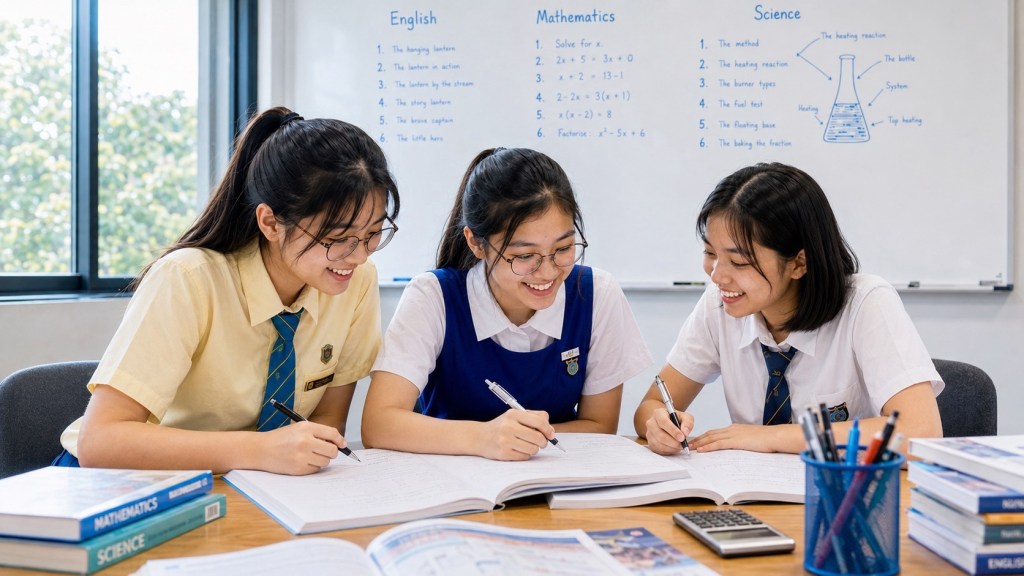
Fernvale parents searching for a Secondary Mathematics tutor in Sengkang now have to navigate a more flexible school system. Under Full Subject-Based Banding, students may take subjects at G1, G2 or G3, and from 2027 graduating students will sit the Singapore-Cambridge Secondary Education Certificate at their respective subject levels. The labels matter, but the tutoring problem remains practical: what Mathematics is this student taking now, and what is stopping reliable performance?
Useful G1, G2 or G3 Mathematics tuition in Sengkang should begin with actual student work rather than assumptions attached to a level. A G2 learner may understand number but struggle with algebraic notation. A G3 learner may know the syllabus but lose marks through signs, graphs and time control. A G1 learner may need stronger proportional reasoning and data interpretation without being reduced to low expectations. At eduKateSengkang, the three-student format makes those differences visible.
The most durable high-demand Secondary Mathematics topics remain algebra, linear equations, functions, graphs, ratio and percentage, geometry, statistics, probability and exam preparation. These ideas recur because Secondary Mathematics is increasingly about relationships and representation, not only calculation.
Fernvale is a local search route, not a separate branch claim
This page is written for Fernvale and nearby Sengkang families comparing Secondary Mathematics support. eduKateSengkang teaches at a nearby Punggol location; we do not claim a separate Fernvale branch. The canonical service owner remains Mathematics Tutor Sengkang.
Full SBB changes subject pathways, not the need for precise diagnosis
G1, G2 and G3 describe subject demand. They do not diagnose the learner. A tutor still needs to ask whether the bottleneck is concept, fluency, algebra, representation, transfer or exam control.
Secondary 1: the symbolic reset
Secondary 1 introduces negative numbers, algebraic notation, equations and graphs. Students who were comfortable in Primary school can feel that Mathematics suddenly changed language. The tutor should connect new symbols to relationships the student already understands.
Secondary 2: transfer becomes the readiness test
By Secondary 2, students need to recognise algebra, ratio and graphical relationships even when the topic is not announced. A student who solves equations only on an “Equations” worksheet has procedural knowledge but incomplete transfer.
Secondary 3: workload and abstraction rise together
Secondary 3 often exposes hidden dependencies because algebra must become more fluent and some students begin Additional Mathematics. A weak fraction or sign habit can appear across several chapters. The tutor should repair the underlying mechanism rather than multiply worksheets.
Secondary 4: the final job is paper conversion
Final-year Mathematics is partly an execution problem. The student must switch among topics, use calculators appropriately, show coherent working, protect time and recover after difficult questions. Prelim papers are most useful when analysed by error type rather than score alone.
G1 Mathematics: usable foundations and independence
G1 students still need accurate number work, proportional reasoning, measurement, geometry, data interpretation and problem solving at the appropriate level. Teaching should build competence and dignity, not repetitive drill without explanation.
G2 Mathematics: algebra and representation matter more
At G2, students increasingly connect arithmetic to algebra and move among tables, equations and graphs. Tuition should vary the surface form of problems so the learner recognises structure rather than memorising question shapes.
G3 Mathematics: precision becomes expensive
G3 students can lose marks even when the main idea is correct. Signs, brackets, compressed working, graph interpretation and inefficient methods become costly. Strong learners often need precision training as much as new content.
Algebra is the Secondary Mathematics spine
Equations, functions, coordinate work, graphs and Additional Mathematics all depend on symbolic control. If algebraic manipulation is slow or fragile, many chapters feel separate and difficult. A tutor should test equality, signs, brackets, like terms, substitution and equation formation.
Graphs should be interpreted, not merely plotted
Graphs represent relationships. Students need to understand gradient, intercepts, scale, shape and change. A useful lesson moves among equation, table, graph and verbal explanation.
Fractions and percentage remain Secondary foundations
Fractions return in algebraic fractions, rates and probability. Percentage returns in finance and comparison. A hidden Primary weakness can therefore appear as a Secondary problem. Good tuition repairs the prerequisite surgically and reconnects the student to current work.
Catch Up, Keep Up and Move Ahead under Full SBB
- Catch Up: repair prerequisites blocking the current subject level.
- Keep Up: consolidate school work and preserve older knowledge.
- Move Ahead: deepen transfer, precision and unfamiliar problem solving once foundations are secure.
What three students changes
A three-student class should make working visible enough for differentiated feedback. One student may need an algebra repair, another graph interpretation and another mixed-paper control. The tutor can keep one shared mathematical conversation while changing support and challenge.
The Fernvale Secondary Mathematics decision
Full SBB gives families more flexible pathways, but the learning logic remains stable. Know the current demand, find the first weak link, repair it, stabilise it and test whether it survives mixed and timed conditions.
Continue: G1, G2 and G3 Mathematics Under Full SBB · Fernvale Additional Mathematics · Secondary 1 Mathematics.
The SEC preparation stack: concept, fluency, transfer and paper control
Secondary Mathematics becomes easier to diagnose when parents separate four layers. Concept asks whether the student understands the relationship. Fluency asks whether common procedures are accurate and efficient enough to free attention. Transfer asks whether the learner can recognise the mathematics when the wording or representation changes. Paper control asks whether all of this survives time pressure and mixed topics.
The lowest unstable layer should usually be repaired first. Timed papers cannot fix a concept gap. Another explanation cannot fix a pacing problem when the concept and method are already secure.
Current 2027 SEC Mathematics codes
For 2027, SEAB lists Mathematics as K110 at G1, K210 at G2 and K310 at G3. Parents should use official SEAB syllabus pages for current examination information because older tuition notes and papers may still display the 2026-and-earlier subject codes.
The code matters for examination alignment. It does not replace diagnosis. The tutor still needs to know what the student can and cannot do independently.
Why fractions remain a Secondary Mathematics issue
Students can believe fractions belong to Primary school, then meet them again inside algebraic fractions, rates, probability, formulae and financial Mathematics. A learner who never became comfortable with equivalence or operations may experience a surprising slowdown when letters are added.
This is a classic hidden prerequisite. The visible topic may be algebra, but the first weak link is fraction structure. Good tuition repairs the earlier idea surgically and then returns to current school work.
Equality should be understood before equation solving becomes fast
Students sometimes learn equation solving as a sequence of moves: move the term, change the sign, divide. The routine can work while equality remains poorly understood. That fragility appears when equations contain fractions, variables on both sides or several transformations.
A tutor should connect each transformation to the idea that equality must be preserved. Whatever operation is performed must leave an equivalent relationship.
How Primary models become Secondary algebra
Students who used bar models in Primary school already understand many comparison and part-whole structures. Secondary algebra can be introduced as a more compact language for those same relationships. A comparison model can become an equation. A repeated pattern can become a rule. A table can become a function.
This bridge reduces the feeling that algebra is a completely new subject. The symbols are new; the relationships often are not.
Factorisation is more than a Secondary 2 chapter
Factorisation later supports equation solving, algebraic fractions, quadratics and Additional Mathematics. Students who see it only as the reverse of expansion may fail to recognise why a factorised form is useful.
The tutor should connect forms and purposes. An expanded form may help simplification. A factorised form may expose common structure, roots or cancellation opportunities. Representation choice becomes part of mathematical judgement.
Functions connect equations and graphs
Function thinking helps students see that an equation, table and graph can describe the same relationship. A tutor should ask what changes when an input changes, what the output means, where the graph crosses an axis and how a parameter alters the relationship.
This becomes especially valuable at G3 and later Additional Mathematics, where graphical and algebraic thinking interact constantly.
Graph scale is a small skill with large consequences
Students can understand the mathematics and still read a graph incorrectly because they ignore the axis scale or units. The tutor should make graph reading a disciplined routine: identify variables, units, scale and relevant features before interpreting.
The same routine supports statistics, functions, coordinate geometry and science subjects.
Geometry should be written as reasoning
Secondary geometry becomes less forgiving of visual guessing. Students need to state properties, mark diagrams and connect steps. A diagram may not be drawn to scale, and several angle or similarity relationships can coexist.
One useful routine is: label what is given, state the property being used, then calculate. The written structure reduces error risk and makes corrections easier.
Statistics and probability require interpretation
Averages, probability and data displays can become mechanical if the student focuses only on formulas. The stronger questions are interpretive: what does this measure tell us, what does it hide, which representation is appropriate and how should two groups be compared?
Secondary Mathematics increasingly includes judgement about information, not only calculation.
Calculator discipline is part of mathematical literacy
Calculators make estimation more important because a wrong input can produce a precise wrong answer. Students should know what magnitude to expect, understand brackets, distinguish exact from approximate values and control rounding.
The calculator is a tool, not an authority. The student remains responsible for deciding whether the result makes sense.
Why note use should shrink as readiness grows
Notes are useful during learning, but open-book practice can create false confidence. The tutor can phase note use: learn with full notes, use a short cue sheet, close the notes, mix the topic with others and return after a delay.
Examination performance depends on retrieval and method selection, not familiarity created by having the example beside the student.
Mixed practice should test discrimination
Blocked practice tells the student which method to use. Mixed practice requires the learner to discriminate among methods. This is especially important in Secondary Mathematics because several techniques can look plausible.
Mixing should arrive after the individual methods are stable enough to compare. Too early, and the student guesses. At the right time, mixed practice builds method selection.
A seven-family error log for Secondary Mathematics
- Concept: misunderstood relationship.
- Algebra: signs, brackets, factorisation or rearrangement.
- Representation: wrong equation, graph, diagram or table.
- Calculator: mode, input or rounding.
- Communication: units, working or final statement.
- Time: valid method but inefficient paper behaviour.
- Transfer: known topic not recognised in a new context.
When the family and tutor can see which error family dominates, revision becomes much more selective.
How to use school tests as evidence
A school test is more useful than its score alone. Classify the lost marks. Did the student know the concept? Was the equation formed correctly? Did a calculator input fail? Was enough working shown? Did the student run out of time?
Across several scripts, patterns emerge. The tutoring plan should respond to the pattern rather than whichever chapter happens to be current that week.
When G2 students are preparing for more demanding work
Families sometimes assume that moving ahead means starting the next level immediately. Often the better preparation is to deepen the current level: secure algebra, stronger transfer, clearer working and better independent retrieval.
Tuition can provide evidence of readiness, but subject-level changes belong within school processes. A responsible tutor should not promise a change in level.
When G3 students need Catch Up
Taking G3 Mathematics does not mean every prerequisite is secure. A G3 student can still need repair in fractions, algebraic fluency, graph reading or time control. The tutor should respond to the actual bottleneck rather than the prestige attached to the level.
How a 90-minute lesson can be structured
- Retrieval: short recall of high-leverage older knowledge.
- Diagnostic check: a question designed to expose the current bottleneck.
- Explicit repair: teach the missing relationship or process.
- Guided practice: support that is gradually reduced.
- Independent transfer: a new question without the method being announced.
- Error review: identify the first wrong step and set the next re-test.
The proportions change by student and time of year. The routine should serve the evidence.
School method and tuition method should not become competing curricula
Secondary Mathematics can have several valid solution routes. Alternative methods are useful when they reduce error, improve understanding or reveal structure. They are harmful when introduced simply because the tutor prefers them and the student is still trying to stabilise the school method.
Method flexibility should grow after one method is secure enough to compare.
How to recognise a plateau
A plateau can mean different things at different levels. A G1 student may need stronger fluency or interpretation. A G2 student may need better algebraic transfer. A G3 student may know the content and need precision, method economy or paper control.
Repeating the same worksheet at higher volume can leave the real plateau untouched.
How to teach recovery from a failed method
Strong students are not students who never get stuck. They have a recovery process: re-read the target, check the representation, return to a known relationship, try another method, estimate the likely result or leave the question temporarily.
A tutor can rehearse recovery by asking “What would you try next?” before giving the answer. Being stuck becomes temporary rather than terminal.
Why timed work should be layered
Timing an unstable topic can reward haste. A better sequence is untimed understanding, reasonable procedural fluency, timed mixed sections and then full papers. The tutor should know which layer is being trained.
When time is lost, measure where the minutes go. Slow algebra, graph interpretation, repeated re-reading and refusal to leave one hard question need different repairs.
How AI and solution apps should be used
Students can now photograph a question and receive a complete solution instantly. This is useful for access to explanation and dangerous for independence. A full solution can make every line look obvious after the strategic choice has already been made.
A stronger protocol is attempt first, mark the exact sticking point, request a hint, close the help and finish from a blank page. A delayed re-attempt should follow.
What less dependence looks like
Successful tuition should create conditions for support to reduce. The student keeps up with school without emergency rescue, retrieves older topics, starts mixed questions independently, corrects some errors without prompting and plans revision from evidence.
Help becomes strategic instead of routine. That is a useful long-term measure of whether the programme is building capability.
Eight Fernvale parent questions
- Which G-level and examination year is the programme aligned to?
- How do you identify hidden Primary prerequisites?
- How do you distinguish concept, algebra and transfer weaknesses?
- How are graphs and calculators taught?
- How are notes faded into retrieval?
- When are mixed and timed sets introduced?
- How do you support possible subject-level transitions without overpromising?
- What evidence would show the student needs less support?
Fernvale summary
For Fernvale families, Secondary Mathematics under Full SBB should become more precise, not more confusing. Know the current G-level. Know the examination year. Identify the first weak link. Repair it at the correct depth. Then test transfer under mixed and timed conditions.
The nearby Punggol class is useful when the three-student format makes the learner’s next step clearer and gradually makes the tutor less necessary.
How Secondary Mathematics should change from S1 to S4
One generic Secondary Mathematics programme cannot serve all four years equally well. Secondary 1 needs a careful transition into symbolic language. Secondary 2 needs transfer and upper-secondary readiness. Secondary 3 needs stronger abstraction, workload control and deeper algebra. Secondary 4 needs consolidation, prelim analysis and examination execution.
The tutor should therefore change both the content and the kind of help. Early-secondary lessons may contain more modelling and explicit explanation. Final-year lessons should contain more mixed recognition, timing, error analysis and independent decision-making.
Secondary 1: directed numbers can expose hidden number weakness
Negative numbers often reveal whether the student understands operations or has relied on positive-number intuition. Sign rules can be memorised, but students need number-line sense and an understanding of what subtraction means when quantities cross zero.
Algebra adds another layer. If number operations are already fragile, letters make the work feel much harder. The tutor should separate number weakness from symbolic-language weakness rather than treating every error as “algebra”.
Secondary 2: factorisation becomes a high-leverage bridge
Factorisation later supports equation solving, algebraic fractions, quadratics and Additional Mathematics. A student who sees it only as the reverse of expansion may struggle to recognise why a factorised form is useful.
The tutor should connect forms and purposes. An expanded form may help simplification; a factorised form may reveal roots, common structure or cancellation opportunities.
Secondary 3: trigonometry and geometry test representation choice
Upper-secondary trigonometry combines diagrams, angle relationships, ratios and equations. Students can memorise formulas and still struggle because they misread the diagram or choose the wrong relationship. A tutor should slow the entry process: label the diagram, identify known and unknown quantities, decide which relationship connects them, then calculate.
Secondary 4: mixed-paper switching becomes expensive
Final papers require students to switch rapidly among algebra, geometry, data and other topics. Every switch demands recognition. Students who practise only blocked chapters may know the methods but lose time deciding which one applies.
Short mixed sets are a useful bridge before full papers. The student can be asked to name the topic family and trigger feature before solving.
How to distinguish weak knowledge from weak retrieval
A student who cannot answer immediately may have forgotten the concept or may simply need a cue. The tutor can test with graduated prompts. If a small hint restores the method, retrieval strength may be the issue. If the student remains confused, deeper re-teaching may be necessary.
This distinction avoids unnecessary repetition of whole chapters.
How to distinguish understanding from supported performance
Students can appear strong while examples, formula sheets or tutor prompts remain available. Independent performance should be checked separately. Close the notes. Remove the method label. Change the wording. Return after a delay.
If performance collapses only when support disappears, the teaching job is scaffold fading rather than more explanation.
Why method economy matters
Two methods can both be correct and have different examination costs. One may be shorter but fragile. Another may be longer but transparent. A third may create cleaner checking opportunities. Students should learn to compare these trade-offs.
Method economy becomes increasingly important in G3 and final-year work because unnecessary algebra consumes both time and attention.
How to use contrast cases
Putting two similar-looking questions side by side can reveal the decisive difference. One may require direct proportion while another is inverse. One graph question may be solved from gradient, another from intercepts. Contrast cases train students to notice structure rather than surface similarity.
This kind of discrimination is exactly what mixed papers demand.
How to use graphing and digital tools without outsourcing the algebra
Digital graphing tools can make functions visible and help students explore how parameters change a graph. They become less useful when the student trusts the display without understanding the equation or scale.
A useful sequence is predict first, use the tool second, then explain any surprise. Technology becomes feedback rather than an answer source.
How to use prelim papers in the SEC transition
Older examination resources can still contain useful Mathematics even when subject codes change. The tutor should know which resource is being used for concept practice and which material reflects the current examination structure.
Official SEAB information should settle current syllabus and assessment questions. Tuition materials should serve learning rather than become the authority on administrative details.
Why confidence should follow capability
Secondary students often say they are “not confident” when the real problem is a specific unstable skill. Confidence becomes more durable when it follows evidence: equations now start correctly, graph scales are read accurately, a mixed set can be completed without prompts or time is no longer lost on one question.
The tutor can build confidence by making improvement visible rather than lowering the mathematical demand.
What a useful parent update should contain
A useful update is brief but specific: current bottleneck, evidence, repair being used, what has improved and the next re-test. “Algebra improving” is less useful than “negative-sign errors reduced in equation work; next check is mixed graph-and-equation problems without notes.”
How to know when tuition should become lighter
The long-term aim is not maximum support forever. If the student keeps up with school, retrieves older topics, begins mixed questions independently and plans revision from evidence, the tutor can reduce prompts and allow more autonomous practice.
Less support can begin inside the lesson before the timetable changes: fewer hints, fewer worked examples and more cold starts.
Fernvale parent checklist
- Do we know the current G-level and examination year?
- Are official syllabus details checked against current SEAB information?
- Does tuition distinguish concept, fluency, transfer and paper-control problems?
- Are Primary prerequisites repaired surgically when needed?
- Are mixed sets used to train method selection?
- Are digital tools used as feedback rather than answer sources?
- Are tutor prompts decreasing?
- Is any subject-level discussion based on evidence rather than status?
One final principle for Fernvale families
Use G1, G2 and G3 to locate the academic demand, then return immediately to the learner. What is secure? What is fragile? What should be built next? The labels are useful only when they help the family understand the next appropriate step.
A Mathematics tutor in Sengkang should make that next step clearer and gradually make the student more capable of taking it alone.
How to make SEC Mathematics revision selective
Revision becomes more useful when topics are classified rather than treated equally. Secure topics need light retrieval. Rusty topics need a quick reactivation. Weak topics need explicit teaching. Exam-control problems need mixed and timed practice. This prevents a student from spending the same amount of time on everything simply because the syllabus is long.
The tutor can update this classification after each test or mixed set. Revision then becomes a live map rather than a fixed calendar.
Why final-year students need a method-selection vocabulary
Students improve when they can explain why they chose a method. “I used simultaneous equations because two unknown relationships are given.” “I used gradient because the question asks for rate of change between two points.” “I factorised because the roots are needed.” This language makes method choice explicit and easier to refine.
How to distinguish a difficult question from a slow routine
Some students lose time because routine algebra is still slow, not because the paper is unusually difficult. Time analysis should separate routine cost from hard-question cost. A tutor can time short standard sets and compare them with mixed-paper performance.
If routine work is slow, build fluency. If only mixed sets are slow, recognition and switching are the likely targets.
Fernvale families should expect clearer decisions
The strongest outcome of Secondary Mathematics tuition is clearer decision-making: the learner recognises the structure, chooses a reasonable method, works accurately and knows how to recover. For parents, progress becomes easier to discuss because the conversation moves from “Math is hard” to a small set of observable capabilities.
That is the practical value of matching a three-student tutorial to the student’s actual G-level and evidence.
Why the final Secondary Mathematics goal is adaptive performance
Coverage matters, but the final goal is adaptation. A student should be able to meet a familiar concept in unfamiliar wording, move between equation and graph, choose a method without a chapter heading and recover when the first route is inefficient. That adaptive performance is what makes knowledge useful in mixed school and SEC papers.
A tutor can train adaptation deliberately by varying representations, asking for method justification and revisiting topics after delay. The student learns not only how to execute a known method, but how to recognise when that method belongs.
For Fernvale parents, this is one of the clearest signs that tuition is working: the learner becomes less surprised by variation and more capable of making a sound first decision independently.
Final Fernvale SEC Mathematics calibration
The final goal is not simply that the syllabus has been covered. The student should be able to retrieve core methods, recognise mathematical structure in mixed questions, execute with reasonable precision and recover when the first approach is inefficient.
This standard applies differently across G1, G2 and G3, but the learning architecture remains consistent. Knowledge becomes useful when the learner can select and adapt it without waiting for the tutor to announce the method.
For Fernvale parents, that growing independence is one of the clearest signs that Secondary Mathematics tuition is doing more than keeping pace with weekly homework.
A final Fernvale parent check is to ask the student to describe the current bottleneck in precise terms. “Math is hard” should gradually become “I lose signs when expanding”, “I misread graph scales”, or “I know the method but choose it too slowly in mixed sets”. Specific language means the learner can participate in diagnosis.
When a student can name the problem, select a repair and later verify that the repair has transferred, Secondary Mathematics tuition is no longer functioning as weekly rescue. It is building a self-correcting learner who can carry the same habits into future subjects and the SEC examination.
One more Fernvale check is to compare the student’s performance with and without familiar cues. Can the learner still identify the method when notes are closed, the chapter heading is removed and the question is phrased differently? If the answer changes dramatically, the next tutoring job is transfer and retrieval rather than another explanation of the same method.
Secondary Mathematics becomes more secure when the student can carry knowledge across those changes. The exact demand differs at G1, G2 and G3, but the principle is constant: usable knowledge must survive delay, variation and the absence of tutor prompts.
For Fernvale families, that is the standard that turns weekly tuition into SEC readiness rather than weekly homework support.
When that transfer becomes reliable, the student is better prepared not only for the next school test but for the broader SEC demand: retrieving knowledge, choosing methods and maintaining control when the problem no longer looks exactly like the practice set.
For Fernvale families, the final calibration is therefore independence under variation. The student should not need the question to look familiar before useful mathematics begins.
When that happens, the programme has moved beyond homework support and into genuine Secondary Mathematics capability.
The practical result is a student who can enter a mixed paper, recognise the relevant mathematics, choose a defensible route and keep working even when the surface form changes. That is the kind of SEC readiness worth building.
For Fernvale families, that combination of recognition, accuracy, transfer and recovery is a clearer sign of progress than simply completing more chapters or more worksheets.
