
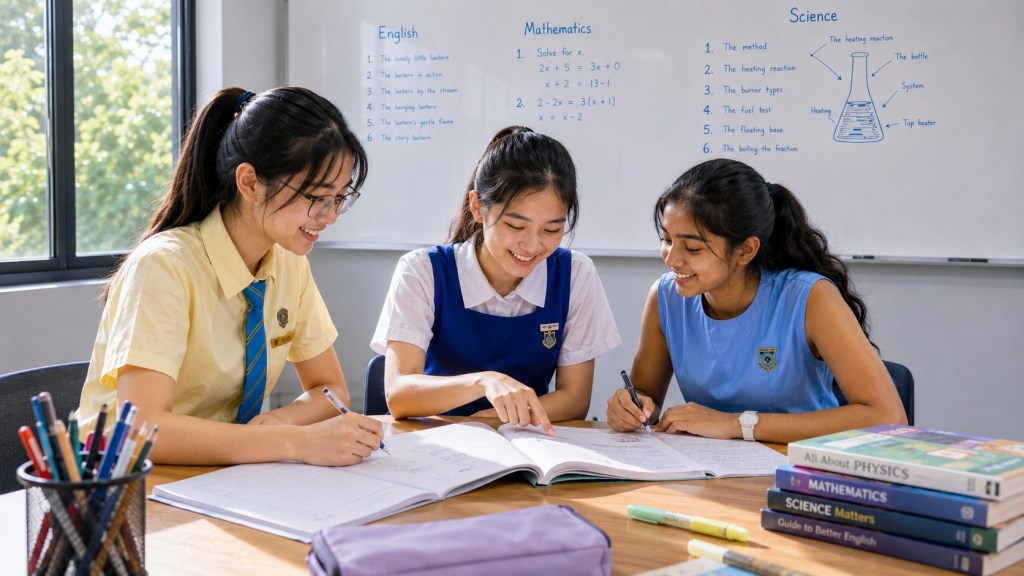
The blurting method is useful for Science because it exposes the difference between material that feels familiar and knowledge a student can actually retrieve without help. The routine is simple: choose a focused topic, hide the notes, write or draw everything you can remember, compare the result with a reliable source, mark the gaps, repair them, and then test the repaired knowledge in a fresh question. For parents searching for the blurting method, active recall, Science revision techniques, PSLE Science revision, Secondary Science study methods or Science tuition in Sengkang, the main value is diagnostic clarity.
Birmingham City University describes blurting as a revision process where students familiarise themselves with a topic, hide the source, write down what they remember, compare against the notes and repeat. The useful learning mechanism is retrieval: the learner has to produce knowledge while the answer is hidden. For Science, however, recall alone is not enough. Students also need to connect the remembered facts into mechanisms, diagrams, data interpretation and application.
This guide therefore uses a Science-specific version: blurt → check → classify the gap → repair → apply → return later. The extra steps protect the method from becoming a long brain dump that rewards volume instead of understanding.
Quick answer: the Science blurting loop
- Choose one small topic. Do not blurt an entire subject.
- Hide the source. Notes, textbook and answer key stay closed.
- Blurt from memory. Write words, mechanisms, diagrams, equations and examples.
- Check against a reliable source. Mark what is missing, wrong or vague.
- Classify the gap. Knowledge, vocabulary, mechanism, representation, experiment or calculation?
- Repair only the weak link. Reopen the source with a specific question.
- Test transfer. Solve one changed Science question.
- Return later. Repeat after a delay without looking at the old blurt.
Why blurting can reveal false familiarity
Students often reread a chapter and feel that everything is obvious. That feeling is partly produced by the information being visible. Blurting removes the external support. The blank page asks a harder question: what can you reconstruct now?
For Science, this can reveal several kinds of weakness. A learner may remember all the keywords but not the mechanism. Another may remember the diagram but not what the arrows mean. Another may write the formula but not the units or conditions. Another may recall the concept but fail to identify where it applies. The blurt becomes a snapshot of the current knowledge structure.
Choose a topic small enough to diagnose
The biggest blurting mistake is choosing a topic that is too large. “PSLE Science” is too large. “Energy” may still be too broad. Better targets include “how evaporation differs from boiling”, “how to identify a fair test”, “how heat moves through a conductor”, “what density means”, “how photosynthesis relates to light”, or “how to read a cooling graph”.
A focused topic makes missing links visible. If the student blurts an entire subject, the result becomes a huge list of unrelated facts and the review becomes difficult to interpret.
What should go into a Science blurt?
- the big idea in one sentence;
- essential vocabulary;
- cause-and-effect mechanisms;
- diagrams or models;
- equations and units where relevant;
- experiment variables and evidence;
- common confusions;
- one example and one non-example;
- one possible examination question;
- one question the learner still cannot answer.
The page does not need to be neat. The purpose is retrieval, not presentation. If the student spends ten minutes drawing perfect borders, the method has drifted into note-making.
Check in three colours: correct, missing and wrong
When the blurt is finished, compare it with the textbook, teacher notes or another reliable source. Mark three categories. Correct means the idea was retrieved accurately. Missing means the learner did not recall it. Wrong means the learner retrieved an inaccurate relationship or misconception.
Wrong information deserves special attention because repeated retrieval of a misconception can strengthen the wrong route. Do not simply add the correct sentence beside it. Ask why the original idea seemed plausible and rebuild the model.
Classify the gap before revising
Not every blank belongs to “memory”. Use a small code: K knowledge, V vocabulary, M mechanism, R representation, E experiment, Q quantitative relationship and T transfer. The code tells the next study step.
A K gap may need retrieval and explanation. An M gap needs cause-and-effect rebuilding. An R gap needs diagram or graph practice. An E gap needs variable and method reasoning. A T gap means the student can recall but not apply, so more blurting alone will not solve the problem.
Primary Science blurting
For Primary 3 and Primary 4, use small blurts with drawings, labels, examples and one mechanism. A child can blurt “materials and their properties” by drawing objects, naming the property being tested and giving one useful application. Keep the task concrete.
For Primary 5 and Primary 6, add experimental reasoning, graph interpretation and open-ended mechanisms. A useful PSLE blurt should not contain only definitions. It should include at least one “why” chain and one changed-context question.
Blurting for PSLE Science
PSLE Science rewards students who can select and apply concepts under unfamiliar conditions. Use blurting to prepare the knowledge network, then immediately switch into application. After a blurt on heat transfer, solve one new setup. After a blurt on plant systems, interpret one unfamiliar diagram. After a blurt on fair tests, critique one experimental method.
The transfer question is the test of whether the blurt built usable knowledge rather than a good memory page.
Blurting for SEC G1, G2 and G3 Science
Secondary students should blurt across multiple representations. For Physics, include model, equation, unit and graph. For Chemistry, connect observable changes, particle explanations and symbolic forms. For Biology, connect structures, functions, processes and system relationships.
The exact depth should follow the student’s current SEAB syllabus. The blurting method is a study process, not a replacement curriculum.
Worked example: blurting evaporation
A Primary 5 learner closes the notes and writes: evaporation happens when water becomes gas; heat makes it faster; clothes dry faster in the Sun. On checking, the student discovers that airflow and exposed surface also matter and that evaporation can occur without direct sunlight.
The gap is not simply “forgot two facts”. The original model wrongly tied evaporation too closely to sunlight. The repair should therefore rebuild the mechanism and conditions. Then the transfer question asks why clothes may dry under a fan in shade.
Worked example: blurting density
A Secondary learner writes the formula correctly but cannot explain why a large heavy object may have lower density than a smaller object. That is a conceptual M gap, not a formula K gap. The repair compares mass and volume together, then tests a new table or graph.
Blurting diagrams
Do not limit blurting to words. Draw the circuit, food web, plant system, particle arrangement or experimental setup from memory. Then label what each part means and explain the relationships. A diagram retrieved without understanding the arrows or symbols is still fragile.
Blurting calculations
For quantitative Science, blurt the relationship, variables, units and meaning. Then solve one example. A formula written from memory is useful, but it does not prove the student can recognise when to use it or interpret the result.
Blurting experiments
Use a blank page to reconstruct the investigation logic: question, changed variable, measured outcome, controls, method, evidence and conclusion. This is especially useful when students memorise experiment phrases without understanding why each step matters.
The 15-minute Science blurt
- 2 minutes: choose a focused topic.
- 5 minutes: blurt from memory.
- 3 minutes: check and classify gaps.
- 3 minutes: repair the highest-value gap.
- 2 minutes: answer one fresh transfer question.
The 30-minute Science blurt
For a larger topic, use ten minutes for retrieval, five for checking, five for mechanism repair, five for application and five for an unsupported re-blurt. The second blurt should be shorter and more structured because the learner now knows which relationships matter.
How often should students blurt?
Blurting is demanding because it requires free recall. Use it selectively. A focused topic may be blurted after initial learning, revisited a few days later and then tested again before mixed practice. It does not need to replace every revision method.
Birmingham City University recommends using the technique in manageable bursts and spacing sessions rather than exhausting the learner. For Science, that is sensible because the method should leave enough energy for application questions.
Common blurting mistakes
- blurting topics that are too large;
- writing everything neatly instead of retrieving quickly;
- checking only what was missing and ignoring wrong ideas;
- treating recall as proof of application;
- repeating the same blurt immediately without delay;
- copying the corrected notes instead of generating a second explanation;
- using blurting for calculations that need worked-example practice first.
Blurting versus flashcards
Flashcards provide cues and test small units. Blurting is freer and tests the structure of a topic. Use flashcards for definitions, symbols and short relationships; use blurting to reveal whether the learner can reconstruct the network connecting them.
Blurting versus concept maps
A concept map organises relationships deliberately. A blurt reveals the relationships currently available from memory. A useful sequence is blurt first, map second: retrieve without help, then reorganise the retrieved material into a clearer model.
Blurting versus past papers
Past papers test mixed selection and examination execution. Blurting diagnoses the knowledge structure before that performance. If a student is failing because prerequisite knowledge is missing, blurting can reveal the gap. If the student knows the content but misreads exam conditions, past-paper analysis may be more valuable.
How parents can use blurting without taking over
Give the child a blank page and topic, then wait. When the learner checks the source, ask what type of gap appeared. Avoid adding your own list before the student has finished. The whole point is to see what the learner can retrieve independently.
After repair, ask one changed question. The parent can help by selecting the new context without supplying the answer.
How a three-student Science tutorial can use blurting
Each student completes an independent blurt before discussion. This preserves individual evidence. Then the tutor compares the three maps, identifies shared and unique gaps, and assigns targeted repair. Students can later explain one repaired relationship to each other, but the initial retrieval should remain private enough to avoid answer leakage.
Useful eduKate Sengkang routes
- Advanced Science Tutorials | Science Flashcards and Active Recall
- Master Science Tutorials Quickly | Science Revision Notes
- Master Science Tutorials Quickly | The Feynman Technique for Science
- Complete Science Index
- Birmingham City University | Blurting Method
Frequently asked questions
Is blurting the same as active recall?
Blurting is one form of active recall. It uses relatively free retrieval on a blank page rather than a set of specific prompts.
Should students blurt before learning the topic?
Usually use it after initial teaching or reading. A pre-topic brain dump can be useful to activate prior knowledge, but it should not be confused with learning new content.
Can blurting help PSLE Science?
Yes, especially for retrieval and misconception diagnosis. Always pair the blurt with application, data or experiment questions so recall develops into exam-ready transfer.
Can blurting work for Secondary Science calculations?
It can help retrieve formulas, units and concepts, but calculations also require worked examples and problem practice. Use the right method for the weak link.
The Science blurting receipt
A successful blurt leaves the student knowing three things: what can already be retrieved, what is missing or wrong, and what the next study action should be. The page is valuable because it reduces uncertainty.
The method becomes powerful when the learner does more than fill the page. Check accurately, repair the right gap, use the Science in a changed question and return after a delay. That is how a brain dump becomes a learning system.
