
Strong Mathematics students create a different tuition question. Parents are not always trying to repair failure; they may be deciding whether additional support will deepen learning or simply add workload. Searches for best Mathematics tuition in Sengkang, advanced Math tuition, enrichment, PSLE Mathematics tuition and whether good students need tuition all sit inside this decision.
A strong student does not automatically need tuition. If the learner can study independently, retain old topics, solve unfamiliar problems, analyse errors and remain appropriately challenged at school, self-study may already be enough.
Tuition can still add value when it provides something the learner does not easily create alone: faster feedback, richer problem selection, comparison of methods, systematic transfer, deeper explanation or disciplined preparation for a major examination.
For Sengkang and nearby Punggol families, the correct question is not ‘Can tuition raise the mark?’ It is ‘What capability would tuition add that the student does not already have?’
Quick answer: when may strong students benefit from tuition?
- They need more challenging transfer rather than more routine questions.
- They benefit from expert feedback on efficient methods.
- They are plateauing because of small precision errors.
- They need structured PSLE or Secondary exam preparation.
- They enjoy comparing alternative solutions.
- They need extension without racing blindly through future chapters.
- They are strong by chapter but less stable on unfamiliar mixed questions.
When self-study may be enough
- The student plans revision independently.
- The learner uses mistakes to choose the next task.
- Old topics remain available after delay.
- Schoolwork provides enough challenge.
- The student can find and use reliable learning resources.
- Tests are stable without heavy adult support.
- The learner can explain and compare methods.
Strong marks do not always mean deep transfer
A student can score highly through reliable execution of familiar school formats.
Extension becomes useful when the learner must apply the same Mathematics in a different representation or context.
That form of difficulty can deepen understanding without simply accelerating the syllabus.
Do not confuse extension with harder arithmetic
Making the numbers larger does not automatically make a problem mathematically richer.
A better extension may require justification, multiple methods, a generalisation or a transfer to an unfamiliar context.
The goal is deeper control, not punishment for being strong.
Why strong students plateau
High-performing students often lose their final marks through precision, checking, inefficient methods or overconfidence on routine questions.
They may also avoid asking for help because most work feels easy until a small set of difficult problems appears.
Targeted coaching can focus on those marginal weaknesses rather than reteaching entire chapters.
PSLE Mathematics for strong students
A strong Primary 6 student still needs Paper 1/Paper 2 pacing, realistic mock conditions and disciplined checking.
The highest-value work may involve unfamiliar problem structures, method comparison and reducing avoidable mark leaks.
Doing more full papers is not automatically the best extension.
Secondary Mathematics for strong students
Secondary learners can benefit from deeper algebraic structure, graphical interpretation, proof-like reasoning and connections between topics.
Strong G3 students may also need guidance on whether and how Additional Mathematics fits their pathway.
Again, depth should precede indiscriminate acceleration.
The value of a three-student group for strong learners
A small group can create useful mathematical contrast. One student may use an equation, another a graph and another a geometric representation.
Comparing correct methods can reveal efficiency and structure.
The group is useful only if each student remains independently accountable.
When tuition can become unnecessary
If the learner is already strong, independent and appropriately challenged, tuition may not add enough value to justify time and cost.
That is a legitimate conclusion.
A strong programme should be willing to recognise when self-study is sufficient.
A parent decision test
- Identify what the student cannot yet do independently.
- Ask whether school or self-study can realistically solve it.
- Define the exact value tuition would add.
- Run a short trial using fresh problems.
- Check whether the learner becomes more capable, not merely busier.
What strong-student tuition should avoid
- Repeating easy worksheets for volume.
- Teaching ahead only for prestige.
- Turning every lesson into competition.
- Removing all productive struggle with hints.
- Assuming high marks mean no weaknesses exist.
- Assuming strong students must always take the hardest possible pathway.
How eduKate Sengkang frames strong-student support
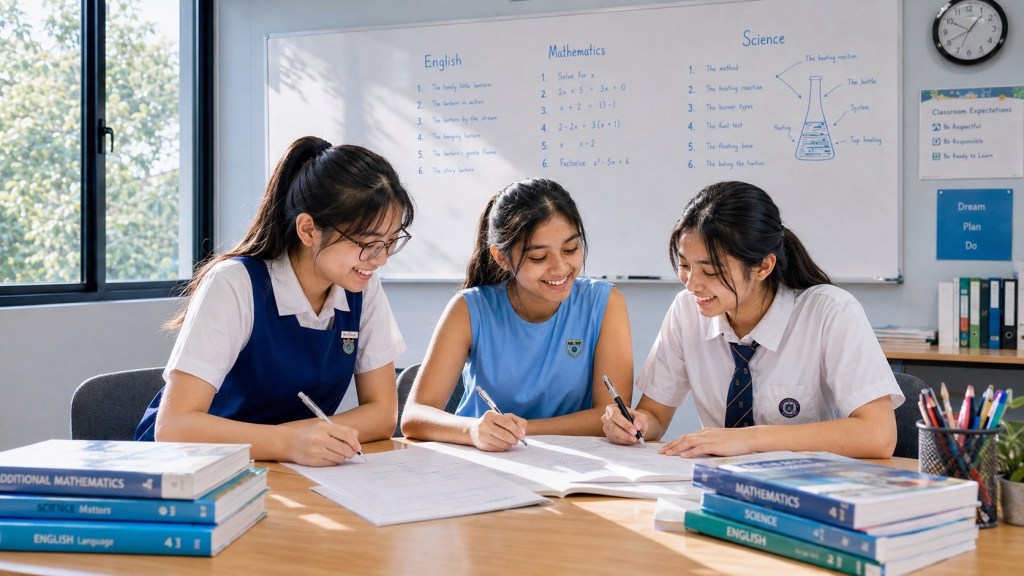
In a three-student Mathematics tutorial, extension can come from richer questioning, comparison of methods and unfamiliar transfer rather than only extra pages.
The tutor can also identify the small precision errors that are easy to miss when the student’s overall score is already high.
Support should remain purposeful.
Frequently asked questions
Can tuition harm a strong student?
It can add unnecessary workload or dependence if the programme does not provide genuine additional value.
Should strong Primary students learn Secondary Mathematics early?
Sometimes light preview is useful, but deep Primary understanding and transfer are often more valuable than racing ahead.
Do high-scoring PSLE students still need exam practice?
Yes, but practice should target realistic paper control, unfamiliar questions and precision rather than sheer volume.
When should a strong student stop tuition?
When the learner can sustain challenge, revision, error correction and exam preparation independently, reducing support can be reasonable.
Continue the parent decision route
Use Self-Study vs Mathematics Tuition, When Should a Student Reduce or Stop Mathematics Tuition? and the Mathematics Hub.
Strong students still need a defined tutoring job
High achievement alone does not answer whether tuition adds value. The Tutor System helps distinguish repair, performance coaching, stretch, route design and self-study so support is chosen for a real learning function rather than maintained by habit.
Browse the wider Advanced Mathematics estate in the Complete Mathematics Index.
