
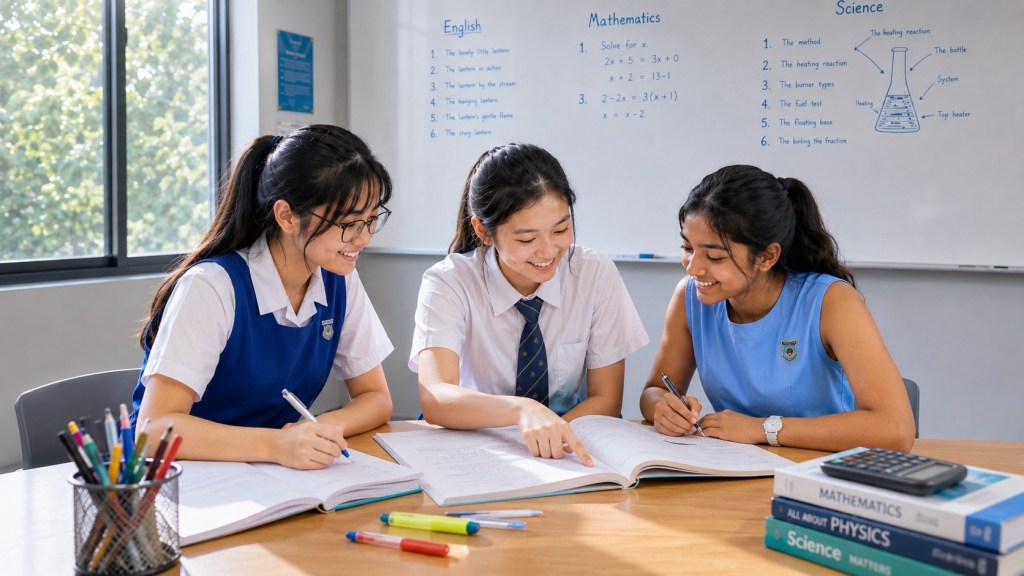
Master English Tutorials Quickly by learning how to read nonfiction, informational texts and textbooks without losing comprehension. Searches for how to read nonfiction, textbook reading strategies, reading comprehension, skimming and scanning, main idea and text structure all point to the same problem: students often approach an information-heavy page as if it were a story that must be read from the first word to the last at one constant speed.
For Primary, PSLE and SEC students in Sengkang and Punggol, nonfiction reading matters far beyond English lessons. Science explanations, Mathematics word problems, Geography resources, History chapters, news articles, websites, reports and examination passages all require readers to find structure, distinguish central ideas from examples, interpret diagrams and captions, learn technical vocabulary and monitor whether the information makes sense.
This tutorial gives a practical system for faster informational reading without turning speed into skimming everything. The method is: preview → set a purpose → map the structure → read selectively → pause for meaning → retrieve → verify. The student changes reading speed according to the job. Headings may be scanned quickly; a dense explanation of cause and effect may need slow rereading. Efficient reading is flexible reading.
The fast answer: nonfiction is organised differently from narrative
- Headings reveal topic hierarchy.
- Introductions often frame the central question or argument.
- Captions, diagrams, tables and sidebars may carry essential information.
- Paragraphs may use description, sequence, cause–effect, compare–contrast or problem–solution structures.
- Technical vocabulary may be defined in context, glossaries or nearby examples.
- Readers can sometimes jump to relevant sections instead of reading every page linearly.
Reading Rockets provides practical guidance on how to read nonfiction text and on teaching text structure. Both emphasise features and structures that help readers navigate informational material.
Step 1: preview before you read deeply
Spend thirty to sixty seconds inspecting the page. Read the title, headings and subheadings. Look at diagrams, captions, bold terms and summary boxes. Ask: what is this text probably trying to explain? What kind of information will I need to find?
Previewing is not cheating. It builds a map. A student who sees headings such as “Causes,” “Effects” and “Possible Solutions” already knows the likely structure before reading the details.
Step 2: define the reading purpose
Reading for a test, for research and for curiosity are different jobs. If the question asks why a process happens, the student should prioritise causal explanation. If the task is to compare two systems, look for shared criteria. If the student is studying a chapter, broader understanding matters and more sections deserve attention.
Purpose controls speed. Without a purpose, students often highlight too much or read every sentence with equal effort.
Step 3: identify the text structure
Description
The text explains characteristics or features. Ask: what are the main attributes?
Sequence
The text explains steps or events in order. Look for first, next, then, after, finally and time markers.
Cause and effect
The text explains why something happens and what follows. Look for because, therefore, leads to, results in, due to and consequently.
Compare and contrast
The text organises similarities and differences. Identify the comparison criteria rather than listing random details.
Problem and solution
The text defines an issue, then evaluates responses. Ask what makes the problem difficult and what trade-offs each solution creates.
Step 4: read in chunks
After one paragraph or short section, pause and say what it did. “This paragraph explains why the population declined.” “This section compares two methods.” “This example shows the effect of the rule.” Chunking prevents students from reaching the bottom of a page with no mental summary.
Step 5: treat visual information as text
Charts, diagrams, photographs and captions are not decoration. Ask what variable is shown, what comparison is being made and how the visual connects to the written explanation. In school subjects, a diagram may contain the clearest representation of the process.
Step 6: manage technical vocabulary
Do not stop for every unfamiliar word. Decide whether the word is essential. If it appears repeatedly, is bolded, is defined by the text or blocks the main idea, learn it. Use morphology, context, diagrams and glossaries before reaching immediately for a dictionary.
Reading Rockets notes that previewing unfamiliar vocabulary before reading can support comprehension. See Previewing Vocabulary Before Reading.
Skimming and scanning are not the same
Skimming is reading quickly for overall structure or gist. Scanning is searching for a specific item such as a date, term, name or statistic. Neither method replaces deep reading. They help the reader decide where deep reading is needed.
A student answering a question about the cause of a phenomenon might scan for the relevant heading, skim the surrounding section and then read the causal explanation slowly.
A worked example: read a textbook section on ecosystems
Preview: headings show “Food Chains,” “Energy Transfer” and “Disruption.” Purpose: understand what happens when one population changes. Structure: cause and effect. Vocabulary: producer, consumer, predator, population. Visual: a food-web diagram.
Read the first paragraph and summarise: energy moves through feeding relationships. Read the second and note the cause–effect chain. Then use the diagram to test the explanation. Finally close the book and explain how removing one species might affect others. The reading session now includes navigation, comprehension and retrieval.
Primary 1–2: learn nonfiction features
Young readers should learn what a title, heading, caption, contents page, index and glossary do. They do not need to use every feature at once. Make reading playful: “Where would we look if we wanted the meaning of this word?” “Which heading would help us find what frogs eat?”
Primary 3–4: reading to learn across subjects
This is where nonfiction becomes increasingly important because Science, Mathematics and other subjects require students to extract information independently. Teach paragraph gist, cause–effect language, comparison and the use of diagrams. A student who reads every word but cannot state the section’s job needs more structure awareness.
Primary 5–6 and PSLE: handle dense information without panic
Upper-Primary students need to switch between close reading and efficient navigation. Before answering, identify what the question requires. Return to the relevant part of the text rather than rereading everything. Use headings and paragraph topics to relocate evidence quickly.
SEC G1, G2 and G3: nonfiction becomes analysis
Secondary students increasingly encounter arguments, reports, articles and multimodal sources. Ask not only what information is present but how it is organised, what assumptions are made, which evidence supports claims and what alternative interpretation may exist.
The annotation rule: mark relationships, not everything
- Circle unfamiliar essential terms.
- Underline the sentence carrying the central claim or main idea.
- Draw arrows for cause and effect.
- Number steps in a sequence.
- Write “vs” beside a comparison.
- Write one margin sentence after each section.
If most of the page is highlighted, the annotation has stopped selecting information.
How to read faster without losing comprehension
Speed comes from decision-making and familiarity, not forcing the eyes to move faster. Preview structure so fewer surprises occur. Skip examples when the concept is already clear and the task does not require them. Slow down at definitions, conditions, exceptions and causal relationships. Reread sentences that change the argument.
The correct reading speed is the speed that preserves the required meaning.
The textbook recall test
After a section, close the book and answer: What was the main idea? What were the three most important details? Which term do I need to remember? What relationship did the diagram show? What question can I now answer that I could not answer before?
If the student cannot answer, rereading may be necessary—but reread with a specific question rather than starting again passively.
A 25-minute nonfiction reading routine
- 2 minutes: preview title, headings, visuals and bold words.
- 2 minutes: state the reading purpose.
- 12 minutes: read in chunks and write one-line gist notes.
- 4 minutes: explain the structure and key vocabulary.
- 3 minutes: close the text and retrieve the main ideas.
- 2 minutes: reopen and verify what was missed.
Common nonfiction reading mistakes
- Reading every sentence at one speed.
- Ignoring diagrams and captions.
- Highlighting almost everything.
- Looking up every unfamiliar word.
- Copying headings as notes without explaining the content.
- Finishing a page without being able to state its main idea.
- Rereading from the beginning instead of locating the difficult section.
Connect this route to existing eduKate Sengkang owners
This page owns nonfiction and textbook navigation across ages. For general reading fluency, use How to Improve Reading Fluency, Speed and Stamina. For text structure, use How to Understand Main Ideas, Text Structure and Information Flow. For note-making, use How to Take Better Notes, Annotate Texts and Remember What You Read.
Parents can route by level through the Primary English capability map and the Secondary English capability map.
When tuition can help
A tutor can watch how a learner approaches a dense page. Does the student preview? Ignore headings? Read without purpose? Lose the relationship between paragraphs? Misread technical vocabulary? Small-group work makes these behaviours visible and allows the tutor to model a better reading route immediately.
eduKate Sengkang uses small groups of up to three learners, allowing the tutor to compare strategies and then test whether the student can navigate a new text independently.
Frequently asked questions
How can students read textbooks faster?
Preview the structure, define the purpose, locate the relevant section, read dense explanations slowly and use retrieval after each chunk. Speed comes from selective attention rather than rushing.
Should students read every textbook page from beginning to end?
Not always. The reading route depends on the task. For studying a chapter, broad coverage matters. For answering a specific question, the index, headings and relevant section may be more efficient.
What is the difference between skimming and scanning?
Skimming looks for overall gist and structure. Scanning searches for a specific detail. Both should lead to deeper reading when important meaning is found.
Why does my child read nonfiction more slowly than stories?
Nonfiction often contains denser concepts, technical vocabulary and unfamiliar structures. Building background knowledge and recognising text structure can reduce the load.
Digital nonfiction needs a different navigation habit
Webpages add menus, hyperlinks, pop-ups, related stories and scrolling. Students can lose the main argument because the page invites constant movement. Before clicking anything, identify the page title, source, date where relevant, main section headings and the question being researched. Open links only when they answer a specific information need.
For Secondary students, this habit also supports source evaluation. A well-written page is not automatically authoritative. Check who produced it, what evidence it uses and whether an original source is available. The existing Secondary 3 guide to digital source verification handles that deeper source-checking route.
Read news articles by separating event, evidence and interpretation
News and current-affairs texts are useful for Secondary English because they combine factual reporting, quotations, statistics and interpretation. Ask three questions: What happened? What evidence is provided? Which statements are interpretation, prediction or opinion? This prevents students from treating every sentence as the same kind of claim.
For younger students, use age-appropriate news and focus on who, what, where, when, why and how. For older students, compare how two sources frame the same issue and identify differences in emphasis.
How to handle a dense textbook paragraph
Dense paragraphs often contain one central relationship surrounded by definitions and examples. First locate the subject of the paragraph. Then identify the main verb or relationship: causes, depends on, differs from, consists of, increases, limits or results in. Rewrite the paragraph as one plain sentence. Return to the details only after the core relationship is clear.
Example: a long paragraph about evaporation may contain examples involving puddles, wet clothes and cooling. The core relationship could be: “Evaporation occurs when higher-energy particles escape from a liquid’s surface.” Once that idea is stable, the examples become evidence and application rather than separate facts to memorise.
The question-stem method
Turn headings into questions before reading. “Effects of Deforestation” becomes “What effects does deforestation produce, and through what mechanisms?” “How Vaccines Work” becomes “What process allows a vaccine to prepare the immune system?” Questions create a retrieval target and make the paragraph’s purpose easier to monitor.
When to slow down
- Definitions of important terms.
- Sentences containing conditions or exceptions.
- Cause-and-effect chains.
- Comparisons where one word changes the conclusion.
- Claims supported by statistics or evidence.
- Instructions with several steps or constraints.
- Paragraphs that contradict the reader’s existing understanding.
When it is safe to move faster
- Repeated examples after the concept is already clear.
- Background detail not required for the current purpose.
- Lists where only one category matters to the question.
- Sections already mastered and being reviewed.
- Navigation text such as menus, references or related links unless needed.
The diagram-to-sentence drill
Choose a chart, process diagram or labelled image and ask the student to express its main relationship in one sentence. Then reverse the task: give a sentence and ask what diagram would represent it. This links verbal and visual information rather than treating them as separate modes.
The 3–2–1 nonfiction exit ticket
- 3 important ideas learned.
- 2 relationships between those ideas.
- 1 question that remains.
This takes two minutes and exposes whether the learner read for meaning. A list of three isolated facts with no relationships usually indicates shallow processing.
A seven-day nonfiction reading practice cycle
- Day 1: practise previewing and predicting structure.
- Day 2: practise cause–effect and sequence texts.
- Day 3: practise compare–contrast and problem–solution texts.
- Day 4: read a page with diagrams and captions; translate visuals into sentences.
- Day 5: read a news or magazine article and separate event, evidence and interpretation.
- Day 6: read one school textbook section and create a 3–2–1 exit ticket.
- Day 7: use an unfamiliar passage and decide independently when to skim, scan, slow down and reread.
How parents can help without explaining the whole page
Ask navigation questions instead of supplying answers. “Which heading looks relevant?” “What does this diagram add?” “Which sentence seems to carry the main relationship?” “What word is blocking the paragraph?” These questions preserve the child’s role as reader.
If the child remains lost, model one section aloud, then hand control back on the next section. The aim is gradual independence.
Measure reading efficiency, not words per minute alone
A student can read faster and understand less. Better measures include how quickly the learner can locate relevant information, state the main idea, explain a relationship and answer a question accurately. Efficient reading combines time and comprehension.
Use a simple test: give a short nonfiction passage and record the time. Ask for a one-sentence gist, three key details and one inference. Repeat a week later with a similar text. Improvement means maintaining or improving comprehension while navigation becomes more deliberate and less hesitant.
The paragraph-job method for textbooks
Write a two- or three-word label beside each paragraph: “defines term”, “explains cause”, “gives example”, “compares systems”, “states limitation”. After a page, read only the labels. They should form a coherent map of the section. If they do not, reread the paragraphs whose job was unclear.
The main-idea compression drill
After reading a section, reduce it to twenty words. Then reduce the twenty words to ten. Compression forces the learner to separate central meaning from supporting detail. The exercise also prepares students for summary writing and note-making.
Reading across English, Science and Humanities
The same navigation skills appear across subjects. Science often emphasises mechanism and cause. History often emphasises chronology, cause, consequence and perspective. Geography may combine systems, comparison, data and place. English nonfiction may analyse viewpoints, rhetoric and structure. Students benefit when they recognise these recurring relationships.
Parents can ask the same core questions regardless of subject: What is this section doing? Which terms are essential? What relationship links the main ideas? What evidence supports the claim? Which visual adds information?
How to read examination passages efficiently
Examination reading has an extra constraint: questions direct attention. Students should understand the paper’s instructions and their teacher’s recommended sequence. In many situations, it is useful to preview the text structure, read with enough depth to establish meaning, then use question demands to return to precise evidence. Rereading the entire passage for every question wastes time.
However, students should not hunt only for matching keywords. A question about motive or effect may require information distributed across several sentences. Efficient navigation must preserve context.
How to handle unfamiliar vocabulary without breaking reading flow
Mark the word and keep reading until the end of the sentence or paragraph. Ask whether the surrounding idea remains understandable. If yes, continue. If the word blocks the main relationship, infer from morphology, contrast, examples or definitions. Verify later if needed.
This prevents a common problem where students stop so often for vocabulary that they lose the overall argument.
A four-week nonfiction reading progression
- Week 1: headings, captions, glossary, index and simple paragraph gist.
- Week 2: text structures and relationship words.
- Week 3: selective annotation, diagrams and technical vocabulary.
- Week 4: timed unfamiliar texts requiring skimming, scanning, deep reading and retrieval.
The independence test
Give the student a new chapter or article and say only: “Show me how you would approach this.” Watch whether the learner previews, identifies the purpose, navigates headings, changes speed and checks understanding without prompts. That performance reveals whether the strategy has become independent.
Final principle: read according to the job
Efficient readers do not use one speed. They preview, navigate, slow down, skip, reread, interpret visuals, retrieve and verify according to purpose. That flexibility is what makes nonfiction and textbook reading faster without sacrificing comprehension.
For Sengkang and Punggol families who want help identifying why a student gets lost in dense English, Science or humanities texts, see the eduKate Sengkang tuition enquiry process.
English route: return to the English Hub or Complete English Index for the wider English estate.
