
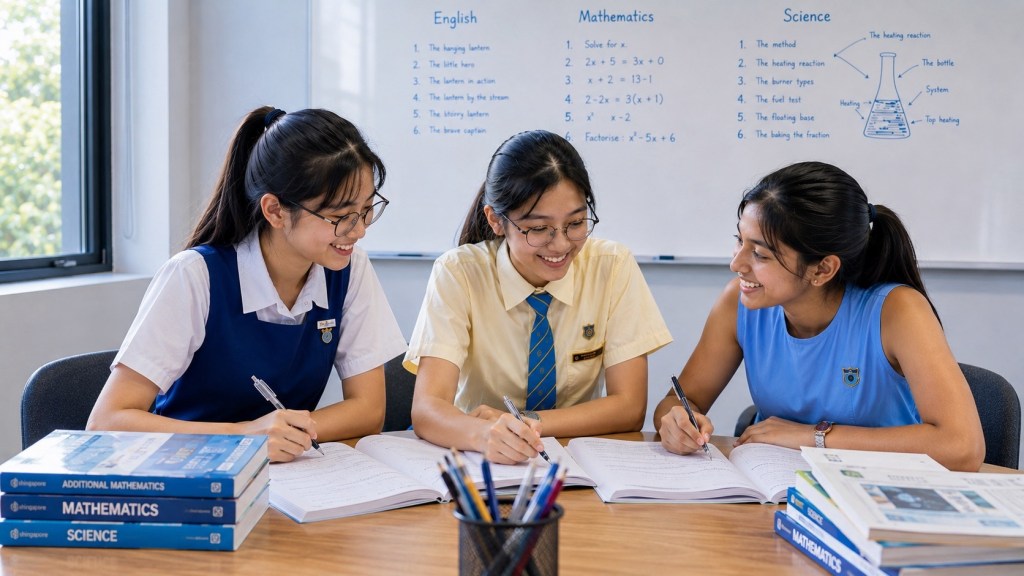
Parents searching for Secondary Mathematics tuition in Sengkang often compare geometry tuition, angle properties, congruence and similarity, coordinate geometry, circle theorems, trigonometry, mensuration, constructions, proof and exam preparation. Geometry can feel difficult because the student must read a diagram, select relevant facts and build a chain of reasoning rather than simply apply one formula.
A strong Secondary Math tutor in Sengkang should therefore teach students how to see structure in diagrams. The learner needs to identify what is given, what must be proved or found, which angle or length relationships are available and how each new result unlocks the next step. Memorising a list of theorems is necessary in places, but it is not enough if the student cannot recognise when a theorem applies.
At eduKate Sengkang, geometry is taught in small groups of up to three students. That allows the tutor to inspect diagrams and working closely. One student may misread an angle relationship, another may know the theorem but fail to justify its use, and a third may reach the right answer with a gap in the proof. The useful teaching job is to locate the first broken link in the geometric chain.
The One-Sentence Goal
A strong geometry learner can read a diagram, identify invariant relationships, choose relevant theorems and build a justified chain from given information to the required result.
Why Geometry Feels Different From Algebra
Algebra often presents the relationships symbolically. Geometry may hide them in a picture. The student has to decide which features matter.
A diagram may contain parallel lines, equal sides, a tangent, a diameter, a right angle, a pair of similar triangles and several irrelevant visual impressions. The student must avoid assuming that a line is horizontal, that two lengths look equal or that an angle looks like 90° unless the information is given or proven.
This is why geometry trains evidence discipline. Appearance is not proof.
What “Weak in Geometry” Can Actually Mean
| Visible problem | Possible first weak link | What we investigate |
|---|---|---|
| Student cannot start | Diagram reading | Can the learner list the given facts and mark them accurately? |
| Uses a theorem randomly | Condition recognition | Does the student know what must be true before the theorem applies? |
| Gets the angle but gives no reason | Justification | Can the learner name the relationship that supports the step? |
| Proof has a logical gap | Chain construction | Has every conclusion been established from earlier facts? |
| Similarity is recognised but corresponding sides are mismatched | Correspondence | Can the student align vertices and ratios consistently? |
| Circle questions feel impossible | Theorem retrieval | Are angle properties of circles organised into a usable network? |
| Performs well on routine diagrams but fails novel ones | Transfer | Can the learner recognise the same relationship after rotation or relabelling? |
Start With the Given Information
Strong geometry work often begins before any calculation. Students should annotate what is known.
- parallel lines;
- equal sides;
- right angles;
- midpoints;
- tangents;
- diameters;
- equal radii;
- known angle values;
- similarity or congruence conditions.
This turns the diagram into an information map. The learner is less likely to overlook a condition buried in the text.
Angle Facts: Build a Small Reliable Core
Students should be fluent with foundational angle relationships:
- angles on a straight line;
- angles around a point;
- vertically opposite angles;
- angles in a triangle;
- angles in a quadrilateral;
- corresponding, alternate and interior angles with parallel lines;
- base angles in isosceles triangles.
The goal is not to recite names. It is to recognise the pattern even when the diagram is rotated.
Worked Example: Parallel Lines
Suppose two parallel lines are cut by a transversal and one acute angle is 58°. The corresponding acute angle is also 58°. The adjacent obtuse angle is 122° because angles on a straight line sum to 180°.
A student who simply writes 122° may be correct but has not shown the reasoning. A strong solution records the relationship used at each step.
Congruence: Same Shape and Size
Congruent triangles are powerful because once congruence is proven, corresponding sides and angles are equal.
Students need to recognise valid conditions such as side-side-side, side-angle-side and angle-side-angle where appropriate to their syllabus.
The common mistake is not usually forgetting the abbreviation. It is mismatching the corresponding parts. We teach students to write triangles in corresponding order so later conclusions remain consistent.
Similarity: Same Shape, Different Scale
Similarity requires students to coordinate angle equality with proportional lengths.
If triangle ABC is similar to triangle DEF and A corresponds to D, B to E and C to F, then AB/DE = BC/EF = AC/DF.
A large proportion of similarity errors come from losing correspondence. We insist on matching vertices before writing ratios.
Scale Factors: Length, Area and Volume Do Not Scale the Same Way
If lengths scale by factor k, areas scale by k² and volumes by k³. Students who memorise these separately may confuse them under pressure.
We connect the powers to dimension. Length is one-dimensional, area is two-dimensional and volume is three-dimensional. This gives the rule a reason.
Circle Geometry: Build a Theorem Network
Circle questions become much easier when theorems are connected rather than stored as an isolated list.
- angle at the centre and angle at the circumference;
- angles in the same segment;
- angle in a semicircle;
- opposite angles of a cyclic quadrilateral;
- radius perpendicular to tangent;
- tangent-chord relationships where included in the course.
Students learn to ask what feature triggers which theorem. A diameter is not just a line; it may activate the angle-in-a-semicircle relationship. A tangent is not just a touching line; the radius to the point of contact creates a right angle.
Proof: Every Statement Needs a Reason
Geometry proof is structured communication. A claim should follow from known information.
Statement → reason → new statement → reason → conclusion.
We teach students to avoid “teleporting” from the diagram to the final conclusion. If two triangles are claimed to be congruent, the required conditions must be stated. If two angles are claimed equal, the theorem or established property should be visible.
Worked Proof Example
Suppose AB = AC in triangle ABC. D lies on BC and AD bisects angle BAC. Prove triangles ABD and ACD are congruent.
- AB = AC — given.
- Angle BAD = angle DAC — AD bisects angle BAC.
- AD = AD — common side.
- Therefore triangles ABD and ACD are congruent by side-angle-side.
The proof is short because the logic is complete.
Coordinate Geometry: Geometry Meets Algebra
Coordinate geometry links visual relationships to numerical ones. Gradient, midpoint, distance and line equations give students alternative ways to establish geometric facts.
Two lines with equal gradients are parallel. Gradients whose product is −1 indicate perpendicularity in the standard non-vertical case. Midpoint coordinates can verify bisection.
This domain rewards flexible movement between diagram and algebra.
Trigonometry: Geometry With Ratios
Right-angled triangle trigonometry gives students another route to unknown lengths and angles.
The student needs to identify the angle of interest, then label opposite, adjacent and hypotenuse relative to that angle. Memorising sine, cosine and tangent without this reference point creates confusion.
We teach the ratio as a relationship, not a button on the calculator.
Bearings and Scale Drawings: Orientation Matters
Bearings combine angle control with direction and convention. Students need to measure clockwise from north and report three-figure bearings where required.
Scale drawings require careful interpretation of the scale relationship. A drawing is a representation, not the object itself.
Mensuration: Formula Is the Beginning, Not the End
Geometry questions often combine reasoning with perimeter, area, surface area or volume.
Students need to identify the relevant shape, decompose composite figures where necessary, maintain units and check whether the requested quantity is one-dimensional, two-dimensional or three-dimensional.
Diagram Not to Scale: Trust the Evidence
One of the most important geometry habits is resisting visual assumption.
A line that looks horizontal may not be. Two angles that look equal may not be. A point that appears central may not be the midpoint. Students should use only information given, marked or proven.
This habit transfers beyond geometry into mathematical reasoning generally.
Construction: Accuracy and Logic
Geometric construction tasks train students to use compass and ruler relationships accurately: perpendicular bisectors, angle bisectors and loci where appropriate.
The marks are not merely for a neat drawing. The construction encodes a geometric condition.
Why Three Students Can Work Well for Geometry
Geometry benefits from discussion because several routes can reach the same result.
- One student may use parallel-line facts.
- Another may identify an isosceles triangle first.
- A third may see a similar-triangle route.
The tutor can compare efficiency and validity. Every student still needs to justify their own chain.
A Practical Teaching Sequence
- Read: identify the target and given information.
- Mark: annotate the diagram.
- Retrieve: recall relevant facts and theorems.
- Choose: select the most promising relationship.
- Chain: write each step with a reason.
- Check: verify that no step relies on appearance alone.
- Compare: consider an alternative route where useful.
- Transfer: solve a rotated, relabelled or less familiar diagram.
Correction Categories We Use
- diagram-reading error;
- angle-property error;
- theorem-condition error;
- correspondence error;
- proof gap;
- scale-factor error;
- circle-theorem retrieval error;
- trigonometric labelling error;
- unit error;
- visual assumption;
- transfer failure after diagram rotation.
What Progress Looks Like
- Students annotate diagrams before calculating.
- Angle reasons appear more consistently.
- Congruence and similarity correspondence improves.
- Theorem choice becomes less random.
- Proof chains have fewer logical gaps.
- Circle geometry feels more connected.
- Students rely less on how diagrams look.
- Trigonometry starts from correct side identification.
- Mixed geometry questions cause less hesitation.
- Rotated or unfamiliar diagrams become easier to decode.
Secondary 1–4: Geometry Builds in Layers
Secondary 1
Strengthen angle facts, polygons, symmetry, basic constructions and visual reasoning.
Secondary 2
Develop congruence, similarity, coordinate ideas, trigonometry and more complex geometric relationships.
Secondary 3
Integrate circle geometry, coordinate methods, mensuration and more demanding proof or multi-step reasoning according to subject level.
Secondary 4
Retrieve theorems quickly and apply them under mixed-paper and examination conditions.
Frequently Asked Questions
Should students memorise all geometry theorems?
Students need reliable theorem knowledge, but they also need to know the conditions under which each theorem applies.
Why can my child do routine angle questions but not proof?
Proof requires chaining several relationships and justifying each step. The difficulty may lie in route selection rather than basic angle facts.
How can parents help?
Ask the learner, “What information is given?” and “What reason supports that step?” Those questions reinforce evidence without introducing a competing method.
What should parents bring to a consultation?
A recent Mathematics paper with diagrams and working is very useful. Geometry errors are often visible in the exact annotation or reasoning step where the chain breaks.
The End Goal Is Geometric Reasoning
The strongest geometry student does not simply remember more theorems. The learner can recognise structure, justify relationships and build a chain that remains valid even when the picture changes.
Continue through Mathematics Tuition Sengkang, Secondary Tuition Sengkang, or the Sengkang tuition enquiry process.
