
Parents searching for Secondary English tuition in Sengkang often look for continuous writing, composition, essay writing, narrative writing, expository writing, argumentative writing, vocabulary, grammar and exam preparation. Those labels are useful, but the most important teaching question remains: where does the student’s writing process first become unreliable?
A strong Secondary English continuous writing tutor in Sengkang should help students generate relevant ideas, organise them for a clear purpose, develop narrative or argumentative content, control paragraphs and sentences, choose precise vocabulary, revise meaning and edit for accuracy. Writing is not improved simply by memorising model essays or inserting “powerful” phrases.
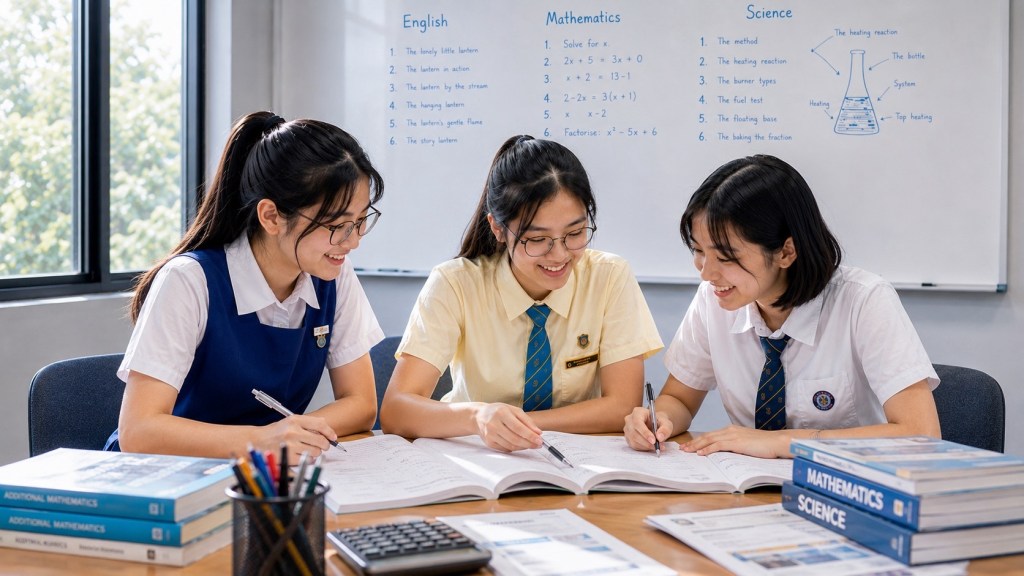
At eduKate Sengkang, continuous writing is taught in small groups of up to three students so the tutor can see planning, drafting and revision rather than only the finished script. One student may have interesting ideas but weak structure. Another may write clean sentences but develop points too thinly. A third may plan well and then lose control under time pressure. The same writing score can hide very different first weak links.
The One-Sentence Goal
A strong Secondary writer can interpret the task, choose a workable position or story, organise ideas, develop them with relevant detail and revise the draft until meaning and language are both controlled.
Continuous Writing Is a Decision System
Students often think good writing begins with “inspiration”. In practice, stronger writing comes from a sequence of decisions: what the task requires, what angle to take, which idea deserves space, what evidence or scene should develop it, what order will help the reader and what can be cut.
This makes writing teachable. We are not waiting for talent to appear. We are improving the quality of decisions.
What “Weak in Composition” Can Actually Mean
| Visible problem | Possible first weak link | What we investigate |
|---|---|---|
| Student cannot start | Task interpretation or idea generation | Can the learner identify a manageable direction? |
| Essay wanders | Organisation | Does each paragraph have a clear job? |
| Narrative feels like a list of events | Scene development | Can the writer slow down at decisive moments? |
| Argument repeats the same point | Idea differentiation | Can the student separate reasons, examples and implications? |
| Vocabulary feels forced | Precision and register | Are words chosen for meaning or display? |
| Grammar deteriorates near the end | Load and pacing | Does accuracy collapse under time pressure? |
| Corrections improve one essay but not the next | Transfer | Has the student learned a principle or only the revised version? |
Interpret the Prompt Before Planning
A surprising amount of weak writing begins with a misread task. Students may write on the broad topic while missing the exact command.
“Describe a time when…” is not the same as “Do you agree that…” or “What are the advantages and disadvantages of…”. Each task creates a different writing job.
Before planning, students should identify:
- topic;
- command;
- audience where relevant;
- required position or narrative focus;
- limits and key terms;
- what would count as going off-topic.
Idea Generation: Choose the Idea You Can Develop
The most original idea is not always the best exam idea. A useful idea is relevant, specific and expandable.
For an argumentative prompt on whether school uniforms are useful, a student may consider identity, equality, cost, discipline, self-expression and practicality. The next step is not to use all six. It is to choose a small set that can be developed clearly.
For narrative writing, the same principle applies. A simple conflict with a clear turning point is often more controllable than an elaborate plot with five locations and ten characters.
Paragraphs Need Jobs
A paragraph should do something identifiable for the reader. In an expository essay, one paragraph may explain a cause, another an effect and another a limitation. In a narrative, one paragraph may establish the situation, another build tension and another show the consequence of a decision.
When a paragraph has no clear job, it tends to repeat, wander or collect unrelated details.
Narrative Writing: Event Is Not the Same as Development
Weak narratives often move rapidly from one event to the next. Stronger narratives allocate space according to significance.
Routine movement can be compressed. The turning point deserves expansion.
Instead of writing five sentences about travelling to school and one sentence about the moment the student discovers an important item missing, the writer can reverse the proportions. The reader needs detail where meaning changes.
Scene Development: Selective Detail
“Show, don’t tell” is often overused. Good writing needs both showing and telling.
If every action is expanded into sensory detail, the writing becomes slow. If every emotion is merely named, the writing becomes flat. Students need to decide when a scene deserves closer attention.
For example, “I was nervous” may be enough in a transition. At a decisive moment, the writer may instead show the repeated checking of notes, dry mouth and hesitation before speaking.
Argumentative Writing: Claim, Reason, Evidence, Explanation
An argumentative paragraph becomes stronger when it contains more than an opinion.
Claim → reason → example or evidence → explanation → link back to the question.
The order can vary, but the underlying logic matters. A paragraph that gives an example without explaining why it supports the claim is incomplete.
Worked Argument Example
Prompt: “Schools should reduce homework. Do you agree?”
Weak point: “Yes, because students are tired.”
Stronger development: “Schools should review excessive homework because work that extends too late into the evening can reduce sleep and leave students less attentive the next day. However, this does not mean homework has no value; shorter assignments designed for retrieval or practice may be more useful than large volumes of repetitive work.”
The stronger paragraph does more than take a side. It qualifies the claim and distinguishes quantity from purpose.
Expository Writing: Organise by Relationship
Students can organise expository essays by cause and effect, problem and solution, advantages and disadvantages, comparison, sequence or categories.
The best structure depends on the question. We discourage mechanical five-paragraph templates when they force unlike ideas into identical boxes.
Counterargument: Use It When It Adds Thinking
A counterargument should not be inserted merely because a template says every essay needs one. It is useful when acknowledging a competing view allows the writer to refine the position.
For example: “Some argue that smartphones should be completely banned in schools because they distract students. That concern is valid during lessons, but a total ban may remove useful functions such as emergency contact or supervised research. A controlled-use policy may therefore be more practical than an absolute prohibition.”
The writer has not simply “added balance”. The writer has improved the claim.
Vocabulary: Precise Beats Impressive
Secondary writing benefits from wider vocabulary, but word choice must remain natural and accurate.
Students should distinguish words by nuance and register. “Concerned”, “alarmed”, “uneasy” and “terrified” are not interchangeable. “Buy” and “purchase” differ in register. “Claim” and “argue” differ in implication.
The writer should choose the word that fits the idea, not the word that appears most advanced.
Sentence Variety: Control Before Complexity
Strong writing uses a range of sentence structures, but complexity is useful only when controlled.
Students build from reliable simple and compound sentences toward subordinate clauses, relative clauses, participial phrases and more flexible sentence openings.
The aim is rhythm and precision, not grammatical decoration.
Cohesion: Make the Reader See the Connection
Transitions should clarify relationships rather than merely make the essay look organised.
“However” signals contrast. “Therefore” signals consequence. “For example” introduces illustration. “In addition” adds a related point. Using the wrong connector can change the logic even when the sentences themselves are grammatically correct.
Revision: Meaning Before Surface
Students often edit spelling first. We teach a higher-value sequence.
- Does the writing answer the exact task?
- Is the main direction clear?
- Does each paragraph have a useful job?
- Is any important point underdeveloped?
- Is any paragraph repetitive or irrelevant?
- Are examples connected to the point?
- Are transitions logical?
- Are sentences clear and grammatically controlled?
- Are spelling and punctuation accurate?
There is little value polishing a sentence in a paragraph that should be removed.
Editing Under Time Pressure
Exam writing requires a shorter editing routine. Students learn to target high-risk areas:
- tense consistency;
- subject-verb agreement;
- sentence fragments and run-ons;
- pronoun reference;
- repeated words;
- missing words;
- punctuation at sentence boundaries;
- spelling of frequently used academic vocabulary.
Model Essays: Reverse Engineer, Don’t Worship
Model essays are useful when students analyse decisions: how the opening establishes focus, how paragraphs develop ideas, how evidence is introduced, how the ending resolves the argument.
They become harmful when students memorise whole passages and force them into unrelated prompts.
We ask: What principle can be transferred? The wording is less important than the underlying craft.
Why Three Students Can Work Well for Writing
Writing is individual, but comparison can sharpen judgement. In a group of three, students can see several valid responses to the same prompt.
- Different thesis statements can be compared.
- Narrative plans can be tested for clarity.
- Paragraph order can be discussed.
- Students hear different examples and counterarguments.
- The tutor can still give line-level feedback to each learner.
- Every student remains responsible for an independent draft.
A Practical Lesson Sequence
- Interpret: decode the prompt.
- Generate: produce possible ideas.
- Select: choose the strongest manageable direction.
- Organise: assign jobs to paragraphs or scenes.
- Draft: write with meaning first.
- Develop: strengthen evidence, examples or decisive scenes.
- Revise: improve structure and relevance.
- Edit: improve language accuracy.
- Transfer: apply the principle to a fresh prompt.
What Progress Looks Like
- Students start planning faster.
- Ideas remain closer to the prompt.
- Paragraphs have clearer jobs.
- Narratives slow down at important moments.
- Arguments contain more explanation and fewer repeated assertions.
- Vocabulary becomes more precise and less forced.
- Sentence variety increases without large accuracy losses.
- Revision changes meaning rather than only spelling.
- Timed writing becomes more stable.
- Corrections transfer to new prompts.
Secondary 1–4: The Writing Job Evolves
Secondary 1
Build paragraph control, expand narrative development and learn to move beyond Primary-level composition habits.
Secondary 2
Develop stronger expository organisation, viewpoint control, evidence and more deliberate revision.
Secondary 3
Handle more demanding argumentative and reflective tasks, counterarguments, nuance and a broader range of structures.
Secondary 4
Integrate planning, development, language and editing under examination time constraints.
Frequently Asked Questions
Should my child memorise model essays?
No. Models are useful for analysing craft, but memorised essays are fragile when the prompt changes.
How do you help a student with no ideas?
We use structured idea generation, prompt decomposition and comparison. Often the problem is not absence of ideas but difficulty selecting and organising them.
Is vocabulary the main way to improve writing?
No. Vocabulary helps, but relevance, organisation, development, sentence control and revision usually matter just as much.
What should parents bring to a consultation?
A recent essay with the original prompt and teacher comments is ideal. It shows whether the problem begins with interpretation, planning, development, language or editing.
The End Goal Is a Writer Who Can Adapt
Strong writing is not the ability to reproduce one polished essay. It is the ability to meet a new prompt, make good decisions and build a response that fits the task.
Continue through English Tuition Sengkang, the Secondary English Learning Hub, or the Sengkang tuition enquiry process.
