
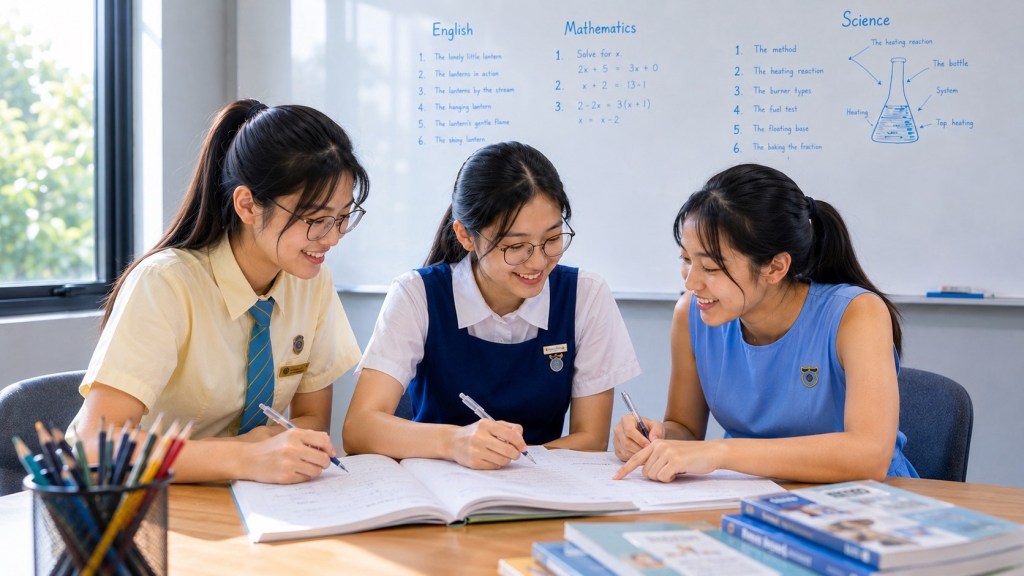
Three students can make learning visible. They do not automatically make teaching intelligent.
A small class creates room for observation, individual questioning and branch-and-rejoin teaching. What happens with that room depends on the teaching system.
Small class size is capacity. Teaching quality is what the capacity is used for.
Without diagnosis, a small class can still give the wrong work very efficiently
A tutor can give three students a large amount of individual attention and still misunderstand the problem.
If the visible error is treated as the cause, the class may practise exactly the wrong thing with exceptional care.
That is why our teaching loop begins with learner state and the earliest useful weak link: what is happening, where does the route first become unreliable, what should change first, and what later evidence would tell us the repair held?
For how observation, teaching and review connect, explore the Education Runtime.
A system keeps the lesson from becoming reactive
Small classes make it easy to respond to every visible difficulty. That can become a weakness if the lesson jumps from error to error without a hierarchy.
A strong system asks which problem is load-bearing. Fixing one prerequisite may remove several later errors. Correcting each later error separately may consume the whole lesson while leaving the dependency untouched.
Responsiveness needs direction.
A system tells us when to stop helping
Individual attention can become addictive for the teaching environment.
The tutor sees a hesitation, helps immediately and gets a better answer. The short-term result looks positive. Repeated often enough, the student can learn to wait.
A teaching system therefore needs a fading rule: explanation when necessary, prompts when useful, then deliberate reduction of support so the learner has to carry more of the route.
Help has succeeded when some of it can disappear.
A system distinguishes practice from proof
A learner can perform beautifully on the fifth similar question immediately after an explanation.
That is useful practice. It is not yet strong proof that the learning is durable.
The system should return later, remove cues, vary the surface and mix topics. It should ask whether the idea can be retrieved, transferred and used under realistic conditions.
See How We Know Learning Has Really Held.
A system protects strong learners from pointless volume
In a small class, a fast learner can finish more work. That does not mean the best next move is always more of the same.
When the present capability is stable, the system should change the job: more unfamiliarity, deeper explanation, alternative representations, comparison, transfer or a larger problem space.
Acceleration should follow readiness, not boredom alone.
A system creates continuity across lessons
A lesson should not forget the evidence generated by the previous lesson.
If a learner needed three prompts last week, can they begin with one this week? If an error was corrected, does it return? If a transfer task failed, what was repaired before the next attempt?
Continuity turns a sequence of classes into development rather than repeated episodes of help.
The system should remain flexible enough to be wrong
A teaching system is useful only if evidence can change it.
If the tutor’s first explanation turns out to be wrong, the plan should update. If the learner repairs faster than expected, support should reduce. If current school demands change, priorities may change.
Structure without revision becomes rigidity.
What parents can ask about the system
- What are you trying to change first?
- What evidence made you choose that?
- How will you know the repair is stable?
- How do you change work for different students in the same class?
- When do you reduce prompts?
- How do you decide a strong student is ready to move ahead?
- What would make you change your current plan?
A good answer should explain the next teaching step in language the parent can use.
What this page does not mean
This page does not say every lesson must follow an identical sequence. Teaching is responsive and subjects differ. The system is a set of decision principles, not a script.
It also does not imply that a larger class cannot contain excellent teaching. The claim is narrower: if a centre chooses a small class, it should use the additional visibility for more than simply “more attention”.
Where to go next
For the class mechanics, read How Can Three Students Share a Class Without Receiving the Same Teaching?. For the observation layer, use What Is a Tutor Actually Watching While a Student Works?. For the full set of parent decision routes, return to the Parents’ Guide.
eduKate Sengkang · Small class size gives teaching more resolution. The system decides what to do with it.
