
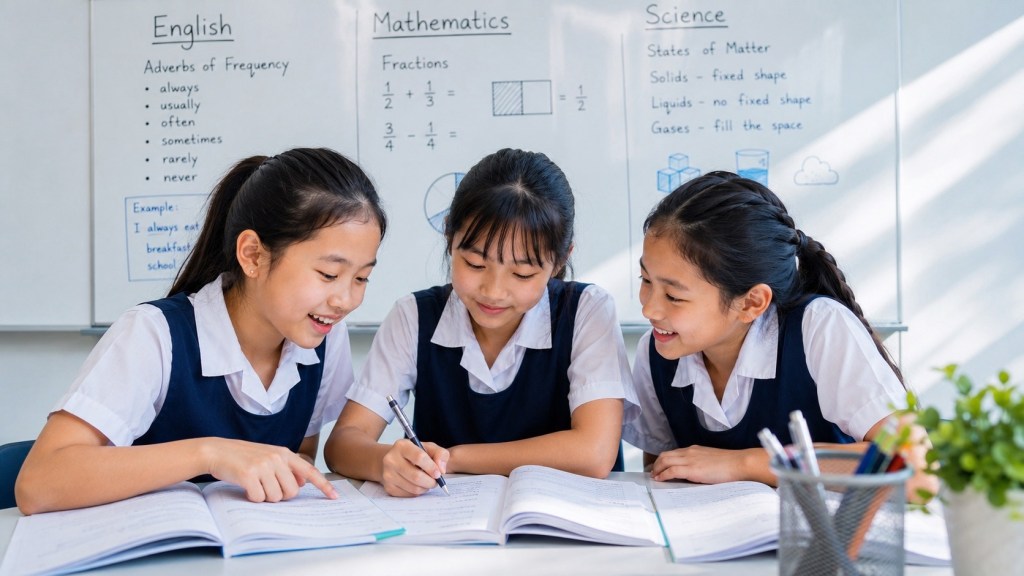
Palm View Primary School is best read as a whole-child learning environment, not simply a school name attached to a neighbourhood. The school’s public vision—“Curious Minds, Caring Hearts, Creative Spirits”—already signals that academic learning sits alongside character, creativity, communication and 21st-century capability. Home and tuition should add value without shrinking that broader learning system into worksheet volume.
For families searching for a Palm View Primary School parent guide, Palm View Primary tuition, tuition near Buangkok, or how to support a child from Palm View Primary School, this page is a learning route rather than a ranking or admissions forecast. Official school facts remain with Palm View Primary School and MOE; eduKate Sengkang owns the learner-state and next-action layer.
Palm View Primary School is at 150 Compassvale Bow, Singapore 544822. The school lists Buangkok as the nearest MRT station, with Renjong and Ranggung LRT stations also nearby. Current school information should always be verified directly at Palm View Primary School.
Buangkok changes the local route
For families on the south-east side of Sengkang, Buangkok may be a more practical transport anchor than Sengkang Central. Tuition should therefore be compared by school-to-home-to-lesson time rather than by the broad label “Sengkang”.
Official transport reference: Palm View Primary School — Contact Us.
Palm View’s whole-child language matters
The school’s public values include Respect, Responsibility, Resilience, Integrity, Care and Harmony, while its mission emphasises developing the whole child to be a force for good. Parents can reinforce this by treating grades as evidence rather than identity and by giving the child increasing responsibility for learning.
Official context: Vision, Mission & Core Values.
Primary 1–2: build foundations and curiosity together
- Read rich texts and talk about them.
- Build number sense through concrete and visual relationships.
- Use play, making and exploration without turning every experience into a test.
- Attempt first and ask for help precisely.
- Keep routines simple enough for the child to own.
Mathematics: concrete to pictorial to abstract
Palm View publicly describes a Concrete–Pictorial–Abstract approach and a problem-solving focus. At home, that means parents should not rush the child from objects and diagrams into symbolic shortcuts before the relationship is understood.
Official context: Palm View Primary School — Mathematics.
English: rich texts and communication first
The school’s public English programme includes STELLAR, vocabulary and grammar instruction, storytelling, speaking and creative expression. Home support should keep language communicative: reading, retelling, discussion and writing—not only editing exercises.
Official context: Palm View Primary School — English Language.
Science: curiosity must become evidence-based explanation
Palm View’s Science programme publicly emphasises inquiry, hands-on investigation and real-world connections. Parents can reinforce this by asking what the child observed, what evidence supports the claim and how the mechanism works.
Official context: Palm View Primary School — Science.
Maker learning should not become another enrichment race
Palm View’s Applied Learning Programme integrates making, design thinking, digital tools and cross-disciplinary work. That is useful because it asks students to apply knowledge in new forms. External enrichment should therefore be added only when it extends a genuine interest or capability—not because every maker experience must be followed by another paid programme.
Official context: Palm View Primary School — Applied Learning Programme.
Primary 3–4: watch the move from activity to understanding
Hands-on learning is valuable only if the child can explain what the activity showed. At this stage, ask the learner to connect experience to concept, evidence and method.
Primary 5: protect transfer and workload
Upper-primary demands can tempt families to replace curiosity with constant exam practice. If marks fall, diagnose first. If the week becomes overloaded, use How Much Tuition Is Too Much?.
Primary 6: integrate breadth with PSLE control
The final year needs timing, checking and paper strategy, but it should not erase the broader learner. Use PSLE Learning Guide, Examination Craft and I Am Brave: The Primary 6 Year.
The parent evidence loop
- Read the child’s actual schoolwork.
- Find the first repeated weak link.
- Classify the learner state.
- Choose the smallest effective repair.
- Retest on fresh work.
- Return ownership as capability improves.
When tuition fits
- A recurring weak link needs focused repair.
- The learner needs closer observation and feedback.
- School learning is not transferring independently.
- PSLE execution has become the main bottleneck.
When tuition may narrow rather than help
- The learner is already stable and curious.
- The week has no room for independent exploration or recovery.
- The new programme simply duplicates school content.
- Enrichment is being added because of comparison rather than a real learning need.
What this guide does not do
This page is independent of Palm View Primary School. It does not rank the school, predict registration outcomes or represent the school’s internal views. Official facts remain with Palm View Primary School and MOE; eduKate Sengkang owns the locality, learner-state and parent next-action layer.
Where this page sits in Atlas V2.0
This is a Buangkok/Compassvale school-coordinate owner in the Sengkang locality layer of Learning Atlas V2.0. It connects Palm View families to subject hubs, Parent Guide, maker-learning judgement, tuition fit and PSLE preparation.
Last updated: 26 September 2026.
