
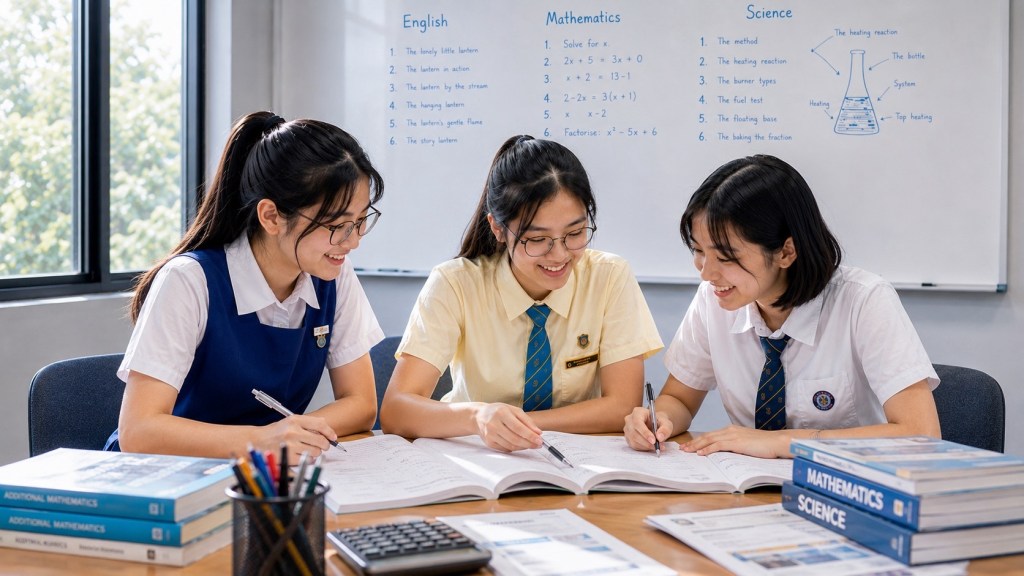
A child who was fine in Primary school and starts failing in Secondary 1 has not necessarily “suddenly become weak”. Secondary 1 changes the operating environment: more subjects, more teachers, more independent organisation, greater abstraction, denser language, new assessment patterns and less repetition of the exact routines that worked in Primary school.
For parents asking why my child was fine in Primary school but is failing Sec 1, why Secondary 1 marks dropped, or why the transition after PSLE feels so difficult, the useful first question is not “Which subject needs more tuition?” It is “What changed in the learning system, and which new demand is the child not yet carrying independently?”
At eduKate Sengkang, the Primary-to-Secondary transition is diagnosed across foundation, abstraction, workload, independence and examination execution. A learner can be strong in one layer and failing in another. The solution should target the first weak link, not simply add hours.
Before choosing the repair: locate the learner state
The visible symptom is only the entrance. Ask what this capability can currently survive: Blocked — the learner cannot reliably start or choose a method; Fragile — it works today but does not reliably return; Stable — it holds on familiar work; Transfer-ready — it survives changed wording, representation or context; Examination-ready — it survives time pressure, mixed questions and paper-level interference.
These are states of a capability, not labels for the child. Use the Learning Atlas V2.0 to move from symptom → state → first weak link → action → evidence → retest.
What changes in Secondary 1
| Transition | Primary school may allow | Secondary 1 increasingly requires |
|---|---|---|
| Organisation | One class teacher coordinates much of the day. | Multiple subjects, deadlines and teachers. |
| Mathematics | Concrete and model-supported reasoning. | More symbolic algebra and abstraction. |
| English | Shorter, more scaffolded language tasks. | Longer texts, argument, inference and independent writing. |
| Science | Concepts learned in familiar themes. | Models, variables, data and discipline-specific explanation. |
| Study system | Parent/tutor may coordinate work. | Learner tracks tasks, materials and revision. |
| Assessment | Topic familiarity can carry performance. | More mixed application and independent selection. |
Do not treat Sec 1 as Primary 7
The transition is not merely another year of more content. The form of learning changes. Algebra introduces symbolic compression. English increasingly requires interpretation and argument. Science moves toward models, variables and evidence. The learner also has to manage a larger school system.
A student can therefore have enough raw ability and still lose marks because the old learning routine no longer fits the new environment.
The five-transition audit
- Foundation: are P6 prerequisites still retrievable?
- Abstraction: can the learner move from concrete examples to symbols, models and general rules?
- Language: can the learner parse longer instructions, explanations and subject vocabulary?
- Organisation: are homework, materials and deadlines being managed independently?
- Assessment: can the learner perform when topics are mixed and support is reduced?
The first repeated failure across these five layers is more useful than the overall Sec 1 score.
Secondary 1 Mathematics
Mathematics often reveals the transition early because algebra changes the representation. A learner who was comfortable with arithmetic may be Blocked by variables, negative numbers or equations, or may know each technique but fail to select it inside mixed work.
Use the Mathematics estate for subject-specific repair. The Sengkang runtime should still ask whether the issue is a missing prerequisite, fragile retrieval, abstraction or examination execution.
Secondary 1 English
English becomes less forgiving of approximate comprehension and formulaic writing. A child may have strong everyday English but struggle with evidence, inference, editing, text structure or sustained written control. Route deeper language work through the English Learning Hub and specialist English owners when needed.
Secondary 1 Science
Science increasingly demands model-based explanation, data reading, variables and more explicit causal reasoning. A learner may remember Primary Science facts but struggle to reorganise them into a more formal Secondary Science framework. Use the Science Hub when the knowledge itself needs repair.
Organisation can look like academic weakness
A child who forgets homework, loses worksheets, studies the wrong chapter or starts revision too late can produce low marks without a deep subject deficit. This is still a learning problem, but the repair is an operating system: capture tasks, plan work, check completion and review before assessment.
Do not solve an organisation failure solely by adding another subject lesson.
The Sec 1 independence gap
Primary-school success can be supported by parents who remind, pack, check and schedule. Secondary 1 often exposes whether the learner can carry those functions themselves. The transition should gradually move control to the student rather than recreating a larger adult-managed system around them.
A 30-day Sec 1 repair
- Week 1: collect assessments and classify lost marks by cause, not just subject.
- Week 2: repair the strongest prerequisite or abstraction gap.
- Week 3: install one organisation routine: capture, plan, execute, review.
- Week 4: use fresh mixed work and a timed section to test whether learning now survives Secondary conditions.
What parents should not do
- Do not add tuition in every subject at once.
- Do not call the child lazy before checking organisation and task-entry demands.
- Do not compare Sec 1 scores directly with Primary percentages as if the assessments are identical.
- Do not keep managing every deadline indefinitely.
- Do not assume a strong PSLE result means every Secondary prerequisite is stable.
- Do not interpret one bad term as a permanent trajectory.
How to talk about the transition
- “Secondary school is asking you to carry more of the system yourself.”
- “Let’s find which part changed first.”
- “Which subject feels hard because of the content, and which feels hard because of organisation?”
- “What can you now do without reminders?”
- “Which old skill is being used inside this new topic?”
When this is a learner-state problem
| Pattern | Route |
|---|---|
| Cannot begin new Secondary tasks | Blocked |
| Can do it after recent teaching but forgets rapidly | Fragile |
| Fine on familiar exercises, weak on mixed application | Stable |
| Can adapt to new tasks but not under test conditions | Examination-ready |
When to seek broader school support
If difficulties span many subjects and routines, compare observations with school teachers rather than treating each low mark in isolation. A broad transition problem may need coordinated changes in workload, organisation and learning routines. Where substantial distress or other concerns persist, seek appropriately qualified support.
Frequently asked questions
Is Sec 1 supposed to be a big jump?
The transition introduces new organisational and academic demands, but the degree of difficulty varies by learner and subject. Use actual evidence to locate the mismatch.
Should tuition teach ahead in Sec 1?
Only if current foundations and school learning are stable. Teaching ahead does not repair an unstable prerequisite or organisation system.
Should parents still check homework?
Parents can monitor the system, but the direction should be toward the learner capturing, planning and checking more of the work independently.
Where this page sits in Atlas V2.0
This is the Sec 1 transition symptom owner under When Learning Slips. It routes into the Secondary Tuition Sengkang spine, English, Mathematics, Science and the learner-state system according to the actual weak link. Use Learning Atlas V2.0 for the full map.
Last updated: 26 September 2026.
See the runtime in a learner story: Alicia’s First Secondary 1 Report
If this symptom looks familiar, continue with Alicia’s First Secondary 1 Report. The story shows how the first Secondary 1 result can mix transition load, organisation and genuine subject gaps.
Use the story for the lived sequence; return to this page and the Learning Atlas V2.0 for diagnosis and routing.
Technical owner | where this symptom goes next
This is a Secondary 1 transition problem until the evidence isolates a subject-specific cause. Use the Learning Runtime Hub for organisation, workload and independence; then route into English, Mathematics or Science only where the failure pattern actually sits. Alicia’s story remains the learner-facing worked case.
\nComplete the learning loop: separate transition load from subject weakness, choose one first weak link, and retest it under the actual Secondary 1 conditions that exposed the problem. Use Alicia’s First Secondary 1 Report as the worked case, Learning Practice & Review for the next attempt, and Learning Has Held before assuming the transition has stabilised.
Return to the Learning Atlas V2.0 whenever the evidence changes the state or the first weak link.
Symptom return routes | Atlas V2.0
- Start Here — return to the symptom library if this is not the only thing happening.
- Learning Runtime — classify whether the capability is Blocked, Fragile, Stable, Transfer-Ready or Examination-Ready.
- Parents’ Guide — decide what the family should start, change, reduce or stop.
- The Tutor System — use when a tutor needs to act on the diagnosed weak link.
- Mathematics Hub — return to the Sengkang Mathematics route when the weak link is mathematical.
- English Hub — return to the Sengkang English route when the weak link is language, reading or writing.
- Science Hub — return to the Sengkang Science route when the weak link is scientific reasoning or explanation.
- Learning Atlas V2.0 — return to the whole route map and retest the learner after the intervention.
