
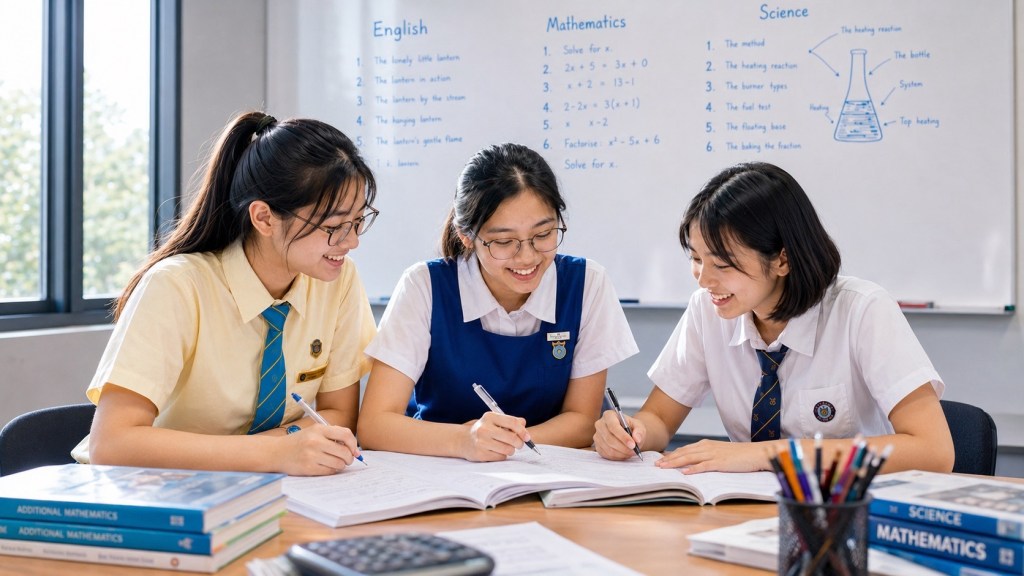
When a child says “my algebra suddenly collapsed in Secondary 2”, the collapse is rarely sudden. Secondary 2 often exposes whether the symbolic foundations from Secondary 1 became durable enough to carry factorisation, graphs, equations, formula manipulation and more complex problem solving. A learner can survive earlier algebra by following local patterns, then struggle when those patterns must be combined.
For parents asking why my child is weak in Sec 2 algebra, why algebra marks fell in Secondary 2, or why Maths was fine before but equations and graphs now seem impossible, the most useful question is not “Which chapter is difficult?” It is “Which algebraic dependency stopped carrying the next one?”
At eduKate Sengkang, Secondary 2 algebra is treated as a dependency system. We inspect number sense → signed numbers → symbolic meaning → equivalence → expansion → factorisation → equations → graphs → transfer. The visible failure may sit at the end of that chain while the repair belongs much earlier.
Before choosing the repair: locate the learner state
The visible symptom is only the entrance. Ask what this capability can currently survive: Blocked — the learner cannot reliably start or choose a method; Fragile — it works today but does not reliably return; Stable — it holds on familiar work; Transfer-ready — it survives changed wording, representation or context; Examination-ready — it survives time pressure, mixed questions and paper-level interference.
These are states of a capability, not labels for the child. Use the Learning Atlas V2.0 to move from symptom → state → first weak link → action → evidence → retest.
Quick answer: diagnose the chain, not the chapter
| Observed problem | Possible earlier weak link | First test |
|---|---|---|
| Sign errors everywhere | Negative-number control | Can the learner explain and execute signed-number operations cold? |
| Expansion/factorisation unstable | Distributive structure | Can they reverse expansion and factorisation reliably? |
| Equations collapse | Equivalence | Do they understand that both sides must remain equal? |
| Graphs feel disconnected | Coordinate and function meaning | Can they connect equation, table and graph? |
| Formula substitution fails | Variable roles / rearrangement | Can they identify what each symbol represents before substituting? |
This is why restarting the whole Secondary 2 syllabus is usually too broad. Find the first dependency that repeatedly fails, repair it, then re-enter current work.
The signs are not just careless
A negative sign can look like a tiny execution slip, but repeated sign errors often reveal unstable structure. If a learner cannot keep track of operations on signed quantities, later algebra becomes noisy because every manipulation carries hidden risk. Repair sign control separately before expecting stable factorisation or equations.
Equivalence is the heart of equation solving
Some students learn equation solving as a sequence of moves: “move this over, change the sign”. That can work on familiar forms and fail badly when the equation changes. The more durable model is equivalence: an equation states that two expressions have the same value, and every legal transformation must preserve that equality.
Ask the learner to explain why an operation can be applied to both sides, not merely which symbol moves where. This turns equation solving from choreography into reasoning.
Expansion and factorisation must become reversible
Expansion and factorisation are inverse views of the same structure. Learners who memorise them as separate chapters often struggle when later A-Math and algebra require moving flexibly between forms. Use paired practice: expand, then factorise the result; factorise, then expand to verify.
Graphs: the point where algebra becomes visible
Secondary 2 graphs can expose whether symbols have meaning. A learner may manipulate equations but not see what gradient, intercept or coordinate relationships represent. Translate across table → equation → graph → verbal description so algebra stops being a disconnected string of symbols.
The repair ladder
- Check signed-number fluency.
- Check symbolic meaning: what does each variable represent?
- Check equivalence and legal transformations.
- Check expansion and factorisation as inverse operations.
- Check equation solving without “move and change sign” shortcuts.
- Translate between equations, tables and graphs.
- Use mixed questions so the chapter label no longer chooses the method.
When the problem is Fragile rather than missing
If the learner can do algebra immediately after revision but loses it a week later, use the Fragile Learner route. The issue is not lack of explanation. It is retrieval and stability.
When the problem is transfer
If routine algebra is strong but unfamiliar word problems or graph questions collapse, the learner may be Stable but not yet Transfer-ready. Change representation and context while preserving the same algebraic structure.
A two-week Secondary 2 algebra reset
- Days 1–2: diagnose signed numbers and basic symbolic control.
- Days 3–4: equivalence, expansion and factorisation repair.
- Days 5–6: equations and rearrangement.
- Day 7: mixed check with no chapter labels.
- Days 8–9: tables, equations and graphs.
- Days 10–11: word problems that require algebraic modelling.
- Days 12–13: timed mixed section.
- Day 14: fresh retest; compare repeated error families.
What parents should avoid
- Do not restart every chapter because marks fell.
- Do not call repeated sign errors “careless” without testing signed-number control.
- Do not teach equations only through transposition shortcuts.
- Do not let the child rely permanently on worked examples beside every question.
- Do not delay repair until Secondary 3, when algebra becomes an even heavier dependency.
Specialist Mathematics handoff
For deeper Secondary Mathematics diagnostics, use How to Catch Up in Maths and the wider BukitTimahTutor Mathematics estate. Sengkang keeps the parent-facing symptom and learner-state route.
Frequently asked questions
Is Sec 2 algebra harder than Sec 1?
It usually places more load on earlier symbolic foundations and adds new relationships. The exact difficulty varies, but weak Sec 1 algebra can become much more visible in Sec 2.
Should my child memorise more algebra rules?
Rules are useful when their meaning and conditions are understood. More memorisation will not repair weak equivalence or representation.
Can this be fixed before Sec 3?
Yes, if the first weak link is identified and repaired systematically. The priority is durable algebraic control, not rushing ahead.
Where this page sits in Atlas V2.0
This is a Secondary Mathematics symptom owner under When Learning Slips. It routes technical depth into the Mathematics estate and BukitTimahTutor while using the learner-state ladder to decide whether the issue is Blocked, Fragile, Stable or transfer-related. Use Learning Atlas V2.0 for the full map.
Last updated: 26 September 2026.
See the runtime in a learner story: Denise’s Secondary 2 Algebra
If this symptom looks familiar, continue with Denise’s Secondary 2 Algebra. The story shows how algebra can look like one chapter problem while the real weak link sits in signed numbers, equality, structure or method selection.
Use the story for the lived sequence; return to this page and the Learning Atlas V2.0 for diagnosis and routing.
Technical owner | where this symptom goes next
This is a Secondary Mathematics dependency problem. Use the Secondary Mathematics S1–S4 Capability Map for the local route, with BukitTimahTutor for deeper Mathematics repair. Denise’s story remains the learner-facing worked case.
Return to the Learning Atlas V2.0 whenever the evidence changes the state or the first weak link.
Symptom return routes | Atlas V2.0
- Start Here — return to the symptom library if this is not the only thing happening.
- Learning Runtime — classify whether the capability is Blocked, Fragile, Stable, Transfer-Ready or Examination-Ready.
- Parents’ Guide — decide what the family should start, change, reduce or stop.
- The Tutor System — use when a tutor needs to act on the diagnosed weak link.
- Mathematics Hub — return to the Sengkang Mathematics route.
- BukitTimahTutor — deeper specialist Mathematics depth when required.
- Learning Atlas V2.0 — return to the whole route map and retest the learner after the intervention.
