
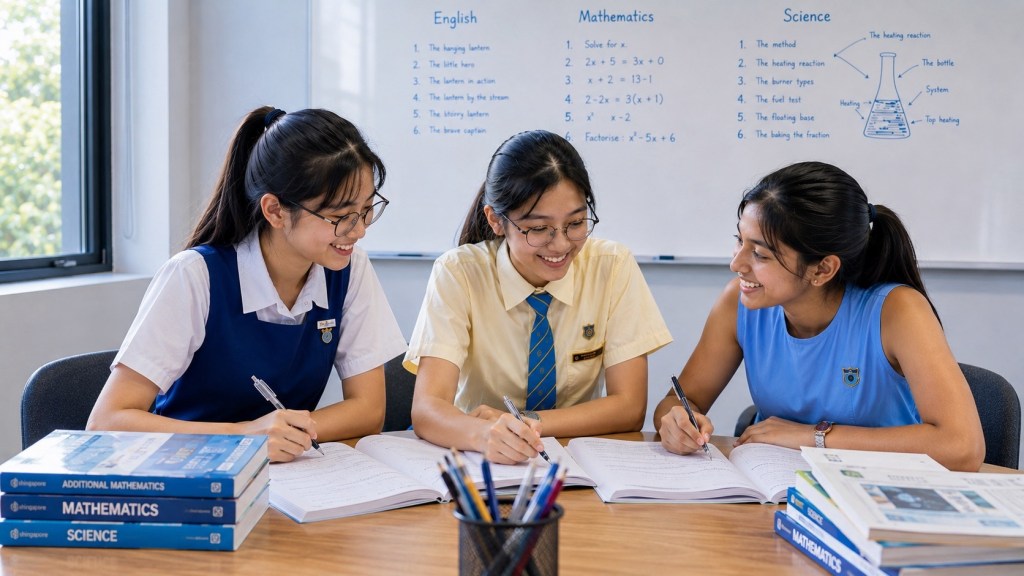
Denise is fast at algebra until the questions stop looking familiar. In Secondary 2, she can expand a bracket she recognises, substitute into a formula and imitate a worked factorisation. But when several moves are combined, signs flip, restrictions disappear and she starts choosing procedures from the appearance of the expression rather than its structure.
Her teacher’s comment says “revise algebra”. Denise hears “I am bad at algebra”. The Atlas asks for a more precise description. Algebra is not one skill. It is a language of relationships that depends on number sense, signed-number control, equivalence, operations, representation and method selection.
This story sits beside the Secondary Mathematics S1–S4 Capability Map, the guide to algebraic factorisation and structural control and the guide to algebraic fractions, restrictions and fractional equations.
The first weak link appears before factorisation
Denise’s corrections initially point to factorisation because that is where the largest marks were lost. But a diagnostic set shows that she also makes sign errors when simplifying expressions and solving equations. The factorisation chapter is not the earliest unstable component. Signed operations and equality transformations are.
This changes the plan. If she repeats only factorisation questions, she may memorise more surface patterns while the same earlier instability continues to corrupt later steps.
Equality is something she must preserve
Denise has learned equation solving as a set of moves: “take it over, change the sign.” That shorthand works until the equation becomes unfamiliar. So the language changes. She now explains each step as an operation applied to both sides, preserving equality.
At first this feels slower. That is acceptable. The goal is not immediate speed; it is a representation that remains valid when the surface changes. Once the structure becomes stable, shorthand can return without becoming magic.
Expansion and factorisation become inverse ideas
Instead of treating expansion and factorisation as unrelated chapters, Denise places them side by side. Expansion distributes multiplication across a sum; factorisation reconstructs a product structure. She checks one with the other. A factorisation can be expanded to verify that it returns the original expression.
Verification turns algebra from a one-way performance into a system with feedback.
Algebraic fractions expose whether the structure really held
When algebraic fractions arrive, Denise’s old habit of cancelling anything that looks repeated becomes dangerous. She has to distinguish factors from terms. She has to notice restrictions on values. She has to factor before cancellation when the expression requires it.
The same repair therefore travels upward: see structure before procedure. If a numerator is a sum, it is not one factor. If a denominator can be zero for a value, that restriction matters even after simplification.
Practice becomes mixed on purpose
Denise used to prefer a page containing twenty versions of the same method. Her accuracy rose quickly, but the worksheet was doing the method-selection work for her. Now a practice set mixes expansion, factorisation, equations, substitution and algebraic fractions. No heading tells her what tool is expected.
The first mixed set feels worse. That is useful evidence. The difficulty has moved from performing a known procedure to selecting a procedure. This is closer to examination and later Mathematics.
The error log records causes, not just questions
Instead of copying whole corrections, Denise tags the cause: sign control, lost equality, did not factor first, cancelled terms instead of factors, forgot restriction, method selection. Over several weeks, the distribution changes. Sign errors fall. Method-selection errors remain. The next practice set therefore changes too.
This is how learning from mistakes becomes adaptive rather than ceremonial.
Transfer begins when algebra appears inside something else
The strongest test arrives in graph work and word problems. Algebra is no longer the title. Denise has to form an expression, rearrange a relationship, interpret a variable and maintain the structure while solving a larger problem.
When she can do that, the capability is no longer merely stable on algebra worksheets. It is beginning to transfer.
The Secondary 2 bridge
Secondary 2 matters because many upper-Secondary Mathematics routes assume algebraic control. Weakness here can later make graphs, coordinate geometry, trigonometry and Additional Mathematics appear more mysterious than they are. Repairing the dependency now gives future topics a stronger floor.
That does not mean Denise must become perfect before moving on. It means future work should not repeatedly fail for the same earlier reason.
Denise’s algebra checklist changes
- What structure is here? Sum, product, quotient, equation, identity or formula?
- What must remain true? Preserve equality and valid restrictions.
- Am I operating on terms or factors? The distinction controls what can be cancelled or factored.
- Can I verify the result? Expand a factorisation, substitute a value or compare both sides.
- Did I choose the method? Or did the worksheet heading choose it for me?
- Will the skill survive inside another topic? That is the transfer test.
The learner becomes more independent as the notation becomes harder
Denise’s progress is not measured by how quickly her tutor can get her through a worksheet. It is measured by how often she can identify the structure, choose the next move, notice an invalid step and recover without rescue.
Use How We Know Learning Has Really Held to test whether the repair survives delay and changed conditions. Use Learning Atlas V2.0 if a new symptom appears. The aim is not a student who never makes an algebra error. It is a student whose errors are increasingly visible to herself.
Parent symptom route: My Child’s Algebra Collapsed in Sec 2
If you arrived because this is happening at home, use My Child’s Algebra Collapsed in Sec 2 when the parent sees falling algebra performance before knowing which structural dependency has failed.
This story is the worked learner case; the symptom page is the parent-facing diagnostic entrance.
