
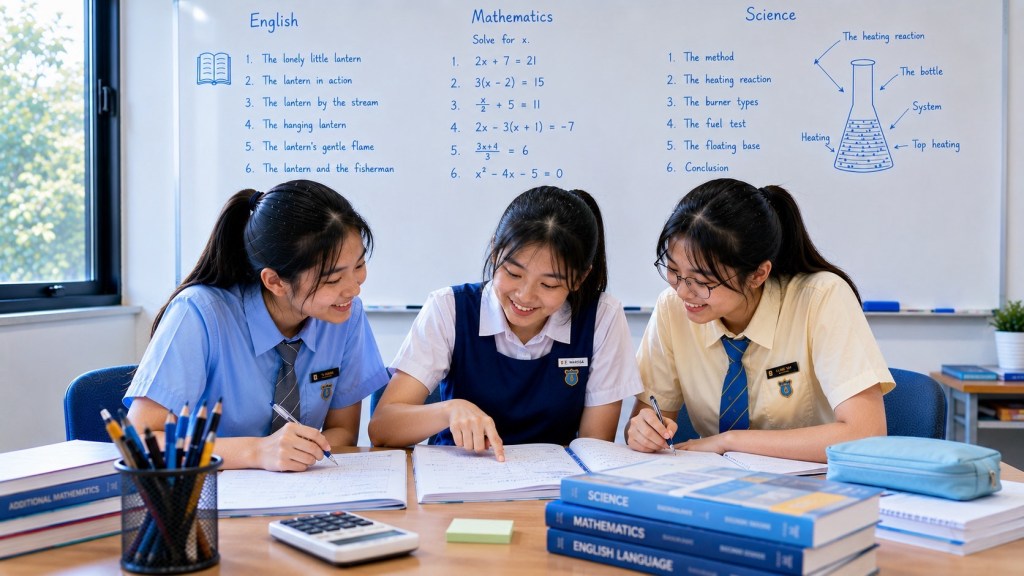
Secondary 3 Mathematics Sengkang | The Voyage of Water
The Voyage Series by eduKate Sengkang
A reservoir contains water.
We could ask:
How much water is there?
Or:
How quickly is the water level changing?
Or:
When will one inflow equal another outflow?
Or:
What equation represents the system?
Or:
What does the graph tell us?
Or:
What tank dimensions satisfy a required capacity?
Or:
Which model best fits the measurements?
Same Water.
Different mathematical problems.
At Secondary 1, we crossed from specific numbers into abstraction.
At Secondary 2, several relationships began operating together as systems of constraints.
Secondary 3 introduces another major change.
The mathematical field now contains routes.
The question is no longer only:
Can I solve this?
It increasingly becomes:
Which mathematical route should I use, why does it fit, and what does that route reveal that another representation might hide?
And in Singapore’s current secondary structure, there is another kind of routing too.
Mathematics is offered at G1, G2 and G3 subject levels, while Additional Mathematics is separately listed at G2 and G3. For the 2027 SEC, SEAB lists Mathematics as G1 K110, G2 K210 and G3 K310, with Additional Mathematics as G2 K232 and G3 K341.
That does not mean:
G1 → G2 → G3 → A-Math
is one compulsory ladder.
It means the mathematical system itself now branches.
So does our Voyage.
Quick Read
Secondary 3 Mathematics is the route-selection stage: the learner must recognise the underlying structure, choose an admissible mathematical route, preserve the conditions that make it valid, and verify the result.
The Mathematical Field Now Has Routes
Secondary 1 built abstraction. Secondary 2 made several relationships operate together as systems. Secondary 3 adds another demand: several mathematically valid paths may now exist, and the learner has to decide which one fits the actual structure of the problem.
A useful route kernel is:
recognise structure → map possible routes → check conditions → choose → execute → verify → switch if the system changes
This is why chapter-by-chapter success can hide a weakness. A worksheet titled “Linear Equations” has already told the learner which door to open. A mixed or unfamiliar problem removes that clue.
For parents, “my child knows the formulas but does not know when to use them” often points to a recognition or route-selection problem rather than a simple lack of practice.
Across G1, G2 and G3, the Voyage remains one rich mathematical field with the technique set, abstraction, independence and route-selection demand calibrated to the learner’s actual subject level. Additional Mathematics remains a separate specialised branch rather than a prestige rung above Mathematics.
Begin With One Water Problem
Suppose a tank initially contains:
40\text{ litres}
Water enters at:
6\text{ litres per minute}
How much water is inside after 8 minutes?
One route:
6\times8=48
Then:
40+48=88
Answer:
88\text{ litres}
Perfectly good.
But we could also write:
W=40+6t
Then substitute:
t=8
So:
W=40+6(8)=88
Same answer.
Different route.
Why Use Algebra When Arithmetic Works?
For this one question, perhaps arithmetic is simpler.
But now ask:
How much after 3 minutes?
After 20 minutes?
When will there be 100 litres?
What happens if the initial amount changes?
What happens if the rate changes?
Suddenly:
W=40+6t
becomes much more useful.
The cost of constructing the general model pays off because the route can be reused.
This is one of the major Secondary mathematical judgements:
Do I need one answer, or do I need the structure that generates many answers?
Route Selection Depends on the Job
Suppose we need:
One numerical state
Arithmetic may be enough.
Many possible states
An equation may be more useful.
Change through time
A graph may reveal the pattern.
Exact point where two systems meet
Algebra may be efficient.
Shape and capacity
Geometry may dominate.
Measurements with variation
Statistics may become more useful.
The strongest method is not universally the most sophisticated-looking method.
It is the method that fits the problem.
Mathematics Is a Toolbox — But Tools Have Jobs
Imagine trying to tighten a screw with a hammer.
The hammer is powerful.
It is still the wrong tool.
The same applies in Mathematics.
A learner may know:
- algebra,
- graphs,
- geometry,
- statistics,
- numerical methods,
but still fail if they cannot identify what kind of relationship the question contains.
Knowledge of tools and selection of tools are separate capabilities.
The Question Before the Calculation
A useful Sec 3 habit is:
What kind of mathematical object am I looking at?
Is this primarily:
- a changing quantity?
- a comparison?
- a geometric constraint?
- a repeated pattern?
- a data problem?
- an equation?
- several interacting equations?
- an optimisation-type choice?
- a representation conversion?
Classification is not the final answer.
It tells us which corridors may be worth opening.
Do Not Choose a Method From a Keyword Alone
Suppose a problem contains the word:
rate.
That does not automatically mean one memorised formula solves everything.
Perhaps rate appears inside:
a graph,
a geometric volume problem,
a simultaneous system,
or a multistep real-world model.
Likewise:
percentage
does not always mean:
multiply by percentage immediately.
Sec 3 problems increasingly hide familiar mathematics inside unfamiliar surface forms.
So:
structure outranks keyword.
Same Water, Different Surface
Consider these three questions.
Question A
A tank contains 30 litres and gains 4 litres each minute. Find the amount after 7 minutes.
Question B
W=30+4t
Find W when t=7.
Question C
A graph begins at 30 and rises by 4 units for each unit of time. Find its value at t=7.
The surface changes.
The underlying relationship does not.
A learner with transfer can recognise the common structure.
Transfer Means Seeing Through the Costume
A weaker learner may think:
I know Question A.
I have never seen Question C.
But the mathematical machine is the same.
INITIAL VALUE+CONSTANT CHANGE × TIME=CURRENT VALUE
This is why Sec 3 Mathematics cannot be built only from repeated familiar worksheet forms.
The student needs to recognise the machine after the costume changes.
Now Reverse the Route
Suppose:
W=30+4t
and:
W=70
Find t.
Then:
70=30+4t
40=4t
t=10
The model has not changed.
Our direction of travel changed.
Earlier:
t\rightarrow W
Now:
W\rightarrow t
A reusable mathematical relationship permits movement in more than one direction.
Sec 3 Begins to Demand Route Flexibility
A student who only remembers:
put numbers into formula
may succeed when the unknown sits where expected.
Then the unknown moves.
Suddenly performance collapses.
This is not necessarily because the Mathematics has become completely new.
The learner’s route has become too rigid.
A stronger mathematical system permits rotation.
Rotate the Unknown
Take:
W=a+rt
We can find:
W
if a,r,t are known.
But we can also find:
a
or:
r
or:
t
if enough of the other quantities are known.
Same relationship.
Different unknown.
This is a useful test of conceptual control.
Do Not Memorise Four Unrelated Formulas
A weaker approach could create:
Formula 1 for W.
Formula 2 for a.
Formula 3 for r.
Formula 4 for t.
But all of them come from:
W=a+rt
If the learner understands the relationship and algebraic transformation, one structure replaces several disconnected memories.
Good abstraction can reduce cognitive load.
One Route Can Be Longer but Safer
Imagine a multistep Water problem.
A student compresses everything into:
0.6(80\times40\times50)-12(8)+15000
Perhaps it is correct.
Perhaps not.
Another student writes:
- Find full tank volume.
- Find initial water volume.
- Find water removed.
- Find final amount.
- Convert units.
The second route is longer on paper.
It may be much easier to verify.
Mathematical efficiency is not simply:
fewest written lines.
It is:
lowest reliable cost for the required task.
Sec 3 Mathematics Is Route Engineering
Think about a difficult problem.
There may be several possible paths.
START │ ├── arithmetic route │ ├── algebra route │ ├── graph route │ ├── geometry route │ └── data route ↓ TARGET
Some routes may be impossible.
Some unnecessarily long.
Some reveal useful checks.
Some depend on knowledge the learner does not currently possess.
Part of mathematical expertise is navigation.
The Shortest Route May Depend on the Learner
An experienced student may see an algebraic shortcut immediately.
Another student may work more reliably using a table first.
If both routes are mathematically valid, the question becomes:
Which route is accurate, explainable and efficient enough for this learner under these conditions?
There is no educational virtue in forcing a fashionable method when another valid route produces better control.
But Route Choice Should Develop
That does not mean:
always use the easiest method forever.
As capability grows, the learner should acquire routes that:
- scale better,
- generalise further,
- reduce repeated work,
- reveal structure,
- and prepare for later Mathematics.
Sometimes a more abstract route is worth learning because it opens future territory.
This Is Where G1, G2 and G3 Matter
Under Full Subject-Based Banding, students have greater flexibility to offer subjects at different subject levels as they progress through secondary school; MOE states that the old Express, Normal (Academic) and Normal (Technical) streams were removed beginning with the 2024 Secondary 1 cohort.
So The Voyage should not say:
three kinds of child.
Instead:
three subject-level apertures through the mathematical field.
The central mathematical world can remain coherent.
What differs is the amount of:
- abstraction,
- symbolic load,
- independence,
- mathematical communication,
- interconnection,
- unfamiliarity,
- and route-selection demand
the learner is expected to carry.
One Water World Across G1, G2 and G3
Take the same underlying Water system:
A tank changes over time.
A more supported aperture might emphasise:
- reading quantities,
- choosing operations,
- interpreting units,
- constructing or reading a graph,
- applying a clearly established relationship.
A wider aperture may require increasingly independent work such as:
- defining variables,
- creating models,
- transforming algebraic forms,
- connecting several representations,
- combining multiple constraints,
- and justifying a chosen method.
Same Water.
Same respect.
Different load.
Difficulty Is Not Human Value
This distinction is important enough to state plainly.
A student taking Mathematics at a different subject level is not therefore:
less worthy,
less capable as a person,
or permanently fixed.
The current Full SBB architecture is explicitly designed to allow students greater flexibility in offering subjects at different levels as they progress.
The educational question is:
What mathematical aperture is productive now, and what capability should be built next?
Now Additional Mathematics Appears
At the 2027 SEC level, SEAB separately lists:
- G2 Mathematics — K210
- G2 Additional Mathematics — K232
- G3 Mathematics — K310
- G3 Additional Mathematics — K341.
This gives our architecture a very important rule.
Additional Mathematics is not simply:
Mathematics, but one level more intelligent.
It is a separate mathematical route.
That means our Voyage should represent it as a branch.
Do Not Draw This
G1 ↓G2 ↓G3 ↓A-MATH
That diagram falsely suggests one universal ladder.
Instead think:
                MATHEMATICS
              /      |      \
            G1      G2      G3
                     \       \
                      \       \
                    A-MATH   A-MATH
                  where offered /
                   appropriate
The exact learner route depends on the subjects taken.
SEAB’s current SEC listings themselves treat Mathematics and Additional Mathematics as distinct subjects.
Branching Is Not Failure
Imagine a transport network.
One route leads to:
engineering-related mathematical demands.
Another to:
business applications.
Another to:
technical practice.
Another to:
further academic Mathematics.
Different future tasks may require different mathematical tools.
A civilisation does not benefit from everybody carrying exactly the same toolkit at exactly the same resolution.
Education needs differentiation without humiliation.
The Shared Trunk Still Matters
Even when routes branch, some mathematical capabilities remain deeply useful:
- numerical sense,
- proportional reasoning,
- algebraic interpretation,
- representation,
- logical consistency,
- graphical understanding,
- estimation,
- checking,
- modelling,
- communication.
The branch does not erase the trunk.
The branch builds from it.
A-Math Should Not Destroy E-Math Foundations
A student can become fascinated by more specialised Mathematics and still make errors in:
fractions,
signs,
basic algebra,
or interpretation.
The more powerful the later machinery becomes, the more expensive weak foundations can become.
A tiny algebraic mistake can propagate through many lines of correct-looking work.
So route expansion increases the value of foundation stability.
Powerful Tools Amplify Both Strength and Error
Imagine a long solution.
Step 1 contains a sign error.
Every later transformation is executed perfectly.
The final answer remains wrong.
The later tools did not repair the early corruption.
They amplified it.
This gives Sec 3 a useful principle:
As mathematical machinery becomes stronger, early-state accuracy matters more, not less.
Checkpoints Prevent Error Propagation
Instead of solving twelve lines and checking only at the end, insert checkpoints.
Ask:
Does this sign make sense?
Are the units compatible?
Does this graph direction fit the equation?
Does this value violate a boundary?
Should the result be increasing or decreasing?
Is the magnitude reasonable?
These are cheap local checks.
They can prevent expensive downstream failure.
Route Choice Includes Check Choice
Different routes permit different checks.
Algebra route
Substitute back.
Graph route
Check whether the point lies on the expected curve or line.
Geometry route
Check dimensions and constraints.
Data route
Check whether interpretation matches the data.
Real-world model
Check units and physical plausibility.
So a strong solver asks:
How will I know if this route has gone wrong?
before reaching the end.
Build Redundancy Into the Solution
Suppose two tanks exchange water.
We calculate:
Tank A = 45 L.
Tank B = 55 L.
If total water should remain:
100 L,
then:
45+55=100
Good.
Now suppose the calculations gave:
45 and 58.
The invariant catches the failure.
A second checking route increases reliability.
One Model, Several Representations
Take:
W=30+4t
We can represent it as:
Equation
W=30+4t
Table
| t | W |
|---|---|
| 0 | 30 |
| 5 | 50 |
| 10 | 70 |
Graph
A straight increasing relationship under the assumed constant-rate conditions.
Verbal statement
The system begins at 30 units and increases by 4 units for each time unit.
These are translations.
Each preserves some important structure.
Representation Choice Is an Information Decision
The equation makes the rule compact.
The table makes selected states explicit.
The graph makes the overall change visible.
The sentence makes the relationship communicable in ordinary language.
No representation is universally superior.
Ask:
What do I need to see next?
Changing Representation Can Unlock a Stuck Problem
Suppose the algebra feels opaque.
Draw the graph.
Suppose the graph is difficult to interpret exactly.
Return to the equation.
Suppose the word problem is confusing.
Build a diagram or table.
This creates an important Sec 3 habit:
If one representation blocks you, rotate the problem.
Do not change the truth.
Change the view.
Rotation Must Preserve the Relationship
However, every conversion introduces risk.
Word problem:
Tank A contains 10 litres more than Tank B.
Correct:
A=B+10
If we draw a diagram showing B larger, the representation is wrong.
A beautiful diagram cannot save a mistranslation.
So after rotating:
check that the invariant relationship survived.
Mathematics Is Full of Preserved Structure
When we:
simplify an expression,
rearrange an equation,
change units,
convert a graph into an equation,
decompose a geometric shape,
we transform representation.
Something important must remain unchanged.
That “something” may be:
- value,
- equality,
- proportional relationship,
- total quantity,
- geometric property,
- solution set.
Good mathematical manipulation preserves invariants.
A Route Is Valid Only If It Preserves What Must Survive
Imagine:
2(x+3)
becoming:
2x+3
The route is shorter.
It is wrong.
The distributive structure was not preserved.
Correct:
2x+6
So mathematical transformation is constrained movement.
Not every legal-looking symbol move is allowed.
Constraints Protect the Mathematical World
This is why Mathematics can feel unforgiving.
You cannot simply decide:
\frac{a+b}{a}=b
because it would be convenient.
The operation has rules.
Those rules preserve the coherence of the system.
Freedom in Mathematics exists inside constraint.
And that is precisely what makes the result transferable.
A More Complicated Water Problem
Imagine two tanks.
Tank A begins with:
100 litres.
Tank B begins with:
40 litres.
Water transfers from A to B at:
5 litres per minute.
Then:
A=100-5t
B=40+5t
When are they equal?
100-5t=40+5t
Therefore:
60=10t
t=6
At that moment:
A=B=70
Now ask a different question:
What stayed constant?
Total:
A+B=140
The local states changed.
The global total did not.
Several Routes Reach the Same Result
We could solve equality algebraically.
Or inspect two graphs.
Or construct a table.
Or use the total invariant:
If both tanks become equal while total water is 140 L, each must contain:
70 L.
Then ask:
When does A fall from 100 to 70?
30 litres must transfer.
At 5 litres per minute:
6 minutes.
Different route.
Same answer.
Which Route Is Best?
The invariant route may be elegant here.
But suppose transfer rates differ or leakage appears.
Then the route may change.
This is exactly the point.
A method is not “best” because it worked beautifully yesterday.
It is best when it matches today’s structure.
Elegant Methods Are Often Structure-Sensitive
The cleverest-looking shortcut often relies on recognising a particular property.
If that property disappears, the shortcut disappears.
Students should therefore learn:
Why does this shortcut work here?
not merely:
This chapter uses this shortcut.
Then the route remains attached to its conditions.
Ask What Makes the Shortcut Legal
Suppose:
total is conserved.
That allows one route.
Now add leakage.
Total is not conserved.
The old shortcut may fail.
The Mathematics changed because the system changed.
That is genuine reasoning.
Route Choice Is Conditional
A mature mathematical statement often sounds like:
Because the total remains constant, I can…
or:
Since the relationship is linear under the given assumption, I can…
or:
Because these quantities are proportional, I can…
The justification explains why the route is admissible.
A Wrong Method Can Produce a Plausible Number
This is dangerous.
Suppose the correct answer is around 50.
A wrong method produces 48.
It looks reasonable.
Magnitude checking may not catch it.
That is why checking must sometimes return to the relationship itself.
Does 48 satisfy the original constraints?
If not, reject it.
Plausibility Is Necessary but Not Sufficient
A physically impossible result is easy to reject.
A physically plausible but mathematically wrong result is harder.
So we need layers of checking:
ARITHMETIC CHECK↓ALGEBRAIC CHECK↓CONSTRAINT CHECK↓UNIT CHECK↓CONTEXT CHECK
No single check catches every failure.
Sec 3 Mathematics Becomes More Adversarial
A learner should start attacking their own answer.
Ask:
What could make this wrong?
Did I reverse a relationship?
Did I use the wrong whole?
Did I assume constancy?
Did I ignore a boundary?
Did I use a formula outside its conditions?
Can I test the answer another way?
This is not pessimism.
It is quality control.
Try to Break the Model
Suppose:
W=20+5t
Ask:
What happens at t=1000?
If the model claims a small tank contains 5,020 litres, we have exposed a domain problem.
Extreme cases can reveal hidden assumptions.
This is a valuable mathematical test.
Boundary Testing Reveals Structure
Suppose a formula involves a denominator.
What happens if the denominator becomes zero?
Suppose a geometric length becomes negative.
Does that make sense?
Suppose a probability leaves the allowed range.
These boundary questions tell us where the representation ceases to describe admissible states.
Strong Mathematics includes knowing where not to use a tool.
Failure Can Be Informative
If a model stops working, ask why.
Perhaps:
- the assumption failed,
- the regime changed,
- the data require another model,
- the variable left the allowed domain,
- an ignored interaction became important.
A failed model does not necessarily mean modelling was useless.
It may reveal missing structure.
Models Are Designed, Not Discovered Whole
A real water system may contain:
rainfall,
evaporation,
inflow,
outflow,
leakage,
changing consumption,
capacity,
pump schedules.
We usually do not model everything at once.
We select.
This is a design choice.
The useful model includes enough structure for the question without becoming needlessly complicated.
Too Simple and Too Complex Are Both Failures
Too simple
The model ignores a major process and gives misleading results.
Too complex
The model contains so many variables that it becomes impossible or unnecessary to operate.
The art is choosing useful resolution.
This is mathematical judgement.
Start With the Smallest Useful Model
Suppose we need only a ten-minute prediction while the pump rate is known to remain constant.
Perhaps:
W=a+rt
is sufficient.
We do not need a giant simulation of Singapore’s entire water infrastructure.
Good modelling is purposeful reduction.
Expand Only When the Residual Matters
Suppose predictions repeatedly differ because outflow was ignored.
Now add outflow.
Suppose capacity becomes relevant.
Add capacity.
Model development can proceed:
SIMPLE MODEL↓TEST↓RESIDUAL / FAILURE↓ADD NECESSARY STRUCTURE↓TEST AGAIN
That is a powerful way to learn Mathematics.
The Model Earns Complexity
Complexity should appear because the problem requires it.
Not because complexity looks impressive.
This is true of algebraic manipulation too.
If a direct route works clearly, use it.
If generalisation provides value, build it.
Mathematics rewards the right structure, not ornamental difficulty.
Data Can Suggest the Route
Suppose measurements are:
| Time | Water |
|---|---|
| 0 | 20 |
| 1 | 25 |
| 2 | 30 |
| 3 | 35 |
A constant-change model seems reasonable for this constructed data.
But suppose:
| Time | Water |
|---|---|
| 0 | 20 |
| 1 | 25 |
| 2 | 35 |
| 3 | 50 |
Now the change itself is changing.
A simple constant-rate model may no longer fit.
The data can tell us that our current route is inadequate.
Do Not Force the Chapter Onto the Problem
Students sometimes learn a new method and begin seeing it everywhere.
We just learnt technique X, so this must use technique X.
But examinations deliberately mix signals.
Real problems do not announce chapter names.
The question is:
What does the structure require?
not:
What did the teacher teach yesterday?
Mixed Problems Reveal Real Ownership
If a student can solve:
“Linear Equations Exercise 4”
that shows local capability.
If the student can recognise a linear relationship inside an unfamiliar geometry or data problem, that demonstrates stronger transfer.
Sec 3 increasingly needs the second.
The Problem Can Hide Its Entry Point
Sometimes the hardest step is not the final calculation.
It is deciding where to begin.
A useful search process is:
WHAT DO I KNOW?↓WHAT DO I NEED?↓WHAT RELATIONSHIPS CONNECT THEM?↓WHICH ONE CAN I ACTIVATE FIRST?
The first move should reduce uncertainty.
Choose the Move That Opens the Board
Imagine a problem with six known quantities.
Five calculations are possible.
Only one produces a value needed downstream.
A student can perform correct but useless calculations.
So ask:
Which calculation creates access to the next necessary relationship?
This is route planning.
A Correct Move Can Still Be Strategically Poor
Suppose you accurately calculate a perimeter that the problem never needs.
The Mathematics is correct.
The route is inefficient.
This distinction becomes increasingly important in timed assessment.
Correctness operates at more than one scale:
Local correctness
This calculation is valid.
Global usefulness
This calculation advances the solution.
Strong solvers manage both.
Time Changes Route Value
Two methods may both work.
Method A takes nine steps.
Method B takes four.
Under unlimited time, either may be fine.
Under examination conditions, route cost matters.
But only if the shorter route remains reliable.
Speed without stability produces failure.
Exam Efficiency Is Controlled Compression
As skill increases, learners may compress familiar operations.
But compression should occur after structure is stable.
Too early:
steps disappear before understanding forms.
Too late:
every trivial operation consumes time.
Expertise gradually learns what can be safely compressed.
Never Compress the Dangerous Step
Some steps deserve to remain visible because they carry high error risk:
- sign changes,
- unit conversions,
- equation construction,
- critical substitutions,
- constraint changes.
Writing one extra line can save an entire solution.
Efficiency is selective.
The Sec 3 Repair Map
When a learner fails, identify the route failure.
Foundation failure
Number, fractions, signs or algebra are unstable.
Recognition failure
The learner cannot identify the underlying mathematical structure.
Translation failure
World → equation/diagram/graph is wrong.
Tool failure
The learner knows the structure but lacks the necessary method.
Route-selection failure
Several methods are known, but the wrong one is chosen.
Execution failure
The selected route is valid but calculations fail.
Constraint failure
A boundary or condition is ignored.
Transfer failure
Knowledge works only in familiar forms.
Verification failure
The learner never attacks the result.
Different failure.
Different repair.
“More Practice” Is Too Coarse
If the learner’s problem is translation, repeating algebra manipulation may not repair it.
If the problem is arithmetic accuracy, more modelling tasks may hide the foundation issue.
If the problem is route selection, chapter-by-chapter drills may actually make the weakness less visible because the chapter name gives away the method.
Diagnosis should precede volume.
Route Fluency Comes After Route Ownership
First:
understand one route.
Then:
execute reliably.
Then:
compare another route.
Then:
choose.
Then:
transfer.
Eventually:
switch when conditions change.
That is much stronger than memorising a collection of disconnected tricks.
G1, G2 and G3 Are Therefore Different Apertures, Not Different Worlds
For the Voyage Series, our Sec 3 collection should preserve one central principle:
The learner should understand why a mathematical route fits the problem they are solving.
At different subject levels, the set of available techniques, complexity and independence can differ.
But the intellectual act remains respectable at every aperture.
The learner is still:
- representing,
- selecting,
- operating,
- checking,
- and interpreting.
Additional Mathematics Creates Another Lens
When a learner also takes Additional Mathematics, the mathematical field gains another specialised toolkit.
That does not make ordinary Mathematics obsolete.
It creates another way of formalising certain classes of problems.
Think:
REAL WORLD ↓MATHEMATICAL QUESTION ↓AVAILABLE TOOLSETS ↙ ↓ ↘MATHS A-MATHS OTHERROUTE ROUTE VALID ROUTE
The job is not to use the most prestigious-looking path.
The job is to use an admissible path that solves the problem clearly and correctly.
More Powerful Tools Do Not Remove Judgement
A learner may possess an advanced technique.
But if a two-line elementary method solves the problem, using a much larger machine may increase error rather than reduce it.
Capability means having options.
Wisdom means choosing among them.
Mathematics Is Becoming a Decision Field
By Sec 3, a learner may repeatedly decide:
arithmetic or algebra?
equation or graph?
exact or approximate?
direct or indirect?
numerical or symbolic?
local calculation or global invariant?
general model or particular case?
The subject is no longer just about performing operations.
It increasingly contains operational judgement.
The Water Route Challenge
Consider this constructed system.
Tank A contains:
120 litres.
Tank B contains:
40 litres.
Water transfers from A to B at:
8 litres per minute.
At the same time, 2 litres per minute leak out of Tank B.
Then:
A=120-8t
B=40+8t-2t
so:
B=40+6t
When are the tank amounts equal?
Set:
120-8t=40+6t
Therefore:
80=14t
t=\frac{40}{7}
approximately:
5.71
minutes.
But now notice something.
The Old Invariant Has Broken
Without leakage:
total water would remain constant.
With leakage:
the combined amount decreases.
Total:
A+B
equals:
120-8t+40+6t
So:
A+B=160-2t
The system loses:
2 litres per minute.
The earlier Sec 2 invariant:
total remains fixed
is no longer valid.
The model changed.
Therefore the route must update.
Old Knowledge Is Useful Only When Its Conditions Survive
A learner who blindly uses:
total = 160
will fail.
The method was valid in the previous system.
Not this one.
This is a major Sec 3 lesson:
Do not transfer the procedure without transferring its assumptions.
Transfer requires both.
Mathematics Has Memory of Conditions
Every powerful rule comes with a hidden label:
valid when…
Expert learners gradually make those labels visible.
For example:
this invariant holds if no quantity enters or leaves the whole system.
this linear model holds while rate remains constant.
this formula applies to this geometric structure.
Knowing a tool includes knowing its boundary.
A Route Map Is Better Than a Trick List
Instead of memorising:
Trick 1
Trick 2
Trick 3
Trick 4
build a map:
PROBLEM TYPE↓STRUCTURE↓POSSIBLE ROUTES↓CONDITIONS↓COST / CLARITY↓CHOOSE↓VERIFY
This survives unfamiliarity much better.
Read Water Another Way
Secondary 3 Mathematics
Which mathematical route best represents and solves this system under its actual constraints?
Secondary 3 English
Which argumentative position best survives evidence, counterargument and consequences?
The parallel is striking.
English has:
several defensible positions.
Mathematics has:
several possible methods.
In both cases, the mature learner does not simply choose the first route available.
They inspect the field.
Then choose.
But Mathematics Has a Different Truth Constraint
In an English argument, several qualified positions can sometimes remain defensible.
In a well-defined mathematical problem, different valid routes should remain constrained by the same formal relationships.
Two correct methods should not produce incompatible exact answers to the same fully specified problem.
If they do, something needs checking.
That difference protects subject integrity.
The Two Lenses Meet
Someone writes:
The tank will be full very soon.
English asks:
What does “very soon” communicate to this audience?
Mathematics asks:
Given the model and capacity, when exactly does the boundary occur?
Suppose Mathematics gives:
12.4 minutes.
Now English may decide whether:
“very soon”
“in approximately twelve minutes”
or:
“before the next fifteen-minute interval”
is the most appropriate representation for the receiver.
Mathematics constrains the state.
English chooses how to communicate it.
Coming Home
Take a Mathematics problem you already know how to solve.
Now ask:
Is there another route?
Find one.
Then ask:
Which route is shorter?
Which is easier to explain?
Which exposes more structure?
Which is easier to check?
Under what condition would my preferred route fail?
Then change the problem slightly.
Does the route survive?
If it does, you have learned something about the method.
If it fails, you have learned something about its boundary.
Either way, the Mathematics got stronger.
That is Secondary 3.
Secondary 3 Mathematics at eduKate Sengkang
Secondary 3 marks an important upper-secondary transition because mathematical pathways and mathematical demands both become more differentiated.
Under Singapore’s current Full Subject-Based Banding structure, students have flexibility to offer subjects at different subject levels as they progress through secondary school. For the 2027 SEC, Mathematics is listed separately at G1 K110, G2 K210 and G3 K310.
SEAB also separately lists G2 Additional Mathematics K232 and G3 Additional Mathematics K341, confirming that Additional Mathematics is a separate subject route rather than simply another label for Mathematics at a higher G-level.
For teaching, that matters.
A student may be struggling because:
- foundational arithmetic is unstable,
- algebra has not automated,
- the student cannot translate from context to representation,
- several methods are known but method selection is weak,
- topic transfer collapses when surface form changes,
- an assumption is ignored,
- or the learner cannot verify a multi-step solution.
Those require different repairs.
At eduKate Sengkang, we therefore work towards:
conceptual depth + method selection + execution accuracy + transfer
with the teaching aperture calibrated to the student’s actual Mathematics route.
The goal is not to force every student through identical mathematical machinery.
It is to make the machinery they are learning increasingly usable, connected and reliable.
Families considering Secondary 3 Mathematics tuition in Sengkang can discuss the learner’s current G1, G2 or G3 Mathematics subject level, whether Additional Mathematics is part of their programme where relevant, their present mathematical foundations, and the most useful next repair or extension.
The Secondary 3 Mathematical Shift
The full progression can now be compressed:
P1 QUANTITY ↓P2 RELATIONSHIP ↓P3 REPRESENTATION ↓P4 HIDDEN STRUCTURE ↓P5 RELATIVE / CHANGING QUANTITY ↓P6 INTEGRATION ↓S1 ABSTRACTION ↓S2 SYSTEMS ↓S3 ROUTES
And Routes means more than G1/G2/G3.
It also means:
several legitimate mathematical tools may now exist inside the learner’s own subject field.
The learner has to know which door to open.
Continue the Voyage
Next Mathematics Voyage
Secondary 4 Mathematics Sengkang | The Voyage of Water
The mathematical column reaches its final Voyage.
The learner must increasingly integrate the tools available within their actual route, recognise unfamiliar structures, choose methods efficiently, verify under examination conditions and move between mathematical representation and real-world interpretation.
Secondary 4 becomes:
synthesis + transformation + execution under constraint.
Continue the English Voyage
Secondary 4 English Sengkang | The Voyage of Water
The entire English column recombines:
representation + interpretation + evidence + argument + evaluation + receiver + purposeful communication.
The learner must decide not only what is defensible, but how the final representation should be built for the task and audience.
The Voyage Series
One World. Many Voyages. Different Ways of Seeing.
Secondary 1 Mathematics built abstraction.
Secondary 2 connected relationships into systems.
Secondary 3 opens the route field.
The learner now owns more than procedures.
They are beginning to own choices among procedures.
And that may be one of the most important mathematical transitions of all.
Because the hardest unfamiliar problem rarely announces:
Use Method 7.
It simply presents a world.
The learner has to recognise the structure and choose a way through.
How eduKate Teaches This Voyage
We diagnose the route failure before increasing practice volume. The breakdown may be foundational arithmetic or algebra, recognition of the underlying structure, translation from context into equation, graph or diagram, possession of the required tool, route selection, execution, respect for constraints, transfer, verification or time control.
Teaching then uses mixed questions, small perturbations to familiar problems, comparison of alternative routes, error analysis and timed transfer. The aim is not merely to make one method fast. It is to make the learner capable of choosing, defending, checking and—when the conditions change—switching methods.
Why 3-Pax Helps Here
One learner can solve, another can challenge the route, and the third can verify the result. The challenger asks whether a shorter, safer or clearer route exists and whether the assumptions that make the chosen shortcut legal are actually present.
The verifier attacks the answer independently through substitution, an invariant, units, a graph, a boundary or the original context. That makes mathematical judgement visible rather than leaving route choice as a silent habit.
What Parents Can Watch For
- Your child performs well in chapter drills but drops sharply in mixed questions.
- Correct calculations are produced that do not advance the solution.
- Keywords trigger formulas before the structure is understood.
- Once a route fails, the learner keeps pushing it instead of changing representation or method.
- Assumptions, units, domains and physical constraints are rarely checked.
- Too much examination time is lost to long but familiar routes.
Frequently Asked Questions
Why can a student know many methods and still fail?
Because possessing a method and recognising when it applies are separate capabilities. Secondary 3 increasingly tests the second.
Is the shortest method always the best?
No. A useful route has the lowest reliable cost for the task. A slightly longer solution may be easier to explain, less error-prone or easier to verify.
Why are mixed questions important?
They remove the chapter label that normally gives away the method. The learner must recognise the structure before choosing a route.
What does good verification look like?
It may use substitution, an independent route, an invariant, units, domain and boundary checks, graph behaviour, magnitude or the original context. No single check catches every failure.
Are G1, G2 and G3 different mathematical worlds?
No. They are different subject-level apertures through one mathematical field, with technique set, abstraction, symbolic load, independence and unfamiliarity calibrated to the learner’s actual route.
Where does Additional Mathematics fit?
Additional Mathematics is a separate specialised branch where relevant. It should not be treated as a ranking of student worth or as the compulsory final rung of a G1-to-G3 ladder.
The Voyage Continues
Secondary 3 opens the route field. Secondary 4 has to recombine it: recognise unfamiliar structures, transform representations, choose efficiently, execute under time pressure and verify before the final answer leaves the mathematical world.
One World. Many Voyages. Different Ways of Seeing.
