
The Voyage Series by eduKate Sengkang
A reservoir contains water.
Its level is changing.
Rain enters.
Water is released.
Consumption varies.
Measurements arrive at intervals.
A graph describes part of the behaviour.
An equation describes another part.
A geometric model converts height into volume.
A percentage describes remaining capacity.
Perhaps two mathematical routes appear capable of reaching the same unknown.
And somewhere inside all of this is a question:
What should I do first?
At Secondary 1, Mathematics crossed from particular numbers into abstraction.
At Secondary 2, several mathematical relationships became systems of constraints.
At Secondary 3, the learner acquired a field of possible routes and had to decide which mathematical tool belonged where.
Secondary 4 is the recombination.
Now the task is:
Can I recognise the structure, select an efficient route, transform it without damaging it, solve accurately, verify independently, and return the answer to the world it came from?
That is the final Mathematics Voyage.
Quick Read
One-sentence answer: Secondary 4 Mathematics is the final recombination stage of the Voyage, where the learner must recognise structure, build a model, choose a route, transform accurately, solve, verify and interpret under constraints.
- The Voyage: the learner is no longer only following a presented route; they increasingly select among possible routes.
- The final kernel: recognise → model → choose → transform → solve → verify → interpret.
- The maturity shift: a correct calculation is not enough if the model, route or interpretation is wrong.
- The practical work: mixed problems, representation switching, route comparison, unit and constraint checks, transfer and timed execution must begin functioning together.
- The aperture: G1, G2 and G3 preserve mathematical dignity while topics, load, depth and scaffolding differ; Additional Mathematics remains a separate specialised branch where taken.
The Secondary 4 Mathematics Voyage in One Sentence
The traveller is no longer given a road through the problem; they must build the map, choose the road, know when to turn back, and verify that the destination belongs to the original world.
Why Parents Notice the Change at Secondary 4
A learner may succeed topic by topic and still struggle when several familiar mathematical ideas appear inside one unfamiliar problem. The final difficulty is often coordination: recognition, translation, representation, route choice, transformation, execution and checking have to work together.
This is why “careless error” can be an incomplete diagnosis. Sometimes the arithmetic is careless. In other cases, the visible mistake is downstream of a wrong model, an inefficient route, overloaded working memory or the absence of an independent check.
The final Mathematics Voyage is therefore about strategic independence under constraint. Speed matters, but not speed for its own sake. The learner needs to choose a route that is mathematically valid, operationally useful and robust enough to survive verification.
The Question No Longer Announces the Chapter
Consider this constructed problem.
A rectangular tank has a base area of:
2.4\text{ m}^2
It initially contains water to a depth of:
0.75\text{ m}
Water enters at a constant rate of:
0.06\text{ m}^3/\text{min}
while another outlet removes:
0.02\text{ m}^3/\text{min}
How long will it take for the water depth to reach:
1.25\text{ m}?
What chapter is this?
Geometry?
Volume?
Rate?
Algebra?
Equations?
It is all of them.
The problem does not care how the textbook was divided.
The learner has to reconstruct the mathematical machine.
Start With the State
Initial water volume:
2.4\times0.75
So:
1.8\text{ m}^3
Target volume:
2.4\times1.25
So:
3.0\text{ m}^3
Required increase:
3.0-1.8=1.2\text{ m}^3
Net rate:
0.06-0.02=0.04\text{ m}^3/\text{min}
Therefore:
t=\frac{1.2}{0.04}
t=30\text{ minutes}
Every individual step is familiar.
The Secondary 4 demand lies in seeing which familiar pieces need to be assembled, and in what order.
The Problem Was a Network
Its structure can be compressed as:
WATER DEPTH ↓BASE AREA × DEPTH ↓VOLUME ↓TARGET VOLUME − INITIAL VOLUME ↓REQUIRED CHANGE ↓INFLOW − OUTFLOW ↓NET RATE ↓CHANGE ÷ RATE ↓TIME
The visible question concerned time.
But time was inaccessible at the beginning.
The learner had to open several intermediate relationships before time became reachable.
This is what integrated Mathematics feels like.
The First Move Changes Everything
Suppose a learner begins by calculating:
0.06\times1.25
The arithmetic may be correct.
But what does the result mean?
Nothing useful for the problem.
This gives us a critical Secondary 4 distinction:
A mathematically valid calculation can still be strategically useless.
The first operation should not merely be something we can do.
It should expose a quantity that the solution path requires.
Ask What Is Locked
The problem asks for time.
What prevents us from finding time immediately?
We do not yet know the required volume change.
So find that.
What prevents us from finding the volume change?
We need the initial and target volumes.
So find those.
This gives us a powerful backwards planning method:
TARGET UNKNOWN↑WHAT DO I NEED TO KNOW FIRST?↑WHAT DOES THAT DEPEND ON?↑WHAT DO I ALREADY HAVE?
Sometimes the fastest way forward is to reason backwards from the final gate.
Forward and Backward Reasoning Meet
Forward reasoning asks:
What can I calculate from the information I have?
Backward reasoning asks:
What must I know to reach the answer?
Strong solving uses both.
If forward reasoning produces many possible calculations, backward reasoning can tell us which one is useful.
If backward reasoning reaches a quantity we cannot yet obtain, forward reasoning tells us what relationships are available.
The two directions meet somewhere in the middle.
Secondary 4 Is Search Through a Mathematical Field
At the beginning of a hard question, the learner may have several possible moves.
Some are dead ends.
Some open useful structure.
Some are possible but expensive.
Some create an elegant shortcut.
So the internal problem increasingly resembles:
CURRENT STATE ↓POSSIBLE MOVE APOSSIBLE MOVE BPOSSIBLE MOVE CPOSSIBLE MOVE D ↓WHICH ONE REDUCES THE PROBLEM?
The exam question is testing more than whether the learner remembers procedures.
It tests whether the learner can navigate.
More Knowledge Creates More Choice
This creates a paradox.
A beginner may know only one method.
An advanced learner may know five.
That is powerful.
But it also creates a new problem:
Which one should I use?
Capability increases the option field.
Judgement becomes more important as capability grows.
The Most Advanced Method Is Not Automatically the Best Method
Suppose an equation can be solved in three lines with elementary algebra.
Using a much larger mathematical machine may be possible.
But if it takes more time and introduces more opportunities for error, it is a poorer route for that task.
Mathematical maturity includes restraint.
Use enough Mathematics to solve the problem well.
Not:
Use the most impressive Mathematics available.
But Do Not Stay Trapped in Primitive Routes
The reverse is also true.
Suppose a learner repeatedly adds terms manually when an algebraic rule would solve the entire family at once.
The concrete route may still work.
But its cost grows rapidly.
So Secondary 4 route choice balances two errors:
overengineering
and:
under-abstraction.
The right amount of mathematical machinery depends on the problem.
Recognise Before You Calculate
A strong Secondary 4 sequence begins:
READ↓IDENTIFY QUANTITIES↓IDENTIFY RELATIONSHIPS↓IDENTIFY CONSTRAINTS↓RECOGNISE STRUCTURE↓CHOOSE REPRESENTATION↓CHOOSE METHOD↓CALCULATE
Many students begin at the final step.
They see numbers and start operating.
That works when the surface makes the method obvious.
It becomes fragile when the question is unfamiliar.
Numbers Are Not Instructions
Suppose a question contains:
12,
35,
80%,
4.2,
and 7.
Those numbers do not tell you what to do.
Their relationships do.
The learner must ask:
What does each number represent?
Which quantities belong together?
Which are states?
Which are rates?
Which are dimensions?
Which are proportions?
Which are constraints?
Once those roles become visible, the operations become much easier to choose.
Units Are Structural Clues
Units are often treated as labels added at the end.
But consider:
0.04\text{ m}^3/\text{min}
and:
1.2\text{ m}^3
If we divide:
\frac{1.2\text{ m}^3}{0.04\text{ m}^3/\text{min}}
the cubic metres cancel conceptually.
The remaining unit is:
minutes.
That tells us the operation is structurally plausible for finding time.
Units can act as a diagnostic before calculation.
Dimensional Mismatch Is an Alarm
Suppose a learner obtains:
30\text{ m}^3
for a question asking:
How long?
Something has gone wrong.
Even without redoing the arithmetic, the unit has detected a structural failure.
That is cheap error control.
Secondary 4 students should use every available constraint.
Estimation Is Another Alarm
Suppose we need an increase of about:
1.2\text{ m}^3
and the tank gains:
0.04\text{ m}^3
each minute.
Roughly:
1.2\div0.04\approx30
So an answer of:
3000 minutes
should immediately feel suspicious.
Estimation does not replace exact Mathematics.
It builds a protective outer shell around it.
Direction Is a Check Too
If:
inflow > outflow,
then water volume should rise.
Suppose our equation predicts that the volume decreases.
Before continuing:
check.
The sign may be wrong.
The processes may have been reversed.
The learner can use qualitative understanding to inspect quantitative work.
Magnitude, Direction, Unit, Constraint
A result can therefore pass several tests:
DIRECTIONDoes the sign/direction make sense?MAGNITUDEIs the size plausible?UNITDoes the unit match the requested quantity?CONSTRAINTDoes the value fit the allowed system?
These checks attack different failure modes.
Repeating the Same Calculation Is a Weak Independent Check
Suppose you solve:
x=12
Then repeat the exact same manipulation.
You may reproduce the same mistake.
A stronger check uses a different route.
Substitute x=12 back into the original equation.
Or check graphically.
Or use an invariant.
Independent checks are more powerful because they do not necessarily share the original error.
Verification Is Part of Solving
A common student model is:
SOLVE↓ANSWER↓DONE
A stronger model is:
MODEL↓SOLVE↓VERIFY↓INTERPRET↓ANSWER
The first answer is a candidate.
Verification upgrades it.
The Original Problem Is the Final Judge
Suppose you derive:
t=30
Return to the Water problem.
After 30 minutes, net water added is:
0.04\times30=1.2\text{ m}^3
Initial volume:
1.8\text{ m}^3
Final volume:
3.0\text{ m}^3
With base area:
2.4\text{ m}^2
the height is:
3.0\div2.4=1.25\text{ m}
The result reconstructs the target state exactly.
Now the answer has survived a full return trip.
A Mathematical Voyage Should Be Reversible Where Possible
The original process:
STATE↓TRANSFORMATION↓NEW STATE
If enough information is known, Mathematics may let us travel backwards:
NEW STATE↑INVERSE RELATIONSHIP↑EARLIER STATE
This gives powerful checking opportunities.
Forward and reverse routes should agree.
Transformation Must Preserve Truth
Consider an equation:
3x+12=42
Subtract 12:
3x=30
Divide by 3:
x=10
The appearance changed at every line.
But the solution set was preserved.
That is the point.
Algebraic transformation is controlled re-representation.
A Shorter Expression Is Not Automatically Equivalent
Suppose:
3(x+4)
becomes:
3x+4
It is shorter.
It is also wrong.
The transformation failed to preserve the original relationship.
Mathematical symbols permit enormous freedom of manipulation—but only inside rules that protect equivalence.
Every Transformation Has an Invariant
When we simplify an equation, preserve:
solution equivalence.
When we convert units, preserve:
physical quantity.
When we redraw a graph, preserve:
represented relationship.
When we decompose a shape, preserve:
relevant geometric total or property.
When we convert a percentage into a decimal, preserve:
relative value.
Secondary 4 Mathematics can therefore be seen as a long study of:
change the representation without damaging what must remain true.
One Problem Can Move Through Many Representations
Imagine the Water tank again.
We might move:
REAL TANK↓DIAGRAM↓DIMENSIONS↓VOLUME EQUATION↓RATE MODEL↓ALGEBRA↓NUMERICAL SOLUTION↓REAL-WORLD INTERPRETATION
Every arrow is a vulnerable translation point.
The final calculation may be perfect while an earlier translation is wrong.
So checking must sometimes move upstream.
The Earliest Error Has the Largest Downstream Reach
Suppose the tank width is copied incorrectly.
Every later volume calculation inherits the error.
Or suppose:
outflow is accidentally written as positive.
The entire model moves in the wrong direction.
Later algebra cannot repair an incorrect starting model.
This is why Secondary 4 problem solving should protect early steps carefully.
Expensive Errors Begin Cheaply
A missing negative sign may take one second to create.
It can destroy fifteen minutes of subsequent work.
So the learner should build inexpensive early gates:
Did I copy correctly?
Did I define the variable?
Did I preserve the direction?
Are the units compatible?
Does the diagram match the wording?
Tiny checks protect large downstream investments.
Mathematics Under Examination Conditions Is Different
At home, the learner may have:
unlimited time,
notes,
teacher guidance,
and the ability to restart.
Under assessment conditions, time is finite.
Therefore route quality includes:
time cost.
A method that is mathematically correct but operationally too slow can still be poor examination strategy.
Time Changes the Value of Options
At the beginning of a question, several routes may be open.
After ten minutes have been spent on one route, switching becomes more expensive.
So another Sec 4 capability is:
recognise when a route is failing early enough to change.
This is not mathematical content in the narrow sense.
It is mathematical execution.
Do Not Continue Merely Because You Started
Suppose after five lines the algebra becomes increasingly complicated.
Ask:
Did I choose the right representation?
Perhaps a graph, substitution or geometric observation gives a much cleaner route.
Sunk effort is not a reason to continue a poor method.
The aim is the solution.
Not loyalty to the first idea.
But Do Not Switch Routes Every Thirty Seconds
The opposite failure exists.
A learner begins algebra.
Then abandons it.
Starts a diagram.
Abandons that.
Tries guessing.
Then returns to algebra.
The problem never receives sustained attack.
So route-switching also needs judgement.
Ask:
Is this route genuinely blocked, or am I merely uncomfortable?
Productive Struggle Has Structure
A difficult problem should create some friction.
That does not mean every moment of confusion is useful.
Useful struggle involves:
- identifying what is known,
- trying a defensible transformation,
- checking consequences,
- revising based on evidence.
Unproductive struggle is:
random symbol movement.
Secondary 4 learners need to distinguish them.
Write Down the State of the Problem
When stuck, stop calculating and state:
I know A.
I need B.
A and B are connected through C.
C is currently unknown.
Now the hidden blockage becomes visible.
Perhaps another part of the problem provides C.
This simple reconstruction can reopen the route.
The Unknown Is Often Hidden Behind Another Unknown
Suppose we need:
time.
But time depends on:
rate.
Rate depends on:
two measured quantities.
Those depend on:
unit conversion.
A complicated problem may be a chain of gates.
Do not try to jump from beginning to end.
Open them in sequence.
Secondary 4 Problems Often Have a Dependency Graph
Conceptually:
KNOWN A ──┐ ├→ INTERMEDIATE X ──┐KNOWN B ──┘ │ ├→ TARGETKNOWN C ─────→ INTERMEDIATE Y ─┘
The learner who sees the dependencies can route efficiently.
The learner who sees only a paragraph of words feels overloaded.
Externalise Complexity
Draw.
Tabulate.
Label.
Define symbols.
Split the problem into states.
This is not childish.
External representation frees working memory for reasoning.
Mathematics gives us notation precisely because complicated relationships are difficult to carry mentally without compression.
But Do Not Fractionate the Problem Forever
Breaking a problem into parts is useful.
Breaking it into so many tiny pieces that the whole relationship disappears is not.
After decomposition:
recombine.
Ask:
How do these quantities connect back to the target?
Decomposition without recomposition creates fragments, not understanding.
Local Accuracy and Global Coherence
A learner can get every small calculation right and still assemble them incorrectly.
So Sec 4 has two levels of correctness.
Local correctness: each operation is valid.
Global coherence: the operations form a route that answers the original problem.
Both matter.
One Beautiful Calculation May Be Irrelevant
Suppose a learner perfectly finds the total surface area of a tank.
But the question concerns only water volume.
The calculation demonstrates ability.
It still does not advance the target.
Secondary 4 demands disciplined relevance.
Mathematics Is Becoming Selective
The learner knows increasingly more Mathematics.
The examination will not ask them to display all of it simultaneously.
Instead:
choose the subset that belongs to this problem.
This is similar to packing for a journey.
Taking every possible tool is not useful if you cannot find the one you need.
The Mathematical Toolkit Has Structure
Within a learner’s actual route, there may be methods for number, algebra, graphs, geometry, mensuration, statistics and probability, alongside other curriculum-specific techniques.
The important Sec 4 capability is not merely possessing these areas separately.
It is increasingly recognising connections between them.
MOE’s current secondary curriculum continues to provide Mathematics across G1, G2 and G3 under Full Subject-Based Banding.
G1, G2 and G3: One World, Different Mathematical Apertures
Under Full Subject-Based Banding, Mathematics is offered at G1, G2 and G3 subject levels rather than the old secondary stream structure defining the student’s entire programme.
For the 2027 Singapore-Cambridge Secondary Education Certificate, SEAB currently lists Mathematics as G1 K110, G2 K210 and G3 K310.
That gives The Voyage Series an important principle:
The world remains rich. The mathematical aperture is calibrated to the subject being taken.
The amount of symbolic complexity, independence, unfamiliarity, integration and explanation can change.
The dignity of the learner does not.
The Final Destination Is Not the Same Calculation for Everyone
A Secondary 4 learner working through one route may need strong control over direct quantitative relationships and interpretation.
Another may face a wider symbolic or modelling field.
Another may need to coordinate more abstract mathematical representations.
The appropriate developmental question is not:
Why is this learner not using somebody else’s entire toolkit?
It is:
Can this learner use the toolkit required by their actual Mathematics route reliably and transfer it into unfamiliar questions?
That is a much better teaching target.
Additional Mathematics Remains a Separate Branch
For 2027 SEC school candidates, SEAB separately lists G2 Additional Mathematics K232 and G3 Additional Mathematics K341, alongside G2 and G3 Mathematics rather than as replacements for them.
So we should preserve the architecture:
MATHEMATICS├── G1 Mathematics├── G2 Mathematics│ └── G2 Additional Mathematics where taken└── G3 Mathematics └── G3 Additional Mathematics where taken
This is a branching toolkit.
Not a single ladder of human intelligence.
A-Math Does Not Make Mathematics Disappear
A learner taking Additional Mathematics still needs strong ordinary mathematical foundations.
Signs still matter.
Fractions still matter.
Algebraic equivalence still matters.
Graphs still matter.
Interpretation still matters.
A sophisticated technique built on an unstable foundation remains fragile.
The branch increases mathematical reach.
It does not remove the trunk.
Powerful Tools Amplify Foundations
Suppose a long algebraic route begins from:
-3
but the learner accidentally writes:
+3
Every later operation may be perfectly executed.
The final result still fails.
As mathematical machinery becomes more powerful, foundational mistakes can become more expensive.
This is why Sec 4 repair work sometimes needs to move downward before moving forward.
Secondary 4 Diagnosis Must Be Precise
A student may say:
I can’t do Mathematics.
That tells us almost nothing.
The actual break may lie in one of several places: foundations, recognition, translation, representation, method choice, execution, transfer, checking or examination management.
Those are different failure mechanisms.
One should not be repaired with the same generic worksheet.
Recognition Failure
The student knows how to solve equations when labelled:
Equations.
Then the same relationship appears inside a Water-volume problem.
They fail.
The problem is not necessarily algebra.
It may be recognition across changed surface form.
Repair:
show several representations of the same mathematical machine.
Translation Failure
The student understands the words.
They know the algebra.
But:
“Tank A contains 15 litres less than Tank B”
becomes the wrong equation.
The failure occurs at:
WORLD↓MATHEMATICAL REPRESENTATION
More equation manipulation may not repair that boundary.
The translation itself needs work.
Route-Selection Failure
The learner possesses several methods.
But always chooses the longest one.
Or chooses a formula requiring a quantity they cannot obtain.
Or starts calculating irrelevant values.
The repair is not:
learn another method.
It is:
learn how to compare routes.
Execution Failure
The model is correct.
The method is correct.
But:
sign errors,
arithmetic errors,
copying errors,
or careless substitutions
damage the output.
This needs automation and reliability work.
Conceptual explanation alone may not fix it.
Verification Failure
The learner reaches:
x=-7
for a physical length.
Writes it down.
Moves on.
A five-second context check would have exposed the problem.
The repair is to install feedback.
Time-Control Failure
The learner can solve the question.
But takes seventeen minutes where the assessment affords much less.
Now the problem is not purely mathematical understanding.
It is execution cost.
The route needs compression, fluency or better triage.
Mixed Questions Reveal True Transfer
A chapter exercise tells the learner which toolbox drawer to open.
A mixed paper removes that clue.
That is why mixed and unfamiliar problems are valuable.
They test whether the Mathematics belongs to the learner rather than only to the chapter heading.
Familiarity Can Create False Confidence
A learner repeatedly completes:
twenty nearly identical questions.
Accuracy rises.
Then one question rotates the diagram or changes the unknown.
Performance collapses.
The student may have automated the surface sequence rather than the underlying structure.
Secondary 4 preparation should therefore include controlled variation.
Change One Thing at a Time
Take a familiar problem.
Move the unknown.
Then change the representation.
Then add an irrelevant detail.
Then reverse the direction.
Then combine it with another topic.
Now we can see exactly where transfer begins to fail.
Variation is diagnostic.
The Answer Should Survive Perturbation
Suppose a learner understands:
W=20+5t
Now change:
starting state.
Does the method survive?
Change the rate.
Still?
Make the rate negative.
Still?
Ask for time instead of W.
Still?
Add a capacity.
Now what changes?
This is how conceptual ownership becomes visible.
Do Not Practise Only the Winning Route
If one method is always supplied, the learner never practises choosing.
Sometimes present:
two valid routes.
Ask which is clearer.
Sometimes present:
one seductive wrong route.
Ask where it fails.
Sometimes ask:
What information is unnecessary?
Method selection itself can be trained.
Error Analysis Is Mathematics Too
Suppose a fictional student writes:
2(x+5)=2x+5
Do not simply correct it.
Ask:
What model of the expression might have produced this error?
Perhaps the learner multiplied only the first term.
Now represent:
two groups of:
x+5
The repair targets the mental structure beneath the mistake.
Errors can reveal the learner’s model.
Wrong Answers Carry Information
Two students both produce a wrong final value.
Student A:
used the right model but made one arithmetic error.
Student B:
constructed the wrong equation but calculated flawlessly.
Same mark outcome.
Completely different educational state.
A good tutor should not treat them as identical.
The Error Log Should Record the Machine, Not Only the Question
Instead of:
Question 7 wrong.
Record:
reversed “less than” relationship.
Or:
ignored capacity constraint.
Or:
correct model, sign error during substitution.
Or:
selected area instead of volume.
Now future practice can target recurrence.
The learner begins recognising their own failure signatures.
Mathematics Becomes Self-Correcting
A mature solver does not depend entirely on an external teacher saying:
wrong.
The student develops internal alarms:
This magnitude feels impossible.
These units do not match.
The graph should be decreasing.
The total should remain constant.
My answer violates the stated range.
The system begins detecting its own drift.
That Is a More Important End State Than One Perfect Paper
A perfect paper is excellent.
But the deeper capability is:
when something goes wrong, can the learner notice and repair it?
Because unfamiliarity is inevitable.
A robust mathematical system needs recovery.
The Final Water System
Imagine the most complete constructed Water problem in our Voyage.
A reservoir has:
an initial volume,
two inflows,
one outflow,
a changing demand,
a geometric capacity,
measurements with uncertainty,
a graph,
and a decision threshold.
Do we solve all of civilisation’s water problems in Secondary 4 Mathematics?
Of course not.
The real world remains vastly richer.
The learner’s job is to model the part the question makes mathematically accessible.
That boundary matters.
Mathematics Is Powerful Because It Is Selective
A model may ignore:
colour,
emotion,
politics,
history,
ecology,
institutional decisions.
Not because those things do not matter to the whole world.
Because the current mathematical model has a narrower purpose.
English might examine the argument around a water policy.
Science might explain the physical process.
Mathematics might quantify the storage trajectory.
Different disciplines preserve different structures.
The Model Should Not Pretend to Be the Whole World
Suppose our equation predicts:
reservoir level reaches a threshold after 40 days.
That result depends on assumptions.
If rainfall changes,
demand changes,
or policy changes,
the future state may change.
So a mature mathematical statement might be:
Under the stated constant-rate assumptions, the threshold is reached after 40 days.
The boundary makes the claim stronger, not weaker.
Assumptions Are Part of the Answer
A model can be correct under its conditions and poor outside them.
Therefore the learner should increasingly recognise phrases such as:
assuming a constant rate
within the stated interval
for the given model
if other conditions remain unchanged
These expressions expose the domain in which the result is meaningful.
A Formula Is a Conditional Machine
Think:
INPUTS+ASSUMPTIONS+RELATIONSHIP=OUTPUT
Remove the assumptions and the machine may be misused.
Knowing Mathematics includes knowing when the Mathematics applies.
The Boundary of a Tool Is Part of the Tool
A student does not truly own a formula merely by remembering it.
They should increasingly know:
What does it represent?
What information does it require?
What assumptions are present?
What outputs can it generate?
When does it fail?
That is much closer to genuine mathematical competence.
Secondary 4 Is the End of This Voyage, Not the End of Mathematics
The learner leaves this column with a much larger toolkit than the Primary 1 child.
But there will always be mathematical structures beyond the current syllabus.
That is not a defect.
Education should not pretend to finish Mathematics.
It should produce a traveller capable of entering the next mathematical territory.
The P1 → S4 Mathematics Voyage
We can finally see the whole ascent.
Primary 1 — Quantity. The learner discovers that the world can be counted and measured.
Primary 2 — Relationship. Quantities begin relating to one another.
Primary 3 — Representation. The same mathematical object can be expressed in several forms.
Primary 4 — Hidden Structure. The learner begins seeing equivalence and structure beneath changing representations.
Primary 5 — Relative and Changing Quantity. Percentage, rate and changing reference states enlarge the field.
Primary 6 — Integration. Several Primary mathematical machines must work together.
Secondary 1 — Abstraction. Particular states become variables, expressions, equations and general rules.
Secondary 2 — Systems. Several relationships constrain the same mathematical world.
Secondary 3 — Routes. The learner has multiple tools and must select among them.
Secondary 4 — Synthesis and Transformation. Recognition, modelling, method selection, execution, verification and interpretation must operate together.
The development is not:
small numbers → bigger numbers.
It is a transformation in the learner’s relationship with mathematical structure.
Return to the First Cup
Primary 1:
Two cups.
Which has more water?
Secondary 4:
We might know the geometry of both containers, construct functions describing changing volumes, compare their graphs, determine when their states intersect, test capacity constraints and interpret the result under stated assumptions.
Same world object.
Different receiver.
That is the whole point of the Voyage.
The Water Never Became Mathematical
The physical Water existed before we described it.
Mathematics built representations of selected properties.
This is important.
W=20+5t
is not Water.
It is a mathematical model of a relationship we chose to preserve.
The learner who understands that distinction can use Mathematics powerfully without confusing the map for the territory.
Read Water One Last Time
Secondary 4 Mathematics
What mathematical structure is present, which route exposes it most efficiently, and does the resulting answer survive every relevant constraint?
Secondary 4 English
What is the strongest defensible representation of the field for this receiver and purpose?
Primary 5–6 Science
What mechanisms and interactions explain the Water system physically?
Now the three Voyages can finally sit beside one another.
Not merged.
Connected.
Three Disciplines, Three Corrections
Suppose someone says:
The reservoir is falling dangerously fast because evaporation has doubled.
English asks:
Who says “dangerously”, what does it imply, and what evidence supports the causal claim?
Mathematics asks:
What measurements define the rate of decline, and how was “doubled” calculated?
Science asks:
What physical evidence supports evaporation as the mechanism?
Each discipline can catch a different failure.
That is why education is more powerful as a connected collection than as three isolated worksheet silos.
The Learner Can Now Rotate the World
The traveller can look at Water and ask:
English:
What does this representation mean, and how should I communicate it?
Mathematics:
What quantities and relationships can I model?
Science:
What physical mechanisms are operating?
One object.
Three operations.
The disciplines diverged precisely enough to become useful.
And because the underlying world remained the same, they can reconnect.
Coming Home
Take one unfamiliar Mathematics problem.
Before calculating, ask:
What is the target?
What is known?
What relationships connect them?
Which information is irrelevant?
Which representation makes the structure visible?
What routes are available?
Which route is reliable and efficient?
What assumptions make it valid?
What could go wrong?
How will I check?
Then solve.
Then return to the original world.
Ask:
What does my answer actually mean?
That is Secondary 4 Mathematics.
And it is a fitting end to the mathematical Voyage.
Secondary 4 Mathematics at eduKate Sengkang
Secondary 4 is an integration and execution stage.
Singapore’s current Full Subject-Based Banding framework offers Mathematics at G1, G2 and G3 subject levels, and the 2027 SEC currently lists G1 Mathematics K110, G2 Mathematics K210 and G3 Mathematics K310.
Additional Mathematics is separately listed for 2027 SEC school candidates at G2 K232 and G3 K341, confirming that it is a distinct mathematical subject route rather than simply a higher numbered version of Mathematics.
That means Secondary 4 Mathematics tuition should not begin with a vague question such as:
Is this student good or bad at Maths?
We need to know the student’s actual route and the location of the failure.
A learner may understand concepts but select methods poorly. Another may model correctly but execute unreliably. Another may perform standard exercises accurately but lose transfer when topics mix. Another may solve correctly but too slowly. Another may carry a foundation error into increasingly powerful upper-secondary machinery.
At eduKate Sengkang, the objective is to bring together:
conceptual depth + method selection + execution accuracy + transfer
until the learner can recognise an unfamiliar structure, choose an appropriate mathematical route and complete it reliably under the constraints of their actual assessment.
The G1 / G2 / G3 Voyage Rule
The 2027 SEC structure does not require us to create three disconnected Water worlds. It gives us three Mathematics subject-level apertures into the same larger world.
The mathematical demand can change through symbolic load, depth, scaffolding, independence, breadth of integration and sophistication of expected reasoning.
But the shared educational question remains:
Can this learner recognise and operate the mathematical structure that belongs to the problem in front of them?
That keeps differentiation academically honest without turning curriculum route into a judgement of human worth.
Additional Mathematics Branch Rule
Where a learner also takes G2 or G3 Additional Mathematics, the Voyage gains another mathematical toolkit. SEAB currently lists those as separate 2027 SEC subjects alongside their Mathematics counterparts.
So the architecture is:
WORLD↓MATHEMATICAL PROBLEM↓LEARNER'S AVAILABLE TOOLKIT↓G1 / G2 / G3 MATHEMATICS ROUTE +ADDITIONAL MATHEMATICSwhere actually taken↓SELECT APPROPRIATE METHOD↓SOLVE↓VERIFY↓INTERPRET
Additional Mathematics expands the option field.
It does not erase the need to choose wisely.
The Completed Mathematics Column
P1 QUANTITY ↓P2 RELATIONSHIP ↓P3 REPRESENTATION ↓P4 HIDDEN STRUCTURE ↓P5 RELATIVE / CHANGING QUANTITY ↓P6 INTEGRATION ↓S1 ABSTRACTION ↓S2 SYSTEMS ↓S3 ROUTES ↓S4 SYNTHESIS / TRANSFORMATION / VERIFICATION
There is no need to push the column further merely because we can.
The developmental object is complete.
The Voyage Series
One World. Many Voyages. Different Ways of Seeing.
Mathematics began with a child asking:
Which cup has more water?
It ends with a learner capable of taking an unfamiliar situation and asking:
What quantities matter?
What relationships constrain them?
How can I represent those relationships?
Which mathematical route should I use?
What remains invariant while I transform the problem?
Does my answer survive checking?
What does it mean in the original world?
The Mathematics grew.
But more importantly, the traveller acquired mathematical freedom without losing mathematical constraint.
That is the final Mathematics Voyage.
How eduKate Teaches This Voyage
The first task is diagnosis. A Secondary 4 Mathematics response can break at foundations, recognition, translation, representation, route selection, transformation, execution, verification or time-control. Two students can reach the same wrong answer through completely different failure mechanisms, so the repair should not be the same generic worksheet.
Teaching repairs the exact operation first, then recombines the system through mixed questions, controlled perturbation, alternative routes, error analysis and timed transfer. The learner should increasingly be able to explain why a route is useful, what constraints protect it, how the answer can be checked and when a stalled route should be abandoned.
Why Three Students Can Be Useful Here
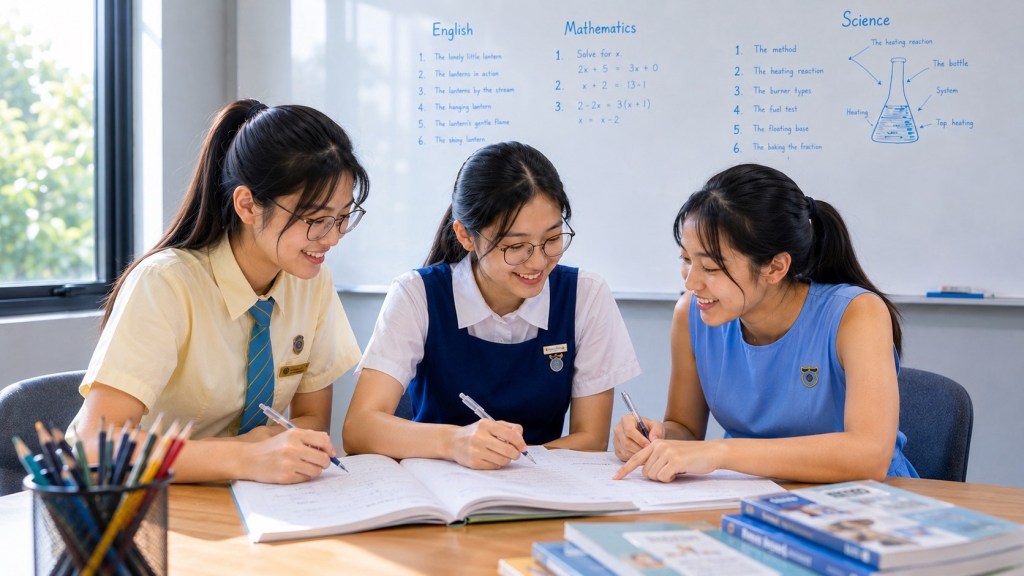
The same mathematical problem can sometimes admit more than one legitimate route. In a three-student class, one learner can propose a route, another can challenge its efficiency or robustness, and a third can verify the units, constraints and final interpretation. The roles rotate so every learner practises solving, comparing and checking.
The group is small enough for detailed individual correction while large enough to make hidden assumptions visible. A learner who always uses one familiar method meets another route and has to decide not merely whether it works, but why one route may be clearer, cheaper or safer under the conditions of the problem.
What Parents Can Look For
- The student identifies givens, unknowns, units and constraints before calculating.
- The student can switch between diagrams, tables, equations or graphs when another representation exposes the structure more clearly.
- The student explains why a chosen route is strategically useful rather than merely familiar.
- Answers are checked for units, magnitude, direction and contextual constraints.
- The student recognises when a route has stalled and switches deliberately rather than abandoning methods randomly.
- The final value is interpreted back in the original problem rather than left as an isolated number.
- Error records identify the failure category—recognition, translation, route, execution, verification or time—rather than labelling everything “careless”.
Frequently Asked Questions
Is more paper practice always the answer?
No. Practice matters, but repeating the same wrong route can automate the failure. If the learner cannot recognise the structure, translate the wording or select a workable method, those operations should be repaired before volume increases.
Why do “careless errors” keep appearing?
Sometimes the cause is arithmetic or copying. Often the visible error is downstream of overload, a weak model, a poor route or missing verification. The useful question is not only where the wrong number appeared, but what earlier state made that error likely.
Why make verification part of solving?
Because the first answer is a candidate, not a guarantee. Units, estimation, direction, constraints, substitution, an inverse relationship or an alternative representation can catch different failure modes. Independent checks are stronger than simply repeating the same calculation.
Does G1, G2 or G3 change the central Voyage?
The curriculum route changes the toolkit, symbolic load, depth, scaffolding and expected independence. The central intellectual work remains serious: recognise the structure available within that route, operate it correctly and verify what the result means.
How does Additional Mathematics fit?
Additional Mathematics is a separate specialised branch where taken. It expands the available mathematical toolkit, but it does not replace the need for strong foundations, sound route selection or verification in Mathematics itself.
When should timed practice become important?
After the relevant concepts and routes are sufficiently stable, timed work tests whether the learner can coordinate them under constraint, recognise when a route is too expensive and still leave enough resource for checking. Timing should test a repaired system, not merely accelerate an unrepaired one.
The Final Mathematics Voyage
The Mathematics Voyage began with a child comparing quantities in the world. Across Primary and Secondary school, that traveller learned relationships, representation, hidden structure, changing quantity, integration, abstraction, systems and route selection.
Secondary 4 recombines the journey: recognise → model → choose → transform → solve → verify → interpret. The learner is no longer only applying methods. They are learning to decide which mathematical machinery belongs to the problem and how to protect the truth of the problem while transforming it.
The final maturity is not merely arriving at an answer. It is knowing why the route fits, how to test the destination, what the answer means in the original world, and how to return when the first route fails.
One World. Many Voyages. Different Ways of Seeing.
