
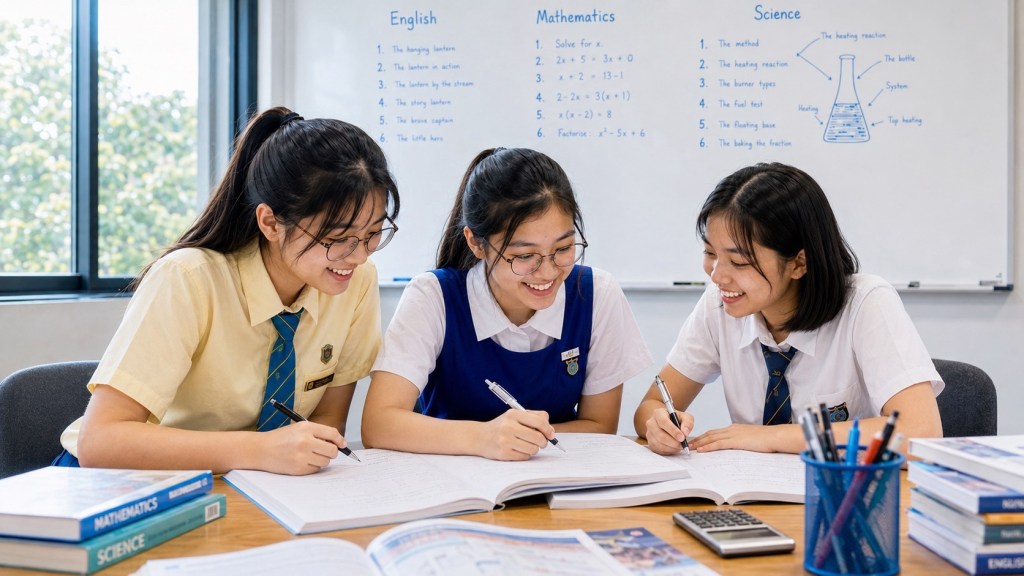
Mixed-topic Mathematics removes the chapter label that normally tells the learner what to do. The question may contain algebra inside geometry, a graph inside a real-world model, a percentage inside a rate problem or probability inside set language. The difficulty is often not one missing formula. It is coordinating several possibilities without losing control of the route.
This Secondary 3 Mathematics Learning Guide develops mixed-topic strategy, route switching, verification, recovery and transfer. It is a consolidation guide: the aim is not to add another chapter but to make the existing chapters work together when the question surface changes.
Use it with the Method Selection Under Mixed Mathematical Load guide. That guide introduces route selection; this one concentrates on staying in control after the first route has begun, detecting when it is failing and recovering without starting the whole problem again.
The First Question Is: What Kind of Relationship Is Present?
Before choosing a formula, classify the structure. Is the relationship additive, proportional, quadratic, geometric, probabilistic, graphical or statistical? Does the question ask for a value, a proof, a comparison, a region, a rate, an intersection or a model?
This classification narrows the method set. It prevents the common habit of trying the most recently practised technique simply because it is familiar.
Worked Example 1: Same Surface, Different Structure
Two questions both mention a rectangular field.
Question A gives perimeter and a relationship between length and width. This is an equation-modelling problem. Question B gives a diagonal and one side. This is a right-triangle geometry problem.
The context is similar, but the mathematical structure is different. Topic recognition must come from relationships, not nouns.
Build a Route Before Calculating
A route can be as short as three notes: “define x → form equation → solve and check”, or “find internal angle → cosine rule → bearing”. Writing the route reduces the chance of starting with arithmetic before the dependencies are clear.
The route does not need to predict every line. It should identify the next relationship and what information that step is expected to produce.
Worked Example 2: Two-Step Dependency
A point is 24 m east and 7 m north of a mast base. The mast is 15 m high. Find the angle of elevation to the top.
Route: horizontal ground distance first, then vertical trigonometry.
Ground distance=√(24²+7²)=25 m. Then tanθ=15/25=0.6, so θ≈31.0°.
Trying tangent before finding the horizontal distance would leave the right triangle incomplete.
A Route Should Produce Something Useful
After each major step, ask what new information has been created and whether it is useful for the final target.
If three lines of algebra have produced expressions that do not connect to the required unknown, the route may be drifting. This is the moment to reassess rather than continue because of sunk effort.
Route Switching Is a Mathematical Skill
Changing method is not failure. It can be evidence of control. A graph may reveal that an algebraic equation has two solutions. A vector route may simplify a coordinate proof. A percentage multiplier may replace repeated separate percentage calculations.
The important question is why the new representation is better suited to the current bottleneck.
Worked Example 3: Switch From Expansion to Factorisation
Solve x²−9=0. Expanding is irrelevant because the expression is already in a useful form. Recognise the difference of squares:
(x−3)(x+3)=0, so x=3 or x=−3.
Method selection is often about choosing the form that exposes the structure rather than performing more operations.
Mixed Questions Often Hide a Familiar Subproblem
A long question may contain several smaller problems: find a missing length, use it in an area calculation, convert units, then compare percentages. Identify and solve these subproblems in dependency order.
The final question may look unfamiliar while each component is familiar when isolated.
Worked Example 4: Geometry Plus Percentage
A square has side 10 cm. Its side length increases by 20%. Find the percentage increase in area.
Original area=100 cm². New side=12 cm, so new area=144 cm². Increase=44 cm².
Percentage increase=44/100×100%=44%.
Alternatively, use scale factor 1.2: area multiplier=1.2²=1.44, again giving 44% increase. The second route is shorter once the dimensional scaling idea is recognised.
Verification Should Happen During the Route
Waiting until the final line to check a five-step solution is risky. Use local checks after high-cost steps: substitute a solved value, compare a length with the triangle, check that probabilities total 1, confirm a matrix order or verify that a graph point satisfies the equation.
Small checks stop early errors from travelling through later work.
Worked Example 5: Check Before Continuing
Suppose a simultaneous-equation step gives x=4 and y=3. Before using these values in a later cost calculation, verify the original conditions.
If 2x+3y=17, then 8+9=17. If 4x−3y=7, then 16−9=7. The pair is consistent, so the route can continue with confidence.
Estimate Before High-Risk Calculator Work
When a calculation involves several powers, trigonometric functions or scientific notation, estimate the expected scale first.
If an expected length should be between 5 and 20 cm, a result of 0.00086 cm or 8600 cm indicates a likely input or unit problem even before the exact error is found.
Recovery Starts From the Last Reliable State
When a route fails, do not erase the entire page automatically. Identify the last line that is definitely correct. Restart from there.
This is faster and preserves useful work. It also trains the student to distinguish valid mathematics from the specific step that broke.
Worked Example 6: Recover From a Wrong Trigonometric Ratio
A student correctly identifies a right triangle with opposite side 8 and adjacent side 15 but writes sinθ=8/15.
The diagram and labels are reliable. Only the ratio selection is wrong. Restart from the labelled triangle: tanθ=8/15, so θ≈28.1°.
There is no need to redraw the entire problem or repeat unrelated steps.
When the First Route Is Valid but Inefficient
Some methods are mathematically correct but unnecessarily long. Efficiency matters because longer routes create more opportunities for arithmetic and sign errors.
If a quadratic factors immediately, the quadratic formula is valid but may be slower. If two simultaneous-equation coefficients already cancel, elimination may be shorter than substitution.
Worked Example 7: Choose the Efficient Route
Solve x²−11x+30=0.
Factorisation gives (x−5)(x−6)=0, so x=5 or 6. The quadratic formula would also work, but factorisation exposes the integer structure immediately.
Mixed Practice Should Remove Chapter Labels
Chapter-labelled practice tells the learner which toolbox to open. Mixed practice tests whether the student can identify the toolbox independently.
Once topic foundations are stable, combine questions from algebra, graphing, geometry, trigonometry, statistics and probability without announcing the method.
Transfer Means the Mathematics Survives a Changed Surface
The same proportional relationship can appear in scale drawings, recipes, rates, percentages and similar figures. The same equality-preservation skill appears in equations, formulae and coordinate problems.
Transfer practice deliberately changes the context while preserving the underlying relationship.
Worked Example 8: Same Proportion, Different Surface
A map scale says 1 cm represents 2.5 km. A 6.4 cm route represents 16 km. A recipe using 250 g flour for 4 portions uses the same direct-proportion structure when scaling to 10 portions: 250×10/4=625 g.
The nouns differ, but the invariant ratio idea survives.
Use Constraints to Reject Impossible Routes Early
A probability above 1, a negative physical length, a triangle side longer than the sum of the other two or a percentage decrease leaving a larger value are signs that the route has violated a constraint.
Constraint checks are often faster than redoing the whole calculation.
Worked Example 9: Probability Constraint
A tree calculation gives P(event)=1.14. No further interpretation is needed before checking the work: the value is impossible for a probability.
Inspect branch totals, whether dependent probabilities changed correctly and whether favourable paths were added or multiplied in the right places.
A Three-Pass Mixed-Question Routine
- Pass 1 — classify: identify target, quantities, constraints and likely representation.
- Pass 2 — execute: solve in dependency order, checking after expensive steps.
- Pass 3 — verify: inspect units, scale, domain, exact form, reasonableness and whether the final answer actually answers the question.
When to Abandon a Route
Change route when the current method requires missing information, creates unnecessary complexity, contradicts a known constraint or stops producing quantities connected to the final target.
Do not abandon a route merely because the arithmetic looks unfamiliar. The decision should be based on mathematical structure, not discomfort alone.
Worked Example 10: Route Audit
A student wants the area of a non-right triangle and knows two sides and the included angle. The student begins finding the third side with cosine rule.
That route is valid, but if area is the only target, the formula 1/2ab sin C already uses the known information directly. The third-side calculation is unnecessary.
Good route auditing asks whether an intermediate result is actually needed.
Common Errors
Using topic keywords instead of relationships: classify from structure, not nouns.
Continuing a failing route because much work has already been done: return to the last reliable state.
Checking only the arithmetic: also check method validity, constraints, units and interpretation.
Practising only labelled chapters: add mixed and transfer questions once foundations are secure.
Independent Practice
1. A rectangle gives perimeter and diagonal. State two different mathematical structures likely to appear.
2. A non-right triangle gives sides 8 and 11 with included angle 52°, and asks only for area. Choose the shortest valid route.
3. Solve x²−13x+40=0 using an efficient method.
4. A simultaneous-equation answer x=3,y=4 will be used later. State a local verification step before continuing.
5. A probability result is 1.08. State the immediate recovery action.
6. A tangent calculation in a right triangle uses opposite=8, adjacent=15. Find the angle.
7. A square side increases by 10%. Find the percentage increase in area using a scale-factor route.
8. Give one near-transfer and one farther-transfer task after correcting a direct-proportion error.
9. A route produces three intermediate values none of which connects to the requested quantity. What should the learner do?
10. State the three passes in the mixed-question routine.
Explained Answers
1. Perimeter gives an algebraic/additive constraint; diagonal creates a right-triangle/Pythagoras structure.
2. Use area=1/2ab sin C directly.
3. (x−5)(x−8)=0, so x=5 or 8.
4. Substitute x=3,y=4 into both original equations.
5. Stop and inspect counting, branch probabilities and add/multiply logic because probabilities cannot exceed 1.
6. tanθ=8/15, so θ≈28.1°.
7. Length factor=1.10, area factor=1.10²=1.21, so area increases 21%.
8. Near transfer: same direct proportion with changed numbers. Farther transfer: scale drawing, unit-price or similar-figure context using the same constant ratio.
9. Audit the route and return to the last reliable state rather than continuing blindly.
10. Classify → execute → verify.
Continue the Secondary 3 Learning Route
Continue with Accuracy, Estimation, Rounding and Calculator Discipline, Word Problems, Representation and Model Building, and Error Analysis, Corrections and Transfer Practice.
