
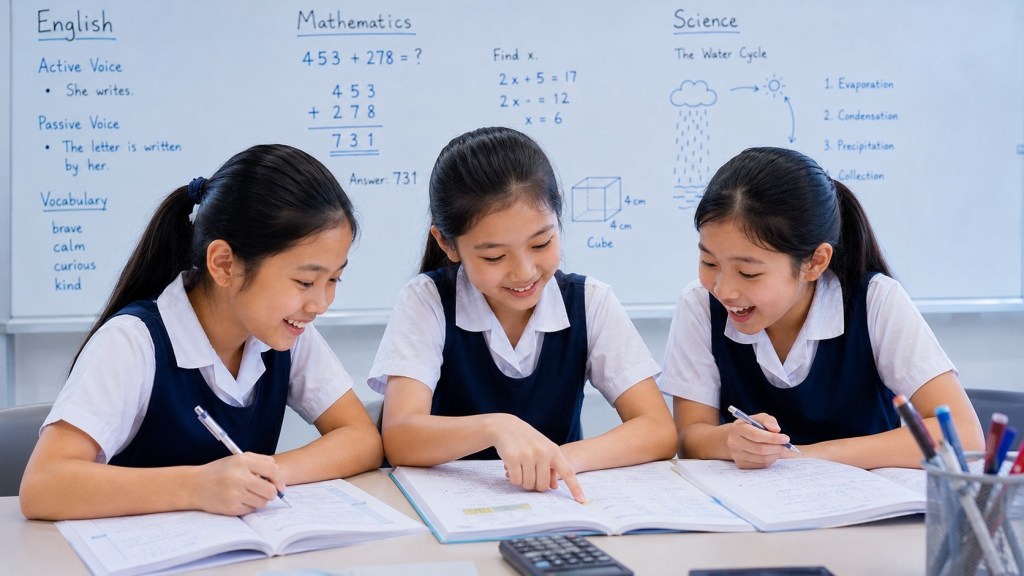
Primary 6 Science is not only the end of Primary Science. It is the point where a pupil can begin changing how Science is learned. In Primary school, broad themes are often taught through familiar systems, investigations and everyday contexts. In Secondary school, the learner meets more specialised disciplines, denser representations, more formal measurements and a greater need to manage models independently.
This guide builds a Primary 6 → Secondary Science bridge around independent learning, model transition, scientific language, practical habits and evidence control. It does not try to pre-teach an entire Secondary syllabus. It prepares the learning system that will have to carry more complex Science.
Return to the Primary 6 Science Learning Hub.
The bridge rule
KEEP THE PRIMARY FOUNDATIONS → MAKE THE MODELS MORE EXPLICIT → IMPROVE MEASUREMENT → INCREASE INDEPENDENCE → SEPARATE DISCIPLINES WITHOUT LOSING CONNECTIONS.
This is an eduKate transition model, not an official MOE or SEAB progression statement.
Part I — What should survive the transition?
The most important Primary Science capabilities should not be discarded:
- observe carefully;
- distinguish observation from inference;
- control variables;
- read graphs and tables;
- trace cause and effect;
- explain systems;
- use evidence;
- recognise model limits;
- revise misconceptions;
- transfer knowledge to unfamiliar contexts.
Secondary Science adds detail, but these habits remain foundational.
Part II — From themes to disciplines
Primary Science often connects ideas through broad themes such as systems, interactions, cycles and energy.
Secondary Science increasingly organises knowledge through disciplinary structures such as:
- Biology;
- Chemistry;
- Physics;
- Earth/environmental contexts;
- experimental and data-analysis practices.
The pupil needs to separate these disciplines enough to learn their models while preserving cross-links.
Part III — Models become more detailed
A Primary-level model is intentionally simplified.
Example: “Blood transports oxygen and digested food substances around the body.”
Later Science may distinguish vessels, exchange surfaces, cells, chemical processes and quantitative relationships in more detail.
The Primary model is not “wrong”; it is a lower-resolution model built for an earlier learning stage.
Part IV — Learn to upgrade a model rather than erase it
Use:
OLD MODEL → WHAT IT EXPLAINS → WHERE IT FAILS → NEW DETAIL → UPDATED MODEL.
This prevents the pupil from treating new Science as a disconnected replacement.
Part V — Scientific vocabulary becomes more specialised
Words that were once sufficient may become too broad.
“Energy” becomes several precisely tracked forms.
“Force” becomes more carefully represented and measured.
“Particle” may acquire a more formal model.
“Reaction” becomes a structured chemical idea rather than a general change.
The learner should expect vocabulary precision to increase with model precision.
Part VI — Measurements become more formal
Primary pupils already work with units, scales, repeated readings and fair tests. Secondary Science typically expects greater control over:
- instrument choice;
- resolution;
- uncertainty;
- graph scales;
- calculated quantities;
- relationships between variables;
- method limitations;
- data quality.
The best preparation is to make Primary measurement habits explicit now.
Part VII — Practical work becomes more independent
Instead of only following a procedure, learners increasingly need to understand why each step exists.
Ask of every practical:
- What question is being tested?
- What changes?
- What is measured?
- Why this instrument?
- Why this range?
- Why these controls?
- How will the data be recorded?
- What conclusion is justified?
Part VIII — Graphs become models, not decorations
In Secondary Science, graphs often carry more of the argument.
Strong P6 preparation includes:
- identifying axes and units;
- reading slope direction;
- recognising plateaus and turning points;
- distinguishing interpolation from extrapolation;
- comparing graph regions;
- using data to support claims.
Part IX — Mathematics becomes more visible inside Science
Secondary Science increasingly uses quantitative relationships.
The bridge skills include:
- ratios;
- rates;
- averages;
- unit conversion;
- proportional thinking;
- rearranging simple relationships later when taught;
- estimating whether an answer is sensible.
Primary pupils do not need to pre-learn advanced formulas. They need confidence comparing quantities correctly.
Part X — Independent learning begins with retrieval
Secondary school increases content volume. Rereading notes becomes less effective as the only strategy.
A stronger routine:
- retrieve from memory;
- check against notes;
- correct errors;
- explain the model aloud;
- apply it to a new example;
- return after a delay.
Part XI — Learn to maintain an error system
Do not keep only a notebook of “wrong questions”. Track the reason:
- concept missing;
- term confused;
- diagram misread;
- unit mistake;
- variable error;
- causal chain incomplete;
- evidence overclaim;
- retrieval failure;
- careless execution.
The repair depends on the failure type.
Part XII — Learn to ask model questions
Instead of asking “What is the answer?”, ask:
- What objects exist in this system?
- What state is each object in?
- What interacts?
- What changes?
- What is conserved or transferred?
- What is measured?
- What evidence supports the explanation?
- Where does the model stop working?
These questions scale well into Secondary Science.
Part XIII — Learn to separate representation from reality
A diagram is a model.
A graph is a model.
A chemical symbol is a representation.
A circuit diagram is not a photograph.
A food web is not a complete ecosystem.
This representational awareness becomes increasingly important as Science becomes more abstract.
Part XIV — The Secondary learner needs a source hierarchy
When studying independently, distinguish:
- teacher/school materials;
- official syllabus or examination guidance;
- textbooks and trusted educational resources;
- supplementary explanations;
- informal online summaries.
Use informal material to clarify, not to override authoritative course boundaries.
Part XV — Do not race ahead blindly
Pre-learning can help when it strengthens foundational models. It can hurt when the pupil memorises advanced terminology without understanding.
Better preparation:
- make P6 concepts secure;
- improve graph reading;
- improve experimental reasoning;
- improve scientific language;
- learn to retrieve independently;
- build confidence with unfamiliar contexts.
Part XVI — Original transition exercise: energy
P6 model: identify energy forms and trace conversion.
Bridge habit: ask where energy enters, where it is transferred, which output is useful and which additional outputs appear.
Later models can add quantitative detail without replacing this route.
Original transition exercise: forces
P6 model: forces can change motion or shape.
Bridge habit: identify the object, direction of interaction, evidence of change and variables that affect the measured outcome.
Later Physics can formalise these ideas further.
Original transition exercise: living systems
P6 model: systems transport materials and depend on interacting organs/processes.
Bridge habit: trace inputs, outputs, pathways and failure points.
Later Biology can increase the resolution of each system.
Original transition exercise: matter
P6 model: matter has mass and occupies space; substances can change state.
Bridge habit: separate observable change from the model used to explain it.
Later Chemistry can introduce more detailed particle and reaction models.
Part XVII — Build a Secondary-ready study page
For each Science topic, maintain one page with:
- core model;
- key vocabulary;
- diagram;
- important variables;
- one representative graph;
- common misconception;
- one mechanism chain;
- one method limitation;
- one transfer question.
This creates a reusable model rather than a pile of copied notes.
Part XVIII — Independence is gradual
A useful progression:
- teacher models reasoning;
- pupil completes guided reasoning;
- pupil reconstructs with prompts;
- pupil solves independently;
- pupil checks and explains own error;
- pupil transfers to a new context.
Part XIX — The BRIDGE test
- B — Base: is the Primary model secure?
- R — Representation: can I read diagrams, graphs and symbols?
- I — Inquiry: can I reason about variables and evidence?
- D — Detail: can I add new detail without losing the model?
- G — Generalise: can I transfer to unfamiliar examples?
- E — Explain independently: can I teach the idea back without notes?
This is an eduKate teaching mnemonic.
Part XX — What should a P6 pupil be able to do before the transition?
- Explain major Primary Science concepts from memory.
- Read an unfamiliar graph.
- Identify variables in an experiment.
- Write a complete causal explanation.
- Judge whether a conclusion exceeds the evidence.
- Recognise common measurement limitations.
- Use units consistently.
- Analyse an error without waiting for the teacher to name it.
- Retrieve after delay.
- Ask a good scientific question.
Where to connect
- Secondary & Post-Secondary Science | Models, Disciplines and Independent Reasoning
- Secondary Tuition Sengkang | Sec 1–4 Learning Progression
- Retrieval, Spaced Review, Interleaving & Long-Term Memory
- Models, Assumptions, Limits & Scientific Claims
Retrieval checklist
- I know which Primary Science habits must survive into Secondary Science.
- I can upgrade a model instead of replacing it blindly.
- I expect vocabulary and measurement precision to increase.
- I can use retrieval rather than rereading alone.
- I maintain an error classification system.
- I treat diagrams and graphs as representations.
- I can trace inputs, outputs and evidence across systems.
- I can study one topic independently with a structured page.
- I can explain a model without notes.
- I can enter Secondary Science ready to learn more detail without losing the foundations.
The quiet return
The best Primary 6 preparation for Secondary Science is not racing ahead into more chapters. It is building a learner who can reconstruct models, measure carefully, read evidence, revise errors and add new detail without losing the system underneath.
Keep the foundation. Increase the resolution. Strengthen the inquiry. Build independence. Carry the model forward.
Return to the Primary 6 Science Learning Hub.
