
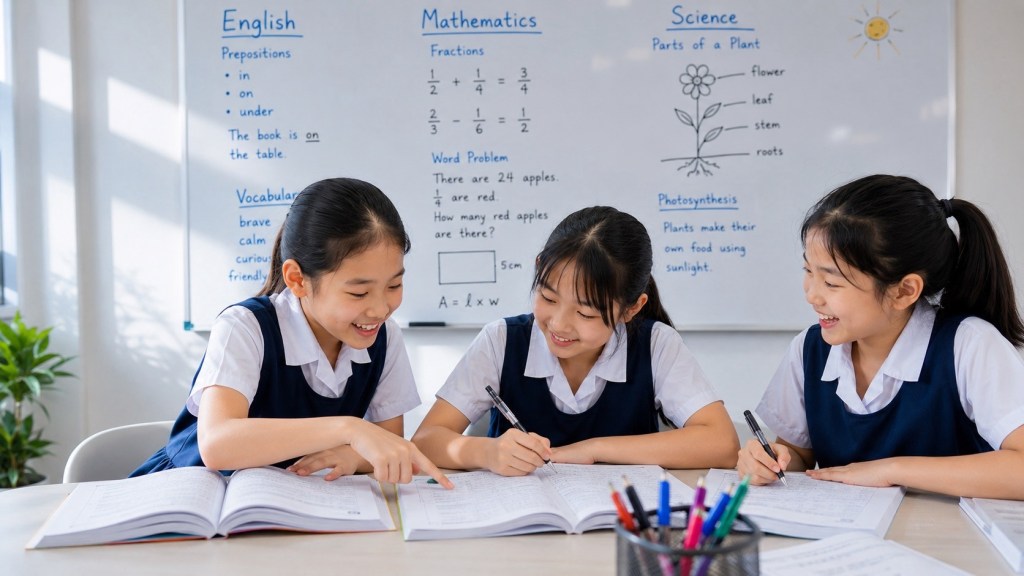
Alicia finds an answer in twelve seconds. Beatrice finds the same answer on three websites. Ciara asks where the three websites found it.
That last question changes the lesson. The girls have not yet measured anything, but they have reached a scientific problem: when information comes from somewhere else, how do we decide what deserves to be carried into our own explanation?
For this fictional classroom case, imagine that all three websites repeat the sentence, “The bigger object must have more mass.” Repetition makes it familiar. It does not make the relationship correct. A large empty cardboard box and a smaller metal object immediately give the group a reason to investigate the claim rather than count how often it appears.
Researching Science means building an answer that another person can check—not collecting the largest number of sentences that appear to support it.
This learning guide is part of the Primary 4 Science Learning Hub. It develops source-based enquiry through familiar questions about plants, digestion, matter, light and heat. It is also a practical guide for the adult helping a child use information without taking over the child’s thinking.
The classroom conversations, source cards, miniature investigations and practice records below are original teaching examples. Unless a real institution is explicitly identified and linked, a source card is fictional; it is not a quotation from an actual book, website or pupil.
Start here: the answer must survive five questions
Before calling a research task complete, ask: What exactly was the question? Who supplied the information? What does that source actually say? Does another suitable source support or qualify it? Can I explain the answer without copying the sentence?
A Primary 4 learner does not need to become a professional researcher before using a book. The aim is a manageable habit: keep the question visible, read a small amount carefully, preserve the important scientific relationship and leave a route back to the source.
| Your immediate problem | Begin with | Useful product |
|---|---|---|
| The search produces too much information | Narrowing the question | One answerable question |
| Several websites say the same thing | Checking independence | A simple source-family record |
| The child copies paragraphs | Writing evidence notes | A short paraphrase checked against the source |
| Two sources seem to disagree | Resolving disagreement | A bounded answer or a named unresolved issue |
| You need a complete lesson | The guided research workshop | A question, source record and independent answer |
| You need to check understanding | Practice and worked decisions | Evidence of source judgement, not just recall |
1. Research is one way of investigating—not a substitute for all the others
Some scientific questions are best approached by observing an object, measuring a change or making a controlled comparison. Other questions require information gathered or explained by someone else. The Primary Science Teaching Trust includes research with secondary sources among its enquiry approaches, alongside observation over time, pattern-seeking, classification and comparative or fair testing. The Ogden Trust also describes research enquiries as opportunities to compare information and develop scientific literacy. These are educational approaches, not a claim that a particular website task is a compulsory Singapore examination component. See PSTT: Enquiry Approaches and The Ogden Trust: Working Scientifically—Research.
Consider two questions. “What is the temperature of the water in our cup now?” requires a suitable measurement of that particular cup. A webpage cannot supply the answer merely by explaining temperature. “What does a thermometer measure?” can be answered through a suitable reference source. The first concerns a present observation. The second concerns established knowledge.
A third question combines the two: “Why did our water temperature decrease?” The group needs its own observations and a scientific explanation of heat transfer. A reference can help explain the mechanism, but it cannot retrospectively supply a missing starting temperature. This distinction protects the investigation from invented evidence.
A good researcher therefore asks which part of the answer should come from the world in front of the learner and which part can come from a reliable explanation. Neither source-based enquiry nor hands-on work wins automatically. The useful method is the one that fits the question.
A practical classification task
Put four question cards on the table: identify the function of the gullet; measure this leaf’s length; find out whether this particular cup has cooled; explain why a shadow forms. Ask the learner to sort them into “reference information,” “our own observation,” or “both may help.” Then ask for a reason.
The point is not rigidly classifying every scientific question forever. It is noticing that different questions demand different evidence. A child who searches online for a measurement of their own leaf has selected the wrong evidence route, even if the resulting website is excellent.
2. Narrow the question before opening the browser
“Research plants” is an invitation to collect a little of everything. A search may return pictures, gardening products, advanced biological explanations, local plant guides and school worksheets. The child now has a selection problem larger than the original Science problem.
Replace the topic with a question that names a relationship. “What are two functions of roots?” is manageable. “How could damage to roots affect the rest of a plant?” is a different question requiring a causal connection. “Why is this plant wilting?” is different again: it asks about a particular case whose water supply, roots and surroundings may not be known.
Write the question on a small card and leave it beside the device or book. Every useful note should have a visible connection to that card. When an interesting fact appears, the learner can decide whether it answers the question, supports a later question or belongs outside this task. This avoids treating curiosity as something to suppress while also preventing the work from dissolving into unrelated browsing.
The question needs a subject and a job
For “How do we see a book under a lamp?”, the subject is seeing a non-light-source object. The job is explaining the route by which light reaches the eye. The task is not a complete report about eyesight. A source section on the anatomy of the retina might be accurate and still be unnecessarily difficult for this learning purpose.
For “What is the difference between mass and volume?”, the job is distinguishing properties. A list of units helps, but units alone are not the entire explanation. The learner must understand why a balance and a measuring cylinder answer different questions.
For “Which cup in our experiment cooled more?”, the job is a comparison of changes. A general article about insulation may support the explanation after the calculation. It cannot replace the calculation.
Turn a large curiosity into a small investigation
Alicia begins with “How does the human body work?” The tutor does not provide a twenty-page summary. Instead, the group chooses one route question: “Which parts does swallowed food pass through after the mouth?” That question can be answered, checked and drawn. Later, a separate question can ask what happens in one of those parts.
This is not making Science less ambitious. It is arranging the ambition into pieces that can be understood. The child can complete a meaningful enquiry, then extend it deliberately rather than accumulate unfamiliar words without a model.
3. Understand what a source is doing
In school enquiry, “secondary-source research” usually means learning from information that is already available rather than collecting all the evidence personally. A book, an educational website, an explanatory video or a museum information panel can serve that role. In professional research, primary, secondary and tertiary sources have more specialised meanings. A university website may host an original study, an explanation of several studies or an introductory reference page. The address alone does not settle the category.
For a Primary 4 task, the more useful questions are concrete: Is this a record of something observed? Is it explaining established knowledge? Is it presenting a model? Is it giving advice or trying to sell something? What kind of claim could it reasonably support?
Suppose a pupil watches a teacher’s recording of a shadow investigation. That video is evidence of the recorded set-up, subject to what the camera shows and what the teacher reports. It is not a direct observation of the pupil’s own classroom. If the pupil writes “We measured a shadow of 14 cm,” they have changed the provenance of the result. “In the teacher’s recorded investigation, the stated shadow width was 14 cm” keeps the distinction intact.
A source can be strong for one job and weak for another
A clear science dictionary is useful for checking a term. It may not contain enough detail to explain an unusual result. A manufacturer is well placed to explain how its sensor reports values. Its advertising language is not automatically an independent evaluation of how much children will learn from the product. A student’s investigation report may preserve valuable measurements while still containing an incorrect explanation.
Do not teach children that a source belongs permanently in a “good” or “bad” box. Teach them to ask whether it is suitable for the present claim. Suitability depends on relevant expertise, the evidence shown, the clarity of the explanation and the limits of the question.
Information is not evidence until its relevance is established
“The cup is blue” is information. It is not useful evidence for a claim about which of two cups had the larger temperature decrease unless colour is relevant to the stated investigation. “Both cups began at the same temperature and one decreased by less” is directly relevant to the cooling comparison.
Researching with books and websites therefore continues the same discipline used in practical Science: identify the property, choose relevant evidence and do not let an available detail stand in for the detail actually needed.
4. Check who is speaking before trusting what is said
Begin with source identity. Look for a named author or responsible organisation, a page or book title and an indication of what the source is intended to do. A source without a named individual is not automatically unusable; an institution may take responsibility for its educational material. Equally, a named individual is not automatically an expert on every scientific subject.
For children, this can be a short conversation. “Who made this page?” “What do they know about the topic?” “Can we find their explanation, or only a slogan?” “Can we get back to this exact page?” The aim is not a long credibility checklist that consumes the lesson. The aim is to prevent anonymous certainty from passing unnoticed.
Search position is not a scientific verdict. A result near the top may be relevant, but the learner still has to open it and inspect the actual page. A short search extract can omit a condition, merge separate sentences or show a fragment that does not answer the child’s question. Research begins after the click as well as before it.
Date matters differently for different claims
A basic explanation of a familiar scientific relationship may remain useful for many years. Instructions for a particular digital device can change when the hardware or software changes. A school assessment notice applies to the year and school named. These are different freshness needs.
Do not train the learner to choose the newest-looking page automatically. Ask what might have changed. For a question about the digestive route, relevant scientific accuracy matters more than a decorative “updated today” label. For instructions about a data logger, the device version and current official guidance matter directly.
Presentation quality is not proof
A beautiful diagram can contain a wrong arrow. A simple page can explain a relationship accurately. A video can be engaging and omit the control conditions that make its demonstration interpretable. Attractive presentation may help a child read, but it should not be confused with verification.
One useful exercise is to remove the decorative parts of two fictional source cards. Leave only the claim, the evidence and the named source. Ask which card better answers the question. This returns attention to the scientific content rather than the visual confidence of the packaging.
5. Read for the relationship, including the small words
The most important word in a science sentence may be “if,” “some,” “usually,” “more,” “less” or “under these conditions.” Those words control the claim. When a learner drops them while taking notes, an accurate explanation can become inaccurate.
Consider this original teaching sentence: “The water volume remains the same when it is transferred to another container, provided none is added or lost.” A note saying “Water volume never changes” has removed the condition. The error did not begin in the source. It was introduced while compressing the sentence.
Teach the learner to identify three parts: the thing being discussed, the relationship being stated and any condition that limits the statement. For a plant question, this may be root function, water uptake and the particular damage described. For a shadow question, it may be object position, shadow size and what happens to the source and screen.
Do not highlight everything
Highlighting an entire paragraph does not make a decision about relevance. Ask the learner to underline only the sentence that helps answer the question and circle the condition that must travel with it. Then ask them to explain why the surrounding sentences are not needed yet.
This is useful even without a browser. A printed source paragraph can be placed beside the question card. The child marks the relationship, closes the source and gives a spoken explanation. Reopening the source afterward provides a meaning check rather than an invitation to copy.
Different vocabulary may describe the same part
A source may use “esophagus” or “oesophagus” where a Primary 4 lesson uses “gullet.” Encountering a different word does not necessarily mean the sources disagree. The adult should help check the equivalence rather than demand that the child memorise every variation. The NIDDK explanation of the digestive system is a useful real example of a source using “esophagus” in the route between mouth and stomach.
The general lesson is larger than this term. Before recording a disagreement, check whether two sources have changed the terminology, the amount of detail or the actual scientific claim. Those are different situations.
6. Write evidence notes that remain connected to their source
A useful research note is short, but it is not detached. It should preserve the question it answers and the route back to the source. A child does not need a university referencing style to achieve this. A page title, organisation or author, page number or web address, and a brief note about the relevant section are enough for many classroom tasks.
| Record field | What to write | Why it matters |
|---|---|---|
| Question | The specific Science question | Prevents unrelated fact collection |
| Source identity | Title and author or organisation | Shows who supplied the information |
| Location | Page number or exact webpage | Makes the note checkable |
| Useful idea | A short explanation in the learner’s words | Tests understanding |
| Condition or limit | What must remain true | Prevents overgeneralisation |
| Next check | A point needing confirmation | Keeps uncertainty visible |
The note should not become a second essay. For a short enquiry, two or three carefully selected notes may be enough. Their value comes from how well they support the answer, not how much they resemble a professional research database.
The read–close–explain–reopen method
Read one small section. Close or cover it. Explain the idea aloud using the original question as a guide. Write a brief note. Reopen the source and compare meanings.
The final step is essential. Writing from memory can introduce errors. The learner might substitute “volume” for “mass,” omit the gullet from a route or reverse the direction of heat transfer. Reopening the source is not cheating; it is checking whether the paraphrase preserved the science.
A paraphrase does not have to replace every scientific word. “Temperature,” “small intestine” and “light source” should remain accurate terms. The goal is not a thesaurus exercise. It is to reconstruct the explanation without copying the source’s whole sentence pattern or losing its meaning.
Separate a quotation from a note
Sometimes a short exact phrase is worth preserving. Mark it as a quotation and keep its source. Otherwise, write the explanation in the learner’s words. Do not let copied text become indistinguishable from the pupil’s own account.
For a Primary 4 task, most of the work should demonstrate understanding through selection, drawing, paraphrasing and application. A page of copied paragraphs gives the tutor little evidence about which ideas the learner can actually use.
7. Three websites may still be one source
Beatrice’s three results look reassuring until Ciara notices identical examples and wording. One page credits another; the third reproduces a paragraph from the first. They are three locations carrying one explanation, not necessarily three independent checks.
Independence matters because copying can multiply an error. It can also multiply a correct explanation without adding much new support. The research task should distinguish “I found it again” from “I checked it against a separate suitable source.”
Children do not need to investigate every website’s entire history. They can notice simple clues: identical sentences, the same unusual example, a visible credit line or an explicit link to the original explanation. Record “possibly copied from Source A” when the relationship is not fully clear.
A fictional source-family exercise
| Source card | What the child finds | How to treat it |
|---|---|---|
| A: class reference book | A named explanation with a diagram | A candidate source to inspect |
| B: homework page | Says it copied the explanation from A | A route to A, not an independent confirmation |
| C: museum education page | Explains the relationship with a different example | A potentially independent check |
| D: short search extract | Shows part of B’s sentence | Open the underlying page before using it |
Ask which pair should be compared first. A and C are more promising than B and D, but the answer is not “museums are always right.” The learner still checks whether both sources address the same relationship and whether the explanation is appropriate.
Independence is not the same as disagreement
Two independent sources can agree because the science is well established. They do not need to disagree to count as separate sources. Equally, two copied pages may appear to disagree because one has shortened the original badly. The useful question is how the information was produced, not whether the wording is different.
This habit also improves peer work. If three pupils all copied one child’s answer, their agreement does not show three independent routes through the problem. The group needs each learner to explain the relationship rather than treat the number of matching notebooks as scientific evidence.
8. When sources disagree, do not vote
Alicia has a simple diagram. Ciara has a fuller explanation. The fuller source names parts that the simple diagram leaves out. That alone is not a contradiction. A model can omit detail for a particular purpose without asserting that the omitted detail does not exist.
Begin by rewriting the disputed claim as one clear sentence. “This source is different” is too vague. “Source A appears to say that only one organ absorbs water” is a checkable concern. Now look for the exact language and the scope of the explanation.
Differences commonly arise from changed terminology, different levels of detail, different conditions, different questions, older information or an actual mistake. These possibilities should not be merged. The response depends on which one occurred.
An authentic example of keeping a simplification bounded
Children commonly associate the small intestine with absorption of digested nutrients and the large intestine with absorption of water from the remaining material. The NIDDK reference explains that the small intestine also absorbs water. The word “only” would therefore make a simplified note misleading. The useful repair is to preserve the P4 learning focus without turning it into an exclusive claim.
The child does not need to add every detail from an adult reference page to a school answer. The source has helped identify a boundary: a simple association is not always a complete description. Research should sharpen the child’s language, not bury the current task beneath advanced content.
A disagreement record
Write four lines: the exact disputed sentence; the source that states it; the source that challenges or qualifies it; and what is still unresolved. This is much more useful than leaving two incompatible notes beside each other and choosing the one that sounds easier.
Sometimes the right outcome is “We need an adult to check this before using it.” That is a responsible research result. The task has identified the uncertainty rather than hidden it inside a confident answer.
When conditions explain the apparent conflict
Imagine two fictional source cards. One says a warm object loses heat to cooler surroundings. Another says a cool object gains heat from warmer surroundings. These are not opposing rules. The temperature relationship has changed. Both descriptions fit the hotter-to-colder transfer model used in the Heat, Temperature, Conductors and Changes guide.
Ask the learner to underline “warm,” “cooler,” “cool” and “warmer.” Much of scientific reading consists of keeping such conditions attached to the explanation.
9. Build an answer, not a collage
Once the useful notes exist, return to the question card. The final answer should have a logical sequence that belongs to the question rather than the order in which websites were opened.
A short source-based answer can contain a direct response, the key scientific relationship, one relevant explanation or example, and a source note. A longer task may need a comparison or an acknowledged limitation. Length should follow the work the answer needs to do.
For a question about how a shadow forms, the answer should connect source, blocking object and receiving surface. A collection containing a fact about the Sun, a definition of a torch and a sentence about darkness does not necessarily form that explanation. The learner must connect the parts.
The sentence test
After drafting, point to each sentence and ask, “What job does this do?” One may answer the question. Another may explain a mechanism. Another may identify a condition. A sentence that performs none of these jobs may be interesting but unnecessary.
Do not remove a sentence merely because it is long. Remove or relocate it when it does not serve the research question. The same principle prevents an answer from becoming too short: a missing causal link cannot be excused by saying the important keyword is already present.
The closed-source explanation test
Cover the notes and ask the child to explain the answer to another learner. Then change one surface feature: use a toy instead of a book, oil instead of water in a container-shape problem, or a rotated digestive-route diagram.
The transfer question should preserve the same scientific relationship. It is not a surprise test of advanced knowledge. Its purpose is to reveal whether the child understood the idea or merely reproduced a sentence attached to one familiar example.
10. A guided research workshop from beginning to end
Use the question, “How should we explain the difference between mass and volume to another Primary 4 pupil?” The adult prepares two suitable reference extracts and the learner’s earlier class notes. No open-ended web search is required for the first attempt.
Before reading: make the confusion visible
Ask the learner to complete two sentences: “Mass tells me…” and “Volume tells me…”. Keep the first attempt. It provides a baseline for the research task. If the learner already distinguishes the properties accurately, the workshop can focus on finding and explaining a counterexample to the rule “bigger always means heavier.”
Put a large lightweight empty container and a smaller heavier object on the table, using safe objects chosen by the adult. The child may predict which has the greater mass, but the prediction is not treated as a measurement. A suitable balance can settle that particular comparison. Reference sources help explain the distinction; the actual objects provide the present evidence.
During reading: choose only what serves the question
Each learner selects one relevant statement from each prepared source. They record the source title and page or section, then paraphrase the distinction. They also note the measurement tool associated with each property.
Beatrice copies a sentence accurately but cannot explain it. The tutor asks for a spoken example rather than another paragraph. Alicia produces a good example but forgets which property was measured. The tutor returns to the two sentence stems. Ciara writes a careful definition but overgeneralises from the two objects. The tutor asks whether one comparison establishes every possible relationship between size and mass.
After reading: construct a teachable answer
The learner writes a short explanation using the two properties, the appropriate tools and the observed comparison if a measurement was actually made. The account says “we measured” only for the group’s own measurements. If no balance was used, it says “our example suggests a question to test” rather than inventing a result.
Now return to the initial two sentence stems. Ask what changed and why. A successful workshop leaves a visible improvement in the explanation and a record of the sources used. It does not merely end with more pages in the notebook.
A fresh transfer
Present two differently shaped containers holding a stated equal volume of liquid. Ask whether height alone establishes volume. This is a neighbouring property distinction, not the same mass comparison. The learner should notice that the scientific job has changed and use the appropriate evidence.
The transfer checks whether the broader habit has developed: name the property before accepting an appearance-based conclusion.
11. The research decision casebook
These cases are designed for discussion. They concern the choices a researcher makes, not just the final Science fact. All unattributed source extracts in this section are invented teaching examples.
Case 1: the first search result
A learner finds a short extract saying, “Objects closer to the light become larger.” She copies it into a shadow answer without opening the page.
Decision: open the source and identify the exact relationship. Does it refer to the object itself, its image or its shadow? Which source and receiving surface remain fixed? The extract may be abbreviated or unsuitable. A copied search result cannot carry conditions that the learner has not inspected.
Repair: write the uncertainty before researching further: “I need to know what becomes larger and which distance changes.” That question is more useful than typing the same broad search again.
Case 2: a book and a website use different words
A reference book uses “gullet.” A linked explanatory page uses “esophagus.” The learner concludes that the website has a different digestive route.
Decision: check the terms. A vocabulary difference is not automatically a scientific disagreement. The adult can help establish the equivalence, after which the child returns to the route question without collecting unnecessary terminology.
Repair: add a small vocabulary note and redraw the route from understanding. Do not replace the child’s whole answer with the fuller source’s anatomical detail.
Case 3: a product page says a cup is best
A fictional product page calls a cup “the best for keeping drinks warm” but gives no starting conditions or comparison method.
Decision: treat this as a claim requiring evidence. Ask best compared with what, over what time and with what starting temperature and volume. The manufacturer may explain the product’s construction, but the adjective alone does not establish comparative performance.
Repair: write the evidence needed rather than choosing the claim because its page looks professional.
Case 4: three pages share one explanation
Three pages contain the same unusual example and acknowledge the same original source.
Decision: record them as one source family for this explanation. They may be useful routes to the original, but they do not provide three independent checks.
Repair: inspect the original and compare it with another suitable explanation. Do not count repeated wording as stronger evidence merely because it appears in more places.
Case 5: an excellent source is too advanced
A child researching root functions finds a detailed explanation containing unfamiliar transport terminology, equations and experimental methods.
Decision: the source may be scientifically strong but unsuitable for independent reading at this point. A teacher can select a relevant passage or provide an age-appropriate source. Difficulty is not a measure of usefulness.
Repair: return to the question. The learner needs the function and its consequence, not every mechanism used to investigate plant transport.
Case 6: the note loses an important condition
Source card: “In this arrangement, moving the card nearer the torch enlarges the shadow on the fixed screen.” The pupil’s note says, “Nearer always means bigger.”
Decision: the note has changed the claim. It removed both the reference point and the fixed-screen condition.
Repair: restore those conditions and test the note against a different movement. The scientific understanding should control the paraphrase, not just its brevity.
Case 7: an old reference and current device instructions
A child uses a general book to learn what temperature means, then follows an old online instruction for a different version of a data logger.
Decision: freshness has different jobs here. The conceptual reference may remain suitable. The device instruction must match the actual hardware and software. The adult should check the current official instructions before any practical use.
Repair: write the device version next to the source record and avoid treating a search date as proof that the instructions match the equipment.
Case 8: reported evidence becomes invented personal evidence
A learner watches a recorded investigation and writes, “We found that the water cooled by 10°C,” although her group performed no experiment.
Decision: correct the origin of the evidence. The result belongs to the recorded investigation.
Repair: write “The demonstration reported…” and include its conditions if available. Then distinguish what the child learned from what the child measured.
Case 9: the source answers a neighbouring question
The question asks which root function helps a plant remain in the soil. The learner finds a good explanation of water absorption and uses it as the whole answer.
Decision: the source information may be correct, but it does not perform this question’s job. Relevance must be checked after correctness.
Repair: research the anchoring function for this task. Keep the absorption note for a separate question rather than forcing it into every plant explanation.
Case 10: a photograph appears to settle a measurement
A website shows a tall container beside a shallow bowl. The learner uses visible water height to decide which holds more liquid, although neither a scale nor a volume is given.
Decision: the picture does not establish the requested volume comparison. Camera perspective and container shape are additional limitations.
Repair: name the missing measurement. A reference can explain volume, but an unlabelled photograph cannot supply the exact amount.
Case 11: a source changes after the notes were written
A class revisits a webpage and finds that a diagram has been replaced. Their notes identify only the organisation, not the page title or section.
Decision: the record is too vague to check efficiently. It may still be possible to locate the explanation, but the source trail needs improvement.
Repair: keep the exact page title and a brief description of the relevant section. When a permitted classroom extract is saved, preserve its source and date rather than stripping away the identity.
Case 12: the learner wants a stronger conclusion than the sources allow
Two suitable sources explain a general relationship, but neither addresses the unusual conditions of the pupil’s proposed investigation.
Decision: use the relationship to make a qualified prediction, not a claim that the outcome has already been measured.
Repair: separate “the sources explain,” “we predict” and “we observed.” These labels keep the different kinds of knowledge from collapsing into one confident sentence.
12. Independent practice: choose the next research action
Attempt the questions before reading the worked decisions. Several questions accept more than one sensible response. The quality of the reason matters more than matching a model sentence.
Practice questions
- A search for “plants” gives hundreds of unrelated results. Write a narrower question suitable for a Primary 4 investigation of roots.
- A source sentence contains “if no water is lost.” Why should that phrase remain in the learner’s note?
- Two webpages explicitly copy the same reference. Do they provide two independent checks? Explain.
- A child wants the present temperature of her own cup. Should she obtain that value from a reference website? Explain.
- A source describes the function of leaves, but the question asks why roots resist uprooting. What should the learner do next?
- Write three pieces of source information that would help another learner find the explanation again.
- A child replaces every scientific term while paraphrasing and makes the explanation unclear. What has gone wrong?
- A website and a book use different names for the same structure. What should be checked before recording a disagreement?
- A demonstration video supplies a result. Write a sentence opening that identifies the result honestly as reported evidence.
- A graph has no axis labels. Can a learner use its shape alone to establish what scientific relationship it shows?
- A source gives a general explanation of cooling. What additional information is needed to decide which of two particular cups cooled more?
- Why might a highly technical source be inappropriate for a child’s independent enquiry even when it is accurate?
- A pupil’s final answer contains six facts but never answers the written question. What review should happen?
- Write a useful response when two apparently suitable sources make genuinely conflicting claims that the child cannot resolve.
- What is the difference between “the source states,” “we predict” and “we measured”?
- Why is an attractive webpage not sufficient evidence of accuracy?
- After reading an explanation of seeing a book, what simple changed-example task could check understanding?
- A pupil finds the same claim on ten pages. What should be checked besides the number of pages?
- Write one reason a source date matters strongly for equipment instructions.
- What would count as a completed research enquiry rather than a completed search?
Worked decisions and reasons
1. “How do roots help a plant remain in the soil?” or “How can root damage affect water uptake?” Each names a manageable relationship. A task should choose one rather than silently merge both.
2. The phrase is part of the scientific condition. Removing it changes a bounded statement into a claim that volume cannot change under any circumstances.
3. Not for the copied explanation. They are two locations carrying the same source. The learner should inspect the original and seek a separate suitable check.
4. No. The temperature of that cup requires a suitable observation or measurement. A website can explain the concept or method but does not know the cup’s present state.
5. Return to the question and find information on anchoring. Correct information about a neighbouring function does not automatically answer the task.
6. Suitable records include the title, named author or organisation, exact page or webpage, relevant section and date accessed when useful. The record should be simple enough that the child actually keeps it.
7. Paraphrasing has been treated as word replacement. Scientific terms should remain accurate. The aim is an independently constructed explanation with the same meaning, not maximum vocabulary change.
8. Check whether the terms refer to the same part and whether the sources discuss the same function and level of detail. Vocabulary variation can look like disagreement.
9. “In the recorded demonstration, the teacher reported…” is an honest opening. “We measured…” would be inappropriate unless the pupils actually performed the measurement.
10. No. Without variable and unit information, the curve is not enough to establish the intended scientific relationship. The learner must locate the missing context.
11. At minimum, the relevant starting and final temperatures are needed to calculate temperature changes. A fair claim about the cause of a difference also needs the comparison conditions.
12. The vocabulary and assumed knowledge may prevent meaningful understanding. The teacher can select a short relevant passage or a more accessible source without lowering the need for accuracy.
13. Apply the sentence-job test: which sentence answers the question, which explains the relationship and which supplies evidence? Remove or relocate irrelevant information and add the missing answer.
14. “These sources appear to disagree about this exact claim. I need help checking it before using either as certain.” This identifies an unresolved issue rather than choosing by preference.
15. They label different origins and statuses: reported knowledge, an expected outcome, and a direct record of the group’s work. Keeping the labels separate prevents invented observations.
16. Design can make information readable without verifying it. The claim still needs an identifiable source, appropriate expertise and a sound explanation or evidence trail.
17. Ask the child to explain how a toy is seen under the same lamp, or to explain what changes when the room is dark. The new example should test the same light-path relationship.
18. Check relevance, source identity, conditions and whether the pages are independent or copied. Repetition alone is not verification.
19. Hardware, software or instructions may have changed. The source must match the equipment and procedure being used now.
20. A completed enquiry has an answer linked to suitable sources, accurate notes, a stated limit where needed and an explanation the learner can reconstruct. A list of search results is only a starting point.
13. A parent and tutor teaching guide
Begin with a prepared pair of sources rather than an unrestricted search. The child can learn relevance, paraphrasing and comparison before managing the distractions and variable quality of the open web. Later, let the learner choose among a small set of candidate sources and explain the choice.
Keep reading difficulty separate from scientific understanding. A pupil who struggles with a dense passage may still reason well from a short spoken explanation, a diagram or an adult-read extract. Providing access to the language does not mean supplying the scientific conclusion. Ask the child to select evidence, connect ideas and explain the result.
Use one discriminating prompt at a time. “Which sentence answers your question?” is more useful than “Read more carefully.” “What condition did your note lose?” is more useful than rewriting the paragraph. “Where did these three pages obtain their explanation?” makes source independence visible without delivering a lecture on publishing.
Three levels of support
Supported: the adult chooses two short sources and reads them with the learner. The learner selects relevant information and produces a spoken or written answer.
Guided: the learner chooses from several prepared sources, records why two are useful and checks a paraphrase against the original.
Independent within boundaries: the learner conducts a bounded search, keeps a source record and returns with both an answer and one question about its limits. Adult supervision and school rules still govern device use.
These are teaching arrangements, not official grades or labels for children. Move between them according to the task. A child can be independent when checking a familiar term and need support when comparing complicated explanations.
A useful assessment conversation
Instead of asking only “Did you find the answer?”, ask the child to show one source decision, one paraphrase check and one limit. Those three pieces reveal the process of research. A fluent copied paragraph can hide weak understanding; a shorter answer with a clear evidence trail can show much more.
Finish with an unfamiliar but related question after the sources are closed. When the learner can use the relationship there, the enquiry has done more than produce a report.
Sources, related guides and a stopping point
For the research approach, begin with Primary Science Teaching Trust: Enquiry Approaches and The Ogden Trust: Working Scientifically—Research. For the real digestive-system reference used in the vocabulary and scope examples, see NIDDK: Your Digestive System & How It Works. Adults should select passages appropriate to the child’s question; the entire adult-level page is not a Primary 4 reading assignment.
Within this library, use Science Reading Comprehension and Dense Question Stems for examination-question reading, Evaluating Everyday Claims and Advertisements for product claims, and Science Journals and Observation Logs for recording the child’s own investigations.
The companion guides develop other ways evidence reaches the learner: Data Loggers, Sensors and Automatic Measurements, Simulations and Virtual Investigations, and Photographs, Video and Time-Lapse Observation. Return to the Primary 4 Science Learning Hub to choose a topic-specific explanation.
At the end of the fictional lesson, Alicia still likes finding answers quickly. Beatrice still likes comparing pages. Ciara still asks where an explanation came from. The improvement is that all three can now show what their source supports, what it leaves uncertain and how they turned its information into their own answer.
That is a useful stopping point: the question is answered, the source trail is visible, the science has survived the paraphrase, and the learner can explain it again without the page speaking for her.
