
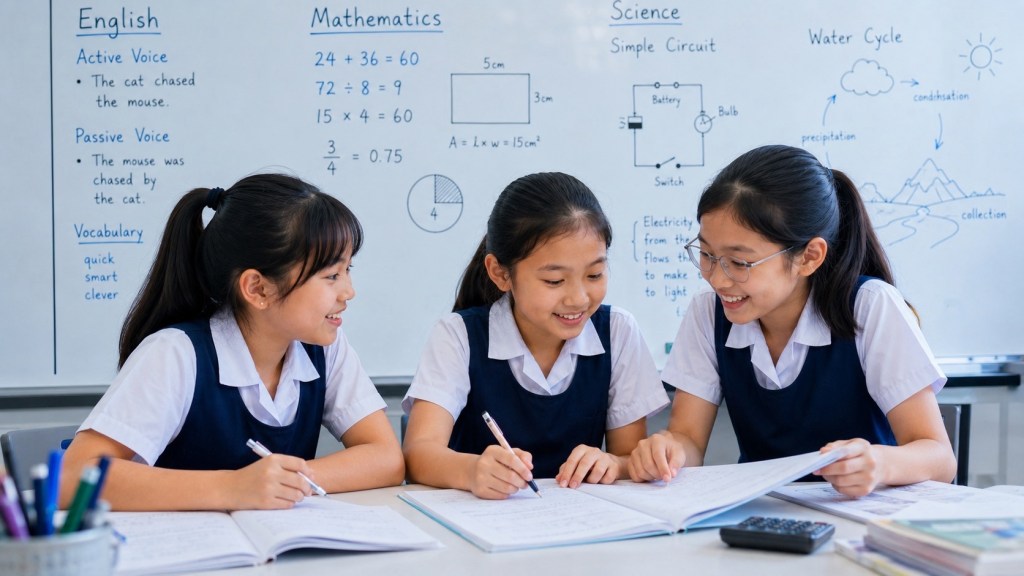
A Science question can have one correct factual answer and still leave room for more than one sensible way to think, investigate or proceed.
That distinction is important.
Primary 4 pupils are often trained to search for the answer immediately. But scientific inquiry sometimes asks for something earlier: the ability to produce several plausible possibilities before choosing which one deserves testing.
Generating possibilities is the disciplined act of seeing more than the first obvious route without pretending that every idea is equally good.
This guide develops a distinct Primary 4 Science capability inside the Primary 4 Science Learning Hub. Its ownership boundary is deliberate: this page focuses on pre-investigation possibility generation. The existing Alternative Explanations, Contradictions and Anomalies guide retains the post-result job of asking what else might explain evidence already collected.
Why Possibility Generation Belongs in Primary Science
Singapore Primary Science process-skill frameworks include generating possibilities: exploring alternatives, choices and possibilities beyond the obvious first response. Contemporary Primary 4 school materials also explicitly develop this skill through suggesting ideas, making predictions and giving reasonable explanations.
The important word is generate. Before evaluation, the learner must have something to evaluate.
Quick Answer: The Possibility Fan
STARTING QUESTION → GENERATE 3 PLAUSIBLE ROUTES → CHECK SCIENCE → CHECK SAFETY → CHECK TESTABILITY → SELECT ONE → PREDICT → TEST
This is an eduKate teaching routine, not an official MOE formula.
Wait, What? More Ideas Is Not the Same as Random Ideas
If the question is:
“How could we find out whether foam reduces cooling?”
Possible routes might include:
- compare foam-wrapped and unwrapped identical cups;
- compare foam and cloth under the same starting conditions;
- test one foam thickness against another.
Random route:
“Paint the cups different colours and count shadows.”
That does not answer the question.
Possibility generation remains constrained by the scientific job.
Generative Mode and Evaluative Mode
Strong inquiry often separates two mental jobs.
Generative mode:
- What could we try?
- What might happen?
- What other variable could we investigate?
- What other representation could help?
Evaluative mode:
- Which option is safest?
- Which is testable?
- Which changes only one important factor?
- Which gives measurable evidence?
Premature evaluation can kill useful ideas. Endless generation can prevent action. The learner needs both.
Possibility Type 1 | Several Testable Questions From One Set-Up
Consider:
- torch;
- card;
- screen.
Possible questions:
- How does object–torch distance affect shadow width?
- How does object size affect shadow width when distances are fixed?
- How does screen position affect shadow size under a fixed source/object arrangement?
Each is a different investigation.
Do not test all three at once.
Possibility Type 2 | Several Predictions From a Model
Suppose the learner understands:
light travels in straight lines.
Possible predictions include:
- moving an object nearer the light source may enlarge the shadow in a fixed-screen arrangement;
- moving the object toward the screen may reduce the shadow size in the same arrangement;
- a larger blocker may create a larger blocked region if other geometry is comparable.
The purpose is not to memorise all outcomes. It is to use the model to generate plausible consequences.
Possibility Type 3 | Several Ways to Measure a Question
Question:
“How much did the plant change?”
Possible measurements:
- height;
- leaf count;
- wilting score;
- time to visible change.
These are not interchangeable.
The learner must choose the measure that best matches the question.
Possibility Type 4 | Several Representations
The same Science can be represented as:
- prose;
- diagram;
- table;
- graph;
- cause-and-effect chain;
- concept map.
Generating representational possibilities is useful when one form hides the relationship.
Possibility Type 5 | Several Safe Methods
Question:
“How can we show that air occupies space?”
Possible safe routes:
- inverted cup in water;
- inflating a balloon and comparing its size before/after;
- trapped air in a syringe with no needle under teacher supervision.
The best route depends on available safe apparatus and the exact claim.
More Than One Valid Route Can Exist
Science assessment can sometimes accept different scientifically valid approaches when the reasoning is sound and the stated apparatus or constraints are respected.
This is an important antidote to the belief that Science always means copying one teacher route exactly.
Possibility Type 6 | Several Hypotheses or Candidate Outcomes
Before testing a new wrapping material, the learner could generate:
- temperature decrease will be smaller;
- temperature decrease will be similar;
- temperature decrease will be larger.
Then use scientific knowledge to decide which is the most reasonable prediction.
Possibility Type 7 | Several Follow-Up Questions
A first test shows foam reduces cooling more than cloth.
Possible next questions:
- Would the result repeat?
- Would thicker foam change the decrease?
- Would another material perform similarly?
- Would the same pattern remain over a longer time?
These are inquiry possibilities, not competing explanations for the first result.
Possibility Type 8 | Several Examples of One Model
Heat transfer:
- hot soup → metal spoon;
- warm room → cold bottle;
- hot drink → cooler air;
- warm water → ice.
Generating several examples tests whether the learner owns the model beyond one textbook surface.
Possibility Type 9 | Several Counterexamples
Wrong rule:
“Bigger object always has more mass.”
Generate possible counterexamples:
- large foam block vs small metal block;
- empty carton vs compact metal weight.
Possibility generation can therefore help expose overgeneralisation.
Possibility Type 10 | Several Clarification Questions
Prompt:
“The object moved closer.”
Possible clarification questions:
- Closer to the torch?
- Closer to the screen?
- Did the screen stay fixed?
Then choose the one that resolves the largest uncertainty first.
The Three-Possibility Rule as Training
When a learner jumps to the first idea, ask for three.
This is not because three is scientifically magical.
It is a training device that interrupts premature closure.
After three plausible options appear, evaluation becomes meaningful.
Premature Closure
Premature closure means stopping at the first explanation, method or answer that seems plausible.
Example:
“Plant Q wilted. Roots are damaged. Therefore root damage caused everything.”
Before the result, possibility generation would have helped design a stronger test by asking what other conditions need control.
After the result, the Alternative Explanations guide takes ownership.
Generate Before You Choose
A useful classroom sequence:
- Write three possible investigation questions.
- Write three possible measurements.
- Write three possible safe methods.
- Choose one combination that answers the target best.
Science Constrains Possibility
Not every imaginative idea is scientifically plausible.
Question:
“What may happen to a cool spoon placed in hot water?”
Plausible:
the spoon gains heat and temperature rises.
Implausible under the stated model:
the spoon becomes colder because “metal creates cold”.
Creativity and scientific constraint must work together.
Evidence Constrains Possibility
Once data exist, some possibilities become less plausible.
Generating possibilities is not refusing evidence.
It is opening the search space before evidence narrows it.
Safety Constrains Possibility
A method is not a good possibility if it requires dangerous heat, chemicals, electrical work or harm to living things.
Safe alternatives should be generated instead.
Curriculum Boundaries Constrain Possibility
Primary 4 depth should come from:
- better questions;
- better comparison;
- better evidence;
- more representations;
- more transfer;
not from racing into later-year terminology.
Original Possibility Workshop 1 | Heat
Starting question:
“Which wrapping reduces cooling?”
Generate three test variations:
- foam vs cloth;
- foam vs no wrapping;
- one layer vs two layers of the same foam.
Now choose the one that best matches the exact learning target.
Original Possibility Workshop 2 | Matter
Starting model:
liquids have fixed volume but no fixed shape.
Generate three transfer cases:
- water in a bowl;
- cooking oil in a bottle;
- juice in a jug.
Then test whether the model remains invariant.
Original Possibility Workshop 3 | Plants
Question:
“How can plant change be recorded?”
Generate:
- height;
- leaf count;
- wilting score.
Then ask which measurement best answers the specific question.
Original Possibility Workshop 4 | Digestion
Goal:
test whether route knowledge is representation-independent.
Generate:
- standard anatomy diagram;
- five boxes and arrows;
- function-clue cards;
- rotated route diagram.
The biological content remains the same while representations vary.
Original Possibility Workshop 5 | Light
Goal:
test straight-line light reasoning.
Generate:
- torch + card + screen;
- lamp + toy + wall;
- window light + object + floor.
Same model, different surfaces.
Possibility Generation and Scientific Questions
One observation can generate several questions.
Observation:
foam cup cools less.
Questions:
- Does thickness matter?
- Does material matter?
- Does time matter?
- Does lid presence matter?
Only one should usually be isolated per fair-test investigation.
Possibility Generation and Design
Question:
“How could we improve the shadow measurement?”
Possible improvements:
- larger screen;
- clearer boundary definition;
- darker room;
- same ruler position;
- repeat measurements.
Then choose the improvement that targets the observed weakness.
Possibility Generation and Answering
Before writing an open-ended explanation, generate two or three possible scientific ideas that might fit.
Then reject those not supported by the question.
This is model selection, not answer inflation.
Possibility Generation and MCQs
Before reading options, predict possible answer shapes.
Example:
“If this asks why the spoon warms, the answer should involve hotter-to-colder heat transfer and conduction.”
That prediction creates a possibility before distractors appear.
Possibility Generation and Peer Work
One learner proposes a method.
A partner adds another.
Then both ask:
- Which one is safer?
- Which is more controlled?
- Which produces measurable evidence?
Peer diversity can widen the possibility set before evaluation.
Possibility Generation and Confidence
The first idea feels obvious partly because it arrived first.
Ask:
“What else could I do before I decide?”
This creates cognitive space.
Possibility Generation and Novelty
Novel does not mean useful.
A good scientific possibility must still be:
- relevant;
- safe;
- testable or explainable;
- within the known model;
- capable of producing interpretable evidence.
A Possibility Filter
| Question | Pass? |
|---|---|
| Does it answer the scientific job? | □ |
| Is it safe? | □ |
| Can it be tested or reasoned about? | □ |
| Does it stay within Primary 4 boundaries? | □ |
| Can useful evidence be collected? | □ |
Common Possibility-Generation Errors
- stops at first idea;
- generates random unrelated ideas;
- judges before generating;
- keeps generating and never chooses;
- changes several variables at once;
- confuses pre-investigation possibilities with post-result explanations;
- creates unsafe methods;
- uses advanced vocabulary instead of better ideas.
Original Practice Set
Question 1
What is the difference between generating and evaluating?
Question 2
Why should a learner sometimes produce more than one method?
Question 3
What makes a possibility scientifically useful?
Question 4
Generate two ways to test a Light concept without changing the scientific model.
Question 5
Generate two measurements that could describe plant change.
Question 6
Why should only one major variable usually be changed in a fair test?
Question 7
How is this page different from Alternative Explanations?
Question 8
What should happen after several possibilities are generated?
Practice Answers
1. Generating creates plausible options; evaluating judges which option best meets the criteria.
2. It prevents premature closure and reveals whether another route may be safer, clearer or more testable.
3. It is relevant, scientifically plausible, safe, testable or reasoned, and capable of producing useful evidence.
4. Examples: torch-card-screen and lamp-toy-wall.
5. Examples: height and leaf count.
6. Changing several factors makes cause harder to isolate.
7. This page generates options before or while planning inquiry; Alternative Explanations evaluates competing causes after evidence appears.
8. Apply criteria, choose a route, predict and test.
The Possibility Diagnostic
| If the learner… | Likely weak link | Repair |
|---|---|---|
| always gives first idea | premature closure | generate three plausible routes |
| gives wild ideas | scientific constraint | use relevance/safety/testability filter |
| cannot choose | evaluation | apply criteria after generation |
| changes many variables | investigation structure | one question per test |
| repeats textbook only | transfer | generate new surface examples |
A 30-Minute Possibility Lesson
Minutes 1–5: generate three questions from one observation.
Minutes 6–10: generate three possible measurements.
Minutes 11–15: generate three safe methods.
Minutes 16–20: apply the possibility filter.
Minutes 21–25: choose one route and predict.
Minutes 26–30: transfer the same generative process to a new topic.
What Parents and Tutors Can Ask
- “What is your first idea?”
- “What are two other plausible routes?”
- “Which one actually answers the question?”
- “Which is safest?”
- “Which gives the clearest measurement?”
- “What will you predict before testing?”
Continue Batch 17
- Seeking Clarification, Resolving Ambiguity and Asking the Next Useful Question
- Making Scientific Decisions with Criteria, Consequences and Values
- Defending Scientific Ideas, Peer Critique and Revision
The Quiet Return
Scientific creativity is not the freedom to say anything.
Open the possibility space. Generate beyond the first obvious route. Keep every idea inside scientific, safety and evidence boundaries. Then choose deliberately—and let the test decide what survives.
