
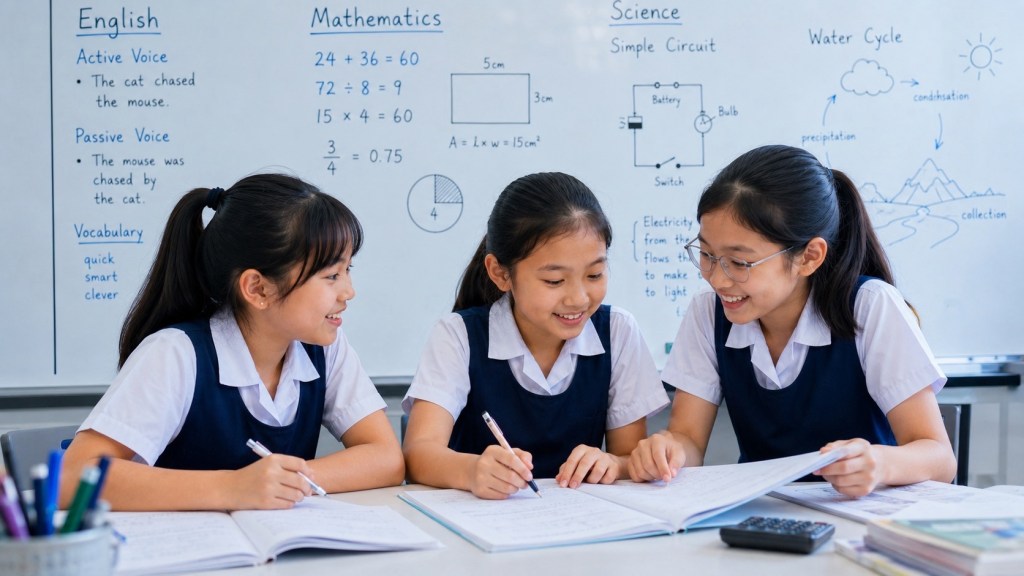
Four pupils stand around one experiment.
One pupil touches every piece of apparatus.
One writes down numbers.
Two watch.
At the end, the group submits one answer.
Was that collaborative Science?
Not necessarily.
Collaboration becomes scientific when pupils share the work of inquiry without surrendering individual responsibility for understanding the evidence.
This guide belongs to the Primary 4 Science Learning Hub. Its job is distinct from the project page’s general team planning and from the peer-critique page’s discussion routines. This page owns live collaborative investigation: roles, apparatus, shared evidence, data integrity and individual accountability.
Why Collaborative Investigation Matters
Primary Science inquiry often uses shared apparatus, limited materials and small-group activity. Research on collaborative science inquiry shows that roles and interaction structures shape what pupils notice, discuss and learn. The current Singapore Primary Science environment also increasingly uses activity-based and collaborative learning to support investigation and scientific discourse.
Useful references include Northshore Primary School Science and research on collaborative science inquiry in primary classrooms.
Quick Answer: The Collaborative Inquiry Loop
SHARED QUESTION → ROLE ASSIGNMENT → COMMON METHOD → SHARED OBSERVATION → DATA CHECK → INDIVIDUAL INTERPRETATION → GROUP CHALLENGE → CONSENSUS / DISAGREEMENT RECORD → ROLE ROTATION
This is an eduKate teaching routine, not an official MOE group-work formula.
Wait, What? Group Work Is Not Automatically Collaboration
Parallel work:
- one pupil measures;
- one writes;
- others wait.
Collaborative inquiry:
- roles are meaningful;
- every pupil knows the question;
- evidence is visible to everyone;
- measurement decisions are discussable;
- interpretation is not outsourced to one “smart” pupil;
- roles rotate.
Principle 1 | One Shared Scientific Question
Every group member should be able to state:
“What are we trying to find out?”
If the recorder knows only what to write and the measurer knows only what to measure, collaboration is fragmented.
Principle 2 | Roles Should Serve the Science
Useful roles can include:
- Question Keeper — protects the central scientific question.
- Apparatus Manager — checks set-up and safe handling.
- Measurer — performs the current measurement.
- Recorder — records value, unit, condition and trial.
- Consistency Checker — watches whether method stays the same.
- Evidence Challenger — asks whether the data support the emerging claim.
- Explainer — summarises the scientific reasoning.
Not every investigation needs all roles. Choose only what the task needs.
Principle 3 | Roles Rotate
If one child is always the measurer, others may never build practical competence.
Rotate after:
- each trial;
- each condition;
- each station;
- each short investigation.
Role rotation turns shared apparatus into shared learning.
Principle 4 | Shared Evidence Must Be Public Inside the Group
Do not let one recorder keep a private notebook.
Use:
- central table;
- shared whiteboard;
- large recording sheet;
- visible digital table if school-approved.
Everyone should see the same evidence.
Principle 5 | Individual Reasoning Still Matters
After data collection, pause.
Before group discussion, each pupil writes one sentence:
“The evidence suggests…”
This prevents one confident voice from supplying the interpretation for everyone.
Group Evidence vs Individual Answer
The group may share:
- apparatus;
- measurements;
- table;
- observations.
But each learner should still be able to:
- explain the pattern;
- state the scientific model;
- identify a limitation;
- answer a fresh transfer question.
Collaborative Investigation 1 | Shadow Distance
Question:
How does object–torch distance affect shadow width?
Possible roles:
- source/set-up manager;
- distance measurer;
- shadow-width measurer;
- recorder;
- consistency checker.
Rotate after each distance condition.
Shared Protocol for the Shadow Task
Before Trial 1, group agrees:
- where object distance is measured from/to;
- where shadow width is measured;
- which unit is used;
- which parts remain fixed.
Collaboration begins by making the method common.
Collaborative Investigation 2 | Cooling
Question:
Which wrapping reduces cooling more?
Possible roles:
- water-volume checker;
- temperature reader;
- timer;
- recorder;
- control checker.
Everyone must know why equal starting conditions matter.
One Person Should Not Read Both Thermometers Automatically
Sometimes consistency is improved by one measurer.
Sometimes learning is improved by role rotation.
A compromise:
- one person reads both thermometers within a single trial for consistency;
- roles rotate for the next trial.
Scientific quality and learning opportunity both matter.
Collaborative Investigation 3 | Matter and Volume
Question:
Does container shape change liquid volume if none is lost?
Roles:
- volume measurer;
- transfer handler;
- spill observer;
- recorder;
- conclusion checker.
If any liquid spills, the group must record that the trial no longer tests clean conservation.
Collaborative Investigation 4 | Plant Observation
A group can observe several comparable plants.
Roles:
- height measurer;
- leaf observer;
- context recorder;
- photo/sketch recorder where permitted;
- inference checker.
Do not harm plants to create evidence.
Collaborative Investigation 5 | Practical Station Rotation
Set stations:
- measurement;
- light;
- matter;
- plant observation.
At each station, roles rotate so every pupil performs a different process skill.
Role: Question Keeper
Job:
keep the group answering the actual scientific question.
Useful prompt:
“Does this measurement help answer our question?”
This prevents interesting but irrelevant detours.
Role: Apparatus Manager
Job:
- check set-up;
- protect safety;
- ensure apparatus is returned/reset;
- announce any equipment problem.
This is not “the child who gets to touch everything”.
Role: Measurer
Job:
- use agreed method;
- read carefully;
- announce value clearly;
- include unit.
Other group members should watch and be allowed to challenge obvious inconsistencies.
Role: Recorder
Job:
- repeat the value aloud;
- record condition;
- record unit;
- mark unusual data;
- never “clean” the data without discussion.
Role: Consistency Checker
Job:
watch for:
- changed starting point;
- different timing;
- different measurement position;
- moving controls;
- switched units.
This role protects method integrity.
Role: Evidence Challenger
Job:
ask one question such as:
- “Does that value fit the others?”
- “What else changed?”
- “Are we comparing the same property?”
- “Do we need to repeat this condition?”
The challenger protects the evidence, not personal status.
Role: Explainer
Job:
summarise:
- what changed;
- what was measured;
- what pattern appeared;
- which scientific idea explains it;
- what the evidence does not prove.
Then another pupil should be asked to restate it.
Shared Method Agreement
Before starting, group completes:
WE WILL CHANGE ___, MEASURE ___, KEEP ___ COMPARABLE, RECORD IN ___, AND STOP IF ___.
This one sentence can align the whole investigation.
Shared Language Agreement
Decide key terms:
- object–torch distance;
- temperature decrease;
- initial volume;
- final volume;
- wilting score.
If pupils use different meanings, shared data become unreliable.
Shared Units
One pupil records cm; another records m; a third forgets units.
Before collecting evidence, agree:
- cm;
- mL;
- °C;
- g;
- min.
Consistency reduces conversion and interpretation errors.
Data Call-and-Response
A useful protocol:
Measurer: “Fourteen centimetres.”
Recorder: “Trial 2, 20 cm distance, shadow width 14 cm—correct?”
Measurer: “Correct.”
This reduces transcription errors.
Group Data Should Not Be Edited Silently
If 29 cm looks anomalous beside 14 and 15 cm:
do not erase it because the group “knows” it is wrong.
Discuss and repeat.
Shared evidence requires transparent changes.
Consensus Is Not the Same as Truth
Four pupils can agree on the wrong explanation.
Ask:
“What evidence supports the consensus?”
Agreement is a social state, not scientific evidence.
Disagreement Can Be Useful
Learner A:
“The lower final temperature means Cup A cooled more.”
Learner B:
“We need starting temperatures.”
Do not vote.
Return to the scientific question: cooling amount requires change from baseline.
Disagreement Protocol
- State each claim.
- Identify evidence each uses.
- Check the scientific model.
- Name missing information.
- Decide whether evidence resolves the disagreement.
- If not, design a next measurement.
Dominant Voice Problem
One fast pupil answers before others think.
Repair:
use silent individual prediction before group discussion.
Sequence:
- everyone writes;
- round-robin share;
- evidence discussion;
- group conclusion.
Quiet Voice Problem
A learner may understand but rarely speak.
Use roles that guarantee contribution:
- must read one measurement;
- must ask one evidence question;
- must summarise one control;
- must give individual interpretation first.
Recorder Trap
The recorder can become a secretary who stops thinking scientifically.
Require the recorder to:
- repeat values;
- flag anomalies;
- ask for units;
- explain the final pattern.
Apparatus Manager Trap
The apparatus manager can become the only hands-on pupil.
Role should be:
protect the common set-up, not monopolise manipulation.
Explainer Trap
The strongest speaker may become permanent explainer.
Rotate explanation duty.
After one explanation, randomly ask another group member to restate the mechanism.
Role Rotation Table
| Trial | Measurer | Recorder | Checker | Explainer |
|---|---|---|---|---|
| 1 | A | B | C | D |
| 2 | B | C | D | A |
| 3 | C | D | A | B |
Rotate deliberately rather than “naturally”.
Shared Evidence, Individual Exit Ticket
After group work, every learner answers independently:
- What changed?
- What was measured?
- What pattern appeared?
- What is one limitation?
This reveals whether group participation became individual understanding.
Shared Evidence, Individual Transfer
After a group shadow investigation, give each pupil a different new diagram.
If the learner can transfer independently, collaboration succeeded as learning.
Collaborative Investigation and Self-Assessment
Group criteria:
- everyone can state question;
- roles are meaningful;
- method is shared;
- data are visible;
- anomalies are discussed;
- each learner can explain result.
Collaborative Investigation and Feedback
Feedback should target group process scientifically.
Weak:
“Work better together.”
Better:
“Your group recorded three measurements, but only one person knows which condition each belongs to. Use a shared table and call-and-response recording.”
Collaborative Investigation and Practical Assessment
During group practicals, teachers can observe:
- apparatus handling;
- measurement consistency;
- questioning;
- role fulfilment;
- data integrity;
- scientific talk.
But individual understanding should still be checked separately.
Collaborative Investigation and Peer Critique
Peer critique happens inside collaboration, but the ownership differs.
This page asks:
How does the group run the inquiry?
The critique guide asks:
How is an idea challenged, defended and revised?
Collaborative Investigation and Projects
A project may last days; collaborative investigation may last fifteen minutes.
This page focuses on the live inquiry event: roles, apparatus, shared data and interpretation.
Collaborative Investigation and Fairness
Fairness has two meanings:
- scientific fairness: comparison conditions are controlled;
- participation fairness: learning opportunities are distributed.
A strong group protects both.
Collaborative Investigation and Safety
Everyone is responsible for safety.
Apparatus manager is not the only person who can call “stop”.
Any group member should stop the task if:
- water approaches electrical equipment;
- apparatus becomes unstable;
- heat becomes unsafe;
- living things are being harmed;
- instructions are misunderstood in a risky way.
Original Group Challenge 1 | Cooling
Design roles for four pupils so that:
- starting temperature is checked;
- time is consistent;
- measurements are recorded;
- controls are monitored.
Then rotate roles for Trial 2.
Original Group Challenge 2 | Matter
One pupil transfers 100 mL water; another watches for spills; another remeasures; another records.
Question:
What should happen if a spill occurs?
Answer:
record the problem and repeat with the correct starting volume rather than pretending the trial demonstrates conservation.
Original Group Challenge 3 | Light
One pupil changes distance; one checks source/screen remain fixed; one measures shadow; one records.
Then all four independently describe the trend.
Original Group Challenge 4 | Plant Observation
Each pupil observes a different comparable plant using the same agreed criteria.
Then compare.
If observations differ widely, ask whether plants differ or observers used different definitions.
Original Group Challenge 5 | Disagreement
Two pupils disagree whether a cup cooled more.
Do not vote.
Ask:
“What baseline and calculation does the question require?”
Group Investigation Checklist
| Question | Check |
|---|---|
| Can everyone state the question? | □ |
| Are roles scientifically meaningful? | □ |
| Is the method shared and explicit? | □ |
| Can everyone see the data? | □ |
| Are anomalies discussed openly? | □ |
| Do roles rotate? | □ |
| Can each learner interpret independently? | □ |
Common Collaboration Errors
- one pupil does all apparatus work;
- recorder stops thinking;
- group votes instead of using evidence;
- roles never rotate;
- data are hidden in one notebook;
- dominant pupil answers first every time;
- quiet pupils have no required contribution;
- consensus is mistaken for correctness;
- group answer hides individual misunderstanding.
Original Practice Set
Question 1
What makes group work scientifically collaborative?
Question 2
Why should roles rotate?
Question 3
Why should data be visible to the whole group?
Question 4
Why is consensus not evidence?
Question 5
What is the job of a consistency checker?
Question 6
How can a group prevent a dominant voice from supplying all the thinking?
Question 7
Why should individual exit tickets follow group investigation?
Question 8
What are the two meanings of fairness in collaborative investigation?
Practice Answers
1. Pupils share a scientific question, method and evidence while each remains accountable for understanding and reasoning.
2. So every learner develops practical and interpretive skills rather than one pupil monopolising a role.
3. Shared visibility allows checking, challenge and common interpretation.
4. Agreement is social; scientific claims still require evidence and model fit.
5. To watch whether timing, measurement position, controls and definitions remain consistent.
6. Require silent individual predictions before discussion and use round-robin sharing.
7. To verify that shared activity became individual scientific understanding.
8. Scientific fairness of the comparison and participation fairness of learning opportunities.
The Collaboration Diagnostic
| If the group… | Likely weak link | Repair |
|---|---|---|
| has one expert | role monopoly | rotate roles + individual exit |
| argues by confidence | evidence use | claim → evidence → model |
| loses data | shared recording | central table + call-back |
| gets inconsistent readings | common method | consistency checker |
| submits one answer only | individual accountability | fresh independent transfer |
A 35-Minute Collaborative Inquiry Lesson
Minutes 1–5: state question and assign roles.
Minutes 6–10: agree measurement definitions and table.
Minutes 11–20: collect evidence with one role rotation.
Minutes 21–25: individual interpretation before discussion.
Minutes 26–30: group challenge and conclusion.
Minutes 31–35: individual exit ticket or transfer item.
What Parents and Tutors Can Ask
- “Can every person state the question?”
- “Who measures next?”
- “Where can everyone see the data?”
- “What does the checker watch for?”
- “Did you agree because of evidence or because someone spoke first?”
- “Can each of you explain the result alone?”
Complete Batch 19 | Primary 4 Science Learning Guide
- Primary 4 Science Learning Guide | Practical Tests and Performance Tasks Under Real Conditions
- Primary 4 Science Learning Guide | Self-Assessment, Rubrics and Success Criteria
- Primary 4 Science Learning Guide | Acting on Feedback, Feedforward and the Next Repair
- Primary 4 Science Learning Guide | Collaborative Investigations, Group Roles and Shared Evidence
Return to the Primary 4 Science Learning Hub.
The Quiet Return
Good collaboration does not make individual thinking disappear.
Share the question. Share the apparatus. Share the evidence. Rotate the roles. Challenge the data openly. Then separate again: each learner should be able to explain the result, identify the limitation and carry the scientific model into a new problem without the group speaking for them.
