
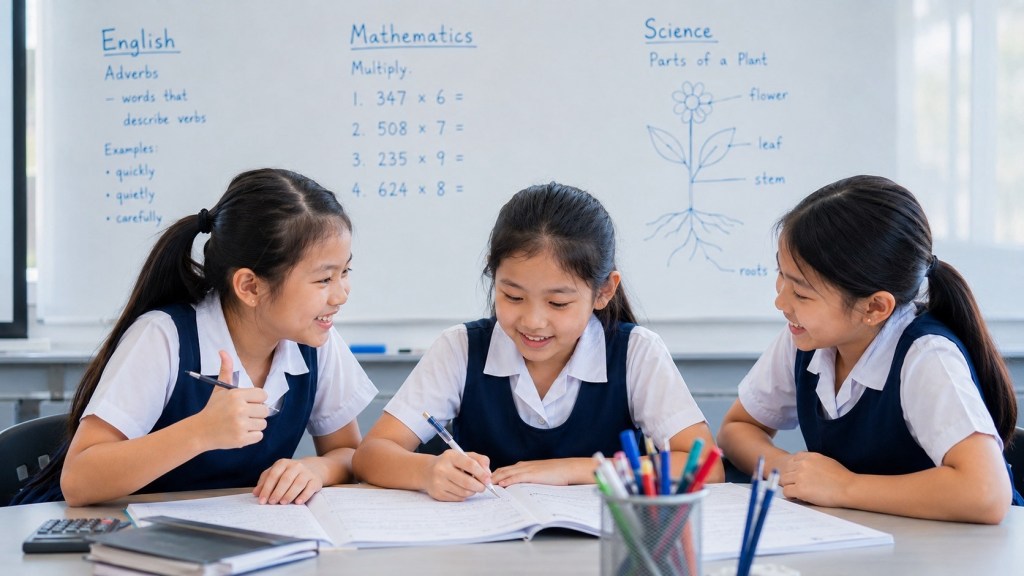
This Primary 2 Mathematics Practice Guide is for the moment when a child already knows the arithmetic but still asks, “What do I do with this problem?” The focus is not keyword hunting. It is relationship recognition, representation choice, state tracking, heuristic use and verification.
Each section contains problems that require the learner to decide what is known, what is unknown, how the quantities relate, which representation is useful and whether the final answer makes sense. The worked solutions deliberately show the reasoning structure, not merely the final operation.
Return to the Primary 2 Mathematics Learning Hub. For concept teaching, use Guides 7, 9, 10, 18–20, 27 and 28.
Read for the relationship → represent it → calculate → return to context → verify.
A Primary 2 Heuristic Toolkit
| Heuristic | Useful when… |
|---|---|
| Part-whole model | parts combine into a whole or a part is missing |
| Comparison model | one quantity is more/fewer than another |
| Equal-group model / array | groups have equal size |
| Timeline / before-after | a quantity or time changes through events |
| Make a systematic list | several answers may satisfy conditions |
| Guess, check and improve | a constrained answer can be tested efficiently |
| Work backwards | the final state is known but the starting state is not |
| Draw a simple diagram | positions, containers or relationships are easier to see visually |
| Use a table | several cases or categories must be organised |
| Eliminate impossible cases | conditions rule out many choices |
Set A | Part-Whole Problems
- There are 28 red balloons and 35 blue balloons. How many altogether?
- A box contains 63 beads altogether. 27 are red. How many are blue?
- A shelf has 42 fiction books and some non-fiction books. There are 75 books altogether. Find the non-fiction books.
- Two classes collected 238 cans and 157 cans. Find the combined total.
Worked Solutions | Set A
- Parts 28 and 35 form the whole: 28+35=63 balloons.
- Whole 63, known part 27: 63−27=36 blue beads.
- 75−42=33 non-fiction books.
- 238+157=395 cans.
Set B | Comparison Problems
- Arun has 76 marbles. Lina has 28 more. How many does Lina have?
- Lina has 104 cards, 27 more than Ben. How many does Ben have?
- Class A collected 68 cans and Class B collected 52. How many more did A collect?
- Mei has 35 stickers. Zhi has 12 fewer. How many does Zhi have?
- Zhi has 38 stickers. Hana has 16 more. How many does Hana have?
Worked Solutions | Set B
- 76+28=104.
- 104−27=77. “More” does not force addition; the larger quantity is already known.
- 68−52=16 cans.
- 35−12=23.
- 38+16=54.
Set C | Equal-Group Problems
- There are 6 bags with 4 apples in each. Find the total.
- Twenty-four apples are shared equally among 6 children. How many each?
- Twenty-four apples are packed 4 per bag. How many bags?
- Five tables each seat 3 pupils. How many pupils can sit?
- Thirty crayons are packed equally into 5 boxes. How many in each?
Worked Solutions | Set C
- 6×4=24 apples.
- 24÷6=4 each.
- 24÷4=6 bags.
- 5×3=15 pupils.
- 30÷5=6 crayons per box.
Set D | Before–After and State Tracking
- A bus has 48 passengers. 19 get off. How many remain?
- Then 26 passengers get on. How many are now on the bus?
- A shop has 350 balloons. It sells 128 in the morning and 96 in the afternoon. How many remain?
- A jar has 38 pencils. 17 are added, then 9 are removed. How many remain?
- A library has 420 books. It receives 85 new books and then loans out 63. How many are left on the shelves?
Worked Solutions | Set D
- 48−19=29.
- 29+26=55. The answer from the first step becomes the new state.
- 350−128=222; 222−96=126.
- 38+17=55; 55−9=46.
- 420+85=505; 505−63=442.
Set E | Working Backwards
- After giving away 18 stickers, Mei has 35 left. How many did she have at first?
- A box contains 42 pencils after 15 were added. How many were there before?
- A bus has 55 passengers after 26 boarded. How many were there immediately before they boarded?
- A child has $4.20 left after spending $2.80. How much did the child have first?
Worked Solutions | Set E
- Undo “give away 18” with +18: 35+18=53.
- Undo +15 with −15: 42−15=27.
- 55−26=29 passengers.
- $4.20+$2.80=$7.00.
Set F | Make a Systematic List
- Find all whole-number pairs from 0 to 10 that add to 10.
- Find all even-number pairs from 0 to 20 that add to 20, without reversing duplicates.
- Find three pairs with a difference of 8.
- Using 2, 3, 4, 5 and 10 times-table facts, find ways to make 20 as equal groups.
Worked Solutions | Set F
- 0+10,1+9,2+8,3+7,4+6,5+5 and reversed forms if order matters.
- 0+20, 2+18, 4+16, 6+14, 8+12, 10+10.
- Examples: 10 and 2; 15 and 7; 100 and 92.
- Examples: 2×10, 4×5, 5×4, 10×2.
The important habit is not the list itself. It is changing one quantity systematically so cases are not missed or repeated randomly.
Set G | Guess, Check and Improve
- I am a 3-digit number between 400 and 500. My tens digit is 2. My ones digit is 7. What am I?
- Two whole numbers add to 30. One is 6 more than the other. Find them.
- A number is greater than 250 but less than 300. It is a multiple of 10 and its tens digit is 7. Find it.
- Find two equal groups whose total is 24 and each group has more than 5 objects.
Worked Solutions | Set G
- 427.
- Try pairs around half of 30: 12 and 18 work because total 30 and difference 6. 12 and 18.
- 270.
- Two groups of 12 satisfy the condition: 2×12=24. If restricted to Primary 2 table factors only, discuss allowed representations with the teacher.
Set H | Missing and Extra Information
- A box has 28 blue beads and some red beads. How many beads altogether? Can you solve exactly?
- A box has 28 blue beads, 35 red beads and weighs 2 kg. How many beads altogether? Which information is extra?
- A shop item costs $6.40. A customer pays some amount. How much change? What is missing?
- A journey begins at 2:30 pm. What time does it end? What is missing?
- A picture graph shows four symbols for cats but gives no key. Can the exact number of cats be known?
Worked Solutions | Set H
- No. Number of red beads is missing.
- 28+35=63 beads. The 2 kg mass is extra.
- The payment amount is missing.
- The duration or end condition is missing.
- No. The scale/key is needed.
Set I | Draw a Model Before Calculating
For each problem, identify the model type before solving.
- Sam has 48 cards. Jo has 17 more. Find Jo’s cards.
- There are 35 red and 29 blue counters. Find the total.
- There are 32 sweets shared among 4 pupils. Find each share.
- A lesson starts at 2:35 pm and lasts 45 minutes. Find the end time.
- A jar has 80 beads. Some are removed and 53 remain. If 27 were removed, check whether the information is consistent.
Worked Solutions | Set I
- Comparison model. 48+17=65.
- Part-whole model. 35+29=64.
- Equal-sharing model. 32÷4=8.
- Timeline. 25 min to 3:00 +20 min = 3:20 pm.
- Before-after model. 80−27=53, so the information is consistent.
Set J | Non-Routine Number Reasoning
- Use the digits 2, 5 and 7 once each to make the greatest 3-digit number and smallest 3-digit number. Find their difference.
- A number is 10 more than 398 and 100 less than another number. Find both numbers.
- Find a 3-digit number with digit sum 12, hundreds digit 5 and tens digit greater than ones digit.
- Find three different calculations with answer 100 using only addition or subtraction.
- Which is closer to 500: 468 or 537? Explain without a calculator.
Worked Solutions | Set J
- Greatest 752; smallest 257; difference = 495.
- 398+10=408. The other number is 408+100=508.
- One example: 5+4+3=12 and 4>3 → 543. Other valid answers may exist.
- Examples: 60+40, 125−25, 47+53.
- 500−468=32; 537−500=37. 468 is closer.
Set K | Multi-Step Mixed Problems
- A class has 28 pupils. Each pupil receives 3 worksheets. The teacher has 90 worksheets. How many worksheets are left?
- A child has $20. A toy costs $8.40 and a book costs $5.75. How much money remains?
- A tank contains 3 L. Another 4 L is added, then 2 L is removed. How much remains?
- A school collected 275 cans on Monday and 189 Tuesday. It packs them equally into 4 large containers. First find the total. Is exact equal sharing possible with whole cans?
- A trip starts at 9:35 am. The first stage takes 25 minutes and the second stage 40 minutes. Find the arrival time.
Worked Solutions | Set K
- 28×3=84; 90−84=6 worksheets.
- $8.40+$5.75=$14.15; $20−$14.15=$5.85.
- 3+4=7; 7−2=5 L.
- 275+189=464. 464÷4=116 cans each, so exact equal sharing is possible.
- 9:35+25 min=10:00; +40 min=10:40 am.
Set L | Error Analysis and Strategy Choice
- A learner sees “12 more than” and always adds. Explain why that rule is unsafe.
- A learner draws a detailed picture of 73 balloons for a comparison problem. Suggest a better representation.
- A learner uses every number in a word problem automatically. What question should be asked first?
- A learner gets a correct answer but cannot say what it represents. What should be repaired?
- A learner repeats the same failed method three times. What could be done instead?
Worked Responses | Set L
- “More than” describes a comparison relationship; the operation depends on which quantity is unknown.
- Use a comparison bar model or number line showing the two quantities and the difference.
- Ask: What does the final unknown depend on? Some numbers may be irrelevant.
- Repair contextual interpretation and unit/role labelling.
- Choose a different representation, trace the first weak link, or work backward from what is known.
Final Mixed Revision | No Strategy Labels
- There are 4 boxes with 6 crayons each. Seven crayons are used. How many remain?
- Mira has 63 stickers, 18 more than Jon. How many does Jon have?
- A 5 L jug contains 2 L. Three more litres are poured in. Is it full?
- A class survey records 8, 6, 4 and 6 votes. How many votes altogether?
- A lesson starts at 1:50 pm and ends at 2:35 pm. Find the duration.
- A number is 100 more than 365. Another number is 27 less than that result. Find the final number.
- Three quarters of 20 counters are red. Five of the remaining counters are blue. How many counters are neither red nor blue?
- A shop has 300 balloons. It sells 96 and later receives 45 new balloons. How many balloons now?
Worked Solutions | Final Mixed Revision
- 4×6=24; 24−7=17 crayons.
- 63−18=45 stickers.
- 2+3=5 L, exactly the stated capacity, so yes.
- 8+6+4+6=24 votes.
- 10 min to 2:00 +35 min=45 minutes.
- 365+100=465; 465−27=438.
- 3/4 of 20=15 red. Remaining=5. If all five remaining are blue, 0 are neither. The wording says five remaining counters are blue, so that uses all remaining counters.
- 300−96=204; 204+45=249 balloons.
A Better Revision Routine Than “Do More Questions”
- Attempt a small mixed set.
- Mark uncertainty, not only wrong answers.
- Classify the first weak link: language, model, fact, procedure, unit, state tracking or verification.
- Repair only that dependency.
- Retry the original question.
- Solve one near variation.
- Return after a delay without the worked solution visible.
What Mastery Looks Like
A strong Primary 2 problem solver can identify the unknown, separate relevant from irrelevant information, choose a useful representation, use part-whole/comparison/equal-group/before-after structures, apply simple heuristics when a direct route is not obvious, track intermediate states, interpret answers with correct units and verify using another representation, inverse operation or reasonableness check.
Heuristics are not magic tricks. They are organised ways of exposing structure when the route is not immediately visible.
