
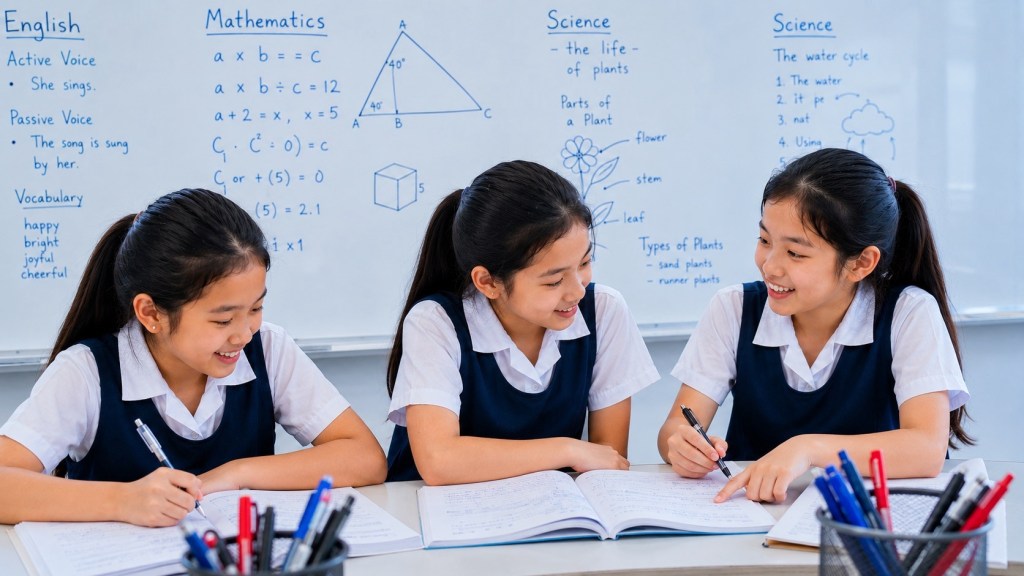
This Primary 2 Mathematics Practice Guide turns the applied strands—money, measurement, time, geometry and data—into a single diagnostic practice system. These topics often look easier than arithmetic because the numbers are smaller. In reality they add extra demands: units, scales, instruments, diagrams, labels, container shape, clock structure and contextual interpretation.
The learner should attempt each set before opening the worked solutions. When an answer is wrong, identify whether the first weak link is the number calculation or the representation rule: money notation, ruler origin, unit choice, balance direction, clock scale, shape attribute, graph key or data category.
Return to the Primary 2 Mathematics Learning Hub. Relevant concept owners include Guides 11–16 and Guides 26, 29, 30, 33–36.
In applied mathematics, the unit, scale, diagram or instrument rule is part of the problem—not decoration around it.
Set A | Money Representation and Exchange
- Convert $3.45 to cents.
- Convert 608¢ to dollars and cents.
- Which is greater: $4.05 or $4.50?
- Make $1 using only 50¢ coins.
- Make $1 using 20¢ coins.
- Write two different coin combinations for 80¢.
- Count: one $5 note, one $2 note, two 50¢ coins and one 20¢ coin.
- True or false: exchanging one $1 coin for two 50¢ coins changes the total value.
Worked Solutions | Set A
- 345¢.
- $6.08.
- $4.50. Compare cents: 50¢ > 5¢.
- 50¢ + 50¢.
- Five 20¢ coins.
- Examples: 50¢+20¢+10¢; four 20¢ coins.
- $8.20.
- False. The representation changes, not the value.
Set B | Money Transactions
- A book costs $4.35 and a pen costs $2.20. Find the total.
- You pay $10 for an item costing $6.70. Find the change.
- Two identical toys cost $3 each. How much altogether?
- A child has $8.50 and spends $2.75. How much remains?
- A snack costs $1.80. Can $1.50 pay for it? How much more is needed?
- A notebook costs $2.40. Three pupils each buy one. What is the total cost?
Worked Solutions | Set B
- $4.35+$2.20=$6.55.
- $10.00−$6.70=$3.30.
- 2×$3=$6.
- $8.50−$2.75=$5.75.
- No. $1.80−$1.50=$0.30 more.
- 3×$2.40=$7.20.
Set C | Rulers, Centimetres and Metres
- A pencil begins at 0 cm and ends at 14 cm. Find its length.
- A crayon begins at 3 cm and ends at 12 cm. Find its length.
- A line begins at 5 cm and ends at 17 cm. Find its length.
- Which unit is more sensible for a classroom length: cm or m?
- Which unit is more sensible for an eraser: cm or m?
- A ribbon is 38 cm. Another is 25 cm. How much longer is the first?
- Order: 42 cm, 18 cm, 35 cm from shortest to longest.
- If you draw a 7 cm line starting at the 2 cm mark, where should it end?
Worked Solutions | Set C
- 14 cm.
- 12−3=9 cm.
- 17−5=12 cm.
- m.
- cm.
- 38−25=13 cm.
- 18 cm, 35 cm, 42 cm.
- 9 cm mark. 9−2=7.
Set D | Mass
- Choose g or kg for the mass of a pencil.
- Choose g or kg for the mass of a child.
- Which is heavier: 650 g or 420 g?
- Find the difference between 650 g and 420 g.
- An object balances 200 g + 100 g + 50 g. What is its mass?
- A balance has a book on the left and a toy on the right. The left side is lower. Which is heavier?
- Two parcels weigh 300 g and 250 g. Find their combined mass.
- Which is more plausible for a school bag: 4 kg or 4 g?
Worked Solutions | Set D
- g.
- kg.
- 650 g.
- 230 g.
- 350 g.
- The book. The heavier pan moves lower.
- 550 g.
- 4 kg.
Set E | Liquid Volume and Capacity
- A jug has capacity 5 L and currently contains 2 L. How much unused capacity remains?
- A 4 L container already has 3 L. Can another 2 L fit fully?
- Two jugs contain 2 L and 3 L. If combined without spilling, what is the total?
- A tall narrow bottle and short wide jug each contain 1 L. Which contains more?
- Which is greater: 6 L or 4 L?
- A bucket can hold 8 L but contains 5 L. State its capacity and current volume separately.
- One container has 7 L and another 3 L. Find the difference.
- Would 20 L be a sensible amount for a small drink bottle? Explain.
Worked Solutions | Set E
- 5−2=3 L unused.
- No. 3+2=5 L, which exceeds 4 L capacity by 1 L.
- 5 L.
- Equal. Both are measured as 1 L; container shape does not change the amount.
- 6 L.
- Capacity=8 L; current volume=5 L.
- 4 L.
- No. It is far beyond an ordinary small-bottle benchmark.
Set F | Reading Analogue and Digital Time
- If the minute hand points at 3, how many minutes past the hour?
- If the minute hand points at 7, how many minutes?
- If the minute hand points at 11, how many minutes?
- Write 7 minutes after 4 in digital form.
- At 6:30, where is the minute hand?
- At 6:30, where should the hour hand be?
- At 4:45, which hour are we still in?
- Choose a.m. or p.m.: a pupil reaches school at 7:20 ___.
Worked Solutions | Set F
- 15 minutes.
- 35 minutes.
- 55 minutes.
- 4:07.
- At 6. Six groups of five minutes = 30.
- Halfway between 6 and 7.
- The four o’clock hour.
- a.m.
Set G | Duration and Timelines
- A lesson starts at 2:35 pm and ends at 3:20 pm. Find the duration.
- A journey begins at 9:25 am and lasts 50 minutes. Find the end time.
- A show ends at 5:10 pm after lasting 40 minutes. Find the start time.
- Convert 2 h to minutes.
- Convert 90 minutes to 1 h and how many minutes?
- A game begins at 10:50 am and lasts 25 minutes. Find the end time.
Worked Solutions | Set G
- 25 min to 3:00, then 20 min → 45 minutes.
- 35 min to 10:00, then 15 min → 10:15 am.
- Count back 10 min to 5:00 and 30 more → 4:30 pm.
- 120 minutes.
- 1 h 30 min.
- 10 min to 11:00, then 15 min → 11:15 am.
Set H | 2D and 3D Shape Attributes
- Name a 2D shape with 3 straight sides.
- Name a 2D shape with 4 equal sides and 4 right angles.
- How many flat faces does a cube have?
- What shape are the faces of a cube?
- Which has no flat faces: sphere or cylinder?
- Which 3D shape has two circular flat faces and one curved surface?
- Does rotating a square change it into a different shape? Explain.
- Which has one straight and one curved boundary: semicircle or full circle?
Worked Solutions | Set H
- Triangle.
- Square.
- 6.
- Squares.
- Sphere.
- Cylinder.
- No. Its side lengths and angles remain the same.
- Semicircle.
Set I | Shape Composition and Grids
- How many equal semicircles make one circle?
- How many equal quarter circles make one circle?
- Two matching right triangles are halves of the same square. What can they form when recombined?
- An L-shaped figure is split into two rectangles. Is this composition or decomposition?
- When copying a grid figure, should you count grid points or intervals for side length?
- A cube face is traced on paper. What 2D outline appears?
Worked Solutions | Set I
- 2.
- 4.
- A square.
- Decomposition.
- Intervals.
- A square.
Set J | Picture Graphs and Scales
A picture graph uses ★ = 2 pupils. Class choices are: Apples ★★★★, Bananas ★★★, Grapes ★★★★★, Oranges ★★.
- How many pupils chose Apples?
- How many chose Bananas?
- Which fruit was most popular?
- How many more chose Grapes than Oranges?
- How many chose Apples and Bananas altogether?
- How many pupils are represented in the whole graph?
Worked Solutions | Set J
- 4×2=8.
- 3×2=6.
- Grapes: 5 symbols = 10 pupils.
- 10−4=6 pupils.
- 8+6=14 pupils.
- 8+6+10+4=28 pupils.
Set K | Data Collection and Graph Construction
- Turn this topic into an answerable question: “Favourite playground game”.
- A survey has category totals 8, 6, 4, 6. The scale is 1 symbol = 2 pupils. How many symbols are needed for each category?
- Why is a scale of 2 convenient for these totals?
- If 24 pupils were surveyed, what total should all category counts add to?
- What graph information must be included so readers know what one symbol means?
- Can a conclusion about one class automatically describe all Primary 2 pupils in Singapore? Explain.
Worked Solutions | Set K
- Example: Which playground game is most popular in our class?
- 4, 3, 2, 3 symbols.
- All totals are even, so each converts to a whole number of 2-pupil symbols.
- 24.
- A key or scale statement.
- No. The conclusion should stay within the population surveyed.
Set L | Error Analysis
- A learner measures from 4 cm to 13 cm and answers 13 cm.
- A learner says the higher pan on a balance is heavier.
- A tall narrow glass is said to contain more than a short wide glass even though both were measured as 1 L.
- The minute hand at 8 is read as 8 minutes.
- $3.05 is read as 3 dollars 50 cents.
- A picture graph with ★=3 items has four stars, and the learner answers 4.
Worked Corrections | Set L
- Length = 13−4=9 cm. Endpoint position is not the same as interval length.
- The lower pan is heavier on a simple balance.
- The measured amounts are equal. Container shape changes appearance, not volume.
- 8×5=40 minutes.
- $3.05 = 3 dollars 5 cents.
- 4×3=12 items. Read the key before the symbol count.
Mixed Applied Challenge
- A child has $10. A notebook costs $3.80 and a pen $2.40. Find the money left.
- A 5 L container holds 2 L. Another 2 L is added. How much unused capacity remains?
- A parcel of 780 g is 320 g heavier than another parcel. Find the other mass.
- A lesson starts at 1:45 pm and lasts 50 minutes. Find the end time.
- A scaled picture graph uses one symbol for 4 books. One category shows 6 symbols. How many books?
- A square is made from two congruent triangles. The square is then rotated. State one property that stays unchanged.
- A ribbon runs from the 7 cm mark to the 19 cm mark of a ruler. Find its length.
- A 6 L jug currently holds 4 L. Is the statement “the jug contains 6 L” correct? Explain.
Worked Solutions | Mixed Applied Challenge
- $3.80+$2.40=$6.20; $10−$6.20=$3.80.
- 2+2=4 L; capacity 5 L → 1 L unused.
- 780−320=460 g.
- 15 min to 2:00, 35 more → 2:35 pm.
- 6×4=24 books.
- Examples: four equal sides or four right angles.
- 19−7=12 cm.
- No. 6 L is capacity; current volume is 4 L.
Mastery Check
A secure learner can attach units to quantities, read instrument rules before calculating, separate capacity from current volume, separate money value from physical coin count, coordinate two clock hands, reason from geometric attributes rather than orientation, decode graph scales and carry applied answers back into context.
