
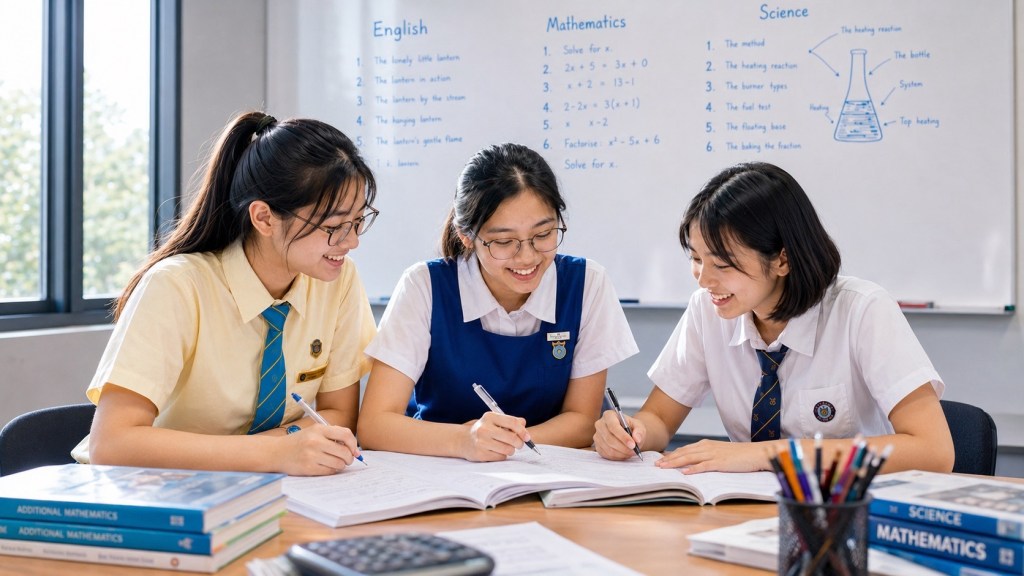
Wait, What? Description Is Not a Competition to Use the Most Adjectives
A Secondary 3 student describes a market as “bright, colourful, vibrant, bustling, lively and exciting”. The words are positive but interchangeable. The reader still does not know what to see, where to look or what makes this market different from another one.
Effective descriptive writing is selective. It chooses a viewpoint, controls where attention moves, builds atmosphere through concrete detail and uses language to make the reader experience a place, person or moment from a particular position.
Description becomes powerful when detail has a job. The writer is not listing the world; the writer is directing the reader through it.
Quick Answer
The Secondary 3 descriptive-writing engine is:
VIEWPOINT → PURPOSE → SPATIAL MAP → SENSORY SELECTION → MOVEMENT → LANGUAGE PATTERN → CONTRAST → ATMOSPHERE → RETURN.
- Viewpoint: where is the observer?
- Purpose: what should the reader feel, notice or understand?
- Spatial map: what is near, far, above, below, inside or beyond?
- Sensory selection: which details carry the atmosphere?
- Movement: how does the reader’s attention travel?
- Language pattern: what verbs, sounds, images or sentence rhythms recur?
- Contrast: what difference makes the scene sharper?
- Atmosphere: what emotional environment emerges?
- Return: how does the ending echo or transform the opening?
Owned Secondary 3 Learning Job
This guide owns one job: helping Secondary 3 students construct descriptive scenes through viewpoint, selection and spatial control rather than decorative language alone.
It belongs to the Secondary English Learning Hub. Its Batch 9 companions cover digital source verification, reflective writing, and morphology, etymology and vocabulary transfer.
Start With Viewpoint
Before choosing language, decide where the observer stands.
- at the doorway looking in;
- inside the crowd moving forward;
- above the scene from a balcony;
- seated and unable to move;
- arriving from bright sunlight into darkness;
- leaving and looking back.
The same place becomes different when the viewpoint changes.
Worked Example 1: One Market, Three Viewpoints
Doorway: the writer first sees movement as a whole—stalls, umbrellas, bodies, light.
Inside the crowd: the writer experiences elbows, voices, heat, smells and blocked sightlines.
After closing: the writer notices empty crates, wet pavement and scraps of paper where noise used to be.
The descriptive choices follow the observer’s access.
Description Has Purpose
A scene may be written to:
- create wonder;
- create unease;
- show loneliness;
- celebrate energy;
- reveal neglect;
- prepare for conflict;
- show change over time;
- make an ordinary place feel newly observed.
Purpose determines which details deserve space.
Selection Beats Coverage
You do not need to describe everything in a room. Choose details that work together.
For neglect: dust in fan blades, faded notices, a chair with one loose screw, a clock that has stopped.
For anticipation: unopened envelopes, chairs arranged in rows, a microphone being tested, doors still closed.
The details form a pattern.
The Detail Job Test
For every detail, ask:
- Does it locate the reader?
- Does it build atmosphere?
- Does it reveal change?
- Does it direct attention?
- Does it create contrast?
- Does it support viewpoint?
If the detail does none of these, it may be decoration without function.
Spatial Control
Description becomes confusing when the reader cannot tell where objects are in relation to one another.
Use spatial movement deliberately:
- near → far;
- left → right;
- outside → inside;
- ground → sky;
- wide view → close detail;
- still point → moving path.
A stable route reduces reader confusion.
Worked Example 2: Wide Shot to Close-Up
Wide: “The station concourse pulsed beneath a grid of white lights.”
Mid-distance: “Queues bent around the ticket gates while rolling suitcases knocked against ankles.”
Close: “On the bench beside me, a child traced circles in the condensation on a plastic cup.”
The camera-like narrowing creates scale, then intimacy.
Sensory Detail: More Is Not Better
Five senses do not need equal coverage. Select the sense that best reveals the scene.
- A dark room may be defined by sound.
- A kitchen may be dominated by heat and smell.
- A crowded bus may be defined by pressure and movement.
- An empty hall may be defined by echo.
Relevant sensory detail is stronger than checklist sensory detail.
Sight: Specificity Before Colour
Weak: “The room was colourful.”
Stronger: “Blue exercise books leaned in uneven towers beside a red mug chipped along the rim.”
Specific objects create a scene the reader can reconstruct.
Sound: Use Direction and Rhythm
Sound can reveal scale and movement:
“A trolley rattled somewhere behind the shutters, then stopped. For a moment, the corridor held only the thin electrical hum of the lights.”
Sound disappearing can be as important as sound appearing.
Smell and Taste: Use Sparingly
Smell is powerful because it can suggest memory, decay, food, weather or enclosed space. But vague phrases such as “a nice smell” do little. Name the source or quality precisely when possible.
Touch and Temperature
Physical sensation places the reader inside the body:
“The metal railing had stored the afternoon heat.”
“Rainwater had soaked through the canvas of my shoes.”
Verbs Carry Description
Adjectives label. Verbs animate.
Weak: “The busy crowd was noisy.”
Stronger: “The crowd spilled through the gate, calling across one another as bags clipped shoulders and shoes scraped the tiles.”
The scene emerges through actions.
Concrete Nouns Reduce Adjective Dependence
Instead of “beautiful flowers”, specify “orchids”, “bougainvillea” or “white frangipani” only when the exact noun is known and relevant. Precision creates image efficiently.
Figurative Language: Comparison Must Clarify
A simile or metaphor should reveal something difficult to see literally.
Weak: “The clouds were like cotton candy.” The comparison is familiar and generic.
Stronger for an approaching storm: “The clouds stacked above the flats like dark shelves being pushed forward.”
The comparison adds mass and movement.
Personification
Personification can make environment feel active:
“The corridor narrowed towards a door that seemed to wait.”
Use it where the human quality contributes to atmosphere. Avoid giving every object an emotion.
Atmosphere Is a Pattern, Not an Adjective
Do not write “The atmosphere was tense” and consider the job complete. Build tension through detail, movement and rhythm.
- voices become shorter;
- people watch the same door;
- a clock becomes noticeable;
- small sounds feel louder;
- movement pauses and restarts.
Worked Example 3: Building Tension Without Naming It
Nobody spoke above a whisper. Every few seconds, someone checked the red number above the door. A trolley rolled past, its wheels clicking once at every tile joint. When the number changed, six people stood at the same time.
The paragraph never uses the word tense. The atmosphere is inferred from coordinated details.
Sentence Rhythm and Atmosphere
Longer sentences can create flow, accumulation or immersion. Short sentences can create impact, interruption or stillness.
Rhythm should follow the scene.
Punctuation as Pace
Commas can accumulate detail. A colon can prepare a reveal. A dash can interrupt. A full stop can create a hard pause. Punctuation should reflect sentence structure first and pacing second.
Contrast Sharpens Atmosphere
Use:
- noise → silence;
- crowd → one isolated person;
- bright exterior → dim interior;
- new object → decaying surroundings;
- movement → stillness;
- warmth → sudden cold.
The difference makes each side more visible.
Worked Example 4: After the Crowd Leaves
Before: voices, stalls, movement, overlapping smells.
After: “Only a single orange rolled beneath a folding table. Water from the cleaning hose carried scraps of receipt paper towards the drain.”
The quiet scene gains meaning because the earlier energy is implied.
Movement Through the Scene
A descriptive passage does not need plot, but it benefits from motion:
- observer walks;
- light changes;
- crowd arrives;
- rain begins;
- doors open;
- sound fades;
- attention shifts from whole to detail.
Movement gives the description a reason to progress.
Static Description Still Needs Sequence
Even if nothing moves, the reader’s attention can move. A room can be described from ceiling to floor, entrance to window or foreground to background.
Description and Narrative
Narrative asks what happens. Description asks what the reader experiences. Strong composition often combines them.
Too much description can stop the story. Too little can make events feel ungrounded. Use description at moments where setting, mood or perception matters.
Description and Viewpoint
Different observers notice different things. A mechanic sees wear. A child sees size. A nervous speaker sees the audience. A commuter sees the closing train doors.
Description can therefore characterise the observer as much as the place.
Description and Memory
Memory changes selection. A returning character may notice what has disappeared rather than what remains.
“The bakery was still there, but the glass jar of coloured sweets had vanished from the counter.”
The missing object can carry time and change more efficiently than a paragraph explaining nostalgia.
The Specificity Ladder
| Level | Example |
|---|---|
| Generic | food |
| Category | noodles |
| Specific | a bowl of steaming noodles |
| Functional detail | steam clouding the plastic divider above the bowl |
The goal is not always maximum specificity. Choose the level that performs the scene’s job.
The Camera Test
Ask whether a camera could show the detail. If yes, it is observable. If no, it may be interpretation.
“The empty chair stood beside the window” is observable.
“The chair looked lonely” is interpretation/personification.
Both can be useful, but the distinction helps students control how much evaluation enters the description.
The Removal Test
Remove one descriptive sentence. If atmosphere, location, contrast or viewpoint does not change, the sentence may be expendable.
The Replacement Test
Replace a generic adjective with one concrete observation.
“The shop was old.” → “The price labels had yellowed around the edges, and the bell above the door rang half a second after it closed.”
The second version lets the reader infer age.
The Sensory Restraint Test
Write a scene using only two senses. This forces selection and prevents five-senses checklist writing.
The Viewpoint Rotation Test
Describe the same place from:
- a first-time visitor;
- a tired worker;
- a child;
- someone returning after ten years.
Compare what each observer notices. This teaches selection as perspective.
Paragraph Architecture for Description
One workable architecture is:
- Arrival or establishing image.
- Movement into the scene.
- Close detail.
- Contrast or change.
- Return image that reinterprets the opening.
This is a scaffold, not a compulsory template.
Worked Mini-Model: Rain at a Hawker Centre
The rain arrived sideways, rattling against the plastic screens before anyone had time to pull them down. Outside, tables emptied in seconds. Inside, the aisles narrowed as umbrellas folded, dripping, between chairs. Steam from the noodle stall thickened the warm air until the windows turned white at their edges. For ten minutes the whole hawker centre seemed to contract around the storm: voices closer, shoulders nearer, metal spoons louder against bowls. Then the rain softened. One by one, the screens rolled up, and the wet pavement beyond them shone as if the afternoon had been polished.
Notice the architecture: arrival → compression → sensory close-up → atmosphere → release. The paragraph does not need a plot to have movement.
Description in Continuous Writing
Use descriptive passages where they change reader understanding:
- opening setting;
- before a turning point;
- after conflict;
- when a familiar place feels different;
- when viewpoint changes.
Description in Reflective Writing
Concrete details can anchor reflection. A cracked trophy, an empty chair or an unread message can become an object around which memory and insight turn.
Description in Comprehension
When analysing descriptive language, move beyond “creates imagery”. Explain:
- what feature is made salient;
- what association is created;
- how the detail fits the viewpoint;
- how it contributes to atmosphere;
- why it appears at this point in the text.
Description and Writer’s Craft
Descriptive writing connects closely to Writer’s Craft: Structure, Tone and Effect. The same choices that students analyse in reading can become tools in writing.
Earliest Weak-Link Diagnosis
| Visible problem | Likely earliest weak link | Repair |
|---|---|---|
| Adjective lists | detail selection | replace labels with concrete observations |
| Scene feels random | spatial route | choose near→far or wide→close movement |
| Five senses mechanically used | sensory prioritisation | choose two dominant senses |
| Lots of imagery, weak atmosphere | pattern coherence | make details serve one emotional environment |
| Reader cannot locate objects | viewpoint/spatial control | anchor observer before describing |
| Description stops narrative | scene function | place detail around turning points or perception change |
| Generic figurative language | comparison precision | compare for movement, shape, texture or effect |
A Weekly Descriptive-Writing Cycle
- Day 1: observe one real place for five minutes and collect ten concrete details.
- Day 2: organise the same details along a spatial route.
- Day 3: rewrite using only two senses.
- Day 4: write the place from another viewpoint.
- Day 5: add one contrast or change in atmosphere.
- Day 6: remove 20% of details using the job test.
- Day 7: write an unfamiliar scene under time without the checklist.
Student Descriptive-Writing Receipt
- Where is the observer?
- What is the purpose of the scene?
- What spatial route will the reader follow?
- Which two or three senses matter most?
- Which concrete nouns can replace generic labels?
- Which verbs make the scene move?
- What pattern creates atmosphere?
- What contrast sharpens the scene?
- Does every detail have a job?
- Does the ending return to or transform the opening?
Parent and Tutor Teaching Guide
Do not begin with adjective banks. Begin with observation. Put an ordinary object on the table and ask for five facts a camera could capture, then five interpretations. The distinction trains students to build from evidence before adding atmosphere.
Walk through a real place and ask the student where attention moves. Then describe the same route backwards. Spatial control becomes easier when the learner experiences it physically.
When figurative language appears, ask what it clarifies. If the comparison only sounds decorative, remove it.
Unfamiliar Transfer Challenge
Give the learner an unfamiliar image of a public place and three possible purposes: welcoming, uneasy, nostalgic. The student must write three 180-word descriptions of the same visual scene using different detail selection, viewpoint and sentence rhythm—without changing the visible facts.
Transfer is successful when atmosphere changes because choices change, not because the student merely swaps adjectives.
Common Secondary 3 Descriptive-Writing Traps
- Using long adjective lists.
- Describing everything equally.
- Using all five senses mechanically.
- Moving randomly around the scene.
- Using figurative language that clarifies nothing.
- Naming atmosphere instead of building it.
- Forgetting the observer’s viewpoint.
- Writing description that stops all movement.
- Using generic nouns where concrete nouns are available.
- Overwriting until every sentence competes for attention.
Useful eduKate Sengkang Routes
- Writer’s Craft: Structure, Tone and Effect
- How Connotation Changes Meaning Beyond Dictionary Definitions
- How Tone, Attitude and Viewpoint Shape Interpretation
- How Writing Works for a Student
Evidence Boundary
The descriptive-writing sequence in this guide is an eduKate teaching scaffold, not an official examination formula. Different composition tasks may reward different balances of description, narrative, reflection and argument. Follow the actual task and school requirements.
Continue Secondary 3 English Learning Guide Batch 9
- Digital Source Verification: Lateral Reading, Click Restraint, Original Sources and AI Claims
- Reflective Writing: Experience, Insight, Change and Perspective
- Morphology, Etymology, Word Families and Academic Vocabulary Transfer
- Return to the Secondary English Learning Hub
The Quiet Return
The strongest description often feels effortless because the reader does not notice the selection machinery underneath it.
Choose where the reader stands. Decide what deserves attention. Move through space deliberately. Let detail build the atmosphere. Then remove whatever does not earn its place.
